Riding Solo to the Ends of the Earth - A Self-Drive Travelogue of Hainan and Guangxi (Part 15)
Monday, March 22, 2021 (Day 18 of Guangxi Self-Drive Tour) Yangshuo Xingping Town to Gaoyou Village (Sanjiang County, Liuzhou City)
Xingping Town → Daxu Ancient Town → Gaoyou Village
Accommodation: Gaoyou Village
Today, before leaving Xingping, I decided to climb Laozhai Mountain.
This mountain has a story—not just because from its summit you can see the most beautiful scenery of the Li River in Xingping, but also because it records the loving story of a Japanese elderly man who loved the Li River and Xingping. In the past, Laozhai Mountain was almost unknown in China, only a paradise for hiking enthusiasts and photography buffs. These seasoned trekkers carved a climbing path with their own feet on the steep and perilous Laozhai Mountain, but it was very dangerous and extremely difficult to climb. Accidents with injuries and deaths occurred from time to time, so the local government still has a sign at the foot of the mountain warning "No Climbing." Later, this Japanese elderly man funded the renovation of the hiking trail, installed handrails on the steepest parts, and allowed non-professional hikers like me to dare to attempt climbing Laozhai Mountain. He also built a pavilion at the summit named "Friendship Pavilion" for climbers to enjoy the cool and shelter from rain.
Despite this, climbing Laozhai Mountain is still quite challenging, mainly in the following aspects: poor road surface, with some sections being dirt paths and dirt steps, very slippery in rain; second, no guardrails along the entire route, except for an iron ladder with handrails installed on the stone cliff just before reaching the summit; third, due to the steep slope, many steps are very high, sometimes one step equals two or three normal stairs. Going up is okay, but going down easily loses balance. It is recommended that friends with heart disease, high blood pressure, or fear of heights not take the risk. Those who go should bring a trekking pole, which helps maintain balance.
Laozhai Mountain is right next to the Xingping Cruise Terminal, not far from the guesthouse. Cross the Xingping River, turn right onto the trail in front of the old town, and walk to the riverbank. It's walkable.
Although the innkeeper told us Laozhai Mountain is next to the cruise terminal, we couldn't find the entrance to the hiking trail when we arrived. We asked several people before finding this inconspicuous trail. The entrance is very ordinary, with no obvious signs, so it's not easy to find. Next to the entrance, on the cement slope, there is a clue left by a kind tourist. According to the clue, climbing Laozhai Mountain seems not difficult—only 1,159 steps and half an hour to the top. I thought about our trip to western Hunan and western Hubei last year, climbing thousands or tens of thousands of steps a day was quite common.
But when I actually started climbing, it was somewhat difficult. The lower part of the mountain is a local cemetery, and this section is relatively flat, but the graves appearing from time to time along the road make it a bit eerie. I guess that might be one reason why Laozhai Mountain hasn't been developed as a formal scenic spot.
There was not a single person in sight along the entire trail. In comparison, Gongfu Mountain seemed much livelier, with three viewing platforms, each with at least a dozen or twenty people. The trail up the mountain wasn't crowded, but at least there was a constant flow of people. Laozhai Mountain is indeed a niche classic among niche places, especially considering today is Sunday.
Finally, I climbed the 80-degree ladder and reached the observation deck at the summit of Laozhai Mountain, where the Friendship Pavilion is also built.
Finally, I met two tourists there—a young couple, new Shanghai residents (out-of-town college graduates who stayed in Shanghai to work, settle down, and become citizens). They are hiking enthusiasts and flew to Guilin on the weekend to climb mountains. Yesterday they spent more than five hours hiking across Nine Horses Hill, and today they came to climb Laozhai Mountain. I asked if they planned to climb Gongfu Mountain; they said there wasn't enough time—they had to return to Guilin in the afternoon to fly back to Shanghai for work tomorrow. Young age is wonderful!
The Friendship Pavilion observation deck is not the highest point of Laozhai Mountain, but beyond that there is no path at all. From the observation deck, you can see a section of the Li River we walked yesterday in front, and behind you can overlook the entire Xingping town, including the old town.
In the picture above, the river on the left is the Li River, and the river on the right is the Xingping River. Our guesthouse is located in the triangular area where the two rivers meet.
The photos above show the scenery from the observation deck. It didn't seem particularly outstanding, at least not as good as the view from Gongfu Mountain. I wondered to myself: Is this the place that attracts photography enthusiasts like moths to a flame? The girl from the young couple opened her phone and showed me a photo her husband took at the very summit (similar to the picture below), which revealed the answer.
From the Friendship Pavilion to the summit is not far, only about twenty or thirty meters, but it's not easy to walk. There is no path, and the exposed rocks are like upward-facing knife blades. You have to crawl using both hands and feet. At that moment, three young men came up. They didn't even stop at the observation deck and, familiar with the route, went straight to the summit. Seeing how relaxed they were, I decided to give it a try. Fortunately, as long as you're careful, it's not extremely dangerous.
Upon reaching the summit, the legendary beautiful scenery of the Li River from Laozhai Mountain unfolded before my eyes, deeply震撼 and beyond words!
The Li River here makes an inverted Omega curve, with perfect lines and overwhelming momentum. The calm river reflects the rolling green peaks on both banks, creating a stunning landscape painting! It is said that many photographic works of the Li River are taken here, the most famous being "Xingping Sunset." However, getting a good photo requires good weather. Today was another cloudy day (since entering Guangxi, we haven't encountered a sunny day), so the photos lack clear layers, and the distant views are blurry. Fortunately, there wasn't too much fog, and we could still see the river surface.
Another pity is that Laozhai Mountain is too close to the river, and the bottom of the inverted Omega curve is hidden by its own cliff, invisible unless you lean out over the edge. It is said that someone attempted this risky move and fell off. That young man had a drone, but since he was a novice and there were people nearby, he didn't dare to fly it.
If I could climb onto those rocks in front, the angle might be better, but I didn't dare take the risk.
Laozhai Mountain is indeed a very niche attraction. In the whole morning, we only met 7 tourists: besides the young couple and the three young men, two young women came up later. Both were traveling alone (Chinese girls are brave; I've also encountered lone Chinese girl travelers abroad). One of them sat down on the ground as soon as she arrived, silent for several minutes, then told us her legs were still shaking. The other said that halfway up, she hesitated by the roadside for nearly twenty minutes. Later, the three young men met her on their way down and told her that a couple in their sixties had made it up, so she gathered the courage to climb.
When we were almost down the mountain, we met three young people panting as they climbed up. Seeing us coming down, they asked how much farther. I told them they had only covered a quarter of the route, and that was the easiest part. The three young men immediately turned around and walked back, saying "Not going, not going," which made me laugh. My original intention was to give them a heads-up, but I didn't expect to scare them away.
I didn't expect climbing Laozhai Mountain to take almost the entire morning, so we didn't enter Daxu Ancient Town. We just had lunch on the street.
Daxu Ancient Town is located 18 kilometers southeast of Guilin city at the confluence of the Ma River and the Li River. It was founded in 200 AD and has a history of over 1,800 years. It was once the head of the four major market towns in Guangxi (the others being Luwei in Binyang, Rongwei in Cangwu, and Qiaowei in Guixian). During the Ming and Qing dynasties, it became a gathering place for merchants from north and south, who built guild halls here, and it was once very prosperous.
Daxu Ancient Town is a paid attraction and relatively large. It's not the kind of place you just snap a photo and leave; you need to savor it, which would take at least half a day. I hesitated and then gave up.
After lunch, we headed directly to tonight's destination: Gaoyou Dong Village (Gaoyou Village).
Gaoyou Village is located in Linxi Township, the northernmost part of Sanjiang County, Liuzhou City, Guangxi. It lies in the mountains at an altitude of about 1,000 meters at the border of Hunan and Guangxi. In fact, taking the expressway to Gaoyou Village, the nearest exit is already within Hunan Province.
Soon after getting off the expressway, we entered the mountains and were tricked by the navigation again. At a three-way intersection, the navigation showed only one road. There were few people around, and we couldn't find anyone to ask for directions. Looking around, I noticed that the road on the left had a very new surface, with a stone tablet beside it inscribed: "Commemoration of the completion of the road hardening project for poverty alleviation in Gaoyou Village." So the left road seemed correct, and I started driving to the left. As we drove, I suddenly noticed the navigation screen had no road; it was all green, with a small arrow wiggling slowly (that was our car). Then the navigation said, "The vehicle is currently driving on a road without data" and then went silent. I broke out in a cold sweat, realizing we were lost in the barren mountains, and we didn't know where this road would take us. The newly paved cement road was quite good but very narrow, only wide enough for one car. I estimated the width: impossible to make a U-turn. Worse, there were no guardrails the entire way. On one side was a bottomless valley—not a sheer cliff, but if we went down, there was no way back up. On the other side was a slope that rose endlessly. There was no choice but to continue, hoping to find a slightly wider place to turn around, but there was none! I wondered: didn't the engineer of this project consider two-way traffic? At the same time, I prayed that no car would come from the opposite direction. So the car kept climbing up the winding mountain road, seemingly to the sky. I don't know how long it took, but after crossing a ridge, the road began to descend. I felt a little relieved: as long as it keeps descending, we'll eventually reach somewhere inhabited. After a long downhill on the steep slope, we finally saw a fork. Driving to the intersection and looking inside, there stood a memorial archway about 100 meters away, with three big characters on the horizontal plaque: "Gaoyou Village." A stone fell from my heart. Later, when I mentioned this to the innkeeper, he said in confusion, "It wasn't that hard to get here?" I realized I had taken the wrong road. First, the navigation hadn't updated the road information in time; second, the stone tablet was somewhat misleading.
In the evening, as the only guests in the village that day, we stayed at the only inn. The only restaurant in the village was closed (the owner had gone to visit relatives), so we had to buy some vegetables from the only grocery store that was open, asked the innkeeper for some rice, and cooked ourselves.
Tuesday, March 23, 2021 (Day 19 of Guangxi Self-Drive Tour) Touring Gaoyou Dong Village, Gaoyou Village to Xiangxiang City, Hunan
Gaoyou Village → Xiangxiang City
Accommodation: Luyuan Hotel
This morning's plan was to visit Gaoyou Dong Village.
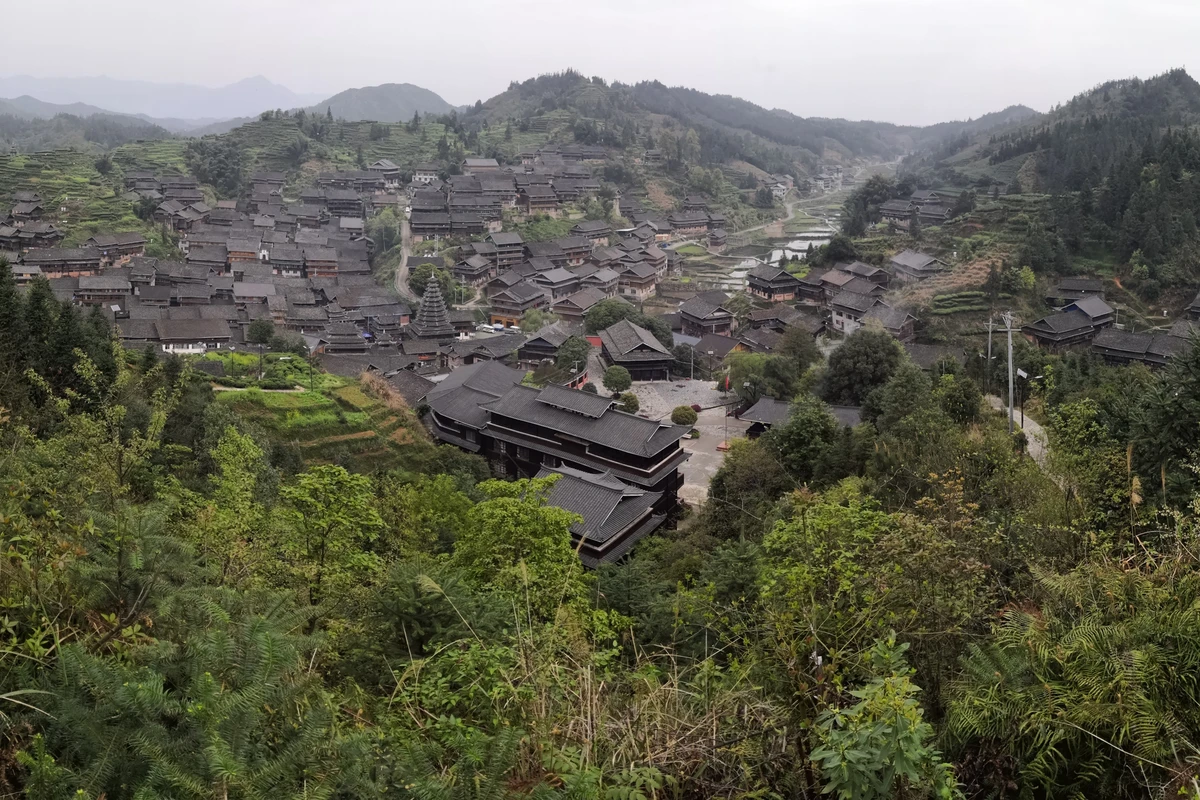
Gaoyou Village is located in a small valley surrounded by mountains. It is the only village in Guangxi Province that belongs to the most upstream area of the Yangtze River's Dongting Lake water system. It is an extension of the Chengyang Bridge Scenic Area in Sanjiang County and also a junction of Guangxi Dong culture and Hunan Dong culture. It possesses traditional Dong cultural excellence and has its own unique living habits. This is a mysterious and pristine homeland, a "Shangri-La" that hermits have sought all their lives, a "poetic paradise" that literati yearn for, and a "dreamland" that keeps tourists from home and abroad lingering. Today, it has become the most important ethnic ecological leisure photography tourism attraction in the Linxi Bajiang Scenic Area of Guangxi Zhuang Autonomous Region, and a sketching training base for Guangxi universities' art majors. The inn we stayed at is the internship base of the Fine Arts Department of Guangxi University. No wonder there are usually few guests, and the owner is not anxious at all.
Gaoyou Village has more than 400 households. For generations, the people have built houses on the high mountains, so they named their village "Gaoyou," meaning "friends on the high mountain." Gaoyou Village has preserved thousand-year-old Dong architecture and culture intact and is known as a "living museum." In 2012, Sanjiang Dong Villages, including Gaoyou Village, were included in the tentative list of UNESCO World Cultural Heritage.
First, we took a walk around the central area of the village, amazed by how clean and tidy it was, spotless. The villagers were simple, honest, warm, and hospitable.
The Gaoyou Drum Tower was built in the Qing Dynasty and is the most distinctive building in Gaoyou Village. In Dong areas, almost every village has a drum tower. It is the activity center of the Dong village, a public place for villagers to discuss matters, hold ceremonies, welcome guests, and engage in singing and dancing entertainment. In large villages, they are built by clan, forming drum tower clusters. Inside the drum tower, there is a long leather drum. When something happens, the drum is beaten to gather people; hence the name "drum tower." The Dong drum tower is regarded as the soul of the ethnic group and the village, and a symbol of unity, happiness, and prosperity. A poem says: "After the spring harvest, invite companions, play the reed pipe, and sit in the drum tower."
The base of the Dong drum tower is mostly square, while the upper part is a pavilion-style structure. The roof types are gable-and-hip, pyramidal, and extended-eave. The drum tower has eaves layered at equal intervals according to relative height. The number of eaves layers is always odd—1, 3, 5, 7, 9, 11, 13, etc. The roof of the Gaoyou Drum Tower is pyramidal, with 13 layers of eaves.
Gaoyou Village has built three observation pavilions on the surrounding hills. These pavilions are the best spots to view the full panorama of Gaoyou Dong Village. We started our tour of Gaoyou Dong Village by climbing the No. 3 observation pavilion in the south.
Within and between Dong villages, there are stone-paved roads everywhere. These stone roads were not built overnight; rather, enthusiastic Dong people added stones one by one, section by section, and eventually they connected into a whole. The unique Dong stone roads are a humanistic testimony to the Dong people's warmth and generosity.
As we climbed higher along the stone road, the full view of the Dong village gradually unfolded before us.
Leaving the No. 3 observation pavilion, we started descending.
From the mountain, the best and newest building in the whole village is Gaoyou Primary School, which shows the villagers' emphasis on education.
Descending from the No. 1 observation pavilion, we reached Huilong Bridge on the west side of the Dong village. Huilong Bridge is a covered bridge built in the Qing Dynasty. Before Gaoyou Dong Village was connected by road, Huilong Bridge was the only passage in and out of the village.
Gaoyou Dong Village is the last scenic spot on our itinerary. With this, the self-drive tour of Hainan and Guangxi comes to an end. Next, we will head back to Shanghai.
Following the innkeeper's directions, we didn't get lost on the return journey. Taking county road X083 to national road G209, it took about 13 kilometers to the entrance of the Baomao Expressway, which took over half an hour. In the afternoon, we drove 400 kilometers to stay in Xiangxiang City.
Wednesday, March 24, 2021: Xiangxiang City, Hunan to Shangrao City, Jiangxi
Xiangxiang City → Shangrao City
Accommodation: Hanting Hotel (Shangrao Zhongshan Road)
Driving distance: 603.7 km
Thursday, March 25, 2021: Shangrao City, Jiangxi to Shanghai City
Shangrao City → Shanghai City
Driving distance: 495.2 km
Thus, the self-drive tour of Hainan and Guangxi, which took 71 days and covered 10,290 kilometers, ended safely, though not without some imperfections.


