Three-Day Trip to Changsha
With three days off from work, I decided to go somewhere a bit farther.
Changsha it is—I had a brief glimpse last year, a short stay, and I felt I didn't get enough.
The high-speed train arrived at Changsha South Station at noon, then I transferred to the subway and took a taxi straight to the hotel to drop off my luggage.
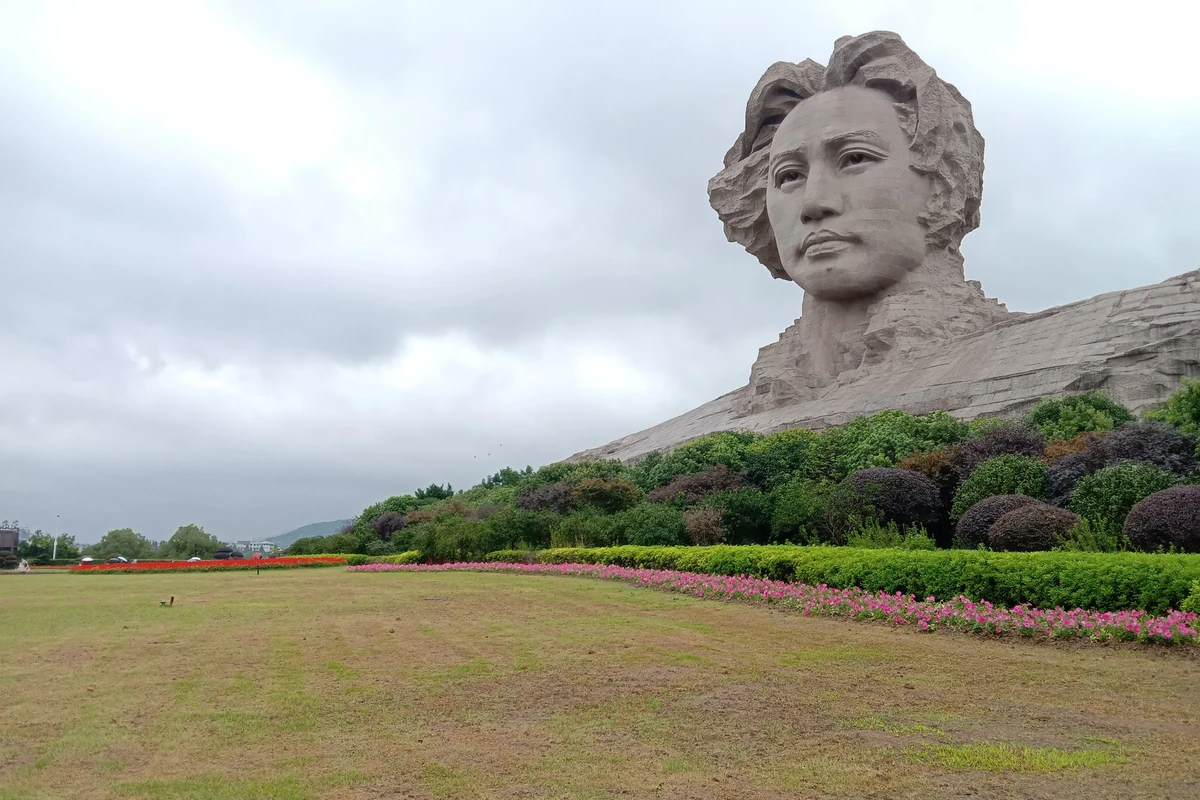
On the first afternoon, my first stop was Orange Island. Last National Day, I stood on the bridge looking down and saw a sea of people; it was said that even the Orange Island subway station didn't stop. This time, I fulfilled that lingering wish from last year. Since it was a Friday, with a light drizzle, there weren't many people. At the entrance of the scenic area, I bought a ticket for the sightseeing car that goes directly to the Chairman Mao statue.
It was autumn, with a light drizzle,
No crimson hills, no layered forests, no clear green river, no hundred boats racing, no eagles soaring in the sky, no fish gliding in the shallows, and certainly no pointing at the landscape, no impassioned writing—only Orange Island head, the Xiang River flowing north.
Standing before the stone statue of Chairman Mao, watching the torrential Xiang River, I imagined the spirit of the young Mao Zedong standing here, that sense of taking the world as his responsibility, that exuberant and unyielding boldness. Turning back to look at the young Mao's statue, it appears dignified, with a hint of worry in his expression, but his eyes reveal a firmness and fearlessness!
The entire scenic area is beautiful. Oranges and pomelos fragrance the air, willows hang by the banks, green grass is lush, and the drizzle creates a misty atmosphere. This place feels unique: to the east lies the bustling commercial district—Wuyi Square, IFC Center, Pozi Street, Taiping Ancient Street; to the west is Yuelu Mountain, with Hunan University and Hunan Normal University nestled at its foot. And all this seems unrelated to Orange Island. It feels like a Jiangnan girl, delicate, graceful, serene, lying firmly in the Xiang River, indifferent to the roaring river, the bustling crowds, and the traffic.
While walking, I chatted with my little girl about the May Fourth Movement youth. That generation of young people truly had the world in their hearts, not for personal gain. Mao Zedong, Zhou Enlai, Liu Shaoqi, Deng Xiaoping and other older revolutionaries grew up in the era of the May Fourth Movement, harboring the sentiment of 'setting the heart for heaven and earth, establishing destiny for the people, continuing the lost teachings of past sages, and establishing peace for all generations,' caring deeply for the people and the world, enduring hardships to create New China.
Second stop: Wuyi Square. Here, the noise of the crowd is everywhere. The worldly hustle and bustle is the most soothing to the soul. The Shimao Global Trade Center and IFC Center stand facing each other, representing nobility and luxury here, while Guojin Street, Pozi Street, and Taiping Ancient Street embody the fires of human life. Snacks, souvenirs, clothing, and various shops line both sides of the streets, with shouts of vendors filling the air—this is a paradise for food lovers! The signs of various shops hanging on the walls along the streets give a hint of old Shanghai and old Hong Kong. Taiping Ancient Street retains a bit of ancient street atmosphere in its architecture and alleys, but commercialism pervades the entire lane. Inside, there is Jia Yi's Former Residence. Unfortunately, it was too late to visit. Finally, feeling a bit tired, we rested at a literary-style bar, then returned to the hotel, ending the day.
The second day, we woke naturally, had breakfast, packed luggage, and moved to another place—Yuelu Mountain. We booked a Vienna Hotel in Yuelu District, dropped off luggage, and took a taxi to Yuelu Mountain.
First stop: Yuelu Academy. Xiao Ya said this is the only scenic spot over the years that sells tickets based on age, not height. At first, Yuelu Academy seemed unremarkable, but as we walked deeper, it revealed profound depth. In ancient times, few academies had such a large space. Many Neo-Confucian scholars like Zhou Dunyi and Zhu Xi lectured here. The couplet 'Only Chu has talent, and it flourishes here' hangs on the simple and grand pillars, bearing a sense of solemnity and simplicity.
Xiao Ya isn't interested in history, so we stayed at Yuelu Academy only briefly. However, she noticed a bookstore and happily went in, buying two books: 'The Hot Zone' and 'The Demon in the Freezer,' both about the struggle between humans and viruses.
Walking up Yuelu Mountain, I really felt out of shape. A mountain only 300 meters above sea level left me gasping for breath. I deeply felt my declining physical strength—time spares no one, and heaven spares no lazy person.
Going down the mountain, we took the cable car to the east gate and then walked from the east gate to the south gate. Along the way, there were low-walled red brick houses with shady trees on both sides. Passing by Hunan Normal University, we reached the foot of the south gate, which is Hunan University. Both universities are open campuses, adjacent to each other. As we walked, we often saw a college of Hunan Normal University or a college of Hunan University right next to the road.
Hunan University and Hunan Normal University are both open universities—no walls, no tall buildings, few modern structures. It seems to prove that the greatness of a university lies not in its tall buildings but in its masters. Perhaps it demonstrates a style of openness, depth, simplicity, dignity, and confidence. On the third day, we visited Central South University, and it was similar. The main gate of CSU initially looks like the gate of a mountain temple. Inside, there is a modern-style building, and other buildings are also relatively simple in style. All three universities have many trees along the roads.
We finished the tour at about 4 p.m. and decided to rest at the hotel. At 6:30, we went out for dinner, then strolled along the Xiang River scenic belt to enjoy Changsha at night.
In terms of city nightscapes, the night view of the Xiang River is not as good as the riverside in Yingtan. The night of the Xiang River is quiet and dim, without the bright lights of other cities. Only a row of low streetlights emit a faint glow. There are few people by the river, occasionally a citizen walking or jogging. Xiao Ya said, 'The night here is not noisy, but that doesn't prevent a big city from being grand.' I asked, 'So it's low-key but deep?' She agreed. Perhaps this is her experience—having seen more, she has her own opinions. Yes, the grandeur of a city—very good!
Day three, we bought return tickets for 12:50 p.m. With a few hours to kill and nothing to do, I noticed a car-sharing service in front of the hotel. I had never seen it before, so I decided to try it. The verification process was a bit troublesome, but I finally succeeded. I drove around the hotel area, went to Central South University, then back to Hunan University, and finally returned to the hotel.
At 3 p.m., we returned to Yingtan, ending the trip.


