National Day Approaching, I Scouted These Spots in Changsha
Just after the Mid-Autumn Festival, National Day is approaching. A fresh wave of heat has pushed Changsha onto the hot search list. Our group headed to Changsha for a 'Looking into the Beautiful Countryside' trip. This journey focused on rural tourism, including homestays, village squares, tea gardens, wineries, and breeding bases. We also visited key enterprises such as Dahang Group, Kamilai, and Yida Town, and explored two intangible cultural heritages: Jinggang shadow puppetry and batik and tie-dye traditional costume dyeing techniques. It was a comprehensive itinerary covering food, drinks, fun, and activities.
Wangcheng is the hometown of Lei Feng, formerly known as Wangcheng County, which was re-designated as a district in May 2011. Famous ancient towns like Tongguan, Jinggang, and Qiaokou boast rich cultural heritage, long history, and abundant tourism resources. During our two-day rural tour, our itinerary was as intense and packed as the lingering summer heat.
01. The Dahang Group Founded by Artillery Tractors
Actually, we first visited the 'Dahang Red Hall' of Dahang Holdings Group Co., Ltd. Upon entering, we saw a statue of Chairman Mao, likely from a speech scene at a Yan'an conference, which immediately commanded respect for Dahang Group.
Dahang Group's initial steel trade business started with artillery tractors. It's hard to imagine that a company ranked 396th among China's top 500 enterprises, a leader in targeted poverty alleviation, now engaged in trade, logistics, real estate, hotels, education, markets, and culture, with projects across provinces, was started with artillery tractors.
02. Kamilai Cotton Candy
When we were kids, eating cotton candy was mostly from roadside stalls. It looked like a huge fluffy mass, but actually contained very little material, more about curiosity than substance.
In Wangcheng, Changsha, we visited Kamilai Food Co., Ltd., where we saw all kinds of designed and packaged candies, especially the cute-shaped cotton candy, and couldn't help but laugh: Can cotton candy be made like this? Such a trivial little thing can become a big business. Kamilai mainly produces various candies and last year won the Wangcheng Economic Development Zone Science and Technology Innovation Award and is a model unit for integrity construction. This was my first time visiting a candy company. Looking through the workshop glass windows at the candy-making process, I finally understood that a single candy's birth involves many steps and considerable effort.
The third floor of the company houses the candy workshop, which is sealed for operation and can only be viewed from outside. There is also a DIY creative space where guests can try making their own candy and enjoy the joy of creating 'sweet words'.
03. Huawei Cloud in Yida Town
An intelligent manufacturing industrial town developed, built, and operated with the concept of city-industry integration. In their own words, they aim to create an industry town that integrates 'industry and culture', an eco-town for green manufacturing, and a vibrant town serving the industrial park.
Currently, one of the prominent enterprises is Huawei (Changsha) DevCloud Innovation Center. For the first time, we met Huawei face-to-face and learned about the latest progress in Huawei's technology. Huawei Cloud employees explained that while Huawei's mobile phone business has contracted, Huawei still retains over 8,000 mobile phone employees, hoping to create new brilliance when chip progress is made.
Huawei Cloud is on par with domestic giants like Alibaba Cloud and Tencent Cloud, with the mission to become the 'black soil' of the intelligent world, bringing the digital world to every person, home, and organization, building an interconnected intelligent world.
04. Heli Qiaojiang, the Last Lotus Shrimp
Lunch was at 'Heli Qiaojiang'. I love the name of this restaurant—very poetic. We had the last lotus shrimp of the year at Heli Qiaojiang. The host was meticulous: besides the spicy flavor shrimp, they also made an oil-fried shrimp dish to cater to non-spicy eaters from other provinces.
Heli Qiaojiang has a large operation with three homestays. Besides the Jinggang Xiangyun Life Pavilion where we stayed tonight, there are two other homestays: 'Heli Qiaojiang' and 'Five Valley'. Especially 'Five Valley' on Tongguan Street, its furnishings are like a star-rated hotel. The surrounding lotus flowers are wilting, and ancient trees sway gracefully, like a painting. Most impressive is the blue water in front, resembling an infinity pool. Overlooking the area, it gives a seaside feeling.
Both 'Heli Qiaojiang' and 'Five Valley' are far from noise, quiet and elegant, in a light luxury style. They are very suitable for parent-child, couples, or family weekend getaways. During National Day Golden Week, if you don't like crowds, you can escape here temporarily.
05. Humans Live Worse Than a Shrimp
We then visited 'Wenheyou Wangcheng Lotus Tea Shrimp Breeding Base'. Staff explained that this is mainly for breeding shrimp. During the breeding season, male shrimp dig holes; females enter to mate when interested. The pair hug and can produce 700-800 eggs. After about two months, young shrimp take shape and are sent elsewhere for cultivation.
The breeding base placed many empty plastic bottles in the pond, calling them 'villas' for male shrimp. During the breeding season, male and female shrimp hug each other, enjoying sweet love.
One of our guys said, 'Humans live worse than shrimps—they get a house and a partner delivered automatically.' It was a mix of amusement and speechlessness.
06. Encountering People Named 'Guo'
After exploring the ancient town of Jinggang in Wangcheng, Changsha, we headed to a place called 'Guo Dawan Wuchang'. But what exactly is 'wuchang'? Locals explained it's like a 'village' or 'hamlet', similar to 'slope' or 'gully' in northern China. Suddenly it made sense.
Another question: Who among us has friends with the surname 'Guo'? There is an idiom 'To borrow a path to destroy Guo', and a famous painting 'Lady Guo Guo's Spring Outing'. In real life, I rarely meet people named Guo. But at 'Guo Dawan Wuchang' in Dabohu Village, Jinggang Town, almost everyone is surnamed Guo. I learned that this surname has lasted for three thousand years, from Guo to Guo (郭), from the Western Zhou to the present, from Taiyuan to Changsha.
'Guo Dawan Wuchang' is a model village for Wangcheng's beautiful new countryside construction. They manage water and graves, integrate agriculture and tourism, involve the whole village, transform old homesteads into suitable rural ecological tourism villages, and achieve good results through live streaming. Entering the village, we saw elderly people chatting by the lake, carefree and enjoying their twilight years, truly 'not knowing there is Han, let alone Wei or Jin'.
Nearby is 'Siyuan Wuchang', which has introduced many modern agricultural enterprises, improved infrastructure, enhanced living environment, and also taken a new path of developing agri-tourism.
'Outside the wall, a swing; beyond the path, a beauty laughs.' Someone was swinging, and old folks sat by the lake chatting. When they saw us, they warmly greeted us.
07. Cloud Travel Tea Industry
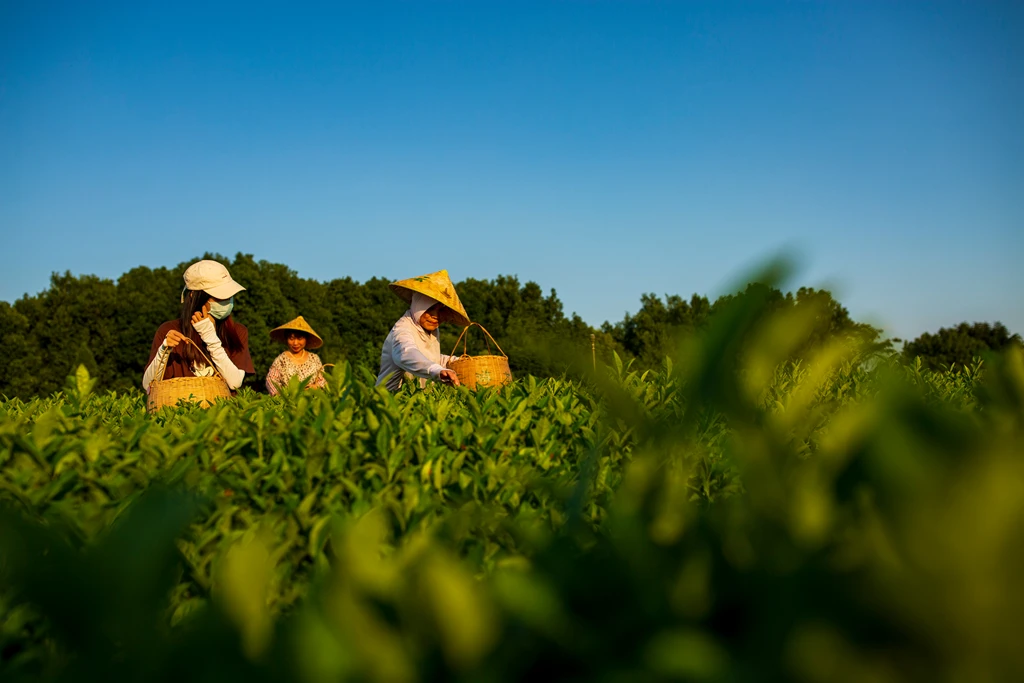
Changsha Cloud Travel Tea Industry Co., Ltd. is located in Lingchong Village, Jinggang Town. I like Cloud Travel's green tea—slightly bitter, a bit smoky. In Changsha's 38°C heat, a cup moistens the mouth, relieves heat and thirst, making me feel refreshed.
Tea growers know that latitude 30°N is a tea-producing belt. Cloud Travel Tea is also in this zone. Terraced tea fields look like musical scores. Our companions rushed into the fields to take photos.
A cup of tea we usually drink goes through many processes from planting to picking and processing. Even the same tea tastes different when made by different people, showing that tea also understands human nature.
Bashan and Shushui (present-day Chongqing and Sichuan) are the earliest tea-producing areas. Now, in Bashu teahouses and restaurants, waiters dressed in ancient costumes are known for 'playing with teapots'. In Guangdong, where I live, Gongfu tea is famous. In my hometown in the northwest, we prefer to drink 'guanguan tea', boiling tea in a small pot called 'ququ pot', preserving ancient customs.
Before leaving, Cloud Travel Tea gave each of us a cup filled with tea. For the next few days, I carried this cup, brewing a large amount of tea—more refreshing than bottled water on the streets.
08. Shadow Puppetry and Dyeing Techniques
These two are unrelated. We had dinner at Cloud Travel Tea, stayed at Jinggang Xiangyun Life Pavilion that night, and visited the Shadow Puppetry Art Museum and Luochun Zhiyi Blue Dye Art Museum.
Luochun Zhiyi Blue Dye Art Museum is also a training center for Wangcheng batik and tie-dye traditional costume dyeing techniques. The shop mainly sells traditional tie-dye and batik clothing, handmade, time-consuming, and exquisite. Female companions couldn't put them down.
Unlike northern shadow puppets with single eyes, Jinggang shadow puppets have 'one and a half eyes'. Traditional shadow puppetry also keeps up with the times. Their skit 'Sun Wukong Kills the COVID-19 Virus' won applause—witty, humorous, and full of contemporary spirit.
Early morning, I saw the sunrise and the quiet ancient town. After breakfast, we went to 'Five Valley', which gave the impression of a seaside mansion, the most peaceful and leisurely homestay I've ever seen.
09. Huangyaozi Winery, the Wine God is a Frog
Good wine needs no bush. Huangyaozi Winery is located in the mountains of Chating Town, Wangcheng District, Changsha. After many twists and turns, we found this farm-style winery.
The owner is Liang Chun, a local young man who looks shrewd and capable. The winery's product 'Huangyaozi Pu Wine Starter' has been passed down for a hundred years, insists on traditional handmade methods, and has applied for intangible cultural heritage. The finished wine is aged in a red earth cave, named 'Chun Lai Zui', which is the original liquor.
Besides making wine, Huangyaozi also preserves several old buildings converted into a rural museum, where we could see no-longer-used farm tools and old carpenter tools. Since it's a farm-style winery, it can receive tourists, and we had lunch there. The owner cooked personally, which made us feel the hardships of entrepreneurship. With fine wine at home, we naturally had a few drinks. Due to the hot weather, I only had half a glass of blueberry wine, low in alcohol, slightly sweet, which the ladies praised.
After visiting the red earth cave for wine storage, we found one person missing. After waiting a long time, he slipped out grinning, saying he met a mountain god and kowtowed three times before daring to leave. Everyone burst into laughter. The 'mountain god' he mentioned was a frog. Living long in the cave, without sunlight, and befriending wine, its color was somewhat unusual.
Before leaving, many people carried wine bottles out the door, as if coming specially to get drunk.
10. 'Mou Tan Xiaoyuan' and 'Qu Ye · Cun Shang Cun Su'
Both of these homestays are located in Chating Town, Wangcheng. 'Mou Tan Xiaoyuan' is in Wangqun Village, an old house with mud walls, renovated into an inn full of cultural atmosphere. The hostess, dressed in linen, looked ethereal and elegant, as if not living on mortal food. Outside the window was a bamboo grove, tall and dense, reminiscent of Du Fu's poem 'I wish new pines would grow a thousand feet tall, but evil bamboo should be cut down ten thousand canes.'
'Qu Ye · Cun Shang Cun Su' is in Miao Village at the foot of Jiufeng Mountain, also far from the hustle and bustle, a good place to escape worldly chaos.
About two to three hundred meters north of the inn, there is a Xizi Tower in the woods—a stone tower from the Qing Dynasty for burning paper with writing. Surprisingly, a hackberry tree grows from the top of the tower like a huge umbrella covering the sky. Its roots run all the way to the bottom of the tower, visible beside the tower door. Tower-tree symbiosis is common, but such a neat, seemingly artificially cultivated one is truly a world wonder. The local area has built a 'Xizi Cultural Hall' to tell the story of this symbiosis. Only half a couplet remains at the door, the second line: 'Xi Zi Ru Jin' (cherishing words like gold). It requires an idiom for the first line, with the last character must be 'tu' (earth). A generous prize awaits the winner. Can you match it?
Both homestays are run by female owners, making one wonder if beautiful women all go to run inns.


