Encounter the Best of Yourself on the Journey – A 9-Day Trip to Xi'an, Zhangjiajie, Fenghuang, and Changsha
Recently, it felt as if I was trapped in a 'certain day,' repeating the same life day after day, with worries coming one after another. My husband and I decided to take our son away for a few days, to relax and recharge, to step out and see the world with childlike hearts, and to live a different life for a while! After making that decision, our mood became surprisingly good, and suddenly those worries didn't seem like such a big deal. Every day we discussed where to go, learned about famous sights and local customs, and immersed ourselves in planning something fulfilling and beautiful. We believed that during the journey, we would surely encounter the best of ourselves!
Because the online flight tickets had a stopover in Xi'an for one day, we decided to take that opportunity to first visit Xi'an to see the Terracotta Warriors, stroll through the Muslim Quarter, view the Bell and Drum Towers, walk on the Ancient City Wall, and then go to Zhangjiajie and Fenghuang. Our son wanted to take a detour to Sichuan to see the Leshan Giant Buddha, but considering the distance, we abandoned that route and decided to go directly from Fenghuang to Changsha and then fly back.
Day 1 (Dandong - Dalian - Xi'an): We arrived at Dalian High-Speed Rail Station after 5 PM. We quickly had dinner at a nearby seafood restaurant, then hurried out to head to the airport. Just as we were about to get in the car, we heard someone shouting urgently, 'Wait, wait!' Turning around, we saw the young waitress from the restaurant, out of breath, standing behind me, handing me my phone and power bank, telling me I had left them on the table. My heart was filled with emotion and warmth. A thousand, ten thousand thanks could not express my gratitude. If I had only discovered it after getting in the car, even returning would have affected our boarding time. If I had lost my phone, this trip would have been impossible to continue with a good mood, because I realize I rely more and more on my phone—whether for daily shopping, contacting friends, or for this trip, the flight tickets, accommodation, and scenic spot tickets were all arranged through my phone. I felt so lucky to have gone to that restaurant; it made our journey all the warmer. I also told my son that we should pass on such warmth to more people!
We arrived at Xi'an Xianyang Airport that night. We contacted a nearby hotel, and their car picked us up and took us to the accommodation in a few minutes.
Day 2 (Xi'an - Zhangjiajie): When we came out in the morning, we found persimmon trees on both sides of the alley. At this season, the trees were full of cute little persimmons, looking from afar like strings of twinkling little lanterns hanging from the branches.
Thanks to my husband having studied in Xi'an, his local classmate drove us to the Mausoleum of Qin Shi Huang Terracotta Warriors and Horses Museum in Lintong in just over an hour. Because we arrived early, there were very few people when we started visiting. I had read some online guides, and they all said it was necessary to hire a guide. After comparing, the official professional guides inside the museum were quite good, with a clearly marked price of 90 yuan for a private tour for our family of three.
The Terracotta Warriors were discovered in 1974 by a farmer surnamed Yang while digging a well. It is said that Qin Shi Huang started construction after he ascended the throne at age 13, and it took 39 years, using over 700,000 craftsmen. After completion, to prevent the secret from being revealed, all the workers were buried alive!
Most of the Terracotta Warriors looked like this when they were excavated: piles of fragments. Our archaeologists carefully identify, classify, number, and glue these fragments together... It takes several restoration experts over five months to piece together just one Terracotta Warrior. How difficult it is! I suddenly felt great respect for those who can spend their whole lives patiently working with these monotonous pottery fragments.
The Terracotta Warriors are known as the Eighth Wonder of the World. As we visited, we saw many foreigners who also love coming here. Some of them are so passionate about the Terracotta Warriors that they are almost obsessed. Our guide told us an interesting story. In 2006, a German tourist named Marlin brought a self-made Qin-dynasty soldier costume. In the morning, he went to the No.1 Pit restoration area, dressed up as a Qin soldier, and jumped into the pit before other tourists arrived. He pretended to be a real Terracotta Warrior. Later, a tourist noticed something was wrong and called the police. After a very difficult process of identification and search, the police finally took him out.
The guide told us that when each Terracotta Warrior was first excavated, it had many bright colors. However, due to technical issues, the colors oxidized quickly once exposed to air, and within a few minutes all the colors disappeared. Such a pity.
Because the No.2 Pit had not been damaged, the Kneeling Archer is the best-preserved one. You can see that the color of his clothing has been preserved using special methods. The texture of his hair is clearly visible, as if real. It is said that each craftsman had to leave his name under the feet of the warrior he made. If any part of the warrior was found to be not finely crafted, that craftsman would have that part of his body cut off as punishment. This shows how cruel the emperor's methods were.
This is a Senior Military Officer. The guide told us the easiest way to identify his rank is by his shoes. The higher the toe of the shoe points up, the higher the official rank. This method makes it easy to determine the rank of these warriors.
At that time, weapons, warhorses, and chariots were all made of bronze. After more than two thousand years, they are still well-preserved!
I had seen the Terracotta Warriors on TV before, but this time, because of their fame, we stopped by on the way. However, when you actually stand by them, you find them standing in neat rows. Each warrior has a different face and expression—truly a thousand people, a thousand faces! Their postures also vary: some are kneeling and shooting, some standing, and some holding horses. But all of them look firmly ahead, ready for battle. These Terracotta Warriors are majestic and grand. They are not only a great treasure of the Chinese nation, but also the crystallization of Chinese wisdom and civilization, symbolizing the splendid culture of our ancient country. Looking at these warriors, I felt my heart surging with excitement and blood boiling. I am so proud to be Chinese! No wonder the former French President Jacques Chirac, who loves Chinese historical relics, came specially to Xi'an to visit them and praised them as the Eighth Wonder of the World!
At noon, we returned to the famous Muslim Quarter in the city center to wander around and have lunch. At the entrance of the Muslim Quarter, we saw the Xi'an Drum Tower. In ancient times, people used the method of morning bell and evening drum to tell the time. Not far away, there is also a Bell Tower.
Xi'an is rich in pomegranates, so the freshly squeezed pomegranate juice here is really sweet!
The sour plum soup and fermented rice wine are sweet and sour, delicious.
According to online reviews, Jia San's soup dumplings are the best. We tried them, but I think this bowl of eight-treasure porridge is the best!
We walked back along the same path from the Muslim Quarter, planning to take our son to ride bicycles on the Xi'an Ancient City Wall. Not far away, we saw the Bell Tower, facing the Drum Tower from a distance.
The Xi'an Ancient City Wall is the wall that used to surround this ancient city. We originally planned to take our son up to ride bicycles while enjoying the scenery inside and outside the wall. But when we got up there, we found that the bicycles didn't have child seats, so we had to give up.
In the afternoon, the sky gradually cleared up, and the sun felt warm and comfortable on our skin. Since we couldn't ride bicycles, we just strolled along the Ancient City Wall. Our son, who usually doesn't like having his picture taken, was in such a good mood that he kept posing for me to take photos. We spent the whole afternoon leisurely walking, looking, and taking pictures on the Ancient City Wall. Looking back now, it was such a wonderful time!
My husband studied at a university in Xi'an, and what he missed most from his college days was the big plate chicken outside the school. That evening, we spent an hour finding a shop that makes big plate chicken. The taste was quite good. We remembered to take a photo only after eating half of it ;)
Day 3 (Zhangjiajie National Forest Park: Yuanjiajie - Yangjiajie - Tianzi Mountain)
We had booked a three-day tour of Zhangjiajie in advance online with Blueberry Travel Agency. It cost 1,199 yuan per person, for a small group of five people. Over the three days, we were very satisfied. Whether it was the food, accommodation, or activities, everything was refined, and there were none of the problems associated with large groups, such as shopping stops, waiting for people, or time limits.
On the first day, we stayed at the Left Hand Right Hand Inn outside the Zhangjiajie scenic area. It was a distinctive and clean inn.
After dropping off our luggage, we followed Guide Lü and arrived at the Zhangjiajie scenic area in just five or six minutes.
The Bailong Elevator – the world's tallest outdoor elevator. As the elevator rose higher through the mountain tunnel, the view opened up before us. Peaks like stone stalagmites rose abruptly from the ground, standing majestic in front of us.
As we walked, we saw many people gathered here taking photos. Guide Lü asked us to guess what the peaks in front looked like. Taking a closer look, haha, we immediately understood why so many people liked to take pictures here. Look, the several peaks on the right – don't they resemble the four great leaders on the old 100-yuan bill?
The filming location of Avatar.
As we walked, Guide Lü kept reminding us: 'When you come to Zhangjiajie Park tomorrow, be careful not to carry food in plastic bags. Always put it in your backpack, and when taking food out, watch out for monkeys. There are many monkeys here.' We all didn't take it seriously, laughing and saying, 'Haha, could monkeys really snatch it right out of our hands?' Before we finished speaking, we heard a girl from our group scream 'Ah!', and a black shadow whisked past her. When we looked clearly, a monkey had already taken the plastic bag from the girl's hand onto the slope outside the guardrail. It was nonchalantly eating a piece of biscuit! Poor girl! She didn't know whether to laugh or cry. A big bag of food was lost to the monkey.
As we continued, we heard more 'Ah! Ah!' shouts ahead. We ran over and saw a monkey sitting inside a female tourist's backpack, rummaging for food! We all quickly checked whether our own backpacks were zipped properly. From then on, whenever we saw monkeys, we were very cautious. Look at their eyes – they were constantly watching every tourist's hands and backpacks, like going through security!
Although these 'little robbers' behaved arrogantly and domineeringly, people didn't dislike them at all. Instead, they took out good food to feed them. It turned out that these bad habits were all spoiled by tourists.
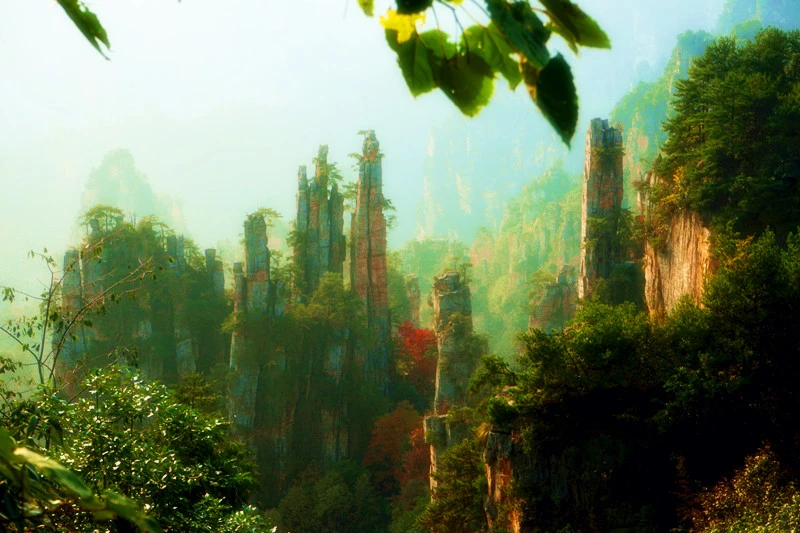
In the afternoon, we arrived at the Yangjiajie area of Zhangjiajie. Looking into the distance, a giant landscape painting unfolded before us. The nearby rocks formed a series of natural Great Walls.
Leaving Yangjiajie, we headed to the Tianzi Mountain area. After admiring the mountains here, you understand why Zhangjiajie is called 'an expanded bonsai, a reduced fairy mountain'.
In the evening, Guide Lü took us to taste the local specialties. Among them, the 'Three Pots' dish received unanimous praise from everyone!
After dinner, we watched the 'Charming Xiangxi' grand performance. It was truly a stunning visual and auditory feast!
When the moon rose, Miao boys would gather in groups under the windows of the girls they liked, using their songs and dances to express love, and choosing by climbing ladders. This original, natural love, clear as spring water and strong as wine, provided us with a pure emotional feast.
'Corpse driving' is a unique folk custom of Xiangxi. This dance tells the true historical story of General Luo Rongguang of Xiangxi, who, at the age of 67, led troops to resist the Eight-Nation Alliance and bled at Dagu Fort, incorporating the legend of 'corpse driving' and showcasing the loyalty, bravery, and love for home of the Xiangxi people.
The mixture of joy and sorrow is one of the most complex human emotions. Miao and Tujia brides start crying before their wedding, some for nearly a month. In fact, they cry for their parents' nurturing grace. The 'weeping marriage' of the Miao and Tujia people performs this complex emotion in a way that moves heaven and earth!
The mystery of Xiangxi is a worldwide topic. The famous 'corpse driving', 'Gu witchcraft', 'Chenzhou talismans', as well as 'chicken fixing', 'climbing mountains of knives and descending seas of fire', flying knives, and hard qigong were all demonstrated.
The knives on the mountain of knives were indeed very sharp.
This is the 'sea of fire'. We also got close to feel the fire – it was real.
Day 4 (Zhangjiajie National Forest Park: Ten-Mile Gallery - Golden Whip Stream - Xibu Street - Zhangjiajie city center)
Sometimes I am a very emotional person. I often fall in love with a place because I like its name. At first, I liked the 'Ten-Mile Gallery' scenic area in Zhangjiajie National Forest Park for this reason, but it did not disappoint me! After breakfast, we entered Zhangjiajie Park again. Our first stop was 'Ten-Mile Gallery'. We took the eco-friendly car. A foreigner smiled at us kindly. My husband naturally sat next to him and chatted fluently in English for over ten minutes. I only knew that my husband had passed CET-6 and had worked as a temporary translator, but this was the first time I saw him talk so freely in English. I suddenly admired him greatly!
After about twenty minutes, we arrived at the 'Ten-Mile Gallery'. Following the suggestion of the two southern girls in our group, we decided not to take the small train but to walk and enjoy the scenery. On both sides of this valley over ten miles long, nature once again used its extraordinary craftsmanship to carve hundreds of stone figures on the rocks, resembling people, objects, birds, or beasts. Some look like 'peacock spreading its tail', 'old man gathering herbs', 'longevity star welcoming guests', 'fierce tiger roaring at the sky'... As we admired this grand scroll painting and walked along, we gradually felt as if we had become part of the painting!
Guide Lü told us these were the Three Sisters Peaks, each holding or leading a child. But we thought they looked more like Joker from Stephen Chow's movie 'A Chinese Odyssey'.
Here, you can let your imagination fly and give them whatever names you like!
A big camel resting on the ground.
This peak looks more like a big camel.
Twilight love – see, the old grandfather is gazing affectionately at the old grandmother.
A stone in the distance gives us a thumbs-up.
At noon, we took the eco-friendly car again and arrived at the next scenic spot – Golden Whip Stream in a few minutes. Following the sound of babbling water, a crystal-clear stream appeared before us. Under the sunlight, the water surface sparkled so brightly that you couldn't look directly at it. The rocks of various sizes in the stream were covered with bright green moss, full of vitality and energy! We threw pebbles into the stream, made boats from leaves, and jumped from one side to the other on the rocks, having so much fun. At that moment, we forgot our age and identity, fully enjoying what nature had given us, completely intoxicated. I think it is only during travel that you can so easily and comfortably encounter the best of yourself!
When we passed through a small square, a group of monkeys ran toward us. Our son was so excited he jumped up and down. In the morning, we had bought peanuts, biscuits, and fruit at the supermarket to feed the monkeys. But when we got to the Ten-Mile Gallery, we only saw one monkey. Guide Lü said we might not see any today, and our son was very disappointed! I think that for a child, being able to get close to small animals is the happiest part of the trip. With yesterday's experience, my husband looked around warily. When the monkeys weren't paying attention, he turned his back, quickly reached into his clothes, and pulled out a few peanuts, afraid they might discover him and grab them directly from his clothes. Ha, he looked like a thief!
But after spending some time with them, we found that the monkeys at Golden Whip Stream were not as wild as those at Yuanjiajie. Even when they were anxious, they would politely wait for you to throw the food to them before eating.
We gave all the remaining food to the monkeys and reluctantly left. Whenever I recall this trip, closing my eyes, I often see this afternoon scene in my mind, and my heart is always filled with warmth...
Leaving Zhangjiajie National Forest Park, we took a double-decker bus to Xibu Street. That kid was so excited to ride a double-decker bus for the first time!
In the evening, we returned to Zhangjiajie city proper. Guide Lü arranged our hotel by the Lishui River. It was also a very tasteful hotel.
I don't remember the name of this fish pot, only that it was fresh, spicy, and delicious – a taste I had never experienced before!
The Lishui River at night.
Day 5 (Zhangjiajie: Tianmen Mountain - Fenghuang Ancient Town)
I had always wanted to come here because of a poem I love: 'Breaking Mount Tianmen gives the River Jiang a way, / The eastward-flowing water here turns to north. / On either bank the green mountains stand face to face, / A lonely sail comes from the sun's place in the north.' But when I actually arrived, I found that this 'Tianmen Mountain' was not the same one as in the poem! However, after a whole day, we were all conquered by this magical Tianmen Mountain!
First 'magic': the cable car going up the mountain. In other places, cable cars start from the foot of the mountain, but Tianmen Mountain's cable car starts from the city of Zhangjiajie itself. The cable car line is 7,455 meters long. After queuing for nearly two hours, we boarded the fully glass cable car, passing over parks, railways, lakes, and finally arriving at the foot of Tianmen Mountain. Then came the terrifying moment: as the cable car went higher, the ropeway became steeper and steeper, until it felt like we were ascending vertically. Looking down through the glass, there was a bottomless abyss beneath us! We all held our breath, not daring to move, afraid that even a slight movement would cause us to fall.
Second 'magic': a natural Tianmen Cave formed on the mountain. This cave attracts adventure lovers from all over the world.
In 2016, the World Wingsuit Flying Championships were held here.
When we reached the top and looked at the wingsuit flying platform, my legs turned to jelly. Thinking about how brave those people were to jump from here, I felt both admiration and worry!
Third 'magic': the winding mountain road downhill. Don't underestimate this road. Its design is unprecedented and will never be repeated. The entire road has 99 curves, each of which is what we commonly call a hairpin turn. We sat in the car, winding along the road. But don't worry, the driver's skill was very high.
In the afternoon, we took a four-hour bus from Zhangjiajie to Fenghuang. When we arrived at Fenghuang Ancient Town, it was already past 7 PM. Just as the ancient town's night lights were turning on, the antique atmosphere made us all feel intoxicated.
Small shrimp freshly caught from the Tuojiang River, still jumping, were deep-fried and eaten. They were both fresh and crispy.
Day 6 (Fenghuang Ancient Town - Changsha)
The ancient town in the morning was quiet and peaceful.
In Hunan, whether in a big restaurant or a small eatery, before the meal, the wait staff would bring a basin and a kettle of hot water for you to scald your utensils and disinfect them. It makes people feel at ease and comfortable. We should really adopt this practice back home.
At noon, we tried a local specialty in the ancient town – blood cake duck. Maybe we weren't used to the taste; it really wasn't as delicious as legend had it.
We strolled through the town's market. Fire ginseng fruit was extremely unpalatable, though I heard it can relieve heat and thirst. Red heart kiwifruit, though expensive, tasted good. Smoked bacon is very famous here.
In four days, we visited the natural scenery of Zhangjiajie and Fenghuang, and also learned a lot about the folk customs of Xiangxi. We grew to like this place more and more.
Day 7 (Changsha: Yuelu Mountain - Orange Isle - Pozi Street)
Standing in the Yuelu Academy, scenes from ancient TV dramas about scholars studying came to mind.
'Loving Evening Pavilion' – the name comes from a line in Du Mu's poem 'Mountain Travel': 'I stop the carriage to enjoy the maple grove in the evening.'
Ancient temple on Yuelu Mountain.
At noon, we bought snacks at Duoluo Street at the foot of Yuelu Mountain. Since we were in Changsha, we had to try its specialty – stinky tofu. We queued for over half an hour to buy it. It was crispy, spicy, and absolutely delicious. Only then did I realize that the stinky tofu I had eaten elsewhere was not authentic at all.
Handsome guy's baked pancake – not only was the guy handsome, but the pancake was also even more delicious.
In Changsha, besides Yuelu Mountain, Orange Isle is also a must-visit. Because we love Chairman Mao's poem 'Changsha: Spring in a Pleasure Garden', we had to come and walk around the place where he visited many times.
After walking for an hour, we finally arrived at the sculpture of a young Chairman Mao. Looking at his solemn expression and the worried look in his eyes for the country and people, I was deeply moved. In 1925, the young Mao Zedong, harboring ideals to save the nation, revisited the old place. Standing at the head of the isle, facing the surging Xiangjiang River, his heart stirred with thoughts, pondering the fate and future of the Chinese nation, and wrote the passionate poem 'Changsha: Spring in a Pleasure Garden'.
'Alone I stand in autumn cold, / Over Orange Islet flowing by the Xiang north. / See hill on hill all red, / Woods on woods dyed in frost; / The whole river is crystal clear, / Boats on boats race fast. / Eagles soar in the sky, / Fish swim in the shoal shallow; / All creatures strive for freedom under frosty sky. / Vast, I ask the boundless earth: / Who can decide the fate of all on earth?'
'With many friends I oft came here. / How splendid were the years gone by! / Then we were young, in the prime of life; / We students were full of spirit and drive. / We pointed to hills and rills, / Writing our criticism and praise, / And treat those lords like mire at face. / Do you still remember, / When in mid-stream we splashed around, / And waves tried to stop our boats?'
The little train – he just couldn't get enough of it. Look at that boy sitting in the front row, smiling from ear to ear.
In the evening, we took the subway directly from Orange Isle to Pozi Street.
That kid, for some reason, was particularly interested in Peking opera. He sat down by himself and listened attentively.
For dinner, we went to a century-old shop – Wenji Four-in-One Old Shop – and ordered double-color fish head and flavored crawfish, among other dishes. Truly worthy of a century-old shop: the double-color fish head had tender, fatty but not greasy flesh, and was spicy and delicious; the flavored crawfish were bright red in color, smooth in texture, and wonderfully spicy – simply a gourmet's delight!
Day 8 (Tianxin Pavilion - Hunan Science and Technology Museum)
Only here did we learn that the Yuelu Academy, Pozi Street, Tianxin Pavilion and other historical sites in Changsha were reduced to ashes in 1938 during the 'Scorched Earth Resistance' when the Japanese army approached Changsha. That fire burned for five days and five nights, and 3,000 Changsha citizens died in the flames. It is historically known as the 'Wenxi Fire'.
The science and technology museum is a must-visit every time we travel with Xiao Mi (our son). He never tires of it!
Day 9 (Changsha - Dalian - Dandong)
At 6 PM, our family of three returned safely to Dandong. We sat together having dinner and reminiscing about every bit of this journey. Although there were many small episodes along the way, we all felt that everything was the best arrangement. Yes! It was precisely because we had this attitude that we could face whatever came our way during the trip with equanimity and calmness. I think we will continue to bring this positive attitude into our future life and work, always maintaining the best version of ourselves!
I also hope that as we grow old, we will sit together in rocking chairs, flipping through these photos, and recalling those beautiful times together...


