A Leisurely Tour of Changsha
More than thirty years ago, I visited Changsha, Hunan, and went to Yuelu Academy, Aiwan Pavilion, and Orange Isle. However, there were some scenic spots in Changsha that I missed at that time because they were not very famous, including Huogong Palace, Tianxin Pavilion, and Baisha Well. From April 23 to 25, 2023, I went to Changsha on a business trip and took the time to revisit these places I had never been to before.
On the evening of the 23rd, after finishing the tour of Yuelu Academy, Aiwan Pavilion, and Orange Isle, I took the subway from Orange Isle Station to Changsha Huangxing Square Station, and then walked to Huogong Palace on nearby Pozi Street, hoping to taste Changsha snacks by reputation.
Changsha Huogong Palace, also known as Qianyuan Palace, was first built in the fifth year of the Wanli era of the Ming Dynasty (1577 AD) and rebuilt in the sixth year of the Daoguang era of the Qing Dynasty (1826 AD). Huogong Palace includes temple buildings such as the Fire God Temple, Wealth God Temple, Maitreya Pavilion, and Puzi Pavilion. It was destroyed in the Wenxi fire in 1938. When rebuilt in 1941, only the Fire God Temple hall was restored, while sheds were built on the ruins for small vendors to operate food stalls and shops. The area around Huogong Palace became a gathering place for Changsha-style snacks, which were praised by local residents and visitors from north and south.
On April 12, 1958, Mao Zedong, accompanied by Hunan Provincial Party Secretary Zhou Xiaozhou and others, inspected Huogong Palace and tasted its snacks. He praised, "Huogong Palace's stinky tofu smells bad but tastes good." Thereafter, tasting snacks at Changsha Huogong Palace became a must-do for Chinese and foreign guests.
In 2001, Changsha carried out renovation and expansion of Huogong Palace, reshaping the Fire God statue, restoring the Fire God Temple and ancient stage, painting the Huogong Palace archway, adding a stone archway, and erecting a monument commemorating Mao Zedong's visit to Huogong Palace. Today, the Huogong Palace area has become a representative public venue in Changsha, Hunan, integrating traditional folk culture, fire temple culture, and food culture. The snacks at Huogong Palace are famous throughout the three Hunan regions.
I walked into the Huogong Palace restaurant, a pavilion-style antique building next to Huogong Palace, which is a "China Time-honored Brand" store. I went to the second floor and specially tasted the famous stinky tofu and braised pork at Huogong Palace.
Beside the ancient stage in front of Huogong Palace, there is a gold-brick screen wall. The collected gold bricks come from the floor bricks discovered during the renovation of Huogong Palace. There is a folk legend about Huogong Palace being "dignified and majestic due to gold bricks paving the floor." In fact, these gold bricks are the remaining city bricks that were carefully fired in the early Ming Dynasty by Changsha Prefecture and other places in response to the call for the city walls of Yingtian Prefecture. Looking closely, these city bricks are engraved with the titles and names of the supervisors.
Leaving Huogong Palace, I strolled through the streets of Changsha at night. Perhaps because it was Sunday, the streets were bustling with people, and shops were crowded with customers. The street screens were playing promotional videos of Changsha, which has become a tourist and leisure destination for men and women from inside and outside Hunan Province.
At around 6:20 a.m. on April 25, I took a taxi in the drizzle from my hotel to Tianxin Pavilion, wanting to see the only remaining section of the ancient city wall in Changsha.
Tianxin Pavilion was originally named "Tianxing Pavilion," deriving from the prevalent theory of "xingye" (astrological fields) in the Ming Dynasty. According to the division of constellations, Changsha City is also called "Star City," corresponding to the "Changsha Star" in the sky. The top of Longfu Mountain, where Tianxing Pavilion is located, is the commanding height of the southeast corner of Changsha City, and was a place for ancient people to observe celestial phenomena and worship the gods. Tianxing Pavilion directly corresponds to the "Changsha Star" in the sky and was regarded by ancient people as a geomantic treasure land signifying good fortune. During the Qianlong era of the Qing Dynasty, as the Chengnan Academy moved to the foot of the Tianxin Pavilion city wall, Tianxin Pavilion became a cultural and sacrificial site corresponding to the academy. It enshrined two deities, Wenchang Dijun and Kuixing, to ensure the prosperity of Changsha's literary fortune. In the past, many people came to worship.
Tianxin Pavilion's base occupies the highest terrain in Changsha's urban area, and combined with its location on a city wall over 30 meters high, with Miaogao Peak nearby and the Yuelu Mountains as a backdrop in the distance, it appears even more steep and beautiful, attracting scholars and writers to climb the pavilion, look into the distance, and compose poetry. There are scenes like "Pavilion Piercing the Clouds," "Green Screen of Lush Mountains," and "Sparse Trees Veiled in Mist." Unfortunately, during the "Wenxi Fire" of 1938 in Changsha, Tianxin Pavilion was reduced to rubble. It was rebuilt in 1983. Since it is a newly built imitation ancient structure, I was not very interested in Tianxin Pavilion itself, and I did not have time to wait for it to open. For this trip, I only came to see the ancient city wall of Changsha at Tianxin Pavilion.
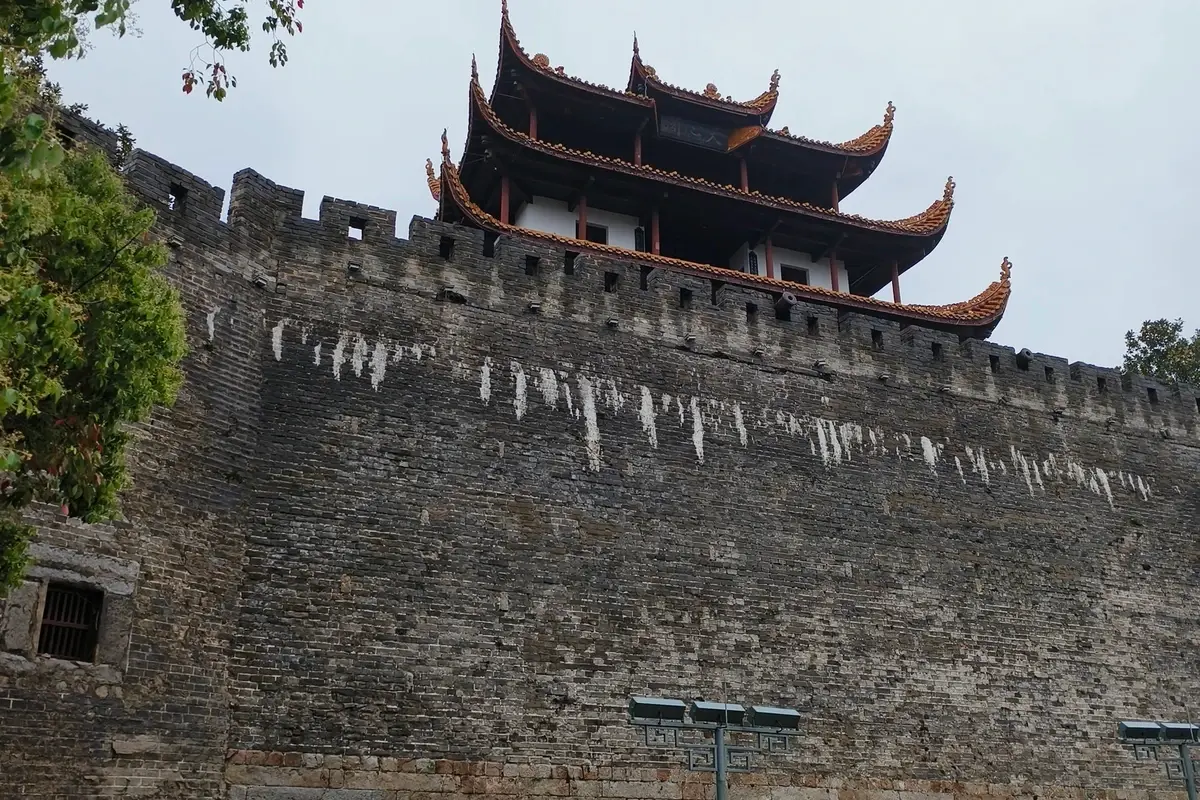
The ancient city wall under Tianxin Pavilion was first built in the fifth year of the reign of Emperor Gaozu of Han (202 BC) by Wu Rui, the King of Changsha, and has a history of over 2,200 years. In the fifth year of the Hongwu era of the Ming Dynasty (1372 AD), Qiu Guang, the military commander of Changsha, repaired and reinforced it. The wall was 8.5 kilometers long, shaped like a strip running north-south and narrow east-west, with nine city gates, greatly enhancing the defensive capability of Changsha City. In 1924, when the ring road of Changsha was built, only this section of the ancient city wall at Tianxin Pavilion was preserved, measuring 251 meters in length and 13.4 meters in height, with two gate barbicans (south and north). It is extremely rare among existing examples of ancient Chinese city defense fortifications and is one of the few cultural carriers and historical sites of ancient Changsha.
Since the Tianxin Pavilion scenic spot had not yet opened, I could not enter to see the scene inside the barbican of the city wall. I could only view this section of the ancient Changsha city wall from the outside. The bricks were mottled, and in the drizzle, it exuded a strong sense of historical vicissitudes.
At the foot of the Tianxin Pavilion city wall, there is a stone sculpture made of high-quality Sichuan general granite, called "Spirit of the Taiping Army." It recreates the battle scene in 1852 when Xiao Chaogui, the Western King of the Taiping Heavenly Kingdom, led the rebel army to attack Changsha City on horseback, swinging his sword. Xiao Chaogui was unfortunately hit by a bullet and died under the Tianxin Pavilion city wall in this fierce battle, and the Taiping army's attack ended in failure.
At the north entrance of the Tianxin Pavilion city wall, there is Chonglie Gate, a memorial arch-style structure made entirely of granite. It was first built in 1946, funded by donations led by Chiang Kai-shek, Chen Cheng, Zhang Zhizhong, and others, to commemorate the soldiers who died in the four major battles of Changsha during the Anti-Japanese War. The couplet on Chonglie Gate reads: "Spirit swallowing the barbarian, courage defending the mountains and rivers."
Beyond Chonglie Gate, there are also memorial structures such as Chonglie Pavilion and Chonglie Tower, also built in 1946 to commemorate the soldiers who died in the four major battles of Changsha during the Anti-Japanese War. Chonglie Tower, also known as the White Tower, is entirely made of granite. Its base is hexagonal, and the tower body is composed of a disc and a cylinder. On top of the cylinder is a globe, representing the earth, with a map of China engraved on its surface. Above the globe stands a stone lion with its head held high, symbolizing the national integrity that Chinese territory is sacred and inviolable.
Leaving the ancient city wall at Tianxin Pavilion, I walked through a small alley to Baisha Well.
Baisha Well is located on the west side of Huilong Mountain in the south of Changsha City, about one kilometer southeast of Tianxin Pavilion. It has been one of the famous springs south of the Yangtze River since ancient times.
Baisha Well is known as "the First Spring of Changsha." Originally, there was only one water outlet, which was relatively strong. By the end of the Ming Dynasty, the water was divided into two outlets, and the flow gradually slowed. After several renovations, it was expanded to four outlets. The well mouth is 0.6 meters square. The spring water gushes out continuously from the bottom of the well, clear and transparent, sweet and delicious, with a steady flow throughout the year.
The exact time when the ancient Baisha Well was first dug can no longer be verified. The local histories of Changsha before the Ming Dynasty have all been lost. The remaining "Changsha Prefecture Annals" printed in the twelfth year of the Chongzhen era of the Ming Dynasty (1639 AD) record: "Baisha Well, in the county (referring to Shanhua County) two li southeast, the well is only about a foot wide, clear, fragrant, sweet, and delicious. The officials and citizens of the whole city draw water from it without end. It is the first spring of Changsha." The Qing Dynasty "Comprehensive Gazetteer" records: "Located two li southeast of the county, it is only about a foot wide, the most sweet and pure, never ceasing even after long drawing." In recent years, some research suggests that the ancient Baisha Well was built during the Spring and Autumn and Warring States periods. Regardless, it is beyond doubt that Baisha Well is an ancient well in Changsha. A folk rhyme goes: "Wuxi Xishan Mountain has no tin, Pinghu Lake water is level, Changde De Mountain has virtue, Changsha sand water is sand-free." It is said that the last two lines come from a couplet at the Dragon King Temple beside Baisha Well in the old days: "Changde De Mountain has virtue, Changsha sand water is sand-free." This couplet reveals the extraordinary clarity and purity of the ancient Baisha well water. In Changsha, tea brewed with Baisha well water is called "sand water tea," with a strong, rich flavor; and Changsha's famous liquor "Baisha Ye" is said to be made with Baisha well water.
In the drizzle, I arrived at Baisha Well. I saw a stone tablet erected against the hillside, inscribed with the words "Ancient Baisha Well." Around the spring eyes, drainage channels were laid, with stone railings on the high sides and stone steps on both sides as passageways. Before the widespread use of tap water, Baisha Well was the main water source for nearby residents. Even today, some nearby residents still come with buckets to draw water for drinking. In my hurry, I actually forgot to cup my hands and drink the water to experience its taste and feel.
After hastily visiting Huogong Palace, the Tianxin Pavilion city wall, and the ancient Baisha Well — the famous historical sites I had missed in Changsha more than thirty years ago — my trip to Changsha this time came to a satisfactory conclusion.


