Melodious Salzburg - Free Travel of the Former Austro-Hungarian Empire, Part 12
D5 Leaving the bustling Hallstatt town in the twilight, we headed north to Lake St. Wolfgang. The lake, the town of St. Wolfgang on the opposite shore, and Mount Schafberg had all merged into the vast winter night twilight.
Since the Middle Ages, the princes and nobles of the Habsburg dynasty loved to vacation in the St. Wolfgang Lake area. Now it is even more beloved by Austrians, and this town has been rated as one of the world's top ten famous towns.
This is the opening location of the movie "The Sound of Music," and the place where Princess Sissi and the prince got engaged in the film. It is a natural creation of the Alpine glaciers, with emerald blue lakes surrounded by mountains.
From the top of Mount Schafberg north of St. Wolfgang, one can see seven lakes and over a hundred peaks in Austria. Lake Wolfgang, Lake Mondsee, and Lake Attersee are all in view. It is hard to find such a wide-open view even in the entire Alpine range stretching through Switzerland, France, and Italy.
Unfortunately, the misty twilight at 4 p.m. made us give up this planned scenic spot on our itinerary.
The small town hall square of St. Gilgen by the lake was decorated with Christmas tree lights.
Having failed to book a resort hotel in the lake area, we rushed straight to the music capital, Salzburg...
We booked an A&O budget hotel near the Salzburg train station with an underground garage, priced at only one-fifth of the rate in the Hallstatt lake area. After some hassle, we finally found the garage to park the car.
The old town of Salzburg is a UNESCO World Heritage Site.
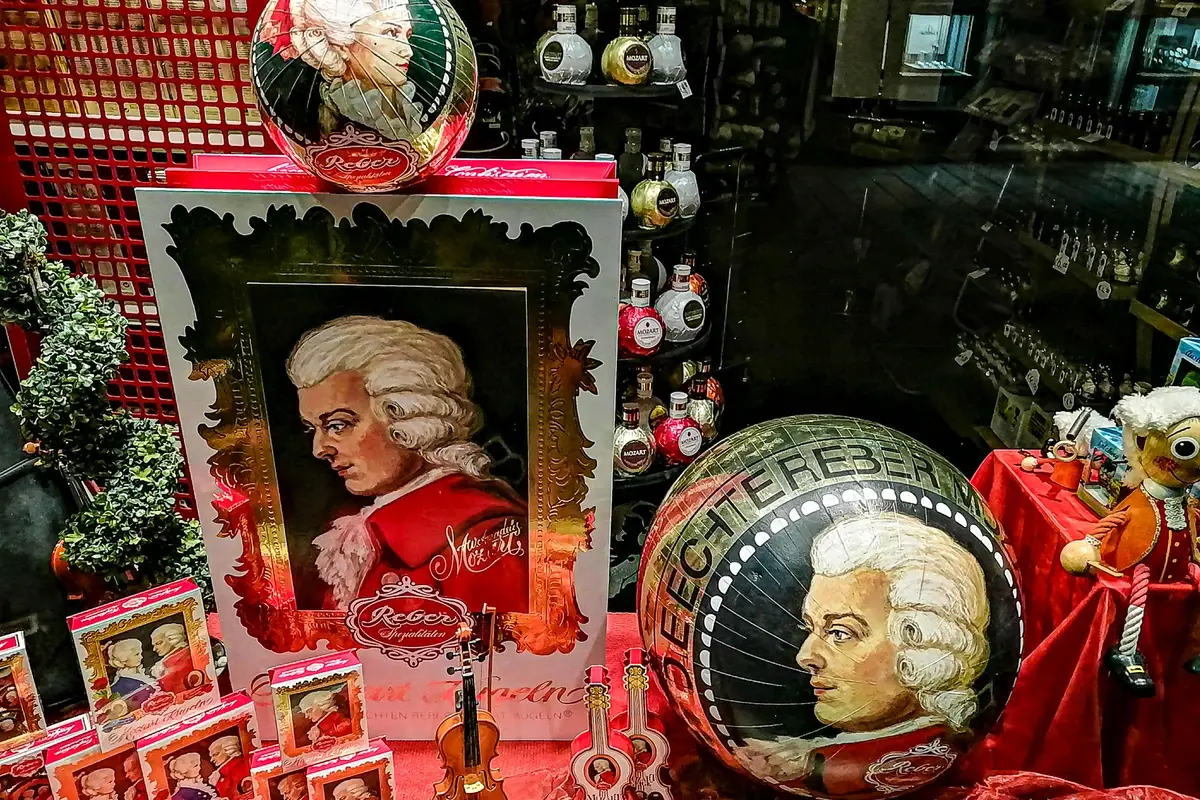
Salzburg can be broken down into "Salz" (salt) and "Burg" (fortress) in German. Since 755 AD, the discovery of salt mines brought prosperity here. Salzburg is the oldest city within Austria's current territory, the birthplace of musical genius Mozart, who spent more than half of his short 36-year life here. It is also the hometown of conductor Herbert von Karajan and the filming location of "The Sound of Music."
The beautiful Salzach River divides Salzburg into the new town and old town. The varied and historic pointed churches and monasteries, lush gardens, and diverse fountains adorn Salzburg with extraordinary beauty. There are also medieval-style houses that evoke imagination, Mozart's birthplace, the Mozarteum University, Mozart Square, and his memorial bronze statue.
We chose to stay two nights in Salzburg. The Baroque architecture within the city has a unique charm. The new and old towns are not large, ranking as Austria's fourth-largest city with a population of 150,000, allowing for leisurely exploration on foot.
Leaving the hotel near the new town train station, we arrived at the lively Mirabell Palace and its Christmas market.
After an Austrian-style bread and sausage dinner, we continued strolling toward the old town.
Across from the new town square, a building called Mozarts Wohnhaus was where Mozart lived from 1773 to 1787.
Now it is the Mozart Residence Museum, displaying the violin, xylophone, and piano he used, his handwritten scores, letters, and stage design blueprints.
To the west of the square is the Doppler Residence. In 1842, Doppler noticed that as a train passed by, the whistle's pitch changed—higher when approaching, lower when receding. He studied this phenomenon, discovering the Doppler effect due to relative motion between wave source and observer.
Later, musicians experimented by playing on a train while others on the platform noted the pitch changes as the train approached and departed...
Crossing the Salzburg chain bridge adorned with padlocks of love.
The Christmas market in the old town of Salzburg is even livelier, stretching from the University of Salzburg through several adjacent streets to Residenzplatz. Amid ancient medieval churches and Baroque buildings, surrounded by charming traditional huts, the market sells all kinds of Christmas items, lit with colorful lights, as if stepping back to the Middle Ages.
This is one of the world's most atmospheric Christmas markets, also known as "Austria's Most Beautiful Shopping Center."
Here you can buy Christmas supplies: decorations, food, toys, handicrafts, everything.
Every day there is choir singing on the square (Tuesdays 6-8 pm), and traditional brass music performances on Thursdays and Saturdays.
Getreidegasse, only a few meters wide, is the busiest street in the old town.
The oil-shining black stone slabs.
The buildings along Getreidegasse are well-preserved in medieval style, in various colors, adorned with exquisite reliefs and cornices.
Is this really a bank?
The construction year is clearly written on the facade of each building.
Every shop has its own beautiful sign, mostly made of metal, very eye-catching. Looking up while walking on the stone street, these distinctive wrought-iron signs compete for attention, becoming a beautiful sight along Getreidegasse.
There is also a Chinese restaurant here.
No. 9 Getreidegasse is a golden six-story building. On January 27, 1756, Mozart was born on the third floor and spent his childhood there.
Some say that in Salzburg, when angels play for God, they play Bach; when they play for themselves, they play Mozart.
Locals commemorate this early-departed genius in a unique way.
Mozartplatz often hosts various music festivals. Exploring Salzburg through music is an appropriate way.
Now Christmas songs are floating from the choir in front of the bell tower; their performance level is far beyond that of the square-dancing aunties' choir in China.
The Salzburg Residenz is a city palace in the old town, formerly the seat of the Prince-Archbishops of Salzburg. Around it are Domplatz, Residenzplatz, and Sigmund-Haffner-Gasse.
The Salzburg Cathedral (Dom), which can accommodate 10,000 people, is a landmark building. Its unique bronze doors symbolize faith, hope, and charity.
Inside the cathedral, you can see the largest pipe organ in Europe, and the art gallery inside exhibits Austrian paintings from the 16th to 18th and 19th centuries.
Residenzplatz is a large square. To the west are the old Residenz and gallery; to the east are the new Residenz and Salzburg Museum; to the south is the cathedral.
Residenzplatz is the central square of the old town, now transformed into a winter skating rink. Seeing the joyful and agile figures of girls, we couldn't help lingering.
Behind the cathedral, the Kapitelplatz features a large fountain, giant chess pieces, and an oversized golden ball with a man standing on it. The fortress on Mönchsberg contrasts strikingly with the golden ball, making an unforgettable impression.
Continuing forward is the cable car station to Hohensalzburg Fortress.
Hohensalzburg Fortress is one of the oldest and best-preserved castle fortresses in Europe, maintaining its appearance since the 15th-century expansion. Construction began in 1077 under Archbishop Gebhard, when Salzburg was one of the richest states in the Holy Roman Empire.
It is said that this mighty fortress has never been conquered since its completion.
Taking the cable car into the fortress, the first thing you see is the inner courtyard, whose surrounding walls form a natural viewing platform overlooking the town below.
From the inner courtyard, you reach the archbishop's Golden Hall, lavishly decorated, where major religious ceremonies were held.
Climbing the stairs brings you to the prince's bedchamber. These opulent bedrooms restore the original furnishings, with cabinet locks coated in gold, sparkling like stars in the night sky.
The underground granary could store enough grain for a thousand soldiers for one year.
The military museum inside the fortress exhibits various weapons and armor from the Middle Ages.
The torture museum displays instruments used to interrogate prisoners and captives. There are also small museums like the witch doctor exhibition, showing medieval life.
The Marionette Museum is one of the highlights, located in the basement, showcasing marionettes used in puppet theaters, including Papageno from "The Magic Flute" and characters from "Amadeus."
There is also an exhibition themed around a doctor.
This doctor, Paracelsus, practiced medicine, and later a Paracelsus Medical University was established in Salzburg.
Since the Middle Ages, Salzburg has always been a prosperous land of music.
Afterwards, you can visit the castle museum, which introduces the castle's history, weapons, handicrafts, judicial development, and related historical events.
In the audiovisual room, you can sit and enjoy a sound and light show about Salzburg's past and present.
The various delicate lamps in the fortress add elegance to the night castle.
There is an open-air café inside the fortress where you can enjoy coffee while admiring the surrounding scenery.
In 1965, the Hollywood film "The Sound of Music" was shot in Salzburg and its nearby mountains. The story is based on the real experience of a Salzburg nun, Maria von Trapp, who was sent to care for seven motherless children in an Austrian family. Maria and the children formed a family choir and toured Austria. She fell in love with and married Baron von Trapp. After the outbreak of World War II, the family endured hardships and, by singing, escaped Nazi-occupied Austria.
The film "The Sound of Music" depicted Salzburg and Austria as a war-free paradise, making Salzburg a pilgrimage site for music lovers worldwide.
The most famous place in the new town is probably Mirabell Palace and Gardens, built in 1606 for Archbishop Wolf Dietrich's mistress Salome. After Dietrich's death, it was renamed Mirabell Palace.
The main feature of this late Renaissance palace is its staircase, but we couldn't find it after several attempts. Now the Marble Hall has become one of the most beautiful and romantic wedding halls in the world, attracting couples from all over to register for marriage.
The Baroque Mirabell Garden is full of beautiful flowers, marble statues, and fountains.
Recreating scenes from "The Sound of Music": Maria leading the seven children dancing and singing around the central fountain, jumping around the Pegasus fountain, and running through the hedge maze tunnel, while enjoying the magnificent view of Hohensalzburg Fortress in the distance. The children sang the famous "Do-Re-Mi."
The grassy slope and ornamental trees beside the garden became our last cherished glimpse as we left Salzburg...
In the early morning, a scene of a community book exchange cabinet on the street corner shows that Salzburg citizens not only love music but also love reading and life...


