A Glimpse of Lushunkou, Half of Modern History: A Day Tour with a Group in Lushunkou
China is so vast, I want to see it. Take you to a place you may or may not have visited before.
A glimpse of Lushunkou, half of modern history: A day tour with a group in Lushunkou.
Due to time constraints, I opted for a day trip to Lushun from Dalian. Lushun and Dalian were originally known as "Lüda (City)" and were integrated. During the Eastern Jin Dynasty, Lushunkou was called "Mashijin" (jin meaning ferry crossing), and in the Yuan Dynasty, it was called "Shizikou" (Lion's Mouth). In the fourth year of Hongwu (1371) of the Ming Dynasty, Emperor Zhu Yuanzhang sent Generals Ma Yun and Ye Wang to lead troops across the sea from Penglai, Shandong, landing here to reclaim Liaodong. Because the sea voyage was smooth, they renamed Shizikou to Lushunkou, a name that has been used ever since.
In 1880, the Qing government established the Beiyang Fleet (predecessor of the Beiyang Navy) here, making Lushun a military fortress. Lushun Naval Port became one of the world's five most famous naval ports at the time. Lushun also served as the "golden waterway" connecting the Liaodong Peninsula and the Shandong Peninsula.
In 1894, during the First Sino-Japanese War, the Japanese navy captured Lushunkou. In 1896, Japanese forces withdrew from the Liaodong Peninsula, and in 1898, it became a leased territory of Tsarist Russia, who invested heavily in planning and building Lushun. In 1904, the Russo-Japanese War broke out on Chinese soil; Japan won, and Lushunkou came under the jurisdiction of the Japanese Navy until the end of World War II forty years later. Near the end of WWII, Soviet forces entered Northeast China and occupied Lushun in August 1945, returning it to China only in May 1955. Hence, the saying: "A glimpse of Lushunkou, half of modern history."
Lushun is an open-air museum of modern Chinese and world history, dotted with old buildings, or historical structures, mostly in Russian or European styles. There are official residences of high-ranking officials, commercial establishments of wealthy merchants, private homes of former Qing aristocrats, as well as hospitals, schools, museums, and more. In different historical periods, these buildings served different purposes and thus carry the weight of history.
Lushun Taiyanggou Historical Scenic Area concentrates many old buildings.
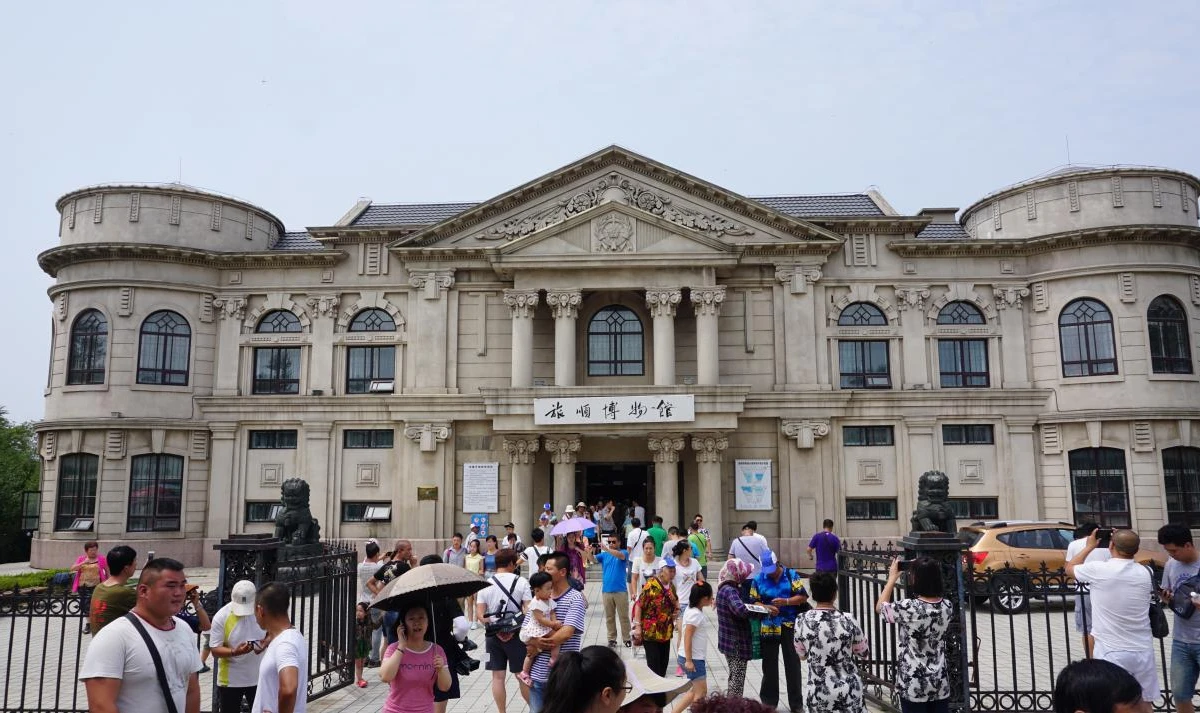
Lushun Museum (formerly the Guandong Governor-General Museum)
We arrived at the Lushun Museum. This building is of Russian architectural style, originally an unfinished "Army Officers' Club" built by Tsarist Russia. It later became the (Japanese) Guandong Governor-General's Manchu-Mongol Artifacts Museum and opened in 1917. After several name changes, it was renamed "Lushun Museum" in 1954, with the calligraphy for the museum name by Guo Moruo. The museum comprises two buildings: the main hall and an annex.
The museum is not only an old building, but its exhibits also retain the style of the past. Those large wooden cabinets date back to the earliest period, with natural lighting as the main source, giving a nostalgic feel—completely unlike modern museums.
Former Headquarters of the Kwantung Army
Built in 1900, before 1904 it served as the Russian Guandong Oblast Army Artillery Headquarters. After the Russo-Japanese War, it was occupied by the Japanese. In 1905, it became the Army Department of the Japanese Guandong Governor-General, and in 1919 it was renamed the Kwantung Army Headquarters. The shocking September 18 Incident (Mukden Incident) was planned here. The day after the incident, the Kwantung Army Headquarters moved to Shenyang. Today it is the Kwantung Army Headquarters Exhibition Hall, but it was closed when I visited.
Former Site of the Russo-Chinese Bank, Lushun Branch
Built in 1902. During the Russian occupation, it was the Lushun branch of the Russo-Chinese Bank, the earliest financial institution in the Lüda region, built in a modern Russian architectural style. In 1904, when the Russo-Japanese War broke out, the Russo-Chinese Bank ceased operations. It now houses the Lushun Numismatic Museum, which opened in 2019.
This tower was built in 1955, before the Soviet Red Army withdrew from Lushun, to commemorate the Soviet Red Army's victory over the Japanese Kwantung Army in 1945. The tower is 45 meters tall, polished granite, in Russian style. The base is pentagonal, with columns and the lower part of the tower forming a colonnade; the center is a pentagonal tower body. Inside, 180 steps lead to a two-story platform. The spire is a five-pointed star made of gilded copper, surrounded by gilded tassel decorations.
Located in front of the Lushun Museum, its foundation was laid in 1955. The tower is cylindrical, carved from precious snowflake marble, 22.2 meters high, with exquisite craftsmanship. It has double platforms surrounded by stone-carved railings and steps on all four sides. The stone balusters are carved with blooming peonies, soaring doves, and white clouds, reflecting Chinese national artistic style. The base of the tower has four reliefs depicting Tiananmen in Beijing, the Kremlin in the Soviet Union, blast furnaces of Anshan Iron and Steel, Friendship Farm, and the beautiful scenery of Lushun Port. The cornerstone bears an inscription by Premier Zhou Enlai: "Foundation Stone of the Sino-Soviet Friendship Tower."
Built in 1898, this was the terminus of the South Manchuria Railway branch line constructed by Tsarist Russia during its occupation of Lushun. It opened for operation in 1903, with the most complete European-style platform in China, still maintaining its original appearance. It is a typical Russian-style wooden building, with a scaly iron-shingled turret above the center of the waiting hall. In 1905 it was occupied by Japan, in 1945 taken over by the Soviet army, and returned to China in 1952. Passenger service has now ceased.
White Jade Mountain and White Jade Pagoda
Looking from Taiyanggou Historical Scenic Area toward Lushun's White Jade Mountain, a tall tower on the mountain is very distinctive. The spire is shaped like a bullet (or some say a candle, symbolizing an eternal flame). It was built by the Japanese after the Russo-Japanese War as a "Loyalty Monument" to honor officers and soldiers who died for the emperor in that war. In 1986, the tower was officially renamed the White Jade Pagoda.
Impressions of Lushun, Night of the Naval Port
In 1980, the song "Night of the Naval Port" became popular across the country. With the development of tourism in the new century, there is a large indoor scene performance titled "Night of the Naval Port."


