In-depth Xiapu Tour 1: Overview – Introduction to Ningde Tourism Resources
"A Journey Through Mountains, Seas, Rivers, and Islands of Eastern Fujian" is a five-minute work compiled from my five years of travel across Eastern Fujian, presented to give everyone a preliminary understanding of the region.
Travel is more than just sightseeing and enjoying scenery.
Abstract: Tourism is a demand in people's lives when society reaches a certain stage of development. It has multiple benefits, such as regulating negative emotions, cultivating character, broadening knowledge, enhancing friendships, and providing holistic enjoyment. At the same time, tourism has a long industrial chain and should be an important means to stimulate domestic demand and boost consumption.
1. Tourism as a Demand in People's Lives:
Tourism falls under the higher-level human needs of knowledge and aesthetics. It helps relieve work fatigue, cope with emotional setbacks, and regulate monotonous life. During travel, people forget worries and enjoy life with ease. It is this brief relaxation that brings sudden insights, or at least makes people feel the meaning of work through tourism consumption and enjoyment, igniting a love for life and meeting new challenges with full enthusiasm.
2. Picturesque Scenery as the Top Choice for Travel Destinations:
Travel inevitably involves fatigue from transportation, discomfort from sleep, diet, and customs, but the sensory stimulation from exotic customs and beautiful scenery still attracts people to travel.
The national standard "Classification, Investigation, and Evaluation of Tourism Resources" (GB/T 189722003) divides tourism resources into 8 main categories, 38 subcategories, and 155 basic types.
According to this classification, there are indeed many tourism resources around us. Broadly speaking, any place that gives tourists a wonderful feeling is a tourist destination. Beauty is all around us. But because we live with it day and night, we become blind to it. Travelers rush to other places in search of their ideal paradise.
But who doesn't praise the beauty of their hometown! When wanderers return, besides the call of family, the mountains, waters, and plants of their hometown also captivate them. Understanding the true face of Lushan depends on the person, time, place, and fate.
Spring outings to admire flowers, watching sunrises and sunsets with admiration and appreciation—these are seasonal sceneries!
Narrowly defined tourist destinations are scenic spots and resorts.
Photographers, painters, and travelers are the pioneers in discovering beautiful scenery and tourism resources, thanks to their talent and unique aesthetic perspective. For example, Hokkaido's "Blue Pond" in Japan became famous after a photo by National Geographic photographer Kent Shiraishi was acquired by Apple and used as one of the default desktops for Mac systems, turning it into a tourist attraction.
All scenery language is emotional language. Beauty comes from our own aesthetics and cultivation. Different people have different feelings about the same place. Chen Tingzhen of Changting, Fujian, wrote about Mount Taimu: "Mount Taimu has no ordinary stones; each seems like a divine work. According to one's perception, all phenomena are in the mind. There are heavenly caves and underground caverns. Infinite scenic wonders make visitors want to return." Lei Dalian of Xiapu inscribed on the ancient official road of Qian Dajun in Yangjiaxi: "Big mountains embrace stones to sleep; small streams sing for whom?" These use literary techniques such as imagination, personification, and metaphor to express artistic conception and praise nature's craftsmanship—this is the connection between tourists and the scenery!
Excellent tour guides' vivid explanations and metaphors help people better appreciate the scenery; stone carvings and descriptions at scenic spots also aid appreciation.
Destruction of original ecology, excessive tourists, garbage, and bad weather can diminish people's enjoyment of the scenery.
3. High-level Tourism is a Process of Complete Relaxation and Enjoyment for All Five Senses:
Work and life are busy. But whether people decide to travel actively, are invited passively, or are persuaded to adjust their mood due to unsatisfactory events in life, once they decide to go, their mood becomes relaxed. This emotion from deep inside has a very good effect on regulating people's emotions and mindset. Therefore, after traveling, people's moods improve (barring very unpleasant events during the trip), and they face new life and work with a positive attitude and full enthusiasm.
With a good mindset and mood, the world becomes beautiful. When the body and mind are relaxed, all five senses can be enjoyed. This is the core; the core and details determine our travel quality.
After deciding, the next step is choosing a destination. Different people have different choices: the wise enjoy mountains, the wise enjoy water; some prefer quiet, others activity; every tourist has their own needs. High-quality tourism services will definitely respect tourists' independent choices of destinations, transportation, accommodation, food, and activities. However, because tourists are unfamiliar with the destination, their choices may not be reasonable, requiring tourism practitioners to optimize them. After personalizing the plan, practitioners help implement it. We call this "assisted self-guided tour."
To let tourists play easily and happily, honest service is a basic professional ethics requirement for tourism practitioners. During service, practitioners should carefully observe tourists' feelings and needs and serve with heart. Conversely, dishonest practices will inevitably make tourists defensive, disrupting the relaxed and harmonious environment and affecting the travel outcome.
With basic services guaranteed, tourists can fully relax. Add a few little touches to let every guest enjoy all five senses, body, and mind! It's actually very simple: generally, the air in tourist areas is good. Take a deep breath, smell the flowers, listen to the birds; pick a citrus leaf, rub it, and smell the fragrance; take off shoes, wade in the water, walk on the beach, give your feet a massage; pick a green tea leaf and chew it, or eat a wild fruit; shout in an empty valley to vent your inner frustrations; listen to regional music or poetry recitations—anything you pick up becomes a holistic enjoyment!
4. Tourism as a Process of Broadening Knowledge:
"Reading ten thousand books is not as good as traveling ten thousand miles." Hearing is false, seeing is true. Perceptual knowledge is the process of forming an understanding of phenomena through direct contact with objective things via sensory organs in practice. It is characterized by directness and deep impression. During travel, people go deep into a specific area, perceive local culture, history, and customs. With a little attention, you can learn a lot, even correct previous misconceptions.
For example, "May your happiness be as boundless as the Eastern Sea flowing forever, may your life be as long as the ageless pine of Southern Mountain." The "ageless pine" was long thought by me to be a pine tree. But in Sanya, Hainan, I realized it was wrong; the "ageless pine" actually refers to the Dracaena (dragon's blood) plant.
Once, I took a few children on a trip upstream. During the trip, I asked them to observe the flowing water, sand, and rocks carefully. Soon they got the answer: upstream has waterfalls and large rocks; midstream has gentle streams, small pebbles, and sand; downstream has a wide river, slow flow, and silt accumulation. This is a geographical phenomenon. Why? The upstream slope is steep, flow is fast, and the force of water is the initiator of this geographical phenomenon. The children suddenly understood.
"Thousands of villages overgrown with creepers, people gone; thousands of households desolate, ghosts sing" is a poem by Mao Zedong, describing the misery caused by schistosomiasis, leaving empty villages, cold and desolate. But locals use the seeds of Ficus pumila to make a cold drink, and the white variety can be used as medicine for back pain. This short introduction contains rich knowledge—poetry, history, biology, cuisine, and Chinese herbal medicine.
How much more knowledge can travel bring? With attention, people's knowledge and experiences grow and accumulate unconsciously during a pleasant journey.
This knowledge comes from scenic spot introductions, geographical markers, my own ability to acquire knowledge, travel companions, guides, parents, and even modern internet technology tools, such as WeChat's "Flower Identifier" app—take a photo of an unknown flower, upload it, and get an answer quickly.
5. Tourism Relaxes People, Facilitates Communication, and Enhances Friendship:
Traveling together is a common choice. Generally, people travel with family or like-minded friends. There are three purposes: first, to get along well and have fun during the trip; second, to enhance relationships during this relaxed and pleasant process; third, to take care of each other and prevent accidents while away from home.
Because of the pleasant scenery, relaxed mindset, and clear purpose, the effect is predictable. Therefore, whether traveling with family or new and old friends, the journey will surely enhance family bonds, friendships, and even love!
6. Tourism is a Microcosm of an Industrial Chain:
During travel, clothing, food, accommodation, and transportation are all necessary. But unlike frugal daily life at home, people traveling are more willing to spend. Reasons: first, they are out for a few days and psychologically accept that travel is for consumption and enjoyment; second, arriving in a strange place, exotic foods and souvenirs always spark strong interest for a try; third, they still care about family and want to bring gifts or souvenirs for loved ones and friends as a token of affection.
Based on these three reasons, business with tourists is relatively easy. However, many unscrupulous merchants exploit this loophole, and fraud and scams occur frequently, which is heartbreaking. We hope our scenic spots can strengthen management, restore a clean sky to the tourism ecological environment, and promote the healthy development of the tourism industry chain.
Noisy cities and hurried footsteps have already made people dizzy. Come on, bring your family, invite a few friends, return to simplicity, and enjoy a few days of carefree, indulgent life!
Potential Conditions and Preliminary Practice of Comprehensive Tourism Development in Eastern Fujian
1. Unique Geographical Location of Eastern Fujian:
According to the "Ningde Municipal Administrative Map," Ningde City (hereafter referred to as Eastern Fujian) governs two districts, two county-level cities, and six counties. Among them, five mountain counties are Gutian, Pingnan, Zhouning, Shouning, and Zherong; the four coastal districts, cities, and counties are Jiaocheng, Dongqiao Development Zone, Fu'an, Fuding, and Xiapu.
Eastern Fujian's geographical location is unique. The coastal cities of Ningde, Fu'an, and Xiapu surround Sandu Ao, forming a peninsula known as Dongchong Peninsula.
Sandu Ao, also known as Sansha Bay, is located in the southeast of Ningde City, Fujian Province, at the midpoint of China's 18,400 km golden coastline. It is a peculiar bay with a small mouth and a large belly, formed by the embrace of Jianjiang Peninsula and Dongchong Peninsula. The inner sea area is 714 square kilometers, exceeding Singapore's land area of 626.4 square kilometers. It mainly includes Baima Port, Guanjingyang, Dongwuyang, Fudingyang, Lumen Port, Yantian Port, and other waters. It has 126 islands, and the only outlet is Dongchongkou, only 2.6 km wide. It is the "gateway to the sea and throat of five counties" of coastal Eastern Fujian, and one of the world's rare "sea lakes." Sun Yat-sen once said in his "Strategy for National Reconstruction" that Sandu Ao is "rare in the world, unique in China."
Dongchong Peninsula embraces Sandu Ao on the inside and faces the rough East China Sea on the outside.
Eastern Fujian faces the sea and has many mountains within its territory, with an overall pattern of backing onto big mountains and facing the sea.
Eastern Fujian's unique geographical location combines mountains and seas, inner and outer seas, with an original ecology.
2. Diverse and Distinctive Tourism Resources Covering the Entire Region:
The biggest difference between comprehensive tourism and scenic spot sightseeing lies in the comprehensiveness. It is the result of harmonious coexistence between humans and nature. It is a process where people integrate into nature with a relaxed mindset, appreciating and enjoying nature's masterpieces according to their own aesthetic standards.
With mountains backing and sea facing, and the unique geographical location of inner and outer seas, Eastern Fujian boasts beautiful scenery and a wide variety of tourism projects.
The "Classification Table of Chinese Tourism Resources" divides tourism resources into 8 main categories, 38 subcategories, and 155 basic types. Eastern Fujian possesses all 8 main categories, and among them, there are more than 31 typical resources.
Eastern Fujian's coastline is winding, extending outward to the East China Sea, and inward to Dongwuyang, Guanjingyang, and Sandu Ao. Inner and outer sea scenery, natural and cultural landscapes alternate, creating unpredictable beauty.
Fujian's coastline is the most tortuous in China. The straight-line distance along the coast is only 535 km, but it winds for 3,051 km, a tortuosity ratio of 1:5.7. Eastern Fujian's coastline is even more so. Take Xiapu as an example: the ratio reaches 1:10—truly tender and lingering...
At high tide, the surface of Sandu Ao is calm like a lake, with islands dotted and fish rafts stretching for tens of kilometers, known as the "Venice of the East." The famous writer Guo Moruo visited Sandu Ao twice and left a well-known poem in 1962: "Three Docks (Sandu) good port unmatched in the world, deep water wide bay like a lake." At low tide, large areas of mudflats are exposed, with winding channels. Residents along the coast engage in aquaculture and farming. The changing mudflat scenery under the light of sunrise and sunset has become a business card showcasing Eastern Fujian's charm to domestic and international tourists.
Dongchong Peninsula is long and narrow, with multiple high points along the way where you can enjoy both inner and outer sea scenery simultaneously.
The outer sea beaches from south to north include Xiahuxi, Lyuxia, Xiaojing, Dajing, Jishi, Gaoluo, Waihaihu, Beidou, Xiaowo, Dongbi, and Huazhu. Each beach is a unique paradise with wide sandy beaches and fine sand. Looking far out, you see the boundless blue sea blending with the sky; up close, you can admire the sea bays embraced by headlands, steep cliffs, and scattered islands, all forming a seascape painting.
The erosion by waves, sea breeze, and rain has created abundant sea-eroded rocks that spark endless imagination and amazement. Climbing the small hills by the sea, weaving through stone caves formed by rainwater erosion, and viewing strange rocks from different angles is both healthy and fun.
Due to the constant changes in light and tide, the same scene looks different at different times. We locals can never finish seeing or appreciating it all. With a good mood, you will always find new discoveries whenever you go out, let alone a first-time visitor from afar.
Eastern Fujian is mountainous, with well-developed water systems and dense rivers. There are 24 major rivers, the largest being the Jiao (Fuchun) and Huotong river systems. All cities, counties, and most towns and villages have streams flowing through them. The forest vegetation in the watersheds is well-protected, with clear water and fresh air, like fairylands. Each is a land of longevity and health. Moreover, there are wonders like Pingnan's Bshuiyang and Mandarin Duck Creek—"unique scenic wonders under heaven, cosmic mysteries"—where you can get wet and have fun; Gutian's sparkling Cuiping Lake; Shouning's Xixi rafting and bridge romance; Zhouning's Carp Creek and Nine-Dragon Waterfall; Zherong's Dongshi Mountain and grasslands—these amazing sceneries will make you linger.
Ecological diversity and rich species. Comprehensive tourism is about enjoyment, and it naturally includes food. Eastern Fujian, with its diverse ecology, features seafood as the main cuisine, supplemented by special mountain delicacies. While enjoying the gifted beautiful scenery, your taste buds are also constantly stimulated. Can we refuse such a place?
In comprehensive tourism, people not only appreciate beautiful scenery but also enjoy various wild pleasures brought by ecological diversity. Climbing mountains, you can enjoy blooming wildflowers and pick wild fruits like myrtle, raspberries, and kumquats; walking on the waves, you are accompanied by various birds; quietly observe mudskippers, sea anemones, fiddler crabs, and other tidal flat animals smiling and waving to you.
Transportation between scenic spots in Eastern Fujian is convenient. Through scientific and reasonable arrangement, travel in Eastern Fujian can almost achieve the goal of reaching a new attraction within 10-30 minutes by car. Tourists experience different sensory stimuli from different types of scenery, gaining rich rewards, and the fatigue level during sightseeing is moderate, making it very suitable for developing comprehensive tourism.
Eastern Fujian people proudly express the richness of tourism resources with "mountains, seas, rivers, islands, lakes, forests, and waterfalls"!
People can enjoy diverse and beautiful experiences brought by all kinds of tourism resources to the fullest. This is the distinctive feature of Eastern Fujian's comprehensive tourism!
3. Eastern Fujian Has Initially Developed the Human, Climatic, and Transportation Conditions for Comprehensive Tourism Development:
1) The people of Eastern Fujian are simple and honest, treating guests with sincerity and enthusiasm, providing the human and folk foundation for comprehensive tourism development.
Many developed tourist attractions in China have problems of cheating, overcharging, and deceiving customers, treating tourism consumption as a one-time affair, lacking integrity, and not seeking return business. Indeed, few people visit the same place multiple times, but the result is ruining the local reputation. Tourists cannot relax during the trip and fail to achieve the goal of a fully enjoyable travel experience. Sincere hospitality is the most important human and folk foundation for a place to develop comprehensive tourism!
Since ancient times, the people of Eastern Fujian have been simple and honest, treating guests with sincerity and enthusiasm. I remember as a child, when local people lived in poverty, every household mainly ate sweet potato rice. But whenever a guest came, they would find a way (often by borrowing rice) to let the guest eat white rice. That's how Eastern Fujian people treat guests! To this day, Eastern Fujian still retains this good human environment. Xiapu has been developing photography tourism for many years, with a large number of photographers visiting annually. But local hotels and reception staff treat them fairly and warmly, with few negative reports of cheating, overcharging, or deceiving.
2) Good Climatic Conditions in Eastern Fujian:
Ningde has a subtropical maritime monsoon climate, with mild winters and cool summers; it is humid with abundant rainfall; summer is longest, autumn shortest; and climate resources are abundant. Due to four high-altitude mountain counties, geographical differences in meteorological elements are significant. The city's annual average temperature is 17.5°C, growing period 327.9 days, frost-free period 270.4 days, sunshine hours 1,637.7 hours, and precipitation 2,350 mm. Precipitation is concentrated in two periods: the rainy season (early flood season) from May to June, and the typhoon season (late flood season) from July to September.
3) Eastern Fujian Has Initially Broken Through Transportation Bottlenecks, with Convenient Access to Major Domestic Cities and Nearby Famous Scenic Spots:
After years of effort, once remote Eastern Fujian now has expressways connecting every county (except Gutian, under construction), and the four coastal districts, cities, and counties all have high-speed rail stations. Take Xiapu as an example: Xiapu is located midway between Fuzhou and Wenzhou, each 160 km away, about 2 hours by expressway and 1 hour by high-speed rail.
4. Eastern Fujian Has Already Conducted Preliminary Practice of Comprehensive Tourism:
The old famous scenic spot in Eastern Fujian is Mount Taimu. Later, investment developed Pingnan's Baishuiyang and Mandarin Duck Creek Scenic Spots, Fu'an's Baiyun Mountain Scenic Spot, and Shouning's Xixi Rafting Scenic Spot. These scenic spots have relatively complete facilities, management, and services.
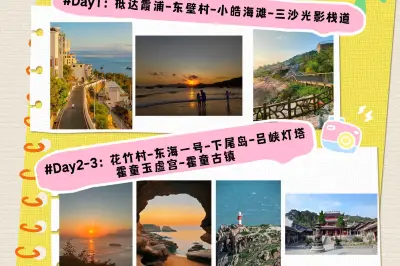
With the rise of the unique industry of photography guiding in Eastern Fujian's tourism chain, a number of scenic spots oriented towards photography services have emerged. Represented by Sansha Town in Xiapu, the government funded the construction of photography spots. Homestays and related industries receiving photography groups gradually rose. Local government-organized photography competitions like "The Sea in My Heart" promoted the construction of photography bases.
Various places used government policies such as "Beautiful Villages" and "New Rural Construction" to build small attractions, adding beauty to Eastern Fujian's scenery.
The arrival of photographers not only brought service fees to some locals but also influenced their awareness of tourism development and service. Some companies and individuals rushed to invest in developing small scenic spots, building simple resort hotels, and offering simple experiential activities like digging clams on the beach, going out to sea for seafood, and camping.
Cultural and sports activities serve as a platform to enhance local visibility and boost local economy and industry development—a common practice worldwide. Eastern Fujian is also trying. The upcoming Provincial Games, as well as the Sansha International Mountain Marathon and other events, can attract a large number of tourists and promote tourism development in Eastern Fujian.
5. Problems in Eastern Fujian's Comprehensive Tourism:
Eastern Fujian's original ecological attractions have both beauty and troubles. First, transportation: many scenic spots can only be reached on foot.
Second, safety hazards: most attractions lack sightseeing trails; some are rough roads, some are grassy paths. Special care must be taken to avoid stepping into empty spaces, especially when viewing reefs and cliffs by the sea, where you often need to get close to cliffs to enjoy the beauty. At such times, you must clearly see and check the road conditions before proceeding, otherwise, falls can easily occur with disastrous consequences. Additionally, harm from snakes, mosquitoes, thorns, and other animals and plants poses many safety risks for unfamiliar tourists.
Third, for ordinary vacations, Ningde's climate conditions are suitable, but all attractions should be closed during typhoons (the dark clouds before a typhoon are a special sight) and heavy rain. Water activities like Pingnan's Baishuiyang, Shouning's Xixi rafting, and seaside baths are only suitable in summer. The outer sea cliffs are windy in winter, causing some discomfort to tourists; tourists should be reminded to wear warm outer clothing. In summer, the ultraviolet rays are strong on the outer sea, so tourists should also be reminded to protect themselves from the sun.
Fourth, Xiapu's beaches were once spotless, but they cannot resist the tide of economic development. Various wastes are making the beautiful girl shabby.
Fifth, preservation of cultural relics and historical heritage. Most ancient dwellings and monuments in Eastern Fujian are made of earth and wood. In recent years, with the continuous improvement of people's living standards, descendants have mostly moved out or built new concrete houses, leaving fewer people living in ancient buildings. The ancient buildings are severely damaged and urgently need protection. At the same time, the excavation of historical and cultural heritage and its organic integration with historical sites also require relevant departments to invest manpower and resources.
Sixth, cultivation of tourism talents. The achievement of every undertaking is the result of favorable timing, geographical convenience, and human harmony. Comprehensive tourism can bring a good life to people and absorb a large amount of employment. But without a large number of professional and dedicated people to engage in this work, Eastern Fujian's comprehensive tourism is bound to repeat the same mistakes, becoming as chaotic as many domestic scenic spots.
Just as a small lotus has just shown its tip, we believe that under the correct guidance of the national comprehensive tourism development guidelines and with the great efforts of governments at all levels in Eastern Fujian, the comprehensive tourism of Eastern Fujian will surely usher in a bright tomorrow!
Please continue to follow "In-depth Xiapu Tour 2: Mount Taimu - Yacheng - Sansha - Yushan Island" and subsequent travel notes.
This travel note is a comprehensive discussion; specific routes will be covered later.