Fujian Travelogue (Compilation of Past Poems) – Eastern and Central Fujian (Part I) ====== Luo Yanxin
♛Fujian Travelogue (Compilation of Past Poems)
Travels in Eastern and Central Fujian (Part I)
Imitating the Immortals' Sun-Drying Technique, a Single Day's Skill Creates a New Tea
—— Miscellaneous Chants from Eastern Fujian, with Postscript
On the first ten-day period of the month after the summer solstice in the year of Bing Shen, I traveled with my wife to Eastern Fujian—the so-called Eastern Fujian refers to the present-day Ningde area—there were both joys and worries, insights and confusions, so I chanted and recorded them for my own amusement.
The ancient port stands by the sea for a thousand years, towering and leisurely.
Just after welcoming the bright moon and clear night, in an instant come startling waves and sudden rain.
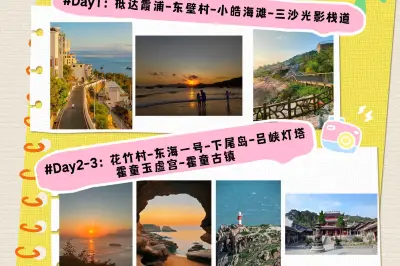
◎Sansha Ancient Port is located on the prominent coastal point of northeastern Fujian Province, in the central part of Xiapu County. It is 126 nautical miles from Keelung Port in Taiwan and only 16 nautical miles from Mazu Island. Historical records show that from the Tang Dynasty to the Qing Dynasty, each successive dynasty established garrisons and stationed troops here. It was known as “the gateway of Funing, the key to Fujian and Zhejiang,” hence earning the reputation of “the strategic thoroughfare between Fujian and Zhejiang” and “the important coastal fortress.”
Sansha Town is the seat of the Eastern Fujian fishing ground and a first-class fishing port. In June 2006, the State Council Taiwan Affairs Office established the first “Xiapu Taiwan Aquatic Products Distribution Center” here; in 2014 it was listed as a national key reform pilot town.
This port has beautiful scenery and is a paradise for photography enthusiasts. However, the weather is unpredictable—when I visited with my wife, we had just enjoyed the beauty of “the sunset spreading across the sky and the moon rising over the sea” when suddenly dark clouds gathered and a sudden rainstorm arrived!
In those days, the Old Mother Taimu gathered clouds and rosy clouds, nurturing snow buds in the Hongxue Cave.
Imitating the immortals' sun-drying technique, in one morning they skillfully transformed and produced new tea.
◎In the Tang Dynasty, Lu Yu’s “Tea Classic” quotes the Sui Dynasty’s “Yongjia Illustrated Record”: “Three hundred li east of Yongjia County there is a White Tea Mountain.” White Tea Mountain is today’s Taimu Mountain within Fuding. This shows that white tea already existed as early as the Sui and Tang Dynasties. Hence the saying: “The world’s best white tea is in Fuding, and the finest white tea is in Panxi.”
The Ming Dynasty work “Boiling Spring Notes for Small Items” records: “Tea processed by fire is inferior; that sun-dried is superior, as it is closer to nature and removes the fire element. Moreover, if the worker’s hands and tools are unclean or the heat is unsuitable, both the aroma and color will be damaged. Sun-dried tea leaves placed in a cup make the leaves stand upright, clear and bright, and especially lovely.” This describes precisely the method of making Baihao Yinzhen (a type of white tea)—sun-drying, with a taboo against directly touching the tea leaves by hand. If the drying skill is insufficient, the tea’s aroma will be damaged. When brewed, the leaves stand upright like silver needles, and the liquor is clear and bright.
On the Hongxue Cave of Taimu Mountain there is a cliff inscription: “Taimu Mountain high, green snow buds; beyond the cave, new rafts cross the sea sky. Tea meditation across the ridge all equal; righteous wine still accompanies righteous tea.” It was inscribed by Zhou Lianggong (Left Commissioner of Fujian, the first Han Chinese to hold this post in the early Qing) when he visited Taimu Mountain during the late Ming and early Qing dynasties.
Why go boating on Jiuli Stream when the hustle and bustle of crowds startles the pheasants?
I urge you to hold your breath and pass quietly, letting birds be joyful and fish at ease, each in its own home.
◎Jiuli Stream, also known as Chi Stream, originates from the three high peaks of Fuding’s Taimu Mountain, Xiapu’s Muhai Point, and Zherong’s Dongshan Ridge. It gathers more than ten tributaries, flows for over fifty li, passes through Yangjia Stream in Xiapu County, and empties into the East China Sea. The stream meanders, flanked by green mountains, lush trees, strange rocks, and clear blue water, very much like the Nine Bends of Wuyi.
It has now become a tourist “hotspot,” with the din of voices frightening birds into hiding—the ecological balance seems to have been disrupted!
Lengcheng once dominated the sky; Chian today is but an illusion over the sea.
If Lengcheng surpasses Chian, would the Japanese pirates bow to the heroes!
◎Lengcheng Earth Fort is located in Lengcheng Village, Qinyu Town, Fuding. Built during the Jiajing reign of the Ming dynasty (1522–1566) to defend against Japanese pirates (wokou), the fort is circular, with a perimeter of 1127 meters, a height of 5.6 meters, and a thickness of 4.67 meters. It has three gates—east, west, and south—each 2.43 meters high, 1.8 meters wide, and 1.55 meters thick, and is well preserved. However, few visitors come.
◎Chian is located east of Xiapu County town, about ten li from the county seat. During the Song, Yuan, and Ming dynasties, it was called “Jintai Port,” a bustling hub for people and goods, named for the red rocky shores along the coast.
This place was once the landing site of the Japanese monk Kūkai when he entered Tang China. Since 1984, followers of Japanese Shingon Buddhism (founded by Kūkai) have visited Chian in Xiapu County to pay homage to their founder. Now there are a Sea-Sacrificing Pavilion, an Overlooking-Sea Pavilion, a Kūkai Memorial Hall, and the Chian Cultural Relics Room. Many Chinese come to pay respects to the Japanese monk.
Viewing the Buddha statue from afar on the celestial terrace, up close it turns to green dust.
The sacred countenance should only be seen from a distance; when you approach, there is no Tathagata.
◎Lingfeng Temple is located on Taimu Mountain in Fuding, Fujian Province, adjacent to the East China Sea, controlling Wu and Yue to the north, and dominating the southeast. It was first built during the Zhenguan reign of the Tang Dynasty and has long been known as “the Buddhist Kingdom of the East Sea, the Immortal Capital on the Sea.”
However, the giant Buddha statue newly sculpted on the mountaintop can only be admired from afar, not approached closely!
Composed hastily by Yanshin of Chouzhou at the
Fuding Jinshuiwan Grand Hotel in midsummer of Bing Shen.
♞Figure 9 – Small regular script inscriptions on two bronze vessels:
In Praise of the San Family Plate
Sleeping silently in the constellation Chen for over a century, once unearthed it astonishes the dark heaven.
Like scattered stars intricately arrayed, rustic charm abounds, all natural!
In Praise of the Mao Family Tripod
The great Western Zhou treasure bears Mao Gong’s policy; the dignified inscription reveals natural majesty.
Seal-script bronzes: after a sigh before the Plum Hermitage, again the Old Man Rao.
Written and inscribed by Yanshin of Chouzhou in early winter of Wuxu.
Luo Yanxin, a native of Chouzhou (Yiwu). Left Hangzhou in youth and lodged in Huizhou: once peddled in severe winter; once toiled under scorching summer; sought profit and fame. Later returned to the right path, but his temples were already touched by autumn. Finally arrived at Jiahe, taught at a school, and delighted in solitary travel.