For Eight Hundred Years, Villagers Have Not Eaten the Carp from the Stream, and Even Bury Them After Death
China is so vast, I want to see it. Let me take you to a place you may or may not have visited.
For eight hundred years, villagers have not eaten the carp from the stream, and even bury them after death.
We may have seen many carp—whether for eating, ornamental, or wild—but in Fujian's eastern region, there is a county called Zhouning. About five kilometers west of the county seat lies Puyuan Village, home to China's first national fish culture theme park—the Carp Stream (Liyu Stream) Scenic Area. It is unique. It boasts the world's only fish funeral custom, the only fish tomb, the only funeral eulogy for fish, and the oldest known carp stream, earning it the title 'Chinese Wonder.'
In 2015, Zhouning Carp Stream had an entrance fee of 40 yuan.
The Carp Stream in Zhouning has a history of 800 years. During the Jiading era of the Southern Song Dynasty, amidst turbulent times, the Zheng clan ancestors migrated from Kaifeng in Henan to the banks of the Nine-Bend Stream in Puyuan Village, Zhouning, Fujian. They planned the layout, built homes, and formed a magical and beautiful ancient village. The village contains the Zheng Clan Ancestral Hall.
The Zheng Clan Ancestral Hall is a five-entry ancient hall-style building with carved beams and painted pillars, splendid and full of rich historical and cultural atmosphere. It is one of the best-preserved ancestral halls in East China. The hall is narrow in front and wide at the back, shaped like an ancient boat, symbolizing the ambition to 'set sail straight into the vast sea.'
In southern water towns, villages are typically arranged around streams and ponds. The flowing water in these streams and ponds is the source of all domestic water—used for cooking, washing rice and vegetables, laundry, and even cleaning toilet buckets. To keep the water clean, every household would contribute money or labor each year to dredge and clean the silt from the streams and ponds. Carp are bottom-dwelling fish; they forage for food in the streambed, and the water current easily carries away the silt, thus helping to clarify the water. The daily task of cleaning was delegated to the carp—a clever solution. Raising fish in the water also helps monitor pollution and prevent poisoning.
To protect the carp in the stream, the Zheng ancestors established village rules: 'As long as people live, the fish shall live; protect the fish unto death. Do not catch or eat them; pass this down for generations.' According to legend, to demonstrate the seriousness of the clan rules, the Zheng clan chief secretly instructed his own grandson to 'steal fish' and caught him on the spot. In the ancestral hall, he severely punished his grandson publicly, and fined him a banquet and a theatrical performance to treat the entire village. In the rural context of the past, this was the maximum penalty. Over time, this tradition was passed down through generations, and to this day, villagers have developed a spontaneous tradition of loving and protecting the fish, never catching or eating carp. The villagers also have a tradition of martial arts—partly to guard against bandits, and partly to deter any uninvited guests who might covet the carp.
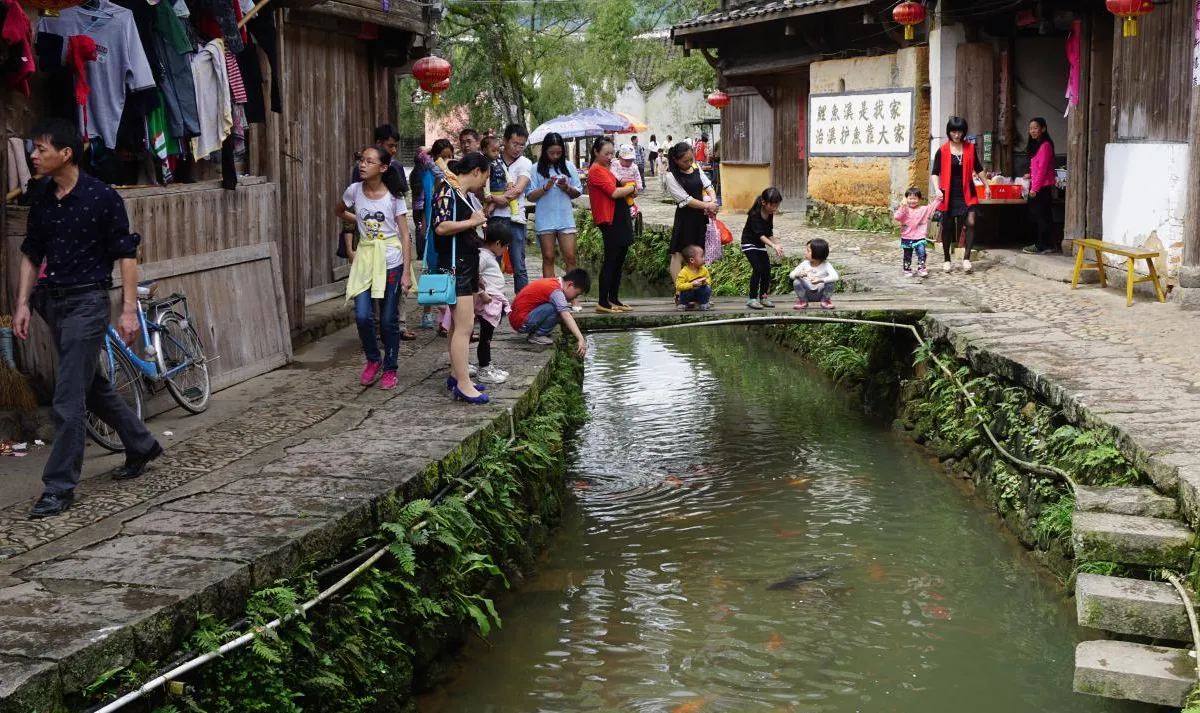
In the ancient village, the carp in the stream respond to the sound of people, gathering when they see human figures. People and fish enjoy each other's company, creating a delightful scene. Today, it has been developed into the Carp Stream Scenic Area.
The scenic area is divided into an upstream 'Stream Hidden Scales' natural theme park and a downstream 'Human-Fish Harmony' cultural theme park.
'Stream Hidden Scales' Theme Park
'Human-Fish Harmony' Theme Park
The Carp Stream is about 500 meters long and several meters wide, freely inhabited by over 7,000 carp of various colors. During the rainy season, the stream swells. Clever villagers built L-shaped underground channels beneath the road so the carp can hide during floods. They also plant green calamus along the stream so the carp can hold onto them and avoid being swept away. Occasionally, carp washed into rice paddies are carefully brought back to the stream by villagers.
The Leap the Dragon Gate Bridge, also known as the True Joy Bridge, is the best spot to watch the carp leap up like dragons jumping over the gate.
The villagers of Puyuan not only protect the fish with their lives but also deify them. On a small hillock downstream of the Carp Stream stand two thousand-year-old Chinese cedar trees, which the villagers call Mandarin Duck Trees. Beneath the trees stands a 'Fish Tombstone,' behind which is a covered deep well. When a fish dies, a respected elder of the village will bury the fish solemnly in the pit, and finally burn incense and paper money, reciting a funeral eulogy in memory of the fish. This 'ceremony' has been passed down through generations.
The Wenchang Pavilion and Guanyin Pavilion in the village.
On a certain year, month, and day in the Gregorian calendar, the people of Carp Stream respectfully, with three stoves of incense and three cups of clear wine, offer a sacrifice to the souls of the dead carp and pray as follows: Tracing back to our ancestors, who raised you to purify the stream, your offspring multiplied, and the stream became famous far and wide for its hidden scales. For eight hundred years, people have understood the nature of fish, and fish have understood human feelings. We have shared hardships and joys together. Oh, the fish, swimming gracefully, nibbling on duckweed and algae, leisurely spitting foam and waving fins—you are the elite of aquatic life, the beauty of the mountain village. Even Lü Shang would not dare to cast a line; even Feng Huan would have no need to tap his sword. No one would drain the pond to catch you, and who would dare to cook you? We look up at the soaring clouds and seas, full of vigor for three thousand miles, waiting for the dragon gate transformation to open up a vast future. But alas, heaven does not grant long life—you suddenly died. We humans are not made of wood or stone; how could we forget our feelings? With sorrow and pain, we bury your spirit and summon your soul, to express our universal love. We only pray that your offspring will flourish. Respectfully offered by the people of Puyuan's Carp Stream.