Ke Ha Pu: A Trip to Xiapu
In Xiapu, there are very few tourists like us who are neither professional photographers nor self-driving or chartering a car. To be honest, without renting a car, Xiapu is not really a convenient travel destination. The attractions are too scattered, and a considerable portion of time is spent on transportation. As a former driver with a license but little practice, I ultimately couldn't resist the allure of its most beautiful tidal flats. However, even though transportation is not so convenient, we could always find a ride to our destinations. Now that I think about it, taking the slow-moving buses limited us to just one or two attractions per day, making the itinerary more relaxed and even adding unexpected surprises.
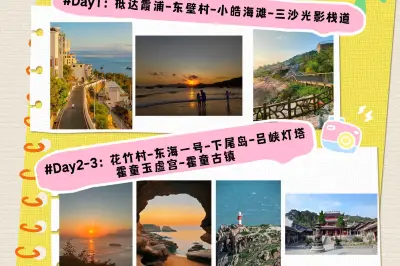
Day 1: Xiaohao - Dongbi
Day 2: Dong'an Island - Banyueli
Day 3: Dajing
Day 4: Shajiang - Zhujiang Island
Day 5: Yibeilongtan Waterfall (originally planned Yulong Cherry Blossom Valley)
During our 6 days and 5 nights in Xiapu, the weather seemed to read our minds. It was almost overcast or rainy for several consecutive days, so we could guiltlessly sleep in without waking up early for sunrise. However, we were granted one sunset, for which we were extremely grateful.
On the first day, we took the eastern route. We took a minibus from the north station to Xiaohao. Although the buses were generally old, we could pay via WeChat QR code. When we got off, the driver quoted 18 yuan per person. As I scanned the payment code, I muttered under my breath. After getting off, I strongly suspected we were overcharged and regretted not asking the fare beforehand. Fortunately, this only happened once, and we never learned the lesson of asking the price before boarding.
Where we got off, there happened to be a small path directly facing the sea. This little village was much quieter than I imagined. Many guesthouses were under construction. Locals said business was good, and I thought it must be during peak season, at least not like it appeared now.
Without the blessing of sunlight, the beauty of the coastal scenery was somewhat diminished. Fortunately, I had mentally prepared myself before leaving, so when I saw Xiaohao Beach, I wasn't too disappointed. The tidal flats on a cloudy day should look like this anyway. Many fishing boats were moored in the distance and nearby, and even the layered waves did not break the tranquil atmosphere.
After the tide receded, the tidal flats were embedded with countless abandoned shells, which puzzled us greatly. I say 'abandoned' because these shells were strung together with holes drilled in them. Some were broken and scattered, while others were still neatly arranged in strings.
Walking along the embankment, we got closer and closer to the fishing boats. Due to the angle, the drying poles in the water looked very dense, and the boats glided easily through the gaps. The closer we got to the water, the stronger the fishy smell in the air became. Upon closer inspection, it turned out that the smell did not come from fish or shrimp, but from whole bags of seaweed. The ground of the work area was also covered with a thick, uneven, wet dark carpet.
December was the seaweed harvest season. The fishermen were indifferent to this repetitive annual labor, but I was quite interested and snooped around everywhere, even sneaking a glance at the crane's paperwork.
The fishermen walked on uneven reefs as if on flat ground in their rubber boots. With a chisel and a basket, they could dig oysters right on the reefs at their doorstep. Truly, 'living by the sea, you rely on the sea' – this couldn't be more accurate. The ingredients were too easy to come by.
The oyster shells on the reefs were actually very sharp. We carefully climbed to more distant reef groups, and both of us got our hands cut to varying degrees.
We were too curious to resist asking the locals about the use of those strings of shells. We learned that they were used to cultivate seaweed seedlings. After the seaweed grew, these shells were useless and naturally discarded, but I always thought they could be reused for something.
When we saw fishermen mending nets, we went up to chat with them. When encountering big waves, seemingly strong fishing nets could be easily torn. Even with repairs, a net often only lasted a few months. Buying a new one cost several hundred yuan, which was a considerable annual expense. I looked at the net for a long time without seeing the entrance. After some guidance, I realized that the net openings were on the sides, not at the ends as I imagined. Thinking about it, if there were only two openings, why make such a long cage?
Xiaohao gave me the feeling that it wasn't a tourist attraction at all, because it was completely original and unadulterated. The locals felt the same way; they couldn't understand why we had traveled thousands of miles to watch them harvest seaweed and mend nets.
Transportation: From the North Gate Station (Xiapu Old Station, near the North Gate Hotel), take a bus heading towards Sansha Town, passing by Xiaohao. Fare: about 12 yuan (estimated). Travel time: half an hour. Buses vary in size, and you can hop on and off anywhere along the road.
If I were to choose a seaside guesthouse in Xiapu, I would definitely consider Dongbi.
Compared to Xiaohao's simplicity, Dongbi has a refreshingly cool vibe. Moreover, the guesthouses here perfectly match the romantic seaside feeling, with much better facilities. The owners of several guesthouses were very nice and didn't drive away tourists who were having fun in the public areas.
Like Xiaohao, Dongbi is also a production area of seaweed. Locals sometimes pack and sell dried seaweed right in front of their homes at prices often lower than in stores. Remember to choose 'first water' seaweed, similar to pre-Qingming Longjing tea.
The charm of Dongbi lies in its sunset. The geometrically arranged seaweed poles break the monotony of the open sea, echoing the distant rolling mountains. The afterglow of the setting sun gradually tinges everything around with gold, and occasional beams of light add the perfect finishing touch.
Whether from a guesthouse, observation deck, or the light-and-shadow boardwalk, you can enjoy the beautiful sunset. So every evening, these places gather tourists. With each deepening of the afterglow, there are exclamations of admiration, which gradually turn into sighs of regret as the light fades. People's emotional expressions are always so direct.
Transportation: From the North Gate Station (Xiapu Old Station, near the North Gate Hotel), take a bus heading towards Sansha Town, passing by Dongbi. Fare: 15 yuan (3 yuan from Xiaohao to Dongbi). Travel time: half an hour. Buses vary in size, and you can hop on and off anywhere along the road.
Xiapu's newly built coastal new city, with rows of brown high-rises, showcases the small county's rapid development in recent years. A friend who visited Xiapu six years ago said that the county had become unrecognizable to him. However, for a population of only a few hundred thousand, these concrete forests clearly exceed the basic demand. The price of over 10,000 yuan for roughcast houses is already high in Xiapu, raising concerns about the bubble behind it. Buses heading south have moved from the original south station to the Binhai New City bus station, which are 1.6 kilometers apart, a short walk.
Getting off at the head of Dong'an Bridge, we were amazed by the dragon-like structures in the sea under the strong coastal wind: such a planting method exists! At first, I thought it was seaweed, but later I learned it was actually kelp (gracilaria), though to me there's no difference. The dragons swayed under the sea surface with the waves, both gentle and spectacular.
The fish rafts in the sea were our target for this trip. Several small houses on the sea were connected together, some scattered, some neatly lined up like in formation. The bottom consisted of plastic barrels or foam, allowing the houses to float on the water.
By the roadside, neatly stacked freshly produced plastic items looked like the floats under the houses. They seemed durable, at least not like foam that would break into particles and drift away over time.
After walking for a while without seeing a dock, we asked a middle-aged man where the Dong'an Dock was. To our surprise, we had already passed it and were on Dong'an Island itself. Good, we saved a ferry ticket.
The trees were peeled and cut into planks used on the fish rafts. I lifted a log; it was quite heavy. The women on this island worked such hard physical labor—it was really tough.
As we walked onto the fish raft, we could see the seawater through the gaps. The gaps and the ropes soaked in the water had grown algae. The long walkway made us walk vigorously, gradually getting used to the swaying and floating sensation. The fishermen didn't mind us playing on the moored boats nearby.
This fish raft was not their living area but a place for maintenance work, and there was even a small shop. The buzzing and vibration of the electric motor resonated with the raft underneath. A father returned from sea with his seven- or eight-year-old son; the boy was obviously accustomed to life at sea. Only we two outsiders stood out conspicuously, with our novelty about everything we saw.
Looking at the peculiar fish rafts, I wondered: was the arrangement free? You could tie yourself to whichever neighbor you wanted, and if you fell out, you could untie and move away. I was curious if there were rules for choosing a location. What if everyone wanted the same area? The water depth varied; if you were in a shallow area, you would experience high and low tides within a day—half the time floating, half the time stranded. This way of settling seemed quite interesting.
I heard that from a mountain, you could overlook the vast fish rafts in a spectacular view. I asked a man who had just come ashore. He casually pointed forward. 'There.' Following his direction, it was an island almost opposite the shore. 'What?! That far!' I suspected he was joking, because the mountain was so far away it appeared only gray. Worse still, the simple woman who was peeling tree bark gave the same answer. I felt desperate.
Considering the afternoon itinerary, we started heading back. When we returned to where we got off, we finally noticed that under the bridge was a dock—the very Dong'an Dock we had missed. Our conspicuous tourist attire drew someone to ask if we wanted to take a boat to the island—that seemingly unreachable island... Our earlier smugness about having walked directly onto the island vanished. But by then, we had no interest in taking a boat, partly due to time constraints and partly because we had at least seen the fish rafts, even if not from the best angle.
Fortunately, there was a small restaurant at the dock. A bowl of seafood noodles for ten yuan restored our energy and lifted our spirits. However, if you have high standards for the dining environment, it's recommended to bring your own snacks.
Also, it's not advisable to use the dock's restroom unless necessary, especially in winter, unless you want to experience the cool sensation of the sea breeze hitting your crotch. No wonder this eco-toilet didn't have the terrible smell I expected.
Transportation: From Binhai New City bus station, take the bus heading towards Taijiang, and get off at Dong'an Dock. Fare: 20 yuan. Travel time: 1 hour.
This is an ancient southern nomadic ethnic group, '畲shē', meaning slash-and-burn cultivation. Many people, like me, may not recognize this character at first. Over a thousand years, they migrated from Fenghuang Mountain in Chaozhou, Guangdong. Today, over 90% of the She people live in the vast mountainous areas of Fujian and Zhejiang, with the rest scattered in Jiangxi, Guangdong, Anhui, and other provinces.
Xiapu has several She villages. The one we went to has a beautiful name: Banyueli (Half Moon Village). There is no direct bus; we had to take a bus to Houshou Village. While waiting at Dong'an for a bus, a private car offered to take us to Houshou for 15 yuan per person. The driver kindly dropped us off at the fork leading to Banyueli and advised us to watch for out-of-town cars along the way, as they were mostly self-driving tourists, so we could hitch a ride.
At first, we actually kept looking back, but a few cars in a row were all local, and by the time we saw them, they had passed. Besides, we felt too embarrassed, so we stopped paying attention and simply considered it a hiking exercise. It was 4 kilometers from Houshou to Banyueli. The route was simple, but there were few people along the way, and the feeling intensified as we went uphill. Additionally, the graves here were very large, which we had noticed when we went to Xiaohao. They were shaped like half a gold ingot or a ship's bow (later confirmed by locals that it was not intentionally built that way). Sometimes they were covered with black cloth. Looking at the sky, I reminded Spring that we should try to get down the mountain before 4 o'clock, otherwise the mountain road would be too dark without streetlights.
Fifteen minutes later, a local car stopped ahead of us. It had a man and a woman inside. They asked if we were going to Banyueli and gave us a ride. Both were tour guides who had business in Banyueli today. Although we didn't ask much, we felt that in such a place with inconvenient transportation, it was probably common for drivers to stop and pick up pedestrians.
By car, it was fast; within minutes we arrived at the village entrance. Although it had been developed as a tourist attraction, it was indeed very quiet in winter. The Longxi Palace at the village entrance was one of the few buildings that remained open for visits. A few idle villagers sat nearby. Other attractions were marked but had their doors locked with iron gates, which was disappointing.
In the village, we saw some promotional photos of She people wearing ethnic costumes. But in reality, we only found one elderly woman wearing a She hat, and she had a stern face, so I only dared to take a few photos stealthily without finding a good angle. The beautiful She woman who appeared many times in the promotional photos was the wife of the museum curator. But I didn't recognize her at first, and I honestly thought she looked much better in her ethnic costume.
The museum was the tallest building in the village; ordinary houses were two stories, but the curator had specially renovated the museum to three stories. A few years ago, some Zhejiang businessmen came to the village and almost demolished and rebuilt the original houses. The curator used all his ability to preserve the old buildings and worked hard to develop tourism here. In my view, there weren't many highlights to attract tourists, but I was relieved that the village was preserved. However, I couldn't help worrying about its future survival—obviously, there were few young people left in the village; they had all gone to work in the town.
The curator's wife particularly recommended one of her photo spots: hidden on the stairs between the first and second floors of the museum. Standing at a certain position on the stairs, light from outside through the window would shine on your face, creating a special triangular bright area. To achieve this effect, the lights upstairs had to be turned off. If the curator's wife saw you taking photos with a camera, she would kindly remind you to reduce the exposure compensation by two stops.
In the village, besides houses built of stone, there were many made of yellow mud. The surfaces were rough and uneven. The village had two distinctly different architectural styles coexisting.
Someone saw the photos on my WeChat moments and commented that they looked like the character '畲'. At first glance, it really did.
Many beehives were placed outdoors, but I didn't see any flowers. I wondered what kind of plant produced the honey.
The village was not large; it could be explored in just over an hour. We politely declined the enthusiastic sales pitches from vendors at the village entrance. The chilly temperature made us not want to eat pomelos, even though they were very cheap. Actually, on the mountain road, we had seen many unpicked pomelos falling to the ground and rotting, which was heartbreaking.
We started descending the mountain. Since we had benefited from hitching a ride uphill, Spring decided to try hitching a ride down as well. I always felt embarrassed, so I delegated this task to her. Within ten minutes, a black car stopped. The young driver asked where we were going before we could speak. 'We're going back to Xiapu. Is it on your way? Even to Houshou is fine.' He smiled and said he was going back to Xiapu anyway. So we got another smooth ride, again in a local car. The young man spoke politely; he was probably from Banyueli, now working in town and coming back on weekends. He asked how I felt about Banyueli. I honestly said I was somewhat disappointed—there was only one old lady wearing the local hat, and she looked grumpy. He laughed and said the old lady was fine, but if you gave her some money, she would be very cooperative for photos.
From him, we learned that Xiapu had been suffering a drought since mid-year, with almost no rainfall for half a year, causing great trouble for residents' daily lives. We then realized why the self-service drink machines in restaurants were often empty and why restrooms were closed to customers due to water shortages. Fortunately, the hotel was not affected by the water cut. To cope with the difficulty, they had to dig groundwater, but this would actually worsen the vicious cycle.
The young man was quite talkative, and before we knew it, we were back in Xiapu. That day, we started to be more careful with water usage in the hotel, hoping for favorable weather in Xiapu next year.
Transportation: From Binhai New City bus station, take the bus heading towards Taijiang, get off at Houshou, then walk 4 kilometers or hitch a ride along the way. Travel time: 40 minutes. Museum ticket: 10 yuan.
Reviews all said that Dajing Ancient Town was very ordinary. I hesitated whether to go just for a beach. In the end, the rating of 'first-level photography spot' convinced me. The terminal was more like a carport than a station. I stepped outside the shelter and saw the shabby sign: Dajing Bus Station.
The ancient town was only a 5-minute walk from the station. Entering the city gate, the reviews were immediately confirmed. Part of the city wall was preserved, which was the only remaining trace of 'ancient city' atmosphere, but the moat had long dried up.
Inside the city, aside from some old houses, the rest had been renovated into a monotonous rural style. Stainless steel railings and ceramic tiles looked out of place surrounded by yellow earth walls. The elderly in the city sat in twos and threes outside their homes, even without chatting. We walked through their expressionless gazes.
The stalls near the city gate were probably the liveliest area. The mixed smells of various seafood products were enough to keep you choosing for a while. When you hesitated about the price and quality, the stall owners would say that old folks like them wouldn't cheat. Hearing that from them, I believed it.
Compared to other seaside places in Xiapu, Dajing Beach was the most like a tourist spot. In fact, it was indeed a formal scenic spot, but the gate style was more suitable for a garden park, and it seemed it should have been ticketed.
In winter, the beach was not crowded with noisy tourists, making it particularly quiet. Although the temperature allowed us to take off shoes and walk on the sand, it was after all past the season for playing in the water.
If you thought this was just an ordinary beach, you could walk along the beach towards wetter areas and find many small crabs. But these extremely alert little creatures always hid before you spotted them. Only the small sand grains left at the entrance of their burrows proved their active tracks. With the embellishment of the waves, the beach had such a vivid giant painting.
The beautiful arc extended from the beach where tourists competed to take photos to the fishermen's working area. They didn't yet know that they had become an indispensable finishing touch to the scenery. Even the shabby huts behind them were sea-view houses.
The shape of the dock reminded me of the stepwells in India.
The sea view from the dock platform was just like a landscape painting. At that moment, I couldn't think of a more fitting adjective than 'glittering'.
To my surprise, there was a hidden house on the slope next to the dock. The path trampled in front of the door seemed to be exclusively theirs. Its unique location was probably why it was named 'Sunlight Peak'.
Transportation: From Binhai New City bus station, take the bus heading towards Dajing, get off at the terminal Dajing. Fare: 15 yuan. Travel time: 1 hour.
The previous day we had happily taken off our shoes to walk on the sand in December, but the next day we encountered a nationwide sharp drop in temperature. The T-shirts and impractical jackets I had smugly brought turned out to be useless. Fortunately, Spring was afraid of the cold and brought extra winter clothes to share with me. I thought high-top shoes would keep me warm, but I neglected that canvas shoes would get wet in the rain, leaving my feet damp all day. I fully experienced the impermanence of life—extreme joy turns to sorrow.
So, Fujian does have winter too.
Probably because the towns and villages here are relatively small, I noticed that the minibus stops were always in good locations. When the villagers saw us looking around, they would take the initiative to say, 'Go that way for nice photos.' It seemed all tourists here had the same goal. Following her direction, we found very conspicuous signs along the road, extending all the way, making it hard to get lost.
The signs finally disappeared in front of a building. In the small house at the entrance, a couple was in charge, with a child beside them. The ticket was marked at 20 yuan, so it was understandable why there were such obvious signs all the way. Even though the boss insisted this was the best viewing spot, Spring still thought it was an unreasonable fee. So I shouldered the task of taking photos for both of us and headed to the highest point to admire the S-bend. The boss specifically reminded me that there was a restroom on the second floor.
This building was apparently built purely for the S-bend. If it was indeed the only shooting spot (and it was proven later), then I could accept the price. Even though it was unfinished and seemed to have no intention of continuing construction, that didn't matter; as long as it was tall enough. Besides, I had the place to myself today.
Cold weather naturally makes you want to use the toilet, especially since the boss had mentioned it. The restroom was quite clean, but I was the only one in the whole building. Fortunately, I had the persistence of an amateur photographer, and even more fortunately, it was daytime.
I walked straight to the rooftop platform, which was undoubtedly the highest point. I imagined during peak season, this place would be crowded with long lenses and tripods, maybe even people camping in the building to wait for sunrise. But now I could enjoy it alone, standing wherever I wanted. At that thought, I felt the 20 yuan was well worth it.
I waited in the wind for more than 20 minutes for the fishing boat to reach the best position. That's less than 1 yuan per minute, so I thought I had gotten my money's worth.
The S-bend wasn't intentionally designed but followed the navigation channel. The drying poles were inserted so densely that I wondered if my photos would come out blurry. I believed that photos taken from this platform would have similar compositions; the only difference would be the bonus points from the weather.
When I came down from the rooftop, I rubbed my frozen hands and felt glad that I had gone to the restroom first; otherwise, I would have had to make an extra trip while shivering on the roof.
If you don't want to climb up to shoot the S-bend, then the four trash cans at the intersection serve as the dividing line (hopefully they will always be placed there). The right side leads to the photography building, and the left side leads down steps to the seaside.
The oyster shells strung together were the most common thing we would see for the next day.
The streets of Shajiang Village were not wide and had many alleys. Seeing the arrow sign for Zhujiang Dock, we turned in. But this place didn't look like a dock at all: a strong fishy smell, piles of waste plastic and rubber, and overgrown weeds made me wonder if I had accidentally entered a landfill.
I heard movements inside a shed. When I looked in, several local women were shucking oysters inside. Meanwhile, people kept bringing in unshucked oysters. Judging by the number of packed oyster shells, they had been working for some time. It seemed that each temporary shed was a small workshop, where the oyster meat was removed after harvesting and then sold to buyers.
Calling this place an oyster slaughterhouse was not an exaggeration, because every inch of the ground was piled with oyster shells. Fresh shells were still intact, while older ones had been trampled into pieces, crushed to the bottom. A natural oyster shell carpet gradually accumulated, explaining the strong fishy smell. But human memory of smells is indeed short; soon we became quite accustomed and no longer noticed the odor, though the crunching sound under every step never stopped.
What really opened our eyes was not just the oyster shell dump, but also the cultivation of oyster seedlings. Holey oyster shells were neatly strung together with some spacing between each pair. I was curious about the use of these shells. An elderly woman told us they were oyster seedlings. Only then did I notice the many tiny oysters on each shell that we had overlooked.
When we wanted to learn more, the elderly woman simply stopped answering due to her limited Mandarin. I was really curious how these oyster seedlings could be firmly attached to the shells. Wouldn't they escape or be washed away by the waves? Or were they glued on? At least I learned that these oyster seedlings were bought, and around this time next year, a new batch of oysters would be harvested. It reminded me of the discarded seaweed seedling shells in Xiaohao, which probably used a similar cultivation method.
After leaving the messy workshop, we finally turned into Zhujiang Dock. A set of steps extending into the water; this dock seemed unremarkable. A lady in a red coat saw us, presumably outsiders. 'Are you here for tourism?' This question was asked every day, and we still answered seriously. The lady suggested we go to the island opposite. Several locals nearby also encouraged us after hearing this.
This suggestion came suddenly and was completely unplanned. I first confirmed the ferry fare: 3 yuan, which was too cheap to ignore. The return time: about every half hour until the afternoon low tide. The villagers predicted the low tide time, and we estimated we could stay on the island for half an hour to an hour. I hesitated about whether to rush. 'Don't go back, stay for a night,' the villagers enthusiastically invited.
To be honest, we really wanted to go and see it, partly to make up for the regret at Dong'an. I was worried about missing the last minibus back to the county, but the lady said the last bus should be in time. Suddenly, a villager said we could walk across the bridge. Although I didn't fully understand the situation of the bridge, it seemed like a backup plan. But the bridge could only be walked on after low tide. Was it currently submerged? And I seemed to hear the lady say that it was better not to take the bridge, as it was a bit dangerous. In my mind, I conjured an image of a railing-less stone bridge exposed at low tide. Ultimately, we were persuaded, but I insisted that we should take the boat as much as possible and only walk the bridge as a last resort. The villagers reminded me to keep the boatman's phone number.
A small boat finally docked, and people boarded one after another. After scanning the payment code to show the boatman, I asked about the return boat time. '2 o'clock,' the boatman replied. It was not yet 1 o'clock; it should be fine. I turned around and saw everyone standing face to face in the cabin, which was a bit comical: the seats were wet from the rain, and with the cold wind, everyone preferred to stand.
I stood at the bow chatting with a local young man. He was also from the island and had come out for some business. Seeing me holding up my phone to record a video, he said, 'It's only nice when the seaweed is drying; now there's nothing much to see.' Actually, even without him saying it, I knew, but even seeing the bare drying poles was already novel to us.
Suddenly, I realized we were passing through the S-bend. Truly, you don't recognize the true face of a mountain when you are in it. Since land was limited, the vast sea area was used as a drying yard—the wisdom of working people.
As we approached the shore, the young man reminded me to hold on tight and steady. I verbally agreed but didn't take it seriously, thinking I had taken ferries before. But I didn't expect the small boat to bump into the dock quite forcefully. There were no tires or any cushioning material on the gunwale. Luckily, the young man pulled me.
Once on the island, I felt inexplicably excited, partly because of the decision after much hesitation, and partly because the bitter cold wind made me want to jump around to warm up. Suddenly, I remembered that I hadn't kept the boatman's number. I quickly turned around and shouted at the receding boat, 'Captain! Two o'clock~~! Two o'clock~~!!' While shouting, I gestured the number two with both hands. The captain raised his hand in acknowledgment. I turned to Spring, 'He heard us, right? He'll wait for us? He didn't think I was making a victory sign?' 'Yeah, he should wait,' we gave each other an encouraging look, silently affirming our agreement with the boatman.
Near the dock, there was a Mazu Temple. As we walked further into the village, the strings of oyster seedlings appeared again. Every few steps, we saw locals stringing oyster seedlings, always women. Only occasionally men were shucking oysters.
Zhujiang Village, also known as Zhuyu, is under Shajiang Town. It got its name because bamboo grew on the island and it was surrounded by water. At that time, Zhujiang was an isolated island with no farmland or mountains to cultivate. The islanders primarily lived by fishing with bamboo fences. During the Ming Chenghua period, they abandoned fishing and began to cultivate oysters. They took oyster shells from the deep sea and placed them in the mud and sand. When the weather was warm and the water blossomed, oysters grew inside the shells. The next year, they took the remaining shells and placed them again in the mud and sand, repeatedly breeding oysters. The Zheng clan relied on this method to make a living. But because oysters were delicious, they were often eaten by large fish. Using stones to enclose them would be washed away by the waves. Finally, the Zheng clan inserted bamboo poles three feet long into the oyster cultivation area and found that bamboo poles grew a large number of oysters, even better than oyster shells. So Zheng's ancestors inserted bamboo into the tidal flats, and the next year, many oysters grew. This technique of bamboo pole oyster cultivation has been passed down through generations, becoming an intangible cultural heritage of Xiapu County. The descendants of Zheng who invented this technique are also known as the 'Oyster King'.
Aside from the oysters that even we had begun to take for granted, such a 'greedy' couplet was particularly eye-catching. The owner must have exhausted all the auspicious words they could think of.
If you want to slowly walk the entire Zhujiang Island, it would take about 2 hours. We stuck to the outer main road, afraid to turn into alleys for fear of getting lost and wasting time. The folk customs here were similar to those in other villages we had visited: when outsiders appeared, villagers would stare but without any expression. When we smiled and greeted them, they would respond, purely out of politeness.
On the way back to the dock, we met a familiar face: it was the lady in the red coat, now in black casual clothes, almost unrecognizable. Seeing us leaving, she greeted us warmly. A few steps later, we met another fellow passenger, who also proactively said goodbye to us. It seemed the villagers were just shy with strangers; once they got to know you, they became extra warm.
We were pleasantly surprised to see a boat already docked at the pier. We joyfully boarded it but then suddenly realized it wasn't the boat we came on. Should we take it or not? It was 1:45; could we wait 15 more minutes in the cold wind at the dock? We made a decision in two seconds: take it!
Soon after the boat departed, we encountered an oncoming boat. I immediately recognized the boatman at the stern. I raised both hands and shouted, 'Captain!' Hoping he could recognize me and wouldn't keep waiting at the dock. The boatman's response reassured me, but it also made me realize that I hadn't actually kept the agreement I thought I had, which made me a bit ashamed.
Spring said we weren't going back to the original dock. Hearing that, my first reaction was that this was punishment for not keeping our promise. But upon closer inspection, I realized it was the same dock; the water level had just dropped significantly, exposing a much longer stretch of steps. The unfinished building appeared again in front of us, telling us that we had passed through the much-yearned S-bend for the second time.
Transportation: From Binhai New City bus station, take the bus heading towards Shajiang, get off at Shajiang. Fare: 15 yuan. Travel time: half an hour.
First-level photography spots: Beiqi, Xishan, Xiaohao, Dongbi, Huazhu, Yangjiaxi, Beidou, Shajiang, Weijiang, Banyueli, Youcaiyu, Xuyao, Haiwei, Dajing, Xiawei Island.
Second-level photography spots: Nan Tailao, Luyang, Shangshui, Ewan, Nanwan, Hanjiang, Zhujiang, Bailu, Panqian.
Third-level photography spots: Wayaang, Yiceng, Xixi, Huanxi, Shatangli, Xiaqishan, Dongguashan, Bailukeng, Wuqi, Wenqi, Chengwu, Daan, Zhuyu, Shichao, Chiao, Shangqi, Yangyu.
To photograph the tidal flats, you need to go on the first and fifteenth days of the lunar month, as these days around are the best times. For different shooting spots, because the scenes are different, the shooting times need to be adjusted slightly. For example, the tidal flats in Xiaohao are surrounded by high mountains, so the sunset time is about 2 hours earlier. Therefore, the best time to go there is two days before the spring tide for better results; Beiqi tidal flats are best on the third day of the lunar month; Beidou coast is for shooting sunrise. The foreground of the sunrise here is the sea, and you can shoot almost every day in a month.
Travelogue Index 1. Itinerary 2. Quiet Xiaohao 3. Lovely Dongbi 4. Oriental Venice 5. She Village in the Mountains 6. Dajing 7. S-Bend: Can be Viewed from Afar, and also Enjoyed Up Close 8. Appendix: Xiapu Photography Spots 9. Appendix: Xiapu Tourist Scenic Roads 10. Xiapu Tides: Travel Information Hotel Index Strategy Index Ticket Index Website Navigation Travel Index Cruise Index Enterprise Travel Index Franchise Cooperation Distribution Alliance Friendly Links Enterprise Gift Card Procurement Insurance Agency Agency Cooperation Hotel Franchise Destination and Scenic Area Cooperation More Cooperation About Ctrip About Ctrip Ctrip Hotspots Contact Us Careers User Agreement Privacy Policy Security Center Ctrip Content Center Intellectual Property Trip.com Group Algorithm Disclosure