Seeking Scenic Beauty, Exploring Delicacies——A Ten-Thousand-Mile Self-Driving Tour of Jiangsu, Fujian, and Zhejiang
DAY1: 5.3. Beijing-Rizhao Rizhao Suning Novotel Hotel
DAY2: 5.4. Rizhao-Taizhou Hailiang Hilton Hampton Inn Taoyuan\Heyuan\Geyuan\Slender West Lake\Daming Temple\Diaohua Building
DAY4: 5.6. Taizhou-Wuzhen Grace Select Hotel Xizha\Nanxun
DAY6: 5.8. Wuzhen-Wuyi Mountain Wuyi Mountain Villa Wuyi Palace\Nine-Bend Stream\Cloud Tour Peak\One-Line Sky\Da Hong Pao
DAY9: 5.11. Wuyi Mountain-Nanjing Tulou Florasis·Yunshuiyao Yunshuichan She B&B Yunshuiyao Ancient Town\Huaiyuan Tower\He Gui Tower\Tianluokeng Tulou Cluster
DAY10: 5.12. Nanjing-Quanzhou Tianxia Anlan Qingyuan Mountain Hotel Kaiyuan Temple
DAY11: 5.13. Quanzhou-Fuzhou-Xiapu Kyriad Hotel Three Lanes and Seven Alleys\Dongbi\Xiao Hao\Beiqi\Beidou
DAY13: 5.15. Xiapu-Lishui Qingtian Qingtian Qiaoxiang Shimao Hotel Chenzhai Qixing Village
DAY14: 5.16. Qingtian-Yandang Mountain Wenzhou Sanyu Kaiyuan Mingdu Hotel Lingyan\Da Longqiu\Fang Cave
DAY16: 5.18. Yandang Mountain-Ningbo Ningbo Yinzhou Meiju Hotel Xikou\Shaoxing\Tianyi Pavilion\Ningbo Museum
DAY20: 5.22. Ningbo-Wuxi Wuxi Center Wanda Yihua Hotel Qingming Bridge\Nan Chang Street\Nanchan Temple
DAY21: 5.23. Wuxi-Rizhao Wulian Songyue Lake Blue Sea Junhua Hotel
DAY22: 5.24. Rizhao-Beijing
Taking advantage of the May Day holiday's toll-free policy, we embarked on a self-driving trip heading south, reaching as far as Nanjing Tulou. The round trip covered 5,964 kilometers, with fuel costs of 4,063 yuan. Excluding the three toll-free days, highway fees totaled 1,952 yuan. Over 21 days, accommodation in standard rooms cost 7,969 yuan. The most expensive was Wuxi at 498 yuan per night, also the most disappointing. The cheapest was Quanzhou at 263 yuan per night, which only had a simpler public area compared to Wuxi; the room size, bathroom facilities, level of modernity, and breakfast were no less impressive. The most beautiful was Wuyi Mountain Villa. Our favorite was the Sanyu Kaiyuan Mingdu Hotel in Hongqiao Town, Wenzhou, where 404 yuan offered nearly luxury-class service. For meals, we generally ate once a day, having a hearty breakfast buffet at the hotel, then exploring until the afternoon before finding a restaurant for a full meal, usually averaging 70-80 yuan per person. The most expensive meal was in Quanzhou, over 300 yuan per person, a wonderful experience. The cheapest was in Rizhao, 18 yuan per person, home-style cooking that was delicious, and not a single meal was disappointing. Tickets were a major expense: 2,497 yuan for two. My husband is over 60, so most tickets were half-price.
Rizhao was just a rest stop. We chose the Suning Novotel Hotel because it was quickly accessible from the highway and had good reviews. The experience was indeed pleasant: the room layout was reasonable, the luggage rack could hold two suitcases, the bed was comfortable, and the shower had strong water pressure. For me, these two points are enough, plus the breakfast was abundant (though quality was average). Worth mentioning were the coffee machine and yogurt. Next to it was a comprehensive shopping mall, convenient for dining and shopping. Parking was in the mall's underground lot, but it was challenging when there were many shoppers. On the return trip, this hotel's price had surged, so we switched to the Wulian Songyue Lake Blue Sea Junhua Hotel. It required taking a national highway and local roads after exiting the expressway, which took time despite good road conditions. Located in a scenic area, the hotel was beautiful with floor-to-ceiling windows covering an entire wall. The bed was slightly firm, and the bedding quality was average. The bathroom was spacious and well-laid-out, but the shower had weak water pressure and the floor had insufficient slope, causing water accumulation. The staff were friendly and attentive, offering dried fruits upon check-in. The room's light strip malfunctioned, flickering constantly, but a technician was quickly called to fix it. There were no dining options nearby, so we had to eat at the hotel. The à la carte menu had a good variety at reasonable prices. However, the scallops in the steamed seafood platter were not properly cleaned, and a few were not fresh with an unpleasant smell; the shrimp had not been deveined. Breakfast was mainly Chinese, with over a dozen hot and cold dishes and various staples, all quite tasty. The floor-to-ceiling windows made the already spacious room brighter. The downsides were the slightly firm bed, weak shower, and slow drainage. The service was excellent: staff greeted us, responded promptly to questions, and offered fruits and nuts. The Chinese breakfast, though not extensive, was delicious.
Arriving at the first stop, Taizhou, after noon, we took a taxi to Taoyuan after a meal. This area should be along the old moat, with many parks and cultural landmarks. Taoyuan is themed around Kong Shangren and his "Peach Blossom Fan," planted with dozens of peach tree varieties, attracting countless visitors during blooming season. Now the garden was extremely quiet. The Qingfeng Pavilion was closed, possibly due to the pandemic or other reasons. The stone boat, also a stage for local operas, had been turned into a restaurant where you couldn't order à la carte; the set menu was around 200-300 yuan per person. The kitchen was on a slope by the shore, small and crude, raising concerns about hygiene and how they served dishes in rainy weather. Chen An was the most charming part of the garden. It wasn't as exquisite as famous southern gardens, but the lack of crowds was a huge advantage. The stone lions at the gate were amusing, with long beards. Before we had finished exploring, the park closed and we were shooed out. The exit led to an old street, newly built in Ming-Qing style, much like similar streets nationwide, dominated by restaurants and local specialties. We stopped by a Hanfu shop and a fairly large Dangdang bookstore.
We spotted Haitangchun Tea House, whose sign boasted "Founded in 1925." We chatted with a young man at the entrance, who introduced himself as the fourth-generation proprietor, looking proud. Without hesitation, we went in. The shop was small; the second floor was off-limits, and tables were densely packed, all full. We had to share a table with two other customers. As we looked at the menu, a waitress urged us to order quickly. Since my husband doesn't eat meat, he asked which dishes were meat-free. She seemed perplexed and called the young man over to check the preparation of some dishes—basically to confirm there were no animal ingredients. Apparently, there weren't many pure vegetarian options. As we were deliberating, the young man impatiently said he had a phone call and left. Then two more customers came and wanted to share our table. We protested it was too crowded, but the waitress said it was the only way. We had no choice but to leave. The owner and staff all seemed rather arrogant, giving us a taste of what it means when a business is too big to care about customers. Walking toward the middle of the street, we found the Qinhu Eight Delicacies Restaurant, also full. The environment and decor were noticeably inferior, but the waitress greeted us warmly and flexibly cleared a work table outside their kitchen for us to sit. When ordering, she helped us with suggestions and recommendations. Following her advice, we ordered braised pufferfish and stewed fish balls and fish cakes, plus boiled dried tofu shreds and asparagus lettuce. We ate very comfortably. The pufferfish, especially, had its liver and skin separately prepared, paired with clover, both delicious and refreshing. Afterward, we strolled along the street, which was quite busy with evening visitors. The sight of freshly baked Huangqio baked cakes whetted our appetite again. We bought two to try and they were indeed tasty, each small and costing 2 yuan. Later, at a highway rest area, we saw Huangqio baked cakes for 3 yuan each. We couldn't resist buying two to compare—they were not only more expensive but also hard and stiff.
The next morning, we headed to Yangzhou. It was the last day of the May Day holiday, and all scenic spots were crowded. We first went to Heyuan Garden. Worried about parking, we left the car at a lot a kilometer away. On the way, we passed the Beijing-Hangzhou Grand Canal, with green banks on both sides. The canal flowed quietly, blending comfortably into the city. Heyuan's front courtyard was small, dominated by a large piece of Taihu stone. Further in was the East Garden, with a four-sided hall in the center and a rockery piled in one corner, serving as both a landscape and a staircase to the upper floor. From here, the covered corridors connected to the West Garden's buildings, all the way to the southern small courtyard. The corridor is said to be 1,500 meters long. The buildings in the east and west gardens were Chinese-style, while the southern courtyard's building was Western-style. The corridor featured Chinese lattice windows in the garden, but turned to French iron railings after a bend, though the patterns remained Chinese. This showed the thoughtful design. The interiors had many imported fixtures, very refined. The owner enjoyed both the beauty of the garden and the comfort and convenience of modern living. Then we visited Geyuan, a purely Chinese-style courtyard with a front residence and rear garden. The main attraction was the back garden, with a pond surrounded by Taihu rockeries and a dragon formed by piled Taihu stones. The front gate of Geyuan opened onto a pedestrian street with various snacks and handicrafts. We saw pushcarts selling small cakes and candied roasted pears, evoking a nostalgic feel.
In the afternoon, we went to Daming Temple. We parked by the roadside and climbed a flight of steps to the temple gate. Daming Temple was first built in the 5th century, destroyed and rebuilt many times. The current halls were reconstructed during the Tongzhi period of the Qing Dynasty, with multiple repairs during the Republic of China and after liberation. Before going to Japan, the monk Jianzhen had served as abbot here. Therefore, a memorial hall was built modeled after Toshodaiji Temple in Nara, with a seated statue of Jianzhen carved from nanmu wood, also modeled after the one in Toshodaiji. The Hall of Reclining Buddha was closed. The Qiling Pagoda stood out prominently; one could ascend for a panoramic view of the entire temple and Slender West Lake (extra fee required). The Jianzhen Memorial Hall, Sutra Library, and Qiling Pagoda were all built in recent decades. The temple was relatively quiet and peaceful, without the thick incense smoke found in many temples. Leaving the temple, we walked a few hundred meters to the north gate of Slender West Lake. My plan was to stroll leisurely from north to south, but my husband, fearing fatigue and lateness, bought a 20-yuan ticket for a 10-minute ride on the sightseeing car to the 24 Bridge. We lingered for a while at Five-Pavilion Bridge and Fishing Terrace. The garden-within-garden attractions were mostly closed. We exited through the south gate around 6:30 p.m. Geyuan and Slender West Lake were repeat visits for us, but doing four spots in one day was still rushed. Initially, we planned three spots and bought a three-attraction combo ticket, but my husband wanted to check off all attractions, so he bought a separate ticket for Geyuan. That day's tickets alone exceeded 300 yuan. At noon, we dined at the Shangri-La Hotel's Xianggong Salt Merchant Banquet. We arrived just as the restaurant was about to close, so we ordered quickly. The service was enthusiastic and efficient. The braised soft-shelled turtle and crystal shrimp were the most popular. The vinegar-braised yellow croaker had a beautiful presentation, sweet and sour with a crispy texture, but had a slight earthy taste.
In Taizhou, we stayed at the Hailiang Hilton Hampton Inn, the only hotel on this trip without a booked breakfast, solely to experience Taizhou morning tea. The hotel was in a relatively remote location, but Taizhou is small, so nothing was far. The room was fairly clean and spacious; the bed and bedding were good, and the shower had strong water pressure. However, there was no luggage rack, which was inconvenient. The lobby only offered hot water, orange juice diluted with who-knows-how-much water, and cheap biscuits bought from the market. By Hampton Inn standards, it fell short. It's spacious, with a good bed and shower, decent bedding, but no luggage rack. The lobby offered only hot water, heavily diluted orange juice, and unappetizing biscuits. By Hampton Inn standards, it was lacking. Taizhou's morning tea is famous: a cup of tea, a plate of hot-dried tofu shreds, a steamer of buns, shaomai or steamed dumplings, and a bowl of fish soup noodles—known locally as "one tea, three dishes, one noodle." We visited Huibinlou and Fuchun. Arriving at Huibinlou at 7 a.m., the large hall was already full. The waitress found us a shared table, but my husband was dissatisfied and waited for a small table. We ordered dried tofu shreds, two bowls of fish soup noodles, and four kinds of buns, of course including crab roe soup dumplings. My favorites were the vegetable buns and green vegetable buns—bright green, sweet, and light. In contrast, the soup dumplings had a slight fishy taste and were not very tasty. The portions of dried tofu shreds and noodles were too large; we left leftovers. By the time we finished, there was a long queue outside. We were glad we came early. The next day, we went to Fuchun Hotel. There were far fewer people; it seemed to be a place for locals. Also spacious, the decor and furniture were outdated and plain. You order and pay at the counter, then find a seat. They also had a wide variety. We ordered the same: dried tofu shreds, buns, noodles—at half the price. The dried tofu shreds were smooth and tender, served in a small portion, which was more reasonable. The buns were not as good as Huibinlou's, but I liked the wild vegetable shaomai. The fish soup noodles were good. The cleaning aunt was diligent, constantly walking around and tidying up. While eating, I noticed her casually drinking a leftover soft drink that someone hadn't finished; it seemed like a habitual action. It saddened me—life at the bottom of the city is not easy. Also worth mentioning is the Southern Song Ancient Gathering restaurant. When we first arrived in Taizhou, we ate there. The staff were already cleaning up and about to close, but we barged in wanting food. We ordered the signature Southern Song Bride Sedan Chicken. Soon, a sedan chair accompanied by suona horns and drum music arrived at our table, instantly dispelling our travel fatigue. We quickly took photos and videos, though we barely caught the excitement. This lively atmosphere whetted our appetite, and along with several tasty light dishes, we were well satisfied.
On the last day before leaving, we went to Diaohua Building (Carved Building). This area was once where Yue Fei stationed troops. Now a faux-ancient street has been built, linking several temples and old residences. Perhaps just after the holiday, or because it was too early, we were the only people on the entire street. We parked at the street entrance and had to walk over half a kilometer to reach the Diaohua Building. In fact, parking near the visitor center in front of the building might have been possible. The 40-yuan ticket was not cheap. The building was mainly constructed by local Confucian merchant Li Songru during the Republic of China, expanding an earlier residence. It is characterized by wood and brick carvings, representing the pinnacle of design and craftsmanship at the time. Every small corner was attended to, and the details revealed skill. Guanlan Tower was a replica built in recent years. This garden is not famous and has only recently been promoted. There were fewer than ten visitors. In a hurry to continue our journey, we only made a quick circle. Later, we realized we had missed the essential part—the Diaohua Building itself.
Arriving in Wuzhen, again in the afternoon, just after the May Day holiday, the streets were deserted. The Didi driver said that a few days ago there was no place to stay or eat, and the streets were packed. We found a still-open restaurant, Xunwu Shuian Restaurant. There was even a queue at the entrance, showing how well they did business. The entrance was beautifully decorated, and the restaurant had character, but the restroom was crude and not very clean. The white water fish was small but tender and fresh. The Typhoon Shelter-style shrimp were just fried shrimp with Huangfeihong peanuts—simple yet tasty. The dishes weren't particularly special, but they were good value.
After eating, we went to Xizha. The 180-yuan ticket shocked me, and boat rides cost extra. Xizha is large, with plenty to see. Since visitors come to eat, drink, and have fun, such a high ticket price is really unreasonable. Although the streets of Wuzhen were empty, Xizha was teeming with tourists. I had to wait a long time before I could get a photo with fewer heads. Sometimes I just gave up on taking pictures. Despite the crowds, Wuzhen is indeed beautiful, evoking images of "green water flowing around houses." The renovations have preserved the old appearance while making it neater and more attractive. Glass windows add light and transparency. The stone-paved streets are flat and clean; stone bridges are staggered; outside the water area, there are large patches of grass and trees. The entire town—temples, ancestral halls, residences, shops—is well-organized. The newly built theater and Muxin Art Museum have a unique charm. The only flaw is that the goods sold in the shops lack character, and there are too many trash bins. Although well-decorated, they stand out in photos. It was my first time seeing Dingsheng cake, a white bowl-shaped rice cake with a pink center—very pretty, but the queue was too long, so I gave up. There was also a stall selling shredded radish cakes that attracted many people. There are luxurious high-end restaurants as well as various small eateries. A simple noodle shop was mostly full. Having developed some interest in Muxin, and learning that Xizha houses the Muxin Art Museum, I decided to visit. Another 20 yuan! The museum was thoughtfully designed, essentially a black-and-white world dominated by wood, with plenty of white space, echoing inside and out, paying attention to details while being grand. Besides his paintings, there were many manuscripts. His paintings are usually monochrome, dim, and semi-abstract—hard to appreciate. But his essays written in prison on various scraps of paper, in tiny handwriting, evoke both sympathy and immense respect for his experiences. His cultivation and elegance are enviable. Fortunately, he returned to his hometown in his later years to spend his remaining days peacefully.
That night, we checked into Grace Select Hotel. The hotel was relatively new; after the May Day holiday, there were few guests. We arrived in the evening. The bar street outside was mostly closed, with only one bar open, seemingly with no customers. But that bar played music until around 10 p.m. The front desk girl warmly poured us homemade tea and introduced the gym and laundry room. The room was fairly clean; the furniture and decor were not high-end, but the bed was comfortable. The shower had only a handheld nozzle, but the water pressure was good. The laundry room provided laundry detergent, disinfectant, and alcohol. Breakfast was not abundant and of average quality. The second day, due to few guests, it was changed to a set meal with only staples and no dishes.
Early in the morning, we drove to Nanxun—the only ancient town with a blend of Chinese and Western styles. Compared to Wuzhen, besides the common water-town characteristics, there are many differences. Nanxun has many wealthy families. In the old days, there was a saying about "four elephants, eight oxen, and twenty-four dogs," ranking wealth by magnitude. The waterways in Nanxun are wider, and the bridges higher, because the boats were larger. The rich here were well-educated, many had studied abroad, and were open to new ideas and technology. This is reflected not only in their Westernized houses but also in their vision and contributions to talent cultivation, national industry, emerging industries, and even the revolution. By the time we reached Baijian Lou, it was noon. We spotted the Ruisiyuan Inn, with a beautiful facade and small courtyard. We went in; the landlady had just finished cooking and was about to eat with her husband. I asked what food was available. She said noodles, egg dumplings, and broad beans. I said we'd discuss it and let them eat first. We eventually decided to eat there: two bowls of vegetarian noodles, a pot of egg dumplings with cabbage and vermicelli soup, and a plate of broad beans. The egg dumpling soup was a bit salty, but everything else was fine—simple and comforting, like home cooking. The landlady was very talkative. While we ate, she kept introducing Nanxun and her home, her tone full of pride. Her neighbor is the husband's family of Carrie Lam, the Chief Executive of Hong Kong, but the house currently seems empty. This B&B/restaurant is managed online by her son, who lives in Shanghai; the elderly couple runs it. It was renovated two years ago, and maintaining the old house is expensive. Just imagine how much manpower and money are needed for the large estates like Xiaolian Zhuang, Zhang Shiming's former residence, Zhang Jingjiang's former residence, and Liu's Ladder Tower. Each former residence has its own character; every corner, every detail, every brick and tile is carefully crafted. Famous calligraphy and paintings are visible everywhere (probably replicas now), and there are exhibitions to see, well worth a visit. There is even a record museum, containing records from the Guangxu period and pure gold records. When we arrived, we caught a wedding procession performance and a colorful boat performance. Along the riverbanks, as usual, there were commercial streets with food, shopping, and B&Bs, but the shops were relatively fewer, making it much quieter than Wuzhen. We saw freshly made Wanfu Big Cakes, tempting. I bought one to try—it was too hot to hold, not too sweet or oily, filling, neither bad nor particularly good. Another small round crispy cake with sugar and oil was less healthy but tastier.
Returning to Wuzhen for a night's rest, we set off the next day for Wuyi Mountain, eating some self-brought food at a rest stop along the way. Wuyi Mountain has always been a high-quality scenic area, with beautiful scenery and good management. The attractions are scattered, so you need to plan a route to avoid wasting time on transportation. Wuyi Mountain is a Danxia landform. These days, the sky was blue with white clouds, making the red and black rocks and green Nine-Bend River stand out in sharp contrast. Naturally, the temperature was also high. Wuyi Palace was close at hand; we passed by it several times, but the palace itself was closed; we could only look from outside. The two Song Dynasty osmanthus trees in the courtyard were lovely. Outside, there were also many ancient trees and buildings with a sense of history, all locked. The Song Street opposite was short, a street for food and shopping. The next day, we first ascended Cloud Tour Peak (Tianyou Peak). At 408 meters above sea level, it's lower than Xiangshan, but the path was carved into the rock, making it a bit difficult. From the top, the distant mountains and nearby waters were breathtaking, worth the climb. We descended via the Huma Ravine behind the peak, passing a stone wall covered with inscriptions by celebrities from various dynasties. The entire descent was through dense forest (we even met a beautiful bird, perhaps a pheasant), completely different from the bare rock on the front side. After descending, we rewarded ourselves with a creative Da Hong Pao popsicle, which nearly chipped our teeth. At noon, we arrived at the Nine-Bend River dock to wait for a bamboo raft. Each raft holds eight people, either self-formed or organized by staff. The four of us combined with another group of four made a full raft. Two oarsmen, one at the front and one at the back—the front one did the paddling, the back one did the talking. As soon as we boarded, the talker started: "If you want to enjoy the scenery in silence, fine; if you want a live commentary, each group pays 100 yuan." The other group wanted it, and we didn't mind, so we paid. The guy with a Fujian-accented Mandarin was quite humorous, seamlessly blending the scenery with internet memes, chatting nonstop the whole way, very diligent. The Nine-Bend River was green and clear; the rocks on both banks varied in shape and color—some like animals, some like faces, some like abstract paintings, some like splashed-ink landscapes. Only the Jade Maiden Peak didn't look like a maiden. Near the end, we saw the back of Dawang Peak. The talker said that in some year (I forget which), a large piece of rock fell off, and now Dawang looks like its back of the head was sliced off. The Nine-Bend River was gentle and beautiful, suitable for all ages. The third morning, we went first to One-Line Sky. It had just rained; the cave was dark; the steps were steep and slippery, but fortunately not too high. Descending, we walked along a tea plantation to Tiger Roaring Rock. The tung trees along the road were in full bloom, with white petals scattered on the ground. Tiger Roaring Rock is a huge stone, on which a giant Guanyin statue was carved. Then we took a bus to see Da Hong Pao. It was so cool inside the bus that we didn't want to get off. The tea garden here was more concentrated. Da Hong Pao sat high up, with sparse leaves. If not for knowing its preciousness, one would hardly notice it. In 2007, the last 20 grams of tea were picked, and no more tea has been made from these six mother trees since. Instead, we were attracted by the large white flowers (wild lilies?) scattered on the cliff. Since there was no water at Water Curtain Cave and it was hot, we decided not to go. Wuyi Mountain's beautiful scenery has attracted countless celebrities and created many legends, thus it also possesses cultural beauty. Its very name is a legend. Peng Zu led his clan to settle here, but there was flooding. Peng Zu's sons, Wu and Yi, led the people to dig rivers and pile mountains to make the area habitable. To commemorate their merits, the mountain was named Wuyi. In the Wuyi Mountain Villa, there is a Peng Zu bedrock, believed to be the site of Peng Zu's residence. Wuyi Mountain is also the birthplace of Zhu Xi's Neo-Confucianism. Wuyi rock tea is another major symbol of Wuyi Mountain. We spent two afternoons strolling through the town. Tea shops lined the streets. We entered three shops. The owners warmly invited us to taste tea, brewing and chatting about tea knowledge and culture. Their movements were skilled and fluid; the tea leaves, pots, and cups all seemed to cooperate. The tea had a beautiful color and fragrant aroma; just looking and smelling was intoxicating. Even I, who doesn't understand or particularly like tea, listened with great interest and felt refreshed after drinking. In the end, we bought some from one shop to take home.
Wuyi Mountain Villa, located next to Wuyi Palace and at the foot of Dawang Mountain, was a pleasure to behold—after all, it was an award-winning design. It was also only a 10-minute walk from the scenic area bus station, with tea gardens right outside the gate and a dining street across the bridge, very convenient. However, the interior was quite different—old, with outdated decor and facilities. The bathroom was cramped, the sofa fabric had holes, and the bed was uncomfortable. Breakfast was mainly Chinese; the Western bread and cakes were terrible, and the Chinese pastries and steamed buns were also not good. A few hot dishes were average. The salad bar saved me, but the kidney beans and chickpeas had a sour taste. The quality and variety both need improvement. The "Mountain-View Panoramic Spring Bath Suite" was actually two standard rooms combined, so it was spacious. The windows overlooked a slope and lawn; each window had a couch-like bench. The outer room had a large tea table with tea sets, and a counter with a sink, beneath which was a refrigerator. There were two bathrooms, but only one had a shower. The sink counter explicitly stated that the water was drinkable spring water—a major feature. The villa's buildings were scattered; ours was far from the lobby and required walking up a slope. Each building had basically one elevator, with many steps in the corridors and between buildings. Each night's booking included a massage voucher, so we could both have massages. We chose foot therapy. The environment was pleasant, with complimentary fruits, cookies, and drinks. The girls were warm and attentive; we chatted happily, finding both physical and emotional relief. The scenic area combo ticket includes boat rides and shuttle buses for 225 yuan, plus a tea garden experience for 365 yuan, valid for three days. The lobby had a salesperson. As soon as we arrived, we consulted her about the itinerary. She introduced the 365 combo ticket without mentioning the 225 option. We were too lazy to check online and bought it, truly regretting it later. It was embarrassing for both the villa and the saleswoman. In fact, we only played for two days and didn't visit the tea garden.
In Wuyi Mountain, we had three proper meals, generally good and reasonably priced. Wuyi's specialty ingredients include stream fish, lotus seeds, mountain bamboo shoots, and tea leaves. Previously, I'd only eaten Longjing shrimp; this time I truly experienced eating tea leaves as a dish. On the first night, we went to Chuī Yān Shān Fáng (Chimney Mountain House) nearby. Originally not planning to eat in the evening, we broke our rule while traveling. The restaurant had a natural style with a bamboo theme; the tables and chairs had a mountain village feel, with both indoor and outdoor areas. We ordered a set meal online and added steamed red-eye fish. The fish's specialty is its soft, edible scales, tender, but many bones. The cinnamon-flavored dish with cumin enhanced the meat's aroma, and the fried tea leaves were crispy. The bamboo shoots with pickled vegetables were rich and appetizing. Táng Yàn Lǎo Wǔ Yí (Tang Banquet Old Wuyi) had high online ratings. We wanted to eat around 3 p.m., and it was still open—bonus points. We ordered the recommended osmanthus white lotus, which we absolutely loved. The lotus seeds were so soft that they turned to mush at a touch; it was a bit sweet, but we devoured it. The bamboo shoots with pickled vegetables were a bit limp; the sweet potato leaves were slightly old; and the homemade old-style pancake was average. The restaurant's recommended Da Hong Pao fish was too spicy for us, and the fish had a slight earthy taste. The communal chicken soup was fresh and not greasy, tasty. Mǐn Wèi Private Kitchen was also open in the afternoon. We climbed to the second floor; the hall was bright, though simple, quite clean. We ordered Nine-Bend River fish, quite tender. The bamboo shoots with pickled vegetables were comparable to those at Chuī Yān. I liked the osmanthus lotus seeds again, and although not as good as Táng Yàn's, they were still very good. Among the three, I preferred Chuī Yān.
After two and a half days at Wuyi Mountain, we continued south to see the Tulou. In the 4th century, during the Yongjia period of the Western Jin, continuous wars and natural disasters in the north forced people to migrate south, beginning a thousand-year history of Han Chinese migrating en masse into Fujian. Those entering southern Fujian mixed with local residents, forming the Hoklo people characterized by the Hokkien dialect. Those who migrated via Jiangxi's Ganzhou into the mountainous western Fujian formed another important Fujianese subgroup: the Hakka, characterized by the Hakka dialect. The Fujian Tulou area in southwestern Fujian is exactly where the Hoklo and Hakka meet. The terrain is steep, sparsely populated, once frequented by wild beasts and bandits. Living in clan-based communities was not only a deep-rooted Confucian tradition but also a practical necessity for gathering strength and resisting external enemies. Tulou began in the Song Dynasty and matured in the late Ming, Qing, and Republic periods; the youngest were built in the 1950s. There are tens of thousands of existing Tulou, widely distributed. Because there are so many, we only chose a few representative ones in Nanjing: the most exquisite Tulou cluster—Tianluokeng Tulou Cluster, also known as "four dishes and one soup," with balanced density and rhythm, a World Heritage site. It is located in Shangban Village, Shuyang Town, not far from the Yunshuiyao Scenic Area. This area includes the tallest Tulou, Changjiao He Gui Tower, and the best-preserved double-ring Meilin Huaiyuan Tower. Yunshuiyao encompasses several villages. Formerly called Changjiao, it was renamed by the local government after the movie "The Knot" (Yunshuiyao) was filmed here. The ancient town features a long river, an ancient path, a waterwheel, over a dozen banyan trees, and dozens of Tulou, surrounded by lush mountains and waters, with tea gardens everywhere. The townspeople all share the surname Jian, also descendants of northerners fleeing war. Since the Ming Dynasty, they migrated to Southeast Asia and Taiwan. Now, there are over 230,000 Taiwanese with ancestral roots in Changjiao. We stayed at Huā Zhù · Yún Shuǐ Yáo Yún Shuǐ Chán Shè (Florasis·Yunshuiyao Yunshuichan She). From the pictures online, its appearance attracted me, and the B&B still stunned us upon arrival. A two-story building with front and back yards. In the front yard, a pond with a few fish swimming cheerfully. An iron-railed spiral staircase led to the second floor. In the back yard, a few tables and umbrellas beside a small stream—it was the breakfast area and a good place to chat over tea. At the front desk was a large tea table. Xiao E (the girl) took time out to brew tea for guests and talk about tea. The landlord's family was gentle and friendly; their breakfast was simple and delicious, and they understood guests' needs well. The room was simple, with complete bathroom facilities. The bed was slightly firm, and the shower had good water pressure. If there was any dissatisfaction, it was the lack of cleanliness—there were hairs on the bathroom wall and stains on the sheets that couldn't be washed off—a common problem with B&Bs, both domestically and internationally. The family also ran another B&B and restaurant by the waterwheel, where the food was good, and they also managed a tea garden with a WeChat store selling tea.
We arrived at the ancient town in the afternoon. After eating at the B&B, we strolled to Huaiyuan Tower as dusk settled. Built in the first year of the Xuantong reign of the Qing Dynasty, the central "Sishi Room" was a study for the clan's children. The entire tower is four stories high, neat and exquisite. Entry cost 5 yuan—all the Tulou we visited charged 5 yuan admission. After all, you can't go into someone's home empty-handed! Inside, the Tulou is mostly wooden structure. There are several staircases to go up and down, narrow and without handrails. Though the slope and step depth were comfortable, some physical stability was needed. Every room was very small, dim due to the surrounding corridors; there were no bathrooms. Cooking was done on the first floor, with smoke spreading everywhere. Although some rooms had air conditioning, overall the living comfort seemed poor. Many Tulou have B&Bs inside, and many tourists are willing to experience this unique lifestyle—I wasn't. Tulou are still inhabited by clan families, each unit also running businesses. What I disliked most was that every Tulou was selling things—local products, cheap daily necessities, or souvenirs—which spoiled the atmosphere, but people have to make a living, so it's understandable. The next morning, we followed the ancient path along the river to He Gui Tower. Passing a Tulou, a middle-aged woman beckoned us in to see a "leaning Tulou." I knew there was a "Leaning Tower" somewhere and thought this was it. Inside, I realized it wasn't; the pillars were tilted, but it wasn't the famous one. We'd already paid and couldn't be bothered to argue. He Gui Tower was built in the tenth year of the Yongzheng reign of the Qing Dynasty, square, five stories, 21.5 meters high. Its most peculiar feature is that they discovered it was built on a swamp. For some reason, they didn't give up and completed it. Perhaps due to even weight distribution, it has stood firm for over 200 years. The outer walls have cracks of varying widths. The ancient town not only preserves remnants from hundreds of years ago but also marks from the Cultural Revolution period, with slogans faintly visible on the Tulou's outer walls, along with newly built modern B&Bs and entertainment facilities, making it feel both ancient and vibrant. After breakfast, we left the town for Tianluokeng. This was a county road without any forks. Near the destination, there was a toll booth—same as the ancient town, 85 yuan per person, both overpriced. The entrance is on the mountain, offering a good vantage point overlooking the cluster. The trail down was well-built. Up close, the Tulou looked somewhat dilapidated. The building's name and couplets were written on red paper, now torn. The couplets were straightforward and lacked artistic conception. Hechang Tower (I hope I remembered correctly) had a feature: its diameter was relatively small, so a phone could capture the entire dome, and you could put a person inside for an interesting photo. A girl in the Tulou enthusiastically took photos for us and let us try herbal tea.
Tulou was the farthest stop; from here, it was the return journey. Quanzhou was not far, but we had to drive a long stretch of mountain roads to reach the highway. Arriving at noon, we were once again close to the restaurant's closing time. We rushed to the restaurant and quickly ordered. CHIC1699 Ocean Private Kitchen had a modern, neutral-toned decor in black, white, and gray, with tasteful style. They first served a pot of drinks and four pieces of pastry—how delightful! The steamed red coral trout was sliced and arranged in a circle, showing sophistication. The handmade fish soup was so delicious that I couldn't bear to finish it or leave a drop. Every dish was both pleasing to the eye and tasty; the tableware was elegant. At our request, they gave us another four pieces of pastry. The per-person price of over 300 yuan was truly great value. In Quanzhou, we enjoyed the most expensive meal but also experienced the cheapest accommodation. Tianxia Anlan Qingyuan Mountain Hotel is located outside the main gate of Qingyuan Mountain, with a beautiful environment and attractive exterior. There were few places to eat or shop nearby. The tea room on the first floor was comfortable, and the breakfast area was cozy. There was a discount at the nearby Dicos. The room was large and had everything needed, with simple decor, a comfortable bed, and a good shower. There was a smart toilet seat. The downside: the washbasin was on the hallway at the entrance, easily splashing water onto the floor.
In the afternoon, we went to the old city's Kaiyuan Temple—a landmark of Quanzhou. The temple was founded in the second year of Chuigong of Empress Wu Zetian's Tang Dynasty. The 700-plus-year-old East and West Pagodas are Kaiyuan's most famous sights. The East Pagoda is "Zhenguo Pagoda," the West is "Renshou Pagoda." They are over 40 meters high, the tallest pair of stone pagodas in China. The relief carvings on the pagoda walls are finely detailed, with smooth lines. The West Pagoda has a noticeable relief of a bearded Guanyin and a monkey pilgrim. The main hall, the Mahavira Hall, also known as the "Hundred-Pillar Hall," originally planned for 100 pillars, but to accommodate Buddha statues and space for worship, beams were lengthened and pillars reduced to 86, still called the "Hundred-Pillar Hall." The Sangpang Historic Site is a thousand-year-old mulberry tree. The Gantang Ordination Altar is one of only three such altars in China. The Sutra Library preserves artifacts from the Tang to the Republic of China. All halls were closed to entry. The next morning, we wanted to visit Qingyuan Mountain, having heard it's free before 7 a.m. At the gate, we were stopped and told we needed tickets. The free entrance is at the back gate, kilometers away. The 70-yuan ticket is not cheap, and we had only one hour, too uneconomical. We returned disappointed, having been misled.
Without climbing the mountain, we went directly to Fuzhou. Arriving early, Three Lanes and Seven Alleys had few people, and shops had just opened. It is said to be the largest surviving historical district in China. Formed since the Jin and Tang dynasties, it was a residential area for nobles and literati, flourishing in the Qing and Republican periods. The entire district is well-restored, with residences, exhibitions, clubs, restaurants, and shops properly arranged. Attracted by a shop's jelly (bingfen), we bought a bowl; it was rich in toppings and delicious. I saw bamboo shoot jelly (sun dong) for the first time—novel, but I was full and saved it for next time. A bakery displayed tempting cakes; I bought a small slice for the road, but forgot and it got moldy. Starbucks occupies a spot in the middle of Nanhou Street, a two-story building enclosing a small courtyard, quite spacious. We went in for a break. We didn't visit any paid residences; we went to a free Shoushan stone exhibition. Hastily concluding our Fuzhou stop, we proceeded to the final activity—lunch. When we arrived at Ziyang Seafood Restaurant, they had already stopped receiving customers. We discussed where to eat, worried other places might also be closed. Seeing our predicament, a young woman who seemed to be a manager said she could work overtime for us, but the head chef was off, so some dishes were unavailable. She helped us order and arranged a private room. We were very grateful. The signature dish, Lychee Pork, was beautiful but too sweet. Steamed scallops and stir-fried razor clams were tender and fresh. The fried noodles were chewy with plenty of ingredients. The mango pomelo sago was rich. The meal was satisfying and inexpensive.
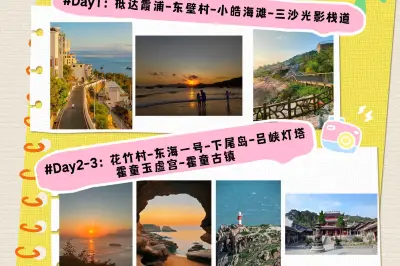
After eating, we moved on to Xiapu. Xiapu was my most uneasy stop. Apart from photography, there isn't much to do, and photography heavily depends on the weather. We were staying only two nights, making it hard to catch favorable weather. Indeed, upon arriving in Xiapu, we saw a vast, hazy scene, with sea and sky merging, very low visibility. Going to Dongbi, we found many people—it seemed others, like me, were unwilling to give up. I took a few random shots and returned to the hotel. We asked locals and checked the weather forecast; tomorrow didn't look good either. But! The next day, we still got up at 4:30 a.m. to go to Beiqi. Again, many people. Near the parking lot, traffic was terrible—people and cars squeezed together on narrow streets, moving slowly. The platform overlooking the beach already had two rows of people, many from photography groups. They said they got up at two or three in the morning to reserve spots. The blurry view before them really let down their efforts. Even though the models wore bright clothes, the camera couldn't auto-focus. But no one gave up! Some models on the beach held nets and posed; the group leaders used loudspeakers to direct them to change positions and poses. Knowing I was late, I could only find gaps between shoulders and armpits to take a few photos. Extricating the car from Beiqi was again difficult. We returned to the hotel for breakfast and rest. At lunchtime, the sky cleared. I immediately decided to go to Xiawei Island. Known for its sea-eroded caves, large rocks interlocked along the coast. People could only jump between rocks to find paths. There were many people, striking various poses, using each other as backgrounds. By evening, clouds rolled in again. Going to Xiaohao felt pointless. We saw a group of retired men and women laughing and taking photos in every pose and combination, nonstop from our arrival to departure—their attitude was enviable. Back at Dongbi, the clouds were thicker and the light dimmer; we had to call it a day. On the last morning, we got up even earlier, 4:30 a.m., and took a Didi to Beidou. There was a hint of red on the horizon. A row of tripods lined the beach, and a drone team was in the sky. Several groups of models served several photography tours. As the sun rose, the leaders or guides shouted orders through loudspeakers or walked over to direct. The models were professional, holding walking poses for half a day without moving, occasionally changing formations. I sneaked shots of several model groups; only the drones were unavoidable—after all, they'd paid. The sun hadn't fully emerged from the lower clouds before it hid in the upper clouds again. Xiapu's photography journey thus ended—not perfect, but not terrible either. The accommodation, Kyriad Hotel, could be considered among the top three in the county. The hotel was large, with many floors; three elevators were always busy, requiring long waits. The room and bathroom were spacious, with a simple style. No wardrobe, no desk, no refrigerator. The luggage rack could only hold one suitcase. The bedding quality was average. The fixtures were new and fairly clean; the shower was strong, but the shower floor was improperly installed, always soaking wet. The toilet paper holder was placed in a corner, requiring a 90-degree turn to reach—an unfriendly design. The laundry room was a plus. Breakfast had few options and average quality. At 7 a.m., the breakfast area was packed; you had to be quick to find a table, as everyone had woken up early and hurried to eat before returning to bed. Soon the crowd thinned.
Qingtian was an added destination. My husband's fellow patient (from the hospital) is from Qingtian. During hospitalization, he vividly described various wonders of his hometown: streets full of bars and coffee shops, the ability to buy anything from around the world, almost every family having someone abroad, people playing mahjong all day without working, every village having a bank, people carrying bags of cash to queue for currency exchange... This filled us with imagination about this small county. Since we were nearby, we made a detour to see it and also to greet the patient. Qingtian is a famous hometown of stone carving in China. Qingtian stone is one of the four famous stones of China. The Stone Carving Museum displayed many masterpieces. The museum itself seemed somewhat unprofessional: the building felt like a hotel with a hollow center; exhibition halls occupied the second and third floors, but the elevators didn't stop there. The lighting was very poor. Perhaps it was borrowed space or a converted building. The Qingtian patient treated us to a meal. We drove along the valley river for a long way to "Fangshan," a local scenic area, then further up a mountain road to a four-story farmhouse restaurant. We didn't understand why they chose such a remote place instead of the county town. The patient said there was a unique dish here: "field fish," a fish that grows in a symbiotic environment with rice paddies, said to be found only here. He invited us for this fish. This farmhouse heritage hotel was no ordinary one. The landlady had done business abroad for many years and had now returned to develop the new countryside, cooperating with the government to promote agricultural products. She is a political advisor and holds a position in the overseas Chinese federation, with wide social connections. She was eloquent and charming. The signature field fish was pinkish; the flesh was tender, the scales edible, with slightly many small bones. There was also green tofu, made from a green leaf juice, firmer than regular tofu, with a grassy fragrance. Other dishes were locally sourced organic ingredients. The landlady brought out blueberry wine and personally accompanied us for drinks and chat. On the way back, we visited the Qingtian stone market. We found 70-80% of the shops locked, empty inside with thick dust. The few open shops had no customers; the owners gathered to play cards. The patient said it used to be very lively. Returning to the county town, we went to the international merchandise street. It was quite large, with new malls under construction, shops lining the streets. However, the goods were rather similar, dominated by alcohol. Supermarkets were numerous, with most shelf space filled with various candies and snacks. Clothing was mainly T-shirts and casual wear. Prices were higher than abroad, even more expensive than discounted online international malls. It wasn't the supposed place where they sell goods not for profit but for convenient currency exchange. The patient treated us to coffee again. He used to run a supermarket in Spain. After falling ill, he returned to China for treatment; his eldest son took over. Now both his sons run supermarkets abroad. In the evening, we went to the central area for Western food. Qingtian has many Western restaurants; Kè Kǎo (Cake?) had good reviews, so we chose it. The restaurant was in a residential complex. The taxi driver dropped us at an intersection, saying we arrived. Looking around, there was no sign of a restaurant. We asked several people before finding it. The restaurant was small with tables spaced out; the kitchen was open; the staff were busy. The dishes looked good and tasted authentic. We ordered one soup, two salads, one pasta, and one thin-crust pizza—good value. They also had two rooms in a nearby building, also full. After dinner, we strolled back. The banks of the Ou River glittered with lights. Classical European-style buildings lined the north bank; modern high-rises lined the south. Under and on the bridges were many people—singing, dancing, playing with children.
The next day, we went to Chenzhai Qixing Village. The small village dates back to the Song Dynasty, seemingly still stuck in the past. Simple modern facilities have been added inside houses, but the external structure exudes antiquity; stone-piled walls look sturdy and beautiful. The Yuxiu Bridge at the village entrance was built in the fourth year of the Wanli reign of the Ming Dynasty. It is only 13.81 meters long, yet built with such complexity: the bridge deck has five bays with corridor roofs; the beam frame is five purlins and two columns; there are bench seats on both sides of the central bay; the suspended roof has a four-corner pyramidal top in the center; small green tiles are laid in yin-yang style. Was this just for beauty, or to display wealth? We trekked over hills for over two hours round trip just to see this bridge. Qingtian Qiaoxiang Shimao Hotel is on the edge of the county, convenient for transportation, with a large front yard for parking. The lobby was quite nice. Breakfast was served nearby; there were many Chinese options and fewer Western ones, but overall quality was good. The room was spacious, with a table and chairs and a casual sofa. Power outlets and switches were convenient; curtains could be opened and closed with one button. I dislike carpet—it's hard to clean. The bathroom was clean and bright; the shower had strong water pressure. The next day at noon, we wanted to eat in the town center but couldn't find a parking space. We had to return to the hotel to eat, but it had passed the meal time. The staff were attentive and helped us order, arranging a large banquet table on the second floor. We ordered three dishes; two came after a long time, and the last didn't arrive and was canceled. The awkwardness of dining outside regular hours was compounded by ordering on the third floor, eating on the second, and paying on the fourth. Before leaving in the afternoon, we tried a coffee shop. The barista very carefully helped us select beans and made pour-over coffee with a sense of ceremony; the latte was also well-made.
Yandang Mountain is known as the foremost mountain in the Southeast, ranked among the Three Mountains and Five Sacred Mountains, with the title of World Geopark. It formed 120 million years ago, part of the circum-Pacific volcanic belt along the Asian continent's edge, and is one of the most complete and typical Cretaceous rhyolitic ancient volcanoes—a caldera. The natural landscape formed by its rhyolite rocks with graceful lines is unique in the world. Before entering the scenic area, there is a visitor center with a large parking lot. Normally, visitors park and transfer to scenic area buses. When we went, there were few people, the visitor center was closed, so we drove directly to each scenic spot, which was more convenient. Also, the visitor center sells combo tickets; at the individual spots, you buy separate tickets: Lingyan and Da Longqiu are 50 yuan each, Fang Cave 40 yuan. Once in the mountains, navigation didn't work, but there was only one road, so we couldn't get lost. The three wonders of Yandang are Da Longqiu, Lingfeng Night View, and Lingyan Flying Crossing. Most of these two days it rained, sometimes heavily, so we canceled Lingfeng. First stop was Lingyan, just in time for the 10 a.m. "must-see" Lingyan Flying Crossing performance. A steel cable was strung between two stone peak tops (Zhanqi Peak and Tianzhu Peak). Visitors sat on a platform beside Lingyan Temple, looking up at a 45-degree angle; you couldn't sit for free—you had to order tea starting at 15 yuan. The performance lasted about half an hour, with pre-recorded narration in high-pitched male and female voices with exaggerated words, explaining the origin. Two parts: first, swinging from the mountaintop sliding down the cliff face, mimicking the movements of herb gatherers; second, a 270-meter-high peak sliding to another peak 200 meters away, doing acrobatic rolls mid-air. Due to the distance, it was hard to see clearly and hard to feel the danger. The horizontal performance involved crawling hand and foot on the cable, not the "tightrope walking" I imagined. Later seeing photos, I found Da Longqiu had a high-altitude bicycle performance, which seemed more thrilling than Lingyan's Flying Crossing. After the show, we walked 10 minutes to Xiao Longqiu (Little Dragon Waterfall); the water was slender and delicate. Wolong Valley and other places were too far to go. Instead, I was attracted by a small stone peak entirely wrapped in green moss, perfect and elegant. Up close, it was Zhuobi Peak, the very spot that inspired Shen Kuo's theory of water erosion. As we exited, the rain and fog grew heavier. When we reached the next stop, Fang Cave, visibility was zero. I walked along the plank road alone; everything was pure white before me. The plank road was chiseled into the rhyolite interlayer (the "golden belt") from Yandang's third eruption phase, with many overhead shelters. A large cave housed a Taoist temple. Ahead was a suspension bridge said to scare many people; if they had come on this day, they wouldn't have been afraid—you couldn't see anything around. Standing before the mist, I felt a sense of loss and turned back. At the next stop, Da Longqiu, the rain had stopped, and there were more tourists, surrounded by several tour groups. I eavesdropped on their guides. Scissors Peak was the most notable besides Da Longqiu. This small, columnar peak was split into two halves of different sizes. From different angles, it appeared as scissors, lovers, a girl, a woodpecker, a bear, a mast—quite vivid. Here, we also saw rare spheroidal rhyolite; I estimated one large ball's diameter at 20-30 cm. But Da Longqiu itself disappointed me. Again, it wasn't the rainy season—a thin stream of water fell from above, seemingly out of breath. You could sense its height but feel no power. It completely failed to match Xu Xiake's description: "The Dragon Waterfall thunders down into the pool; the rock face opens steeply, the water hangs in the air, startling the mind and eyes." Or Yuan Mei's Qing Dynasty description: "Above 20 zhang it is a waterfall; below 20 zhang it is not a waterfall, but all turns to smoke, mist, silk, jade dust, pearl bits, glass threads, willow catkins." It seems its reputation as one of China's four major waterfalls rests solely on its 190-meter height. The weather was too bad, so we had to end our one-day tour of Yandang Mountain. Near Yandang, most accommodation was B&Bs, but we couldn't find a suitable hotel. We stayed at the Wenzhou Sanyu Kaiyuan Mingdu Hotel in Hongqiao Town, 20 km away. We never expected such a high-class hotel in this small town. Tall and ornate lobby, fast and smooth elevators, heavy and substantial doors, proper furniture, elegant and bright bathroom, plus a gym and pool—all pleasant and relaxing. Breakfast was especially satisfying: hundreds of choices from Chinese and Western cuisine, high quality and taste; the Western cakes were authentic, so I ate a lot of cake early in the morning.
Ningbo is not far from Xikou, Zhoushan, and Shaoxing. Not wanting to switch hotels frequently, we decided to stay in Ningbo. We arrived at noon, first ate at Tianyi Square, then went to Tianyi Pavilion in the afternoon. Tianyi Pavilion is a library built by retired official Fan Qin during the Jiajing period of the Ming Dynasty (1561-1566). Fan Qin must have loved books dearly, leading to the ancestral saying: "Books are not divided among generations and do not leave the pavilion." His descendants for thirteen generations abided by this, guarding this heavy family legacy. For a long time, Tianyi Pavilion was the largest private library in China, holding over 70,000 volumes at its peak. Its architectural style also became a model for the seven later libraries (South and North). When Emperor Qianlong compiled the Siku Quanshu, Tianyi Pavilion contributed over 600 rare editions. After the Opium War and subsequent wars and thefts, only about 17,000 volumes remained. In 1933, a strong typhoon damaged the pavilion, and the government began to intervene in reconstruction and management. After liberation, through continuous repairs, expansion, and collection, it formed its current scale, holding 300,000 ancient volumes. Fan's former residence occupies only a small part, adjacent to the earlier library Dongming Thatched Cottage. Next to it is the Mingzhou Stele Forest, with hundreds of steles recording ancient official education history, set into walls forming a courtyard, protected by a long corridor. In the courtyard are the Zunjing Pavilion and Tianyi Pavilion. To the south is an expanded garden; East Garden and South Garden are scattered with rockeries, ponds, pavilions. East Garden is particularly lush, with many tree trunks covered in "green hair"—a fern called wawaye, a dioecious ancient fern and Chinese medicinal herb. Interesting animal stone carvings collected from various places are scattered around. Further south, several courtyards serve as exhibition halls. We were lucky to meet a volunteer docent from Ningbo Museum and an old Ningbo native. The docent's expertise combined with the old man's vivid memories made the Tianyi Pavilion come alive for us. The most noteworthy item in the garden is the stone carving of the "Lanting Preface" in the Shenlong version, carved during the Ming Dynasty by calligrapher Feng Fang, based on the version copied by Feng Chengsu and others on imperial order from the original. Feng Fang himself, a close friend of Fan Qin, also had his calligraphy work "Dizhu Xing" displayed here. East of the exhibition area is the Mahjong Museum in the Chen's Ancestral Hall, exhibiting mahjong tiles of various materials from ancient times and around the world. Mr. Chen Yufeng is considered the inventor of mahjong. This game, evolving from ancient Madi and dice, took shape in the mid-to-late Qing Dynasty. Chen integrated and popularized it. The game became popular among Ningbo fishermen as a leisure activity during long fishing trips at sea, resistant to seawater. The name "majiang" comes from the Ningbo dialect for "sparrow" (má jiàng), as sparrows are land birds; when fishermen returned from sea and saw sparrows, it meant they were home. Chen, knowing English, also introduced mahjong to foreigners. Japanese samurai learned mahjong from Westerners. So, the mahjong table in Chen's ancestral hall shows three figures: Chen, the British consul in Ningbo, and a Japanese samurai, leaving one seat for visitors. Many sit in that seat for photos, but more touch the patriarch's hand for luck. To the west, a room displays only a ten-thousand-man sedan chair, claimed to be the best sedan chair in the world. It was a "luxury car" for Ningbo wealthy families marrying off their daughters. Dimensions: 150 cm long, 90 cm wide, 275 cm high. It uses red gold wood carving technique: red lacquer base with gold foil appliqué, various carving methods depicting figures, flowers, birds, fish, and insects, symbolizing blessings like "Celestial blessings, unicorn sending sons, scholar succeeding in exams." The sedan chair is hung with gold and silver embroideries and hand-painted glass. Made from century-old camphor wood using mortise and tenon joints, its 238 components can be disassembled and reassembled. With a luxury car, naturally a fleet was needed—"thousand mu of fertile fields, ten-li red dowry" refers to the elaborate bridal procession. Further west is the Qin's Branch Ancestral Hall, rich in Ningbo merchant culture. Built in the 1920s, it was constructed by the son of wealthy Ningbo merchant Qin Jun'an. The original Qin Ancestral Hall was dilapidated; the son wanted to rebuild but, because he was from a secondary branch, was opposed by the clan. So he chose a new site and built this branch hall, perhaps out of spite. He spared no expense, hiring the best construction team with fine materials and craftsmanship, resulting in this exquisite and beautiful hall, covered with wood, brick, and stone carvings. The lattice windows even feature money and bat patterns, exuding wealth. The most beautiful is the stage, especially the caisson ceiling, formed by 16 curved lines of dougong and decorated panels spiraling upward to a dome—hailed by experts as the finest in eastern Zhejiang. At night, I saw online that today was Museum Day—a meaningful day.
The next day, we drove to Shaoxing in the rain. The rain came and went; lucky for us, it stopped when we arrived at Keyan. So we didn't bring an umbrella, but later we got soaked along the way. More luck: today the ticket price was discounted to 80 yuan per person, probably because it was Tourism Day. In ancient times, Keshan was a quarry, leaving behind various stone pits, caves, pools, and cliffs of different shapes. Upon entering, we happened to catch a guide explaining to a tour group; she sounded reliable, so we joined. The classic route: Keyan-Jian Lake-Luzhen, with a short ride on a wupeng (black awning) boat. First, a circular plaza with a curved wall inscribed with the full Diamond Sutra. Standing at the center point and speaking produced an echo. A short walk brought us to the Stone Buddha, a meticulous work by three generations of stonemasons from the Sui and Tang dynasties. Further on was the landmark "Cloud Bone" (Yun Gu), an inverted pagoda-shaped rock over 30 meters high, rough-surfaced and mottled, standing stubbornly for over a thousand years. Even more stubborn is the ancient cypress on its top, surviving alone for a thousand years with unknown nourishment. From across the lake, the Cloud Bone appeared slender and graceful, like a long spinning top. Its more elegant name is "Stove Pillar Clear Smoke." Continuing, we reached the newly built "Three Origins Converged" sculpture, combining statues of Laozi, Confucius, and Shakyamuni with a half-black, half-white face. The artist had profound meanings, which I felt were a bit forced. The sky was gray, but the guide girl radiated spring. Laughing and chatting, she described sights and also her childhood in Shaoxing, her grandmother's local dishes, and even broke into a Shaoxing opera song—sweet voice, correct tones. I didn't understand a word but was fascinated. Yue (Shaoxing) has produced many famous figures: Yu the Great, Goujian, Wang Xizhi, Lu You, Xu Wei, Qiu Jin, Zhou Enlai, Lu Xun, Zhu Kezhen. Lu Xun is instantly recognizable. Yu the Great stands alone in a pool; his statue's chest is hollow: one interpretation is selflessness, another is lack of care for his family. Beside the pool is a row of footprints, only right feet, because Yu's left foot rotted from long immersion in water while controlling floods. We were about to take a boat to Luzhen when it started raining again, but the waiting area had a canopy. The wupeng boat turned out to be large, seating over twenty people. The canopy was beautifully woven bamboo with neatly embedded shells, quite refined. Disembarking, we had to walk on an ancient towpath, which, though renovated, was a bit precarious, especially in the rain. Along the shore, we came to Luzhen, preceded by a statue group: "Toulao Laoshi," depicting King Goujian of Yue attacking Wu; villagers offered wine for the journey, and Goujian poured it into the river for soldiers to drink, boosting morale. The statues and Luzhen are both new constructions. A commercial street lacked novelty. The settings and characters from Lu Xun's works add a touch of uniqueness to Luzhen. The stage and theater used to have regular performances, suspended after the pandemic. After touring Luzhen in the rain, we returned to the city for a meal. To park conveniently, we chose the Shimao Crowne Plaza's Yuedu Mansion. Again, the restaurant was about to close. We hastily ate, then took a taxi to Lu Xun's Former Residence. Again, we forgot umbrellas and shoe covers. The rain grew heavier. The residence had verandas, so it was okay walking along. Not only was it large, but the facilities were also refined—showing the wealth of Lu Xun's family. Despite his opposition to the government, Lu Xun always enjoyed high salary and fame—requiring great wisdom. Hearing that the Former Residence of the Calligraphy Sage (Wang Xizhi) was worth seeing, we took another taxi. While waiting, our clothes were basically soaked. The Former Residence of the Calligraphy Sage is also newly restored. Many didn't know it; even the driver didn't recognize it. Following the navigation, we went through long, winding alleys and were dropped at a junction. No signs, no people around. Going right led to a residential area. After asking several people, we learned the site was to the left. Rain had soaked not only our clothes but also our shoes; my eyes could barely open. After walking tens of meters, we saw the archway of "Calligraphy Sage's Former Residence." I told my husband to wait under the eaves and proceeded alone through the dark, rainy mist. Apart from a pond, two locked rooms, and vegetation everywhere, there was nothing—and no one. Finally, I met a woman who insisted on walking despite the rain. She told me it was just a small park; Wang Xizhi's former residence was actually in the community I saw when exiting the taxi. I walked back—it was still a distance; entering and touring would take time. Worried about my husband, I returned. We took a taxi back to the hotel to retrieve the car and returned to Ningbo.