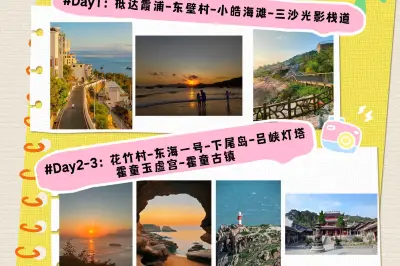
Fairyland Fuding | Traversing Taimu Mountain Caves, Resting on Yuanshan Island, Stringing Together a Romantic Journey to Fuding
Previously, I only knew of Fuding white tea, but not of Fuding itself.
It all began when Brother Li Zhuang of the 'Landscape in Painting' group invited me to visit Fuding. Due to the pandemic, we kept delaying the trip, but we finally made it in July—this can be considered a blessing.
This time, from 'International Village' (Shijiazhuang) to Fuding, I could have flown directly to Wenzhou, but for some reason I chose a rather circuitous route.
Fastest route: Direct flight from 'International Village' at 7:30 AM, landing in Wenzhou at 9:55 AM, then a 41-minute high-speed train from Wenzhou South Station to Fuding.
Circuitous route: Depart from 'International Village' at 1:55 PM, transfer in Lianyungang for a 45-minute stop, land in Wenzhou at 5:55 PM, then a 41-minute high-speed train from Wenzhou South Station to Fuding.
Even though the road was difficult and long, we eventually arrived.
Fuding, a land of abundant blessings. According to the 'Funing Prefecture Annals': 'Fuding Mountain, in the 20th district, its veins come from Pingyang Chiyang, the peak is the highest, visible from dozens of li away, the county is named after it.'
Since ancient times, Fuding has been the gateway between Fujian and Zhejiang, a strategic crossroads of Wu and Yue, with a history spanning a thousand years. Although it was established as a county in the fourth year of Emperor Qianlong of the Qing Dynasty, a mere 300 years ago, its human history stretches back five thousand years, with many archaeological sites telling the story of its long years.
Fuding boasts a superior geographical location and convenient transportation. It is 230 km south of Fuzhou Changle International Airport, 100 km north of Wenzhou Longwan International Airport, and 142 nautical miles east of Keelung, Taiwan. National Highway 104, the Shenhai Expressway, and the Wenzhou-Fuzhou Railway run through the entire area, making travel easy.
Fuding has beautiful landscapes, including the World Geopark, National AAAAA-level Tourist Attraction, National Scenic Area, National Natural Heritage site Taimu Mountain, and Yuanshan Island, one of 'China's Ten Most Beautiful Islands', along with many other high-quality tourist attractions.
It is rich in products, such as Fuding white tea and Fuding betel nut taro, which are China's geographical indication products. It has been awarded the titles 'Hometown of Chinese White Tea' and 'Hometown of Chinese Bass'.
Fuding is also China's first 'Gourmet Landmark City', with endless mountain and sea delicacies waiting for you. It is said that many people from Wenzhou take special high-speed trains on weekends to eat seafood in Fuding.
Known as 'Fujian's Famous Food City' and 'Oriental City That Never Sleeps', Fuding is famous for its specialty snacks and seafood stalls that spread across the city. The Shihu Seafood Street is one of the top ten snack streets in China, on par with Shanghai's City God Temple and Nanjing's Confucius Temple snack streets.
Famous Fuding snacks include Jiang's Fish Slices, Xiyang Meat Slices, Xuncheng Meat Swallow, Fuding Pot Edge Paste, Xiaqi Hand-Pulled Noodles, Xiamiao Rice Noodles, Diantou Rice Noodle Soup, Qianqi Horn Cake, Shajiang Seafood Noodles, Guanyang Mud Min Noodles, and Cross Street Rice Cake Soup—too many to list.
Fuding has rich tourism resources. During my three days in Fuding, I visited Taimu Mountain, the 'Fairy Capital on the Sea'; Yuanshan Islands, the 'Southern Tianshan'; Niulanggang, 'Blue Sea and Golden Sand'; and Lvxueya Manor, among other places. The numerous natural landscapes and rich cultural sights—including ancient temples, stone inscriptions, folk houses, and castles—ensure that every day of your trip to Fuding is different and colorful.
Although there are many places I haven't visited, based on my experiences and knowledge, I recommend the following itineraries and routes for your reference.
One-day tour: Taimu Mountain
Recommended route: View Couple Peak, Eighteen Arhats Rock, walk the wooden boardwalk, ascend to Immortal Welcoming Terrace, view Welcoming Guest Peak, Immortal Playing Chess, Immortal Sawing Planks, Golden Cat Pouncing on Mouse, drill through Blue Stream Gully, One Line Sky, pass through a Tile, visit the place where the Taimu Goddess cultivated immortality, ascend Heaven-Piercing Cave to South Heavenly Gate, view Nine Carp Facing the Sky, walk through Dripping Water Cave, Three Bends Cave, pass General Cave, gaze at Southern Pillar of Heaven, ascend Great Stone, and take in the views of Taimu Mountain.
One-day tour: Taimu Mountain, Niulanggang
Morning: Visit Taimu Mountain Scenic Area (choose the classic route according to time; there is a map in the scenic area). After lunch, visit Niulanggang.
Two-day tour: In-depth Taimu Mountain
Day 1: Refer to the one-day Taimu Mountain itinerary.
Day 2: Climb to the top of Wulonggang to Crescent Moon Peak to watch the sunrise over the sea. After breakfast at Baiyun Temple, walk across the sky bridge to Jiuli Lake to see the panoramic view of Taimu Mountain's lakes and mountains, visit the famous Taimu temple—Xiangshan Temple and the Five Hundred Arhats Hall, and walk along the only suspended plank road in Fujian Province that overlooks the sea.
After lunch, visit the Taimu Goddess statue square and Taimu Mountain Museum, then end the trip as appropriate.
Three-day tour: Taimu Mountain, Yuanshan Island, Niulanggang
Day 1: Refer to the one-day Taimu Mountain itinerary.
Day 2: After breakfast, go to Yujing Pier and take a ferry to Yuanshan Island. Visit Big and Small Tianhu Lakes, Moon Bay, the glass viewing platform at Niujiao Village, the air-raid shelter at Yangguwei, and the Tianhu Grassland.
Day 3: Watch the sunrise in the morning, then leave the island for Niulanggang. In the evening, enjoy seafood and beer in downtown Fuding.
A poem titled 'Dragon Well' praises Taimu Mountain:
Misty banners hang low on green trees,
The mountain gate slants west in the setting sun.
The ancient altar spans a thousand layered peaks,
Green waters wind through a winding stream.
In the pines, valley sounds mingle with clear chimes,
Among bamboo, cloud mists blur the small pavilion.
The Zen mind has severed ties with the dusty world,
But does not hinder the lone gibbon's midnight cry.
This poem captures the essence of Taimu Mountain: 'strange rocks, interesting caves, perilous peaks, serene pools, and misty illusions.' All these await you when you visit.
Taimu Mountain lies directly south of Fuding city, only 45 km away. It stands majestically on the coast of the East China Sea, surrounded by sea on three sides and mountains on one side. The main peak is 917.3 meters above sea level, and its granite peak forest landform is unique in China. Along with Wuyi Mountain and Yandang Mountain, it is known as one of the three famous mountains of Fujian and Zhejiang, and was listed as a UNESCO Global Geopark in 2010.
Taimu (pronounced 'mu') Mountain is easy to mispronounce and often mistakenly called Tianmu Mountain. Only by climbing this mountain can you appreciate its charm as 'China's most beautiful mountain by the sea.' Legend has it that immortals of the East China Sea often gather here, earning it the reputation of 'Fairy Capital on the Sea.'
Taimu Mountain was formerly called 'Cai Mountain.' Rongchengzi, the teacher of the Yellow Emperor, once practiced alchemy here. During the time of Emperor Yao, the ancient Yue people's founding mother planted orchids in the mountain, using white tea to cure the people's illnesses. She later attained immortality and was enshrined as the Taimu Goddess, the first goddess of Fujian, and the mountain was renamed Taimu Mountain. During the reign of Emperor Wu of Han, it was designated as the first among the 36 famous mountains of the world, changing 'mu' (mother) to 'mu' (old woman) and fixing the name Taimu Mountain.
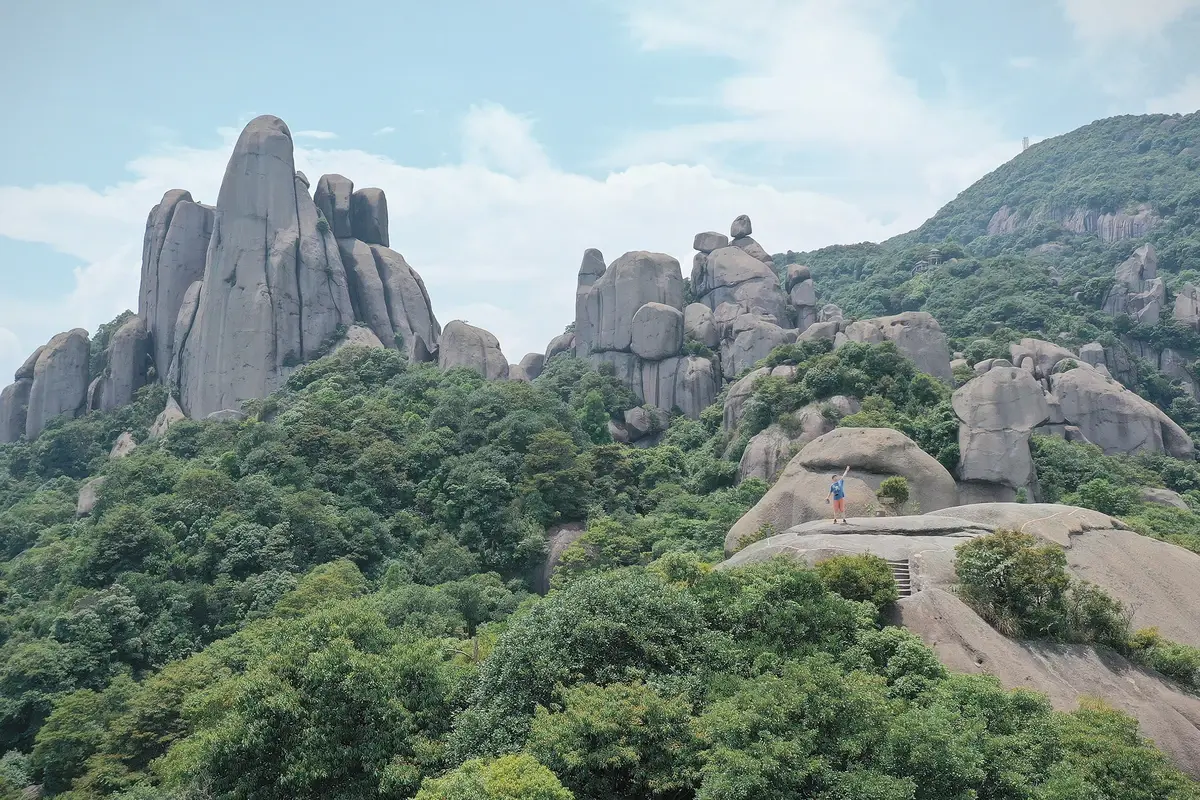
Before entering the mountain, you are greeted by oddly shaped peaks. Each granite rock peak can be whatever you imagine—'30% looking, 70% imagining' is the principle. Taimu Mountain has 54 peaks and 360 distinct rock formations: Couple Rock, Jade Monkey Looking in the Mirror, General Rock, Monk Preaching, Cloud Mark Rock, Flying Rock, Welcoming Immortal Peak, Immortal Playing Chess, Wind-Moving Rock, Sea Lion Gazing at the Sky, Squatting Monkey Watching the Sea, Golden Cat Pouncing on Mouse, Immortal Sawing Planks, Jade Rabbit Listening to the Tide—each one lifelike and vivid.
'In the pines, valley sounds mingle with clear chimes, / Among bamboo, cloud mists blur the small pavilion.'
In the valleys, the wind shakes the pine forest, sounding like waves; by the streams, bamboo shadows dance and a cool breeze brushes the face. Walking among the pines and bamboo brings a touch of coolness on a hot summer day, and traversing the cave paths is a major feature of Taimu Mountain: 'strange rocks, even stranger caves.'
Earth movements caused granite rock masses to collapse and pile up, creating a rich network of crisscrossing caves. Some extend upward to the sky, called Sky-Piercing Cave; some go downward to the sea, called Sea-Reaching Cave. It is said you can 'climb to the nine heavens to embrace the moon, dive to the five oceans to catch turtles.'
Climbing Taimu Mountain inevitably involves traversing caves. Each cave has a beautiful name and its own unique legend. There are 108 caves in total, including Dragon Pool Cave, Gourd Cave, White Horse Cave, Hongxue Cave, Sky-Piercing Cave, Three Bends Cave, Seven Stars Cave, Dripping Water Cave—big caves hiding small caves, small caves containing larger caves, caves within caves, all interconnected.
Inside these caves, the interplay of stone walls and light creates a fantastic world. Click the shutter, and every beautiful photo will take your social media feed by storm.
Especially the natural wonder 'One Line Sky,' where only one person can squeeze through sideways—truly thrilling. As the saying goes, 'If you don't crawl through One Line Sky, you miss half the scenery.'
Relics of Buddhism, Taoism, Confucianism, and Manichaeism, as well as cliff inscriptions and the birthplace of white tea, are preserved here. There are serene places like Guoxing Temple, Lengjia Pagoda, Sagong Ridge, a Tile Temple, suspended Copper Hall, Xiangshan Temple, and tranquil spots like Longtan Lake, Exposed Dragon Pool, and Nine Carp Pool.
Taimu Mountain, with its unique peaks and beautiful scenery, truly requires the Sea-Viewing Plank Road to appreciate the complete spectacle of mountains and sea.
Built along the southeastern sea-facing cliffs of Taimu Mountain, this plank road offers a full view of the seascape, hence its name.
The plank road is 820 meters long, with an average altitude of 600 meters. From here, you can gaze at the distant Yuanshan Islands and, up close, overlook some of Taimu Mountain's interior scenery.
This is the only suspended plank road in China that allows you to see the sea.
'Cliffs of ten thousand feet red, I come and go alone; the cuckoo cries in the rain, the rain spurs the blossoms. When it rains, enter the caves; when encountering water, climb the mountains. In the pavilion, eat the sweetest watermelon of the summer; at the Tile Temple, enjoy a light vegetarian noodle lunch; at Danjing (Elixir Well), taste the fragrant white tea; in the Echo Gallery, experience the changing clouds and mist; on the Sea-Viewing Plank Road, enjoy the magnificent sunrise over a sea of clouds. Through winding paths and changing views, every encounter is a beautiful meeting.'
Is climbing Taimu Mountain tiring?
People think climbing a mountain must be tiring, but if the scenery is constantly beautiful and fun, you forget the fatigue.
First, Taimu Mountain is not very high—917 meters above sea level. The car can reach over 500 meters, so climbing to the top only requires ascending about 400 meters. Still feel pressured?
Second, the main attractions are concentrated between 500 and 700 meters. Along the way, 360 unique peaks and strange rocks, resembling people and objects with uncanny skill, will dazzle you so much you won't have time to complain about being tired.
Third, Taimu Mountain has the most caves of any mountain in China—over 100 rock caves crisscross like a maze. As you move, you sometimes squat, sometimes bend, sometimes sidle, sometimes crawl—it's full of fun and joy, not tiring.
Fourth, Taimu Mountain faces the sea. Ascending to a height and looking out over the East China Sea gives you a rare sense of grandeur that will surely open your mind and fill you with exhilaration.
15 Unmissable Instagram-worthy spots at Taimu Mountain
Grand View of Peak Forest: Winding paths and turning peaks, the granite peak forest stone formations are rare in the world.
Couple Peak: At the foot of Taimu Mountain stands a majestic and graceful peak. From afar, it looks like a pair of long-separated lovers whispering to each other.
Taimu Goddess Square: Legend says that Emperor Yao's mother was sailing on the sea when suddenly thick fog appeared and she lost her way. When the sun rose and the fog cleared, a fairy mountain appeared on the coast of the East China Sea—Taimu Mountain. She moved the boat ashore and went sightseeing. But she was so captivated by the mountain scenery that she forgot to return and settled in Half-Cloud Cave to cultivate. Now she gazes calmly at the sea, protecting the local people.
Baiyun Temple: A prosperous Tang Dynasty temple, site of the mystical dream platform. Follow the footsteps of ancestors to find the 'Number One Famous Mountain of the World,' a Manichaean relic.
Immortal Cave: A naturally formed immortal cave, infinite scenery lies on the perilous peak.
Longzhu Gang: The best spot to watch the sunrise and sea of clouds at Taimu Mountain.
Nine Carp Facing the Sky: Legend has it that a wandering immortal from the East China Sea passed over Taimu Mountain and mistook the rolling peaks below for the surging ocean. He casually threw down several carp to reproduce and benefit the world. The divine carp leaped upward but could not return to the celestial realm, eventually turning to stone, leaving this exquisite scene.
Wisteria Corridor: Located at Guoxing Temple, the blooming season is from late March to early April. When the wisteria flowers fall, walking here feels like being in a sea of flowers, incredibly beautiful.
Heavenly Pillar Peak: A pillar propping up the sky under the Great Stone, the Dinghai Shenzhen (Stabilizing Sea Needle) of myth.
Sea-Viewing Plank Road: The only suspended plank road in China with a sea view.
Nine Carp Lake: Located to the right of Xiangshan Temple, nestled in a deep valley, small and exquisite with a serene environment. The lake reflects the strange peaks and rocks of Nine Carp Facing the Sky, picturesque and poetic.
One Line Sky: A huge rock stands majestically, with a narrow crack like a knife cut in the middle. Looking up through the crack, a thread of blue sky appears clear as a ribbon, hence the name.
A Tile (Yi Pian Wa): A golden hall nestled between two peaks, with its back against the main peak of Taimu Mountain—Nine Carp Facing the Sky—and flanked by Saint Ascension Stone on the left and Lotus Peak on the right. The famous mountain has a famous hall; the unique scenery adds a wonder.
Suspended Copper Hall: Built on the cliff beside a Tile Temple, entirely made of copper, using 150 tons of copper and costing over 15 million yuan, completed in 2011. From afar, it gleams golden on the cliff, very striking.
Longtan Lake: With abundant water, the lake overflows the spillway dam, forming a beaded water curtain. The reflection of the Eighteen Arhats Rock on the back side shimmers in the lake. Visitors strolling on the corridor atop the dam feel as if they are in a fairyland. In spring and summer, colorful rhododendrons bloom all around, creating a riot of color that makes visitors linger.
The Taimu Mountain range is the essence of the Taimu Mountain Scenic Area, famous for its 'perilous peaks, strange rocks, deep caves, and misty illusions.' Exploring all the sights takes 1-2 days. The scenic area uses a one-ticket system: 140 yuan per person (including shuttle bus fare).
Besides Taimu Mountain, the 'Fairy Capital on the Sea,' Fuding in Fujian also has the Fuyao Islands, which means 'blessed land, beautiful jade.' These islands face Taimu Mountain across the sea and are only 3 nautical miles from the mainland at the closest point. They comprise 11 islands, including Dayu Mountain, Xiaoyu Mountain, Yuanyang Island, Yinyu Island, Niaoyu Island, and 9 reefs, covering a total area of 24.5 square kilometers. Legend has it that they were formed from a flat peach given by the Queen Mother of the West to the Dragon King of the East China Sea.
Among them, Dayu Mountain Island is known as the 'Heavenly Lake on the Sea, Southern Tianshan' and is rated as one of China's ten most beautiful islands.
This divine island is still little known. Half is grassland, half is sea. Especially after rain, the mist and clouds are ethereal, like a scene from the movie 'The Lord of the Rings,' making you feel as if you've entered Middle-earth.
Large areas of emerald green grassland, blue Big and Small Tianhu Lakes, layered terraced fields like fingerprints on the earth, winding mountain roads, reed marshes swaying in the wind, small fishing villages against the mountains and sea... Even in gloom, this small island appears more artistic and romantic, earning it a place among 'China's Ten Most Beautiful Islands' as evaluated by 'Chinese National Geography' magazine.
Chasing waves, feeling the sea breeze, watching sunrise and sunset, admiring drifting clouds and mist, staying in a bed and breakfast in a small fishing village, cycling happily on the ring road—all unhappiness can be healed here.
Mazu Village is where the ferry terminal and visitor center are located. You can inquire here about many island-related matters. Now, you need a nucleic acid test to land on the island, which can be done at the village clinic.
Near the terminal, there are many restaurants serving decent seafood. The island is not overly commercialized, retaining the simplicity of an original fishing village.
At an altitude of 200 meters on the island, there are three lakes of varying sizes. The lake water never dries up, is sweet and clear to the bottom, and is often shrouded in clouds and mist, resembling the Heavenly Pool of legend, hence called 'Tianhu' (Heavenly Lake).
Big Tianhu Lake covers over 1,000 mu (about 66.7 hectares), and Small Tianhu Lake covers over 200 mu. The two lakes are about 500 meters apart. Surrounded by peaks in a shape resembling a bowl (yu in Chinese), and since 'yu' is homophonic with 'yu' (island), the island got its name: Yushan Island.
Around Tianhu Lake, the slopes are covered with a ten-thousand-mu grassland. The sea breeze blows, and walking in the wilderness with a vast view, you just want to waste time together, watching over this place for the rest of your life.
Here you can watch the sunrise in the morning and the sunset in the evening, healing all unhappiness.
Moon Bay: The beach here is soft and clean, and the seaside is super photogenic. You can easily take artistic photos that will dominate your social media.
A walk around the island from Moon Bay to Dongjiao Village takes you along a beautiful ring road, which feels like Taiwan's coastal road—very artistic.
Dongjiao Village Glass Viewing Platform: As its name suggests, Dongjiao Village is the easternmost fishing village on Yuanshan Island. The glass viewing platform offers a bird's-eye view of the beautiful village and the boats anchored in the harbor, refreshing and uplifting.
Yangguwei Air-Raid Shelter: This is an air-raid shelter from the 1950s and 1960s, about 30 meters long, built of reinforced concrete. It is well-equipped with storage rooms, a kitchen, and a bathroom, but due to years of neglect, it is now abandoned. Passing through the cave leads to the sea, making it a great spot for photos.
Tips:
1. A one-day trip is tight; it is recommended to stay in a guesthouse on the island to experience the island's quiet nights.
2. Watch the sunrise in the early morning; even without sunrise, the sea of clouds is stunning, worthy of a fairy island on the sea.
3. The temperature difference between morning and evening is significant, so it's best to bring a jacket.
4. Bring several changes of beautiful clothes to take many photos.
5. Be sure to watch the sunset at Big and Small Tianhu Lakes—bring your loved one if you have one, or your best friend.
Recommended accommodation: Sea Sky Lake Guesthouse. The host is very welcoming, and the food is delicious. The rooftop terrace offers sunrise views, and the courtyard has a seaside corridor where small dinners can be organized.
Room prices range from 200 to 800 yuan per night, and meals average around 100 yuan per person.
Yuanshan Island scenic area ticket: 40 yuan. The ferry departs from Yujing Pier in Xiamen Township, Fuding (exit at Baiyang on G15 Expressway) or from Sansha Pier in Xiapu County (exit at Sansha on G15 Expressway). One-way ferry ticket: 50 yuan.
Fuding not only has Taimu Mountain and Yuanshan Island but also coastal resorts like Niulanggang. Located southeast of Qinyu Town, Fuding, only 32 km from Taimu Mountain, it is nestled against mountains and facing the sea, opposite Yuanshan Island. Especially in the sweltering summer, many people come here to explore the beach and waves, seeking coolness and fun.
Why is it called Niulanggang? There is a poignant story. Long ago, at the foot of Taimu Mountain, there was a mute cowherd (Niulang). He was chased by government soldiers for rebellion. Crossing mountains and rivers, he reached the seaside and found no way out, so he rode his old ox into the sea and disappeared among the towering waves. Later generations named this place Niulanggang to commemorate him. On the mountain, there is also a cave called Zhinü Cave (Weaver Girl Cave), adding another version of the Cowherd and Weaver Girl legend.
Niulanggang offers many activities: a rare high-altitude water slide, a flat beach with fine sand, a trendy and romantic campsite popular with young people, strange rocks all around, and a blue lighthouse that serves as the most beautiful backdrop for photos.
Recommended reasons: An excellent summer resort, especially for families. Many bring their children to play on the beach and swim in the sea, with well-established safety facilities in the water.
The high-altitude water slide is rare in China. It is 520 meters long, with a maximum drop of 57 meters, and seven curves. Sliding down from a height by water flow is extremely thrilling.
The scenic area's wooden boardwalk is built along the mountain. Walking on it, you can enjoy the sea view, feel the refreshing sea breeze, and take beautiful photos.
Beside the sea, there is a Chaoyin Cave (Tide Sound Cave), a hollowed-out cave in the reef that looks like a door or window opening in the rock. It is submerged at high tide, but when the tide recedes, it gives a feeling similar to the 'Holy Elephant Heavenly Gate'—very magical.
Tips for visiting Niulanggang:
Transportation: Self-drive directly to Niulanggang Coastal Scenic Area. By high-speed rail, get off at Taimu Mountain Station, then take a bus or taxi.
Tickets: 40 yuan per person; rafting 80 yuan per person.
1. Please bring swimwear, swim trunks, beach shoes, sunglasses, towels, etc., for water activities.
2. The sun is strong in summer; prepare sun protection.
Fuding offers over 1,000 dishes and more than 380 types of snacks. Among them, 45 have been awarded the title 'China Famous Snacks,' and 145 are Fujian Famous Snacks. Just Fuding betel nut taro can be made into over 50 varieties of delicious food.
Strolling through the streets and alleys of Fuding, you see restaurants of various grades and rows of food stalls on every street. Popular snack stalls are scattered throughout the city, with unique flavors yet affordable prices. The sweet, sour, spicy, and fragrant tastes are mouthwatering and leave a lasting impression.
Fuding Souvenirs:
Fuding white tea is renowned far and wide. Taimu Mountain is the origin of Fuding white tea. The tea here offers good value for money—you can buy with confidence. Many tea shops in the city and scenic areas are tastefully decorated and actually offer free tea tasting!
The fusion of mountains and sea, the symphony of nature and humanity, has created the most beautiful city in northern Fujian and the most beautiful mountain along China's coast. It requires careful appreciation, just like sipping a cup of white tea: you take a sip or two, it tastes light, but when you close your eyes, you feel a mellow and lingering aftertaste. [End]