A 5-Day, 4-Night Self-Drive Trip to Xiapu: Falling in Love with the Sea, Villages, Banyan Trees, and the Scent of Seafood in the Air!
My husband and I started our relationship because of Fujian. So we make a pact to visit Fujian every year. The first time was Pingtan. The second was Xiapu. There will be a third, a fourth, a fifth... Every year we pick a small city in Fujian and spend a few happy days by the sea—what I call the little joys of life.
DAY 1: Flight: Chongqing - Fuzhou, stay one night in Fuzhou.
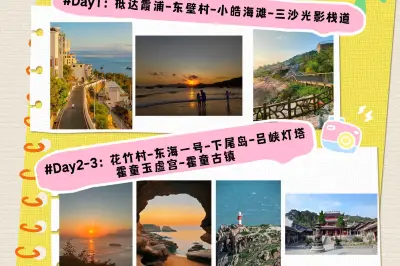
DAY 2: High-speed rail: Fuzhou South Station - Xiapu Station. Rent a car and visit: Xiaohao Beach - Dongbi Village - Huazhu Village (Xiapu East Line, 80 km in total, self-drive). Meals: Shejianshang de Seafood Restaurant (Taikang Road). Accommodation: Huazhu She · Xiapu Yuanju Shanhaiju B&B (near Gaoluo Beach).
DAY 3: Visit: Beioi Mudflat - Gaoluo Beach - Dajing Beach - Xiawei Island - Lixia Beach (Xiapu South Line). Transport: 100 km total, self-drive. Meals: Sansha Classic Snacks (Taikang store). Stay: Atour Hotel (Ningde Xiapu World Trade Plaza).
DAY 4: Visit: Yushan Island. Dinner: New Meiyuan Seafood Restaurant (main store). Accommodation: Xiapu Yucun Banshe Villa.
DAY 5: Self-drive Xiapu West Line: Banyueli → Oracle Bone Script → Xuyao Fishing Village → Jiangsha S-Bend. Accommodation: Xiapu Yunman Guanhai Holiday B&B (Meihua Village).
DAY 6: Return trip: The easiest way to reach Xiapu is by high-speed rail from Fuzhou. So we first fly from Chongqing to Fuzhou Airport, then take the airport shuttle—Yuanxiang Express—directly from the airport to Fuzhou South Station. The distance from the airport to Fuzhou South Station is 37 km, fare 31 RMB/person.
We chose to stay one night at a hotel near Fuzhou South Station.
We achieved oyster freedom: grilled oysters 10 for 7 RMB, so my husband bought 20 at once and ate them all himself.
From Fuzhou to Xiapu it takes just over an hour.
We arrived in Xiapu before noon, rented a car in the afternoon, and officially started our journey.
Attractions—Dongbi Village
Xiapu, Ningde, Fujian has self-drive routes covering the East, West, and South lines. Xiaohao Beach - Huazhu Village - Dongbi Village belong to the East Line, 80 km in total.
Xiaohao Beach is mainly for aerial shots of mudflats. The weather wasn't great when I went, so the photos didn't turn out well. However, Xiaohao Beach is indeed the closest beach to the main urban area of Xiapu for viewing mudflats, and it's also the必经之路 to Dongbi Village, so it's worth a stop.
Because we loved Dongbi Village so much, we came back again a few days later.
You can park on the small slope opposite the orange Christian church—there's a dedicated parking lot. Above the parking lot is the Dongyanbi Boardwalk; if you're fit, you can walk along the sea.
This small white village hugging the seaside cliffs is really quaint and refreshing, like a trip to Hualien, Taiwan.
The seaside path leading to the Yiqiyisu B&B allows you to capture the sea and the small village together in one shot. The winding road has very few cars. You can stand on the boardwalk above and look down to photograph this path.
Dongbi Village's guesthouses should be the most popular—nestled against the mountains and facing the sea, with thousands of acres of shallow mudflats used for cultivating laver. The village is stacked on the hillside, with some parts connecting to the bay.
Most pretty girls like to run down a staircase leading to the seaside path to take photos, and they have to queue. Next to this staircase is the most famous internet-famous guesthouse + coffee shop "Shijianhai" (Time Sea). The super-popular "path to the sea" is right next to Shijianhai. Come at dusk when the sun is out; I went at noon and it was backlit—you know what I mean…
Not only does it have a café, a Western restaurant, and guesthouses, but also Shijian Bookstore. Everything here is run by the same owner, who single-handedly elevated the aesthetics of the entire Dongbi Village to a new level.
The tatami seat on the ground floor, which is like a picture frame, requires booking far in advance. It really makes you feel one with the scenery. I heard the owner is a designer, so no wonder the design is so thoughtful.
We had coffee at Shijianhai Café. The huge floor-to-ceiling window frames Xiapu like a flowing feast.
Sitting by the large window with coffee, waiting for the unique sunset of Dongbi. Shijianhai, founded in 2016, is famous for this room with a view.
During the National Day holiday when there are many people, the afternoon tea seats by this large window are only available until 5 PM, after which they must make way for dinner reservations.
The guesthouses, bars, and book bars built along the mountain are arranged in a staggered, undulating pattern.
There are seating areas both indoors and outdoors.
The prices for coffee and desserts are not cheap but not expensive either, comparable to Starbucks! With such a view, the price can indeed be higher.
I looked at the evening menu; it focuses on fusion cuisine, mostly Western dishes made with local seafood.
Both the restaurant and guesthouses have unobstructed terraces with small outdoor gardens.
There's an infinity pool and scenic courtyards; most rooms offer 270° sea views.
The upper part of Shijianhai is just at a bend. I really like this bend—it feels very Japanese and also like Hualien, Taiwan.
Especially the barbecue restaurant at the corner with a spiral staircase. The handsome, slender owner standing there gives off such a "Quiet Summer" vibe!
Dongbi Village is a stop on the Xiapu East Line self-drive route. Many people come here specifically for the sunset. The entire village consists of white houses, built halfway up the mountain along the coast, earning it the nickname "Santorini."
At dusk, watch the sunset glow over Dongbi Village and photograph the mudflats.
Xiapu was the earliest open trade port with Taiwan in Fujian. It is known as "the hometown of kelp in China" and "the hometown of laver in China," with reputations as "the key point between Fujian and Zhejiang," "the land of fish and rice," and "the coastal Zou-Lu" (a cultural reference).
Attractions—Huazhu Village
Driving further from Dongbi Village brings you to Huazhu Village. On this trip to Xiapu, I discovered that there are many, many villages. The most famous are probably Dongbi and Huazhu, both on the East Line. Huazhu Village is located in the northeast of Sansha Town, Xiapu County, Fujian. It's a peninsula-style village surrounded by the sea on three sides.
Huazhu Village is really well-built. It's a peninsula-style village surrounded by the sea on three sides, with stone houses scattered up and down the slopes.
Huazhu Village left a good impression on me—a ancient stone village surrounded by flowers. Which woman doesn't love flowers?
Stone houses can withstand sea storms and prevent wall corrosion from seawater. There are plenty of stones by the sea, so building with stone is a perfect match of time, place, and people!
The best part is that the small yards of Huazhu Village are full of blooming flowers—truly the dream of a standalone flower-filled courtyard.
Huazhu Village is not large; the villagers mainly produce kelp. Some villagers have also started businesses like guesthouses, cafés, and restaurants.
There are guesthouses here for watching the sunrise. You can stay one night, get up early the next morning to catch the sunrise, then go back to sleep—highly recommended.
Many people come here specifically for the sunrise. Huazhu Village has two sunrise viewpoints on the opposite slope, making it one of the famous photography spots on the Xiapu East Line. Unfortunately, the weather wasn't good when I came. In the foreground: buoys and bamboo poles; midground: fish raft houses; background: island sails—the whole scene was orderly. Huazhu is also the best place to view the "Fuyao Islands" panorama, especially the spectacular sunrise, earning it the reputation as "China's Sunrise Landmark." CCTV has broadcast the Huazhu sunrise live twice.
Attractions—Self-Drive on Fujian Xiapu East Sea Line 1
I really love this coastal self-drive route in Xiapu, Fujian! I went twice in a row! The viewing platforms along the way are excellent. The last time I drove such a good coastal route was on the Great Ocean Road in Australia! Fujian Xiapu put a lot of effort into this line.
Self-drive: Half a day on the Fujian Xiapu East Sea Line 1: enough to visit all attractions on this route. Distance: within 100 km round trip. Route: Gaoluo Beach - Dajing Beach - Xiaojing Beach - Xiawei Island - Lixia Lighthouse. Cost: all free—free parking, free beach access, no tolls!
The "East Sea No. 1 Sightseeing Line" also designed a 4.5-meter-wide footpath for runners, with separation barriers for pedestrian and vehicle safety. So it's very safe and scenic for running.
There is a viewing platform every 500 meters or so. The most famous one is [Haiwei Castle].
This viewing platform is entirely white castle-style architecture. White castle, blue sky, green sea—for a moment, it had a bit of a "Santorini" vibe.
This is also a must-stop for one-day tour buses, so it's full of elderly tour groups. Haiwei Castle is a multifunctional leisure area; besides photo-taking and enjoying the scenery, the castle's interior has different types of restrooms and a nursing room.
These seven aunties formed a rainbow: red, orange, yellow, green, blue, indigo, violet.
Of course, other viewpoints along the way are quieter and less crowded, but the sea is still the same—calm and beautiful.
The East Sea Line 1 essentially follows the coastline of this sea.
[Gaoluo Beach] Since we stayed in a guesthouse near Gaoluo Beach, I got up early to try to see the sunrise, but unfortunately the weather didn't cooperate—the sun hid behind clouds, and only faint light was visible. There are many guesthouses around Gaoluo Beach. During the day, you can dig in the sand, ride beach buggies, and enjoy various beach activities.
The most common sight at Gaoluo Beach is families digging in the sand.
Right in the parking lot, there is a Ming and Qing dynasty White Horse Ming Imperial Palace, completely ignored—almost standing in a pile of trash because the parking lot is really dirty and messy, with rubbish everywhere.
[Dajing Beach] Dajing Beach originally charged a 30 RMB entrance fee, but for some reason, it was open to the public during National Day. There's a large archway and a long snack street (though no vendors), then you pass through a forest boardwalk to reach the beach area. It's probably a nationally owned and developed attraction, not a wild beach.
There are also dedicated free foot-washing areas, free restrooms, and a small shop. It's a fairly mature scenic spot.
This beach area is quite large, offering various activities.
There's also Dajing Castle, which has weathered over 600 years and is still basically intact. It is said to be the longest rural ancient castle in China today, and was listed as a Fujian provincial key cultural relic protection unit in 1991.
[Xiaojing Beach] Compared to Dajing and Gaoluo, Xiaojing Beach is really small—a little crescent bay with very few tourists. There were no signs pointing to the parking area. Fortunately, there were few cars, so we drove slowly and found an entrance down a slope near an abandoned factory. Another self-driver followed me cautiously, drove directly onto the sand, set up a canopy, and prepared to spend the afternoon sipping coffee. But the fishy smell at Xiaojing Beach is very strong—hope they can stand it.
Not far from Xiaojing Beach, there is a RV campsite. It was closed when we went, but many people still drove or walked up. We didn't go up. I asked a local what there was to see. They said a wooden boardwalk had been built and was very photogenic. I took a look—it was just okay.
So I just took pictures of the sea.
[Xiawei Island] Unfortunately, the weather was bad when we went to Xiawei Island. After a long walk, we reached the entrance of the wind-eroded cave, but were stopped because it was high tide!
However, it really resembles the Twelve Apostles on the Great Ocean Road in Australia—wind-eroded reefs and the sea, though not as regular as the Twelve Apostles.
[Lixia Lighthouse] This might be my favorite attraction in Xiapu! And it's free.
It's actually an undeveloped spot, near the Lyxia Wind Farm and Lyxia Village. The road is all gravel and very dusty, feeling like entering a no-man's land. I doubted I was on the right route until I saw a few private cars parked in an open area at the end of the navigation. Above us were wind turbines. In this open area, there was a wire fence with a small gate. Passing through the gate, we arrived at the cliff by the sea where the lighthouse stands—the view opened up and was truly beautiful!
There is a lighthouse, wind turbines, and the sea water here is a dark green color, giving a feeling of being in Taiwan.
To capture the staircase and the lighthouse together in one shot, you need to stand on another cliff hill and take a distant photo.
Fishing boats were circling nearby.
Arriving at Lixia Lighthouse also marks the end of the East Sea Line 1 self-drive route. The return journey is not the same way but via an inland road without sea views.
Attractions—Yushan Island
Xiapu has quite a few islands. We chose a relatively developed one, also because it was rated by National Geographic as one of the "10 Most Beautiful Islands in China."
Boarding pier: Sansha Pier or Yujing Pier. Ferry ticket: book online in advance, 100 RMB/person round trip. Boarding time: departure 9:00, return 13:30 + 15:00. Recommended attractions: Tianhu Scenic Area, Moon Bay Beach, Dongjiao Glass Boardwalk. Ticket info: There are two routes (A and B). Pets are allowed on the island, but only on the deck. Route A: Mazu Village → Yuni Bird eco-shuttle, 30 RMB/person round trip. Route B: Mazu Village → Tianhu Scenic Area, ticket 40 RMB + shuttle 36 RMB/person round trip.
The best view of the lake and sea together is at Tianhu Scenic Area, so we chose Route B. Since it requires a long uphill hike, wear sneakers. You first pass a temple and a large tea plantation.
There is no food at all in Tianhu Scenic Area; only a small shop at the shuttle pick-up point sells a few snacks, so it's best to bring your own food and water. From May to August, the alpine meadow is green; in October it's yellow, but there are reeds along the way.
I don't know if I should thank the rare cloudy day in Xiapu, but I actually saw the water and sky merge into one color. The hazy moving boats seemed to float in the sky—very impressionistic.
I saw this scene at the top of Yushan Island in Xiapu, Fujian. Because from the top, not only can you see the sea, but there are also three natural lakes on the island peak, named "Sun," "Moon," and "Star" lakes according to their shapes. Standing on the peak, you can see lakes and the sea together, earning it the reputation as "Heavenly Lake on the Sea."
Yushan Island is relatively well-developed, so it charges an entrance fee. Now Yushan Island belongs to Fuding, not Xiapu.
Mazu Village has some guesthouses; you can stay one night to watch the sunset.
We came down the mountain at noon and had a bowl of seafood rice noodles (15 RMB) in the village, with shrimp, crab, shellfish—very abundant.
After lunch, we strolled through Mazu Village, saw houses under construction everywhere, with many islanders converting their homes into guesthouses.
There were some cute graffiti on the walls.
This "Banse B&B" is the largest on the island, several stories high. I even saw the owner's promotional video online.
Xiapu has many Christian churches; there's one on the island too.
Because of the bad weather, we didn't go to the beach or the glass boardwalk, as the loop requires a separate chartered car, which isn't cheap. But we were satisfied to have seen the core scenic area. So we returned at 13:30.
Attractions—Banyueli (Half Moon Village)
Due to bad weather, we had extra time to explore the city of Xiapu. There are many, many villages in Xiapu, Ningde, Fujian. You'll pass various village names while driving. The most famous and ancient one is [Banyueli], with over 300 years of history. The five banyan trees in the village are also over 300 years old. It's on the West Line self-drive route in Xiapu, Ningde, Fujian.
I really love the ancient banyan trees in Xiapu, Fujian! They are huge, lush, magnificent, with twisted branches—a symbol of vitality.
The self-drive routes in Xiapu, Ningde, Fujian include the East, West, and South lines. The West Line is probably the least popular because it doesn't face the sea—it's an inland route for mountains and villages. Since we had bad weather, we chose to drive the West Line for one day.
Banyueli Ancient Village is located in Bailukeng Administrative Village, Xinan Town, Xiapu. It's a historical and cultural village of the She ethnic group, with over 300 years of history.
Mountains surround it on three sides, and the village is shaped like a half-moon. Many well-preserved ancient houses and She ethnic relics still remain.
You can stroll through in an hour, but I really loved the ancient banyan trees here.
Longxi Palace, a Ming-Qing ancient building. It was first built in the 8th year of Yongzheng of the Qing Dynasty (1730), backing onto Mire Mountain, facing Yutu Mountain, and bounded by Yanding Mountain to the east. It covers 508 square meters, with a hard mountain-style roof and a beam-lifting and through-tenon wooden structure composed of brackets. From south to north, it features a gate, stage, main hall, deity hall, and shrine. The stage's caisson ceiling is built with five levels of square brackets, forming an octagonal caisson that looks square from afar. The craftsmanship is intricate and meticulous, with each bracket projecting three times, showing unique She architectural features. The palace enshrines deities worshipped by the She people: Marshal Xue (Tang dynasty general Xue Rengui), Marshal Chen (Chen Jiulang, also known as Jiuxian, a martial official from late Tang/Five Dynasties), King Ping Shui Ming (Yang Congyi, a Song dynasty general and flood control hero), and Marshal Lei Wanchun (Tang dynasty general). Interestingly, the mountain villagers also worship Mazu, the sea goddess. Longxi Palace was listed as a provincial cultural relic protection unit in 2006 (with the Lei family ancestral hall and three ancient Lei houses as subsidiary units).
At the entrance of Longxi Palace, I ate a Fujian snack: very delicious, 5 RMB per bowl.
The village also has Leishiru Mansion, Lei Weijin's Former Residence, Lei Zhimao's Former Residence, the Scholar's Courtyard, and the Lei Family Ancestral Hall—all listed as subsidiary protection units of Longxi Palace by the provincial government.
It is one of the first batch of national traditional villages and a famous historical and cultural village in China. Sa Beining and Jing Tian also visited here to experience local customs, such as the "crying marriage" ritual.
Later, I noticed that wherever there were temples along the way, there were ancient banyan trees. Each one looked like a centuries-old banyan, radiating a strong life force. It felt as if a field of time surrounded them, indescribable but full of natural energy.
No entrance fee; parking is convenient, 10 RMB per car. There's a She Folk Museum inside, 10 RMB per person.
This is also one of the five major She cultural villages in China.
Continuing along the West Line, there is an attraction called "Oracle Bone Script"—actually quite funny. Not only is the road badly damaged with no entrance, but locals also set up a shed to charge admission: 30 RMB per person, plus 20 RMB for a model. We took a look from afar and left—not worth it.
Another spot on this line is Xuyao Fishing Village: not much to see, just a distant glance.
The farthest point on the West Line is Jiangsha S-Bend: a photography base that charges admission. Since we chose the West Line because of bad weather, going there would be a waste. Along this line, there are many Mazu temples. It's a self-drive route where you stop at whatever catches your interest.
Accommodation—Huazhu She · Xiapu Yuanju Shanhaiju B&B
Borrowing from nature's scenery to create humanistic ambiance. This is a guesthouse located at Gaoluo Beach in Xiapu, Fujian.
It leans against the mountain and faces the sea, just a 3-minute walk to Gaoluo Beach.
The entire guesthouse is antique and full of Zen.
It's a new guesthouse opened this year called [Huazhu She · Xiapu Yuanju Shanhaiju B&B].
The butler guy was warm and nice; breakfast was a hearty bowl of seafood noodles.
The standalone building has its own courtyard, infused with Zen—pavilions, rockeries, trees—every detail crafted with care, quiet and serene.
The wooden furniture and chairs are steady and elegant. Every room has a tea set; the owner loves tea, and there is an elegant tea room.
The guesthouse is also very "high-tech": all hallways have smart voice-activated lights, and rooms have smart curtains and projectors.
Since this place itself is Gaoluo Village, staying here offers an authentic local experience.
Watch sunrise and sunset on the beach, stroll along the sea breeze. In the evening, you can borrow the guesthouse's fishing boat for island exploration, reef viewing, or fishing. Return fully loaded and treat yourself to a seafood feast.
This is also the starting point of the Xiapu East Sea Line 1. Sleep well to start your journey full of energy!
B&B: Huazhu She · Xiapu Yuanju Shanhaiju B&B
Address: No. 38 Yangzhongcuo, Tingxiaxi Village, Gaoluo Village, Changchun Town, Xiapu, Fujian.
Accommodation—Xiapu Yucun Banshe Villa
This is not a French town; it's a seaside cliff resort in Fujian. Take photos of the lawn with sea views on the hillside. Only from a high vantage point can you capture the integration of lawn and sea, including fences, flowers, and wooden chairs—a perfect holiday scene.
This guesthouse really captured my heart. Accessed by self-drive, it's located on a seaside cliff with absolutely stunning views!
Especially the 7,000-square-meter cliffside lawn with sea view. For a moment, I felt like I was in a French château, then in New Zealand. Every shot was a guaranteed French-style masterpiece. Behind two wooden chairs on the hilltop, the sea spreads out. Sitting on the chair, with an ancient banyan on the left and the cliff and sea in front, I felt like I was in the scenery.
This Xiapu guesthouse is Yucun Banshe Villa, located in Xiananyang Natural Village, Meihua Village, Yacheng Town, Xiapu County.
The village lives a half-fishing, half-farming life, hence the name Yucun Banshe (half village, half villa)—half willingness, half gain, half pure joy. The cliffside lawn sloping down reminded me of the hill in "The Wind Rises."
It was renovated from 9 old houses, with 20 rooms.
When we stayed, we saw a newlywed couple taking wedding photos—such a perfect choice!
Wedding photos here are very photogenic!
The new Chinese-style courtyard, tatami, tea room—I thought they were quite Japanese.
The guesthouse also offers free ancient costumes and Hanfu; pets are allowed, and there is a steam room.
At the entrance, there's an infinity pool on the rooftop—not only can you take photos with the cliffside banyan, but you can also capture the entire guesthouse from the pool!
This area is close to Yangjiaxi and Taimu Mountain.
We stayed in the "Xiaoyaoju" (Carefree Residence) room, lying in bed and watching the sea—a true room with a view, right?
Only accessible by self-drive; free parking.
Appelles toiletries set. Appelles is a high-end organic skincare brand from Australia, providing organic care products for five-star luxury boutique hotels and resorts.
Breakfast is a free buffet. There are no restaurants nearby except by driving 15 minutes to Yacheng town, but mountain roads are not recommended at night. For dinner at the guesthouse, you need to order in advance with the butler.
Accommodation—Xiapu Yunman Guanhai Holiday B&B
Just above Yucun Banshe Villa, there is another adjacent guesthouse called Xiapu Yunman Guanhai Holiday B&B.
They are very close to each other, visible to one another. This one is higher, at an altitude of 200 meters on the hillside; Yucun is below, both can see the sea 180°.
"Clear sky, blue sea, warm returning shore; lingering clouds, ancient trees bathed in morning light; evening breeze light over Jiuli; moon rests over Meishan, night quiet"... In front of the main building, there is an infinity pool. Enjoy a panoramic feast of sunrise and sunset: half emerald forest, half boundless Pacific, with all the islands and sea of clouds in view.
Exit the Yacheng Expressway and drive up the coastal mountain road to reach this white building. Here you can also see sunrise, sunset, and fishing boats heading out to sea.
The guesthouse has a 300-year-old banyan tree with a 10-meter-high swing hanging from it.
This is the breakfast served at the guesthouse.
This is the room I stayed in this time.
On the ground floor of the main building, the Yunman Seafood Restaurant features 25-meter panoramic floor-to-ceiling windows, making you feel as if you are in the clouds over the sea.
7 Food & Drink Shops on Taikang Road
I probably visited Taikang Road the most during my time in Xiapu! Eating seafood, sampling Xiapu specialties, drinking 1litre bubble tea, and coffee—all on this street. Because "Fujian's best seafood comes from Xiapu," and even CCTV has repeatedly featured the Xiapu night market seafood here.
[Shejianshang de Seafood Restaurant] The first stop was Shejianshang de Seafood Restaurant. It's ranked No.1 on Dianping's Xiapu seafood popularity list. I saw for myself how busy these seafood restaurants are during National Day! This one, and the whole row, were extremely busy! To what extent?
The peripheral parking areas were all filled with large round tables; upstairs and downstairs, inside and outside were packed with people. Tables were turned over several times during lunch and dinner! There were staff assigned to guide guests to seats. Besides regular employees, it felt like the owner had called in all their relatives to help—old and young, none in uniform. Some looked like retired uncles, others like students still in school, all carrying dishes—obviously temporary help! First, get a number, then choose seafood. The staff responsible for ordering, selecting seafood, and cashing out were clearly experienced. Amidst all the chaos and so many diners, no orders were mixed up or wrong—impressive! Then after the National Day peak passed, police and city management showed up, and the parking areas returned to normal.
Eating seafood here is all about freshness.
There's a wide variety, but the prices aren't particularly cheap. To eat comfortably, expect 200+ RMB per person.
The shrimp dipping sauce here is usually soy sauce.
[New Meiyuan Seafood Restaurant] The second stop was next door, equally popular: New Meiyuan Seafood Restaurant (Main Store), ranked second on Xiapu's seafood hot list! Right next to "Shejianshang de Seafood Restaurant." I think the cooking methods and flavors are similar, as are the prices and crowd levels.
Every time I eat at these two places, I order 1litre bubble tea from across the street and bring it in. They don't restrict outside drinks.
Scallion oil octopus tentacles—first time eating just the tentacles, delicious!
Fried oysters with eggs—a bit heavy if you eat too much.
[Chao Zhou Wang (Congee King)] In a coastal city, you must try seafood congee! It's one of my favorites. On Taikang Road, there's a low-key seafood congee shop. Many locals probably eat here. It's not an internet-famous shop, but the congee is really fresh. I loved it.
The price varies depending on the seafood you choose. The more expensive the seafood, the pricier the congee. I had shrimp congee, which came with free pickles and snacks. The focus is on Chaoshan-style congee; one serving is enough for two.
I don't recommend other items, including the rice rolls and cold mixed enoki mushrooms—they had a weird soapy taste.
Outside, I saw a crayfish restaurant across the street. Since crayfish season was over, they simply closed for 100 days! Bold move!
[Sansha Classic Snacks] This place is also on Taikang Road, packed with people queuing. It's ranked No.1 on Ningde's noodle and snack hot list.
Chicken rolls at 4 RMB each are tasty! But they're cold—pre-fried and placed on a plate, then served when ordered. Chicken rolls are actually "chicken neck"? (Note: "鸡卷" jī juǎn is a Sansha snack; it's not made from chicken but from lean pork and scallion whites rolled into cylinders, wrapped in suet, cut into sections, coated in wet flour, and deep-fried—crispy outside, fragrant inside. Pretty good.)
Seafood pot-side (guo bian): lots of seafood; the "guo bian" is like dough lumps, another Fujian snack. Main ingredients: clams, dried shrimp, rice, shrimp, oysters, cabbage.
Fried Minnan paste (jīan mǐnnán hú): similar to radish cake, made from batter, soft inside, crispy outside. A bit heavy for me. It's made from Sansha's specialty: dried shrimp, cuttlefish, lean pork, mushrooms, dried bamboo shoots, celery, green onions, etc., cut into small pieces, cooked into soup, then mixed with chilled sweet potato starch paste from Sansha, stirred vigorously with a special wooden stick, adding lard along the edge until the paste turns dark green. Then add fried, skinned peanuts.
[Xindongguan Fish Balls] This shop is right next to "Sansha Classic Snacks." I think their fish balls and fish ball noodles are really good!
Actually, this shop also sells various Sansha classic snacks, but the name doesn't reflect that.
Herbal Soup (Cao Ben Tang) is a chain brand under Fuzhou Herbal Catering Management Co., specializing in health tonics and combining local flavors. They offer over a hundred items: herbal soups, local snacks, farmhouse dishes, soup noodles, and set meals.
We still had seafood rice noodles.
[Shanxia Coffee] Taikang Road area indeed gathers all kinds of food in Xiapu, from hotpot to coffee and milk tea, all on this street.
There are few independent cafés in Xiapu, but two are next to each other here. We chose a small café frequented by locals.
Coffee is not expensive; the latte has a strong milky taste and good texture. Being able to drink such coffee in Xiapu is nice! Of course, Xiapu also has Starbucks and Luckin.
The café is small but warmly decorated.
Xiapu Cuisine—Other Must-Try Xiapu Snacks
1. Grilled Oysters: In Xiapu, you can truly achieve oyster freedom! No matter where you go by the sea, you'll see oyster farms, and on the road, you'll see trucks full of oysters. So oysters are really cheap here! Generally, grilled oyster stalls sell 10 RMB for 7 small oysters or 10 RMB for 5 large ones. My husband would buy at least 20 at a time!
2. Special Large Intestine Noodles: The large intestine here is cut into shreds, not spicy, but fresh without any foul smell.
3. Meat Swallow (Rouyan): Also called Taiping Yan, it's a traditional intangible cultural heritage snack from Fuzhou, Fujian. The meat is hand-pounded into a paste; from filling to wrapper, it's all meat. The wrapper is paper-thin, chewy and firm.
4. Seafood Rice Noodles: Xiapu's seafood rice noodles are extremely cost-effective, 10-20 RMB per bowl, with everything: shrimp, crab, squid, fish balls, shellfish, vegetables, razor clams... Really fresh and abundant. I could have a bowl every day!
5. Pork Chop Noodles: The pork chop here is different from what I imagined, but still quite tasty.
6. Fish Balls: Fujian's fish balls are completely different from frozen ones inland—chewy, juicy, and soft.
7. Changle Ice Rice (Changle Bing Fan): I actually had Changle Ice Rice this time in Xiapu, sold from a small cart. Super delicious, 10 RMB per bowl. Many repeat customers.
Changle Ice Rice evolved from the traditional Fuzhou summer drink "ice water." It's a popular summer dessert in the Fuzhou area.
My trip to Xiapu, full of eating, drinking, and playing, has ended. Fujian, see you next year!