Winter Trip in Fujian (Tiantai & Xiapu)
In the last month of 2022, I embarked on my first trip in three years, feeling grateful and fortunate. We drove ourselves.
On the morning of the 14th, after a nucleic acid test in the neighborhood, we set off, entering the expressway at Fengjing Toll Station, heading for Tiantai County, Taizhou City, Zhejiang Province. At the two service areas we passed through, we had to show green health codes and wear masks. There were very few vehicles and visitors, and half of the shops were closed. By evening, we arrived at Huazhu Yupu Yeshe in Tiantai County, located on the dam of Tongbai Reservoir. Since it was on a mountain, the temperature was very low. There were no other guests in the entire guesthouse, and the room had no air conditioning—only an electric blanket. It was freezing.
For dinner, we ate at the only open local restaurant on the dam. The owner was very hospitable, and the fish head soup was highly commendable.
On the 15th, after breakfast, we left the guesthouse and headed to Qiongtai Xiangu Scenic Area, but unfortunately it was closed when we arrived. So we went downhill to Tiantai Mountain Waterfall. There were no tourists in the waterfall park; the air was fresh and comfortable, and we took off our masks for the first time. We walked up the steps along the waterfall. The sound of water gurgled, and the stream meandered beautifully. It was truly amazing. When we reached the middle terrace, the waterfall suddenly surged, cascading down with mist swirling around. It was grand and majestic, like thousands of horses galloping—so spectacular and overwhelming. We stayed for a long time, our coats soaked by the flying spray, reluctant to leave.
At noon, we went to Guoqing Temple to see the Sui Pagoda and the Sui Plum Blossom Tree. I had been here once ten years ago. As time passed, the temple remained cold and lonely, with a simple, ancient, and profound cultural atmosphere.
We had a vegetarian buffet lunch, then drove to Taishun Kaiyuan Hotel for accommodation.
On the 16th, the hotel breakfast was abundant. At noon, we drove to Xu'ao Di Ancient Village, a nearly thousand-year-old village that was now dilapidated and uninhabited. The structures were all made of mud, stone, bricks, and tiles, preserving a complete and simple original village. We saw the ruins of a Juren (imperial examination degree holder) study hall from ancient times, making it hard to imagine the hardships of ancient scholars. The village was small, with no tourists, and was eerily quiet. I hope that when I visit again next year, it will still retain its ancient simplicity, undisturbed.
At noon, we arrived at Xiaqiao Village in Sixi Town to see the famous "Covered Bridges." The two main covered bridges, made of wood and stone, have stood for a thousand years, showcasing the great wisdom of the ancients. Since it had been raining all day, it felt damp and cold. We passed through quickly and drove to Xiapu, staying at a newly opened guesthouse called Xi'an.
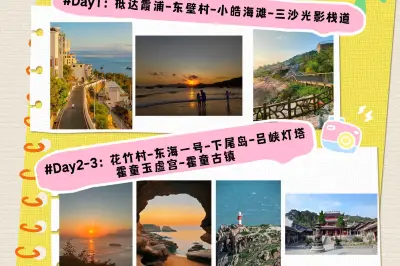
The guesthouse was architecturally distinctive, reflecting thoughtful design. The owner was warm and arranged a very rich breakfast. After breakfast, we went to Xiapu's popular internet-famous Light and Shadow Boardwalk. There were no other tourists along the entire route—we had the place to ourselves. We strolled slowly from west to east along the boardwalk, hearing only the sound of waves hitting the sandy beach and rocks. No fishing boats passed by, and there was no wind. Faint sunlight filtered through thick clouds and scattered on the sea, creating a static ink painting.
The 18th was a rest day. We didn't go out. The sun was nice, so we stayed in the room, basking in the sun and reading. Outside the window was the sea, with sparkling water and gentle waves. Time stood still in peace.
On the 19th, we traveled all day: Big Golden Beach, Gaoluo Beach, Xiawei Island, Lvxia Lighthouse, Jishi Pier, and Haiwei Cape. The fine sand at Big Golden Beach glowed golden under the direct sunlight. Xiawei Island was closed and not open. The mountain road to Lvxia Lighthouse was rough, but the view at the end was worth the journey. The pier was a seafood trading market.
We stayed in Xiapu for three days, eating a lot of seafood of all sizes and seeing various beachscapes. It truly deserves to be called a poetic coast.