The Sacred Place That Forged the Military Soul: Gutian Conference Site — Fujian Travel Notes, May 2023 (Part 2)
The Sacred Place That Forged the Military Soul — Gutian Conference Site
— Fujian Travel Notes, May 2023 (Part 2)
On May 9, 2023, after our group tour ended in Xiamen, Director Zhuang arranged a ride-hailing car to take us to the Education Apartment near Xiamen Railway Station. Our accommodation was not yet settled, and we finally checked into the Jin'an Hotel on Fengyu Road, opposite the station.
On May 10, we began our independent travel. Our first stop was the Gutian Conference Site. We took the D6478 train from Xiamen Station at 6:47 am and arrived at Gutian Conference Site Station at 8:27 am on time. According to online information, there is a bus from Gutian Conference Site Station to the Gutian Conference scenic area, with a fare of 1 yuan. After getting off the train, we saw only one bus. The driver said buses were infrequent, and if we didn't board this one, we might wait a long time. Everyone hurriedly got on, packing the bus full. The fare was 7 yuan, with no discounts for disability or veteran preference cards. The distance was quite long, about 10 kilometers or more. We spent four hours visiting the Gutian Conference Site scenic area and returned to Xiamen by the D6583 train at 1:56 pm. With the high-speed rail now available, visiting the Gutian Conference Site is quite convenient.
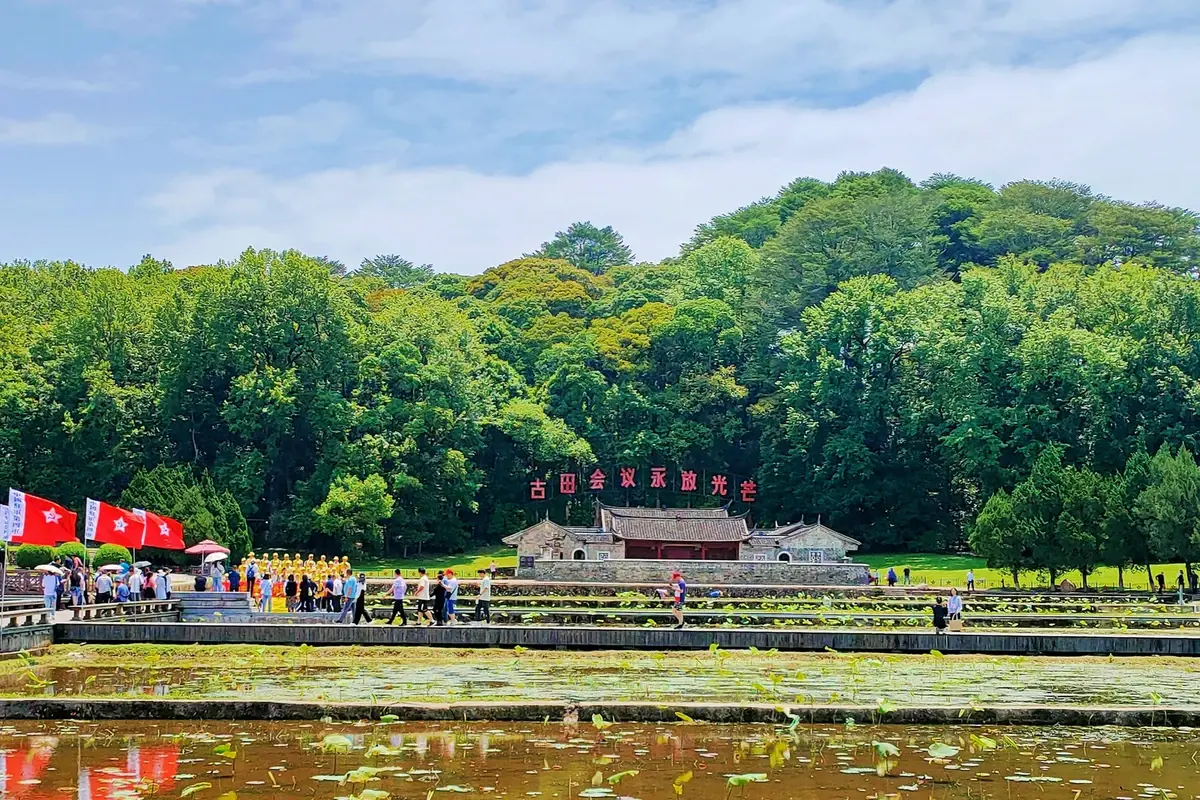
The Gutian Conference Site is located at the foot of Bijiashan Mountain, Caimeiling, Gutian Town, Shanghang County, Longyan City, Fujian Province. Originally the Liao Clan Ancestral Hall, also known as Wanyuan Ancestral Hall, it was first built in 1848, covering an area of 826 square meters. It is a national key cultural relic protection unit, a national AAAAA-level tourist attraction, an advanced collective in the national cultural relics system, and a national red tourism scenic spot.
The Gutian Conference was held on December 28–29, 1929. It passed the historic Gutian Conference Resolution and elected 11 members of the Front Committee, with Chairman Mao as the secretary. The Gutian Conference Resolution is a guiding document for the construction of the Communist Party of China and the people's army. The Gutian Conference is a milestone in the history of party and army building, and the Gutian Conference spirit is an important part of the Chinese revolutionary spirit.
The Gutian Conference was convened under the influence of three backgrounds:
First, in late June 1929, Chairman Mao was removed from his position as secretary of the Front Committee and stripped of his military command. Various non-proletarian ideologies within the Fourth Red Army spread and grew, seriously harming the revolutionary cause and military struggle.
Second, the Central Committee and Zhou Enlai, who was in charge of the Military Commission at the time, affirmed Chairman Mao's correct views. All officers and soldiers should uphold the leadership of Mao and Zhu, and the secretary of the Front Committee should still be Chairman Mao—this was the content of the "September Letter."
Third, Chen Yi returned from Shanghai to western Fujian, truly grasped the spirit of the "September Letter," voluntarily stepped aside, and personally invited Chairman Mao to serve as secretary of the Front Committee.
The Gutian Conference lasted two days and became a united and victorious conference. The conference passed the Gutian Conference Resolution. The core and most important part of the resolution is the first section, "On Correcting Erroneous Ideas in the Party."
"On Correcting Erroneous Ideas in the Party" systematically summarized the rich experience accumulated by the Red Army from the Nanchang Uprising to December 1929. It analyzed and criticized various erroneous ideas existing in the Fourth Red Army, such as purely military viewpoints, extreme democratization, non-organizational viewpoints, absolute egalitarianism, subjectivism, individualism, roving bandit ideology, and remnants of putschism—their sources, manifestations, and effects. It emphasized the absolute leadership of the party over the Red Army and required that party ideological construction be given priority. This document is a guiding text for the construction of the Communist Party of China and the people's army under its leadership, laying an important ideological foundation for the political work of the army and the strengthening of party building.
"On Correcting Erroneous Ideas in the Party" is an important summary of the party's experience in party and army building since its founding. It concretized, theorized, and systematized the principles of party and army building formed since the establishment of the Jinggangshan base. For the first time, it comprehensively, systematically, and scientifically resolved the direction and line issues for the construction of our party and army, fundamentally drawing a clear line between a proletarian army and a bourgeois army. From the very beginning of our army's founding, it was completely established on the basis of Marxism, Leninism, and Mao Zedong Thought, solving the problem of how to build a revolutionary army primarily composed of peasants into a new type of people's army of a proletarian nature. This article is the product of Chairman Mao's victory in the proletarian revolutionary line, establishing the principle of building the party through ideology and building the army through politics. It is an important symbol of the formation of Mao Zedong's thought on party building and provided a guarantee for the Communist Party of China leading the Chinese revolution to continuous victory.
In the Gutian Conference Memorial Hall, there is a statue titled "Chairman Mao Writing at His Desk," which filled me with deep respect and increased my admiration for Chairman Mao. In the harsh war environments of Jinggangshan, Gutian, Ruijin, and under the dim light of a tung oil lamp, Chairman Mao wrote brilliant works such as "On Correcting Erroneous Ideas in the Party" and "A Single Spark Can Start a Prairie Fire," forging the soul of the Communist Party of China and the military soul of the people's army.
The Ninth Party Congress of the Fourth Red Army elected 11 full members and 3 alternate members of the Front Committee, with Chairman Mao as secretary. Their names, photos, and resumes were displayed (video).
Entering the scenic area, we walked along the riverside avenue, enjoying the sights along the way. After visiting the "Former Site of the Fourth Red Army Logistics Department," we followed the path up to visit the "Chairman Mao Memorial Park." The story of Chairman Mao Memorial Park is as follows:
Chairman Mao Memorial Park is located on the right side of the hill behind the Gutian Conference Site. In the park stands a giant white marble statue of Chairman Mao. According to reports, the statue was first carved in 1969, but due to historical reasons, only a rough outline was completed, and then it was placed in a house near the Gutian Conference Site for 40 years. In recent years, the local area has continuously promoted the maintenance and protection of the Gutian Conference site complex, with three phases of work already completed, giving the site area a completely new look. In 2009, the 80th anniversary of the Gutian Conference, many people raised the issue of placing the statue of Chairman Mao again. The local authorities worked hard to find the original sculptor and asked him to continue guiding the completion of the carving. On June 6, at an auspicious time, the statue of Chairman Mao was formally installed.
The design of the entire statue is ingenious, using relevant dimensions to allude to important events in Chairman Mao's life and Chinese revolutionary history. For example, the statue's height is 7.1 meters, symbolizing the founding of the Party on July 1; the total height of the statue is 10.1 meters; the width of the first platform is 1.949 meters, symbolizing the founding of New China on October 1, 1949; the base is an octagon, symbolizing the Red Army's octagonal cap; the base has five layers, symbolizing the five-pointed star and the five-star red flag; from bottom to top, the first to third layers are 0.18 meters, 0.93 meters, and 1.929 meters respectively, while the fourth and fifth layers together form a slope of 1.228 meters, symbolizing Chairman Mao's birth in 1893 and the convening of the Gutian Conference on December 28, 1929; the side length of the octagonal base is 4.1 meters, symbolizing Chairman Mao's 41 years in power from the Zunyi Conference in 1935 to 1976; the distance from the base surface is 9.9 meters, and the width of the third platform is 19.76 meters, symbolizing Chairman Mao's death on September 9, 1976.
As I climbed the 151 steps, I noticed that the stone carvings on each platform had different meanings. For example, "The first platform has a depth of 1.9 meters, and together with the following 11 steps, it symbolizes the outbreak of the Xinhai Revolution in 1911." I felt this was somewhat forced, as the Gutian Conference does not have a direct or inevitable connection with the Xinhai Revolution of 1911. It would have been better to design it to symbolize the founding of the Communist Party of China in 1921, or the Nanchang Uprising or the Autumn Harvest Uprising in 1927.
Video: The power of faith summons people from all over the country to come here and receive a red baptism. The spirit of the Gutian Conference shines forever!
The Gutian Conference Site is a courtyard-style building, facing west. Along the central axis are the front courtyard, front hall, central courtyard, and back hall. It has two rows of rooms, each with three bays, and side rooms on the left and right. It has a hanging ridge roof, brick-wood structure, with column-and-tie timber framing and a three-rammed-earth floor. The back hall was originally the meeting hall of the Gutian Conference. The left wing housed the bedrooms of Chairman Mao and Comrade Chen Yi during the conference, and the right wing housed the bedroom of Commander Zhu.
Carefully examining the conference site, it remains largely as it was. Compared to a village meeting room today, it is incomparable. The bedrooms of Chairman Mao and others, compared to modern luxury homes, are worlds apart—one is simple and rustic, the other splendid and magnificent. This shows how hard-won everything we have today is.
"Success begins in Gutian." With the party soul forged by Chairman Mao—"building the party ideologically"—the Communist Party of China can achieve one success after another on the path forward. "Building the party ideologically" means carrying out active ideological struggle; only with success in ideological struggle can there be success in the revolutionary cause.
"Success begins in Gutian." With the military soul forged by Chairman Mao—"building the army politically"—the people's army can achieve one victory after another in harsh revolutionary wars. "Building the army politically" means adhering to the principle of "the party commands the gun" and highlighting that "ideological and political work" is one of the fundamental differences between the people's army and old-style armies. Without a new type of people's army, there would be no victory in the Long March, no victory in the War of Resistance Against Japan, no victory in the Liberation War, and no birth of New China.
History chose Gutian, and Gutian made history. Setting out from Gutian, the party led the people's army to develop and grow through struggle. The power of faith is truly immense. Truth can withstand the test of time. The Gutian spirit, like the Jinggangshan spirit, Long March spirit, Yan'an spirit, and Xibaipo spirit, is a precious spiritual asset of the Chinese revolution. Only by inheriting and carrying forward these spiritual assets, learning the true essence of the Gutian spirit, and carrying out active ideological struggle and social revolution can we embark on a new journey in the new era and achieve new victories.
The Gutian Conference Site is worth visiting; it was not a wasted trip. Surrounded by mountains, Gutian Site is a small basin with green hills and clear waters. The air is fresh, and the theme is red—nourishing the heart and educating people. In front of the site is a large lotus pond and lotus field. Previously, rapeseed was planted there; now, lotus flowers are grown. When we went, the lotus leaves were just emerging; June is when the lotus flowers bloom. In June, the lotus emerges unstained from the mud, standing gracefully and charmingly, evoking longing.
On the evening of the 10th, we went to the busiest area of Xiamen Special Economic Zone, one of China's first special economic zones, to enjoy the beautiful night view of "Zhonghua City" and Zhongshan Road Pedestrian Street. As we leave Xiamen, we wish Xiamen a brighter future and the people of Xiamen increasing happiness!
Video: Night view of Xiamen Zhongshan Road Pedestrian Street (1)
Video: Night view of Xiamen Zhonghua City (2)
Text and photos by Peng Xuetai
May 29, 2023