Mountains and Seas of Southeastern Fujian
Years ago, a friend asked me: "The benevolent love mountains, the wise love water. What do you like?" I answered without hesitation: "I love both mountains and waters!" Over the years, I've come to feel that I prefer to view mountains from afar, unwilling to endure the hardship of climbing, while I enjoy getting close to water. So, adhering to my lazy principle: "View mountains from a distance, appreciate water up close!"
Just as the more books you read, the more you realize your lack of knowledge, as time passes, the number of places I've visited has increased year by year, yet I increasingly feel that from friends' conversations and from videos and books, so many mountains and waters have emerged that I haven't explored, haven't experienced firsthand, haven't taken beautiful photos of, or tasted local delicacies.
Fujian Province is definitely a tourist destination I have overlooked.
Every time I proudly boast that among China's 34 provinces and municipalities, the only ones I haven't set foot in are Tibet, Macau, and Chongqing—just three—Gulangyu Island in Xiamen has always represented Fujian in my heart. For many years, in my impression, Gulangyu was synonymous with Fujian. My two trips to Gulangyu were both direct flights to Xiamen. As for other parts of Fujian, they never even crossed my mind or caught my attention.
For this year's fourth quarter monthly trips, I had long planned a trip to Greater Shanghai and to admire the autumn scenery of southern Anhui. I didn't know where to go in December until I saw photos of relatives visiting Fujian Tulou and Pingtan. It suddenly reminded me that the beautiful mudflat scenery of Xiapu I had once seen also belongs to Fujian Province. Although it's a bit far, I could still string them together. Thus, the plan for a trip encircling the mountains and seas of southeastern Fujian—Tulou, Pingtan, and Xiapu—began to take shape.
Having rented cars for self-driving twice before, I was bolder this time. I rented the same Nissan Sylphy used in southern Anhui—comfortable and affordable. The previous trips were around 500 kilometers each. This time, the three locations were far apart, so it would definitely exceed that distance and set a new record.
The Fujian trip started with a hotpot at Haidilao in Xiamen.
Off-season airfare is really attractive. From Beijing to Fuzhou, the airfare plus taxes was about 60% of the high-speed rail ticket, but the plane seats were cramped and uncomfortable. The train took a long time—even though it was high-speed rail, the distance was over 1,800 kilometers, and the fastest trip took nearly eight hours. After weighing options, my money-conscious self chose the plane to save both time and money.
With long distances and scattered attractions, this itinerary required a lot of thought. I didn't want any part of the trip to be compromised; even the transit stops for one night were carefully selected and incorporated into the travel plan.
It was my first time flying out of Daxing Airport. The modern design was very upscale. Although I didn't see the legendary "Eye of Daxing," the overall streamlined lines and modern style were pleasing to the eye. Unfortunately, I didn't have much time to look around.
Upon landing in Fuzhou, to have enough time for Tulou the next day, we drove three hours that day to check in at Xiamen.
I felt a sense of familiarity and warmth toward Xiamen because I had been there twice before, though both trips centered on Gulangyu. Other places—Nanputuo, Xiamen University, and the Island Ring Road—had also been revisited. This time, we chose to stay near the Wanda Plaza in Jimei area for convenient dinner. We didn't plan any sightseeing—just an overnight transit stop.
Getting on the expressway directly from the airport, the three-hour drive wasn't boring. There were many clouds, and sunlight filtering through them was bright but not harsh. As we approached Xiamen, rows of small villas with orange-red roofs—three to four stories high—looked like charming European towns. Magenta bougainvillea bloomed in clusters. Only in such a warm, humid southern coastal city could it be so luxurious; in the north, we would have to keep them as pets in our homes, carefully nurtured.
Since Haidilao opened in Beijing, it has become my favorite. Over the years, that hasn't changed. My son, especially, chooses Haidilao for most of his dates and gatherings. After the special three years, I once again earned a gold card, receiving complimentary fruit and VIP treatment.
I found a Haidilao nearby. Thinking that I'd be eating Fujian cuisine for many days and might not find it to my taste, I couldn't resist having a hearty meal of my favorite. The same great service, the same great taste—I ate to my heart's content!
A Day Immersed in Tulou and Yunshuiyao Ancient Town
Hastily made preparations—though not ideal, still useful! To design this unplanned itinerary, I not only browsed many travel guides and blogs but also bought a book about traveling in Fujian. Over the years, travel books have taken up half of my bookshelf, becoming a treasure I'm proud of.
The cover of the book is Fujian's calling card—Tulou.
Fujian Tulou are scattered across the mountainous landscape of Fujian, composed of countless large and small tulou clusters. This is the kingdom of tulou, built along the contours of the mountains, grand and spectacular. These sites are far apart, and self-driving is the most convenient way. Among the many tulou clusters, we chose to visit the Tianluokeng Scenic Area and Yunshuiyao Scenic Area.
Tianluokeng, commonly known as "Four Dishes and One Soup," is the iconic tulou complex in Fujian. It consists of three round buildings, one oval building, and one square building in the center, said to be built according to the five elements' generative order of "Metal, Wood, Water, Fire, Earth."
We first went to the upper observation platform, where we could overlook the full view of the "Four Dishes and One Soup." The overall layout was well-proportioned, surrounded by terraced fields, blending seamlessly with the natural mountain terrain. It also looked like a blooming flower, so magnificent and dazzling amidst the fields.
The observation platform had two levels. Standing on the lower level and taking photos from the upper level allowed for perfect shots that integrated with the tulou. We tried a few angles with a selfie stick, but the framing wasn't ideal, so we paid a local to take a group photo. The photo was printed and laminated on the spot, which was very convenient.
Next to the observation platform, there was a steep stone staircase leading down. Some enthusiastic locals offered to be our guide for 60 yuan, taking us down to tour the tulou from inside. Looking at the narrow, steep stone path, and thinking we would have to climb back up the same way, we decided against it.
Following the winding mountain road, we arrived at the lower observation platform, which offered a side view of the tulou groups at eye level. Surrounded by layered terraced fields with crisscrossing ridges, yellow and green fields and well-arranged tulou stood proudly, creating a three-dimensional scene. This place is also called the "Fujian version of the Potala Palace."
Continuing along the mountain road, we reached Yuchang Lou, known as the "Number One Strange Building in the World."
At the village entrance, a young girl warmly greeted us. She claimed to live in the tulou and offered to be our guide, explaining and taking photos for just ten yuan. That was quite affordable, and since we wanted to explore the tulou up close, we gladly agreed.
Walking into the village, there were small fruit stalls selling large pomelos—ten yuan for three—quite tempting.
Yuchang Lou was first built in the late Yuan to early Ming dynasties, over 700 years ago. It is one of the oldest existing tulou. Having weathered centuries of wind and rain and many earthquakes, it remains as steady as Mount Tai.
To defend against frequent bandits and enemies, local villagers used local materials, building tulou with straw and clay, layer by layer, adapting to the mountain terrain. The thick outer walls, even the thinnest part over a meter thick, not only resisted external threats but also kept the interior warm in winter and cool in summer.
Upon entering the main gate of the tulou, the courtyard was paved with cobblestones of various sizes. The tulou had five floors. The biggest highlight was that the supporting pillars from the third floor upward were all tilted askew, seemingly ready to collapse, but in fact they were sturdy and durable. The most eye-catching feature was a long wooden pillar that extended from the ground straight up to the fifth floor, standing in the courtyard. This reminded me of the Leaning Tower of Pisa—a similar effect.
The tulou were highly practical, and many people still live in them. Each household occupied a vertical strip of rooms from top to bottom, connected by narrow wooden staircases. The first floor housed the kitchen with a well, while upper floors contained storage rooms, bedrooms, and more. It was like a row of townhouses!
Our young guide took us inside to visit. In a corner on the first floor, there was a well still in use. The tour was primarily aimed at marketing—letting us rest and taste tea. Although we knew this was a common travel trick, after being warmly urged to try several different teas, we symbolically bought some as souvenirs from the tulou trip.
It was difficult to capture the entire tulou in a photo. I tried different angles, always wanting to capture more of the tulou in the frame, but it was quite challenging.
Art originates from life. Tulou are the homes of the Hakka people, masterpieces of traditional residential architecture, and unique artistic treasures of the Chinese nation. I marveled at the wisdom and intelligence of ancient laborers, who created this unique architectural style imbued with Eastern mystery, adding a significant chapter to the history of human architecture.
Fujian Tulou—worth visiting!
We grabbed a simple lunch near Yuchang Lou. Following a beautiful mountain path, we arrived at our accommodation for the night—Yunshuiyao Ancient Town.
Yunshuiyao became widely known after the film "The Knot" (Yunshuiyao) was shot there. Its main attractions include Yunshuiyao Ancient Town, Hegui Lou, and Huaiyuan Lou. Both Hegui Lou and Huaiyuan Lou are UNESCO World Heritage sites.
I had carefully selected a guesthouse located in the center of the ancient town, near the big waterwheel, midway between the two tulou. The riverside paths branched off in two directions—one to Huaiyuan Lou and the other to Hegui Lou. According to the map, each was about a kilometer away. That distance sounded fine but posed a dilemma: walking would be tiring, and driving might not allow convenient parking. Wanting to explore the ancient town along the way, we finally decided to walk.
Passing through the back door of the guesthouse, we came to a huge banyan tree with layered, intertwining branches and dense foliage, forming a natural umbrella. Sunlight filtered through, casting dappled spots on the ground. Many tourists were there taking photos. A person dressed as a clown enthusiastically offered to take group photos for everyone.
Through the banyan tree and a string of small shops, we walked along the stream, heading first to Hegui Lou near the village entrance.
The path was paved with cobblestones of various sizes. The stream babbled, and a small bridge made of stone slabs added liveliness.
Occasionally, tulou—square or round—would pop up along the way, with villagers washing clothes, cooking, and farming.
We passed large fields of sugarcane. Freshly squeezed sugarcane juice was sold for five yuan a small bottle. We watched as the peeled sugarcane was fed into a juicer, and a pale yellow liquid flowed out. When I opened the bottle, a few drops spilled, making my hands and the bottle sticky—pure and additive-free. Drinking freshly squeezed sugarcane juice in a sugarcane field—perfectly fitting!
Hegui Lou was built during the Yongzheng reign of the Qing Dynasty. It is a rare rectangular tulou, five stories high, gradually narrowing from bottom to top, with over a hundred rooms. Legend has it that the entire building was constructed on a swamp. What is visible now is that the central area of the tulou contains a large patch of swampy land, perpetually damp, with bamboo poles able to penetrate two to three meters deep.
Leaving Hegui Lou, we first retraced our steps, then headed toward Huaiyuan Lou at the other end. Two kilometers of stop-and-go walking—traveling can be quite tiring.
Huaiyuan Lou, surrounded by rice paddies and tea plantations, is the most exquisitely built and best-preserved double-ring round tulou, with smooth outer walls. In front of the main gate, cobblestones formed a Tai Chi pattern. We walked inside the tulou courtyard, took a lap, and saw small pools and stoves outside each household on the first floor, and clothes hung to dry upstairs, giving the tulou a lively, domestic atmosphere.
By the time we left Huaiyuan Lou, it was dark. To our surprise, the red lanterns hanging outside the building had lit up. In daylight, I hadn't noticed the strings of red lanterns. The lights illuminated the tulou, creating a spectacular scene of bright lights and floral displays—completely different from the daytime view.
Suddenly, I felt glad we hadn't driven. If we had returned to the hotel early after a quick visit, we would have missed such a beautiful sight!
The ancient town under the lights was even more dazzling than in daytime. Lanterns of all shapes and sizes were hung, and the houses, river, and small bridges were all more beautifully adorned.
The mountain night was cool. We had dinner at the guesthouse, wearing sweaters and lightweight down jackets, yet still shivering. We ate hastily and returned to our room to rest.
Today was truly tiring—we walked a lot and unavoidably climbed some mountain steps. Starting tomorrow, we head to the coast.
Quanzhou: Half City of Mortal Smoke, Half City of Immortals
In the morning, the car was covered with dew, and the windows were so wet we couldn't see clearly. We wiped them carefully with tissues and set off for Quanzhou.
Transit stop No. 2, chosen without compromise—Quanzhou.
Our second destination was Pingtan Island, administered by Fuzhou City. It was about 400 kilometers from the Nanjing Tulou cluster, a drive of over four hours. When planning the itinerary, I had intended to depart at noon today, stop in Quanzhou for a night, and at most visit one scenic spot. Unexpectedly, our "senior group" had managed to visit both the "Four Dishes and One Soup" scenic area and Yunshuiyao yesterday. Though tiring, it freed up half a day at today's transit stop for sightseeing. So now we had to replan this squeezed half-day trip.
Quanzhou is an ancient city with a long history, recognized by the United Nations as the starting point of the ancient Maritime Silk Road. In Quanzhou, religious cultural influences are everywhere, and Kaiyuan Temple and Guanyue Temple are especially famous.
Our Quanzhou visit began at Laojun Rock on Qingyuan Mountain. Qingyuan Mountain is Quanzhou's first 5A scenic area and a landmark attraction. According to introductions, it integrates natural landscapes with historical heritage, with beautiful scenery and numerous famous sites. Our itinerary only covered Laojun Rock at the foot of the mountain—the oldest existing Taoist stone statue in China.
We parked at the lot and walked a few minutes to see the statue of Confucius asking Laozi for advice. The lifelike figures, with dignified and natural expressions, vividly illustrated the historical anecdote from the Records of the Grand Historian. Turning around, we saw the statue of Laozi against a backdrop of blue sky, green mountains, and lush trees. The exquisite carving showed a kind, joyful, and approachable elder, inspiring reverence. The stone carving reading "Laozi, the Best Under Heaven" in front highlighted Laozi's status in Chinese hearts.
Leaving Laojun Rock, we headed to Kaiyuan Temple. Built during the reign of Empress Wu Zetian, Kaiyuan Temple has a history of over 1,300 years and is one of the largest Buddhist temples in Fujian. Entering through the main gate, we visited several halls in sequence, then went to the courtyard to see the East and West Pagodas. The Zhenguo Pagoda on the east and the Renshou Pagoda on the west are over 40 meters tall, a famous pair of stone pagodas in China and a symbol of Quanzhou ancient city.
Kaiyuan Temple is located on West Street. Exiting the temple, we merged into the endless stream of tourists on West Street. It was noon, so we decided to find a restaurant on West Street for lunch. After checking reviews, we found a somewhat famous spot a few hundred meters away, which gave us a chance to stroll along West Street.
West Street is a well-preserved ancient street block in Quanzhou, with many buildings retaining their original historical appearance. West Street is like a string of dazzling pearls, connecting many colorful cultural relics and ancient streets and residences. Both sides of the street are lined with shops and snack stalls. Exquisite hairpins and fragrant oyster omelets have strong local characteristics. Walking a few hundred meters along West Street, we turned into a small alley and found the recommended restaurant. It was after 1 PM, but we still waited for a table outside. We ordered local specialties: Quanzhou ginger duck, southern Fujian oyster omelet, and oil-drizzled conch slices.
Continuing the tour in the afternoon, we went to Tonghuai Guanyue Temple, a rare temple in China that worships both Guan Yu and Yue Fei together. Incense was burning vigorously, and we could see blue smoke and smell the incense from far away. The temple features a strong southern Fujian ancient architectural style with rich colors and exquisite carvings, worth seeing.
"A mountain is famous not for its height but for its immortals." Quanzhou, with half city of mortal smoke and half city of immortals, has a unique charm. I believe it will bring us good luck.
Exploring Southern Pingtan Island
Head to the sea!
From today, we plunge into the embrace of the sea, getting up close and personal—enjoying seascapes and eating seafood.
In recent years, Pingtan Island, famous for its "blue tears" phenomenon, has become a popular tourist destination and the first stop of the "sea" part of our mountain-sea trip.
Pingtan Island is China's fifth-largest island, with a large area and scattered attractions, divided into northern and southern routes.
The Pingtan trip must start from 68 Nautical Miles!
Entering the scenic area, we saw a large sign saying "The Closest Point of Mainland China to Taiwan," attracting tourists to take photos. Standing in front of it, a sense of pride welled up. On the beach opposite, small red wooden houses were particularly eye-catching against the sea backdrop, exuding a fairy-tale romance—a perfect photo spot.
Taking an electric cart to the seaside, the coast wasn't sandy beach but covered with stones of various sizes, piled or scattered. There were several photo spots. Along the constructed stone path, we could reach two observation platforms—one high and one low—from which we could gaze into the distance. A round arch made of large green stones; looking through the arch into the distance was also a good photo idea. A stele inscribed with "Mainland China—Taiwan Island, Closest Distance 68 Nautical Miles" and carved with the map of the cross-strait positions.
On the way back, we stopped at a 68 Nautical Mile stamp photo spot. It was another rocky beach with large stones. Besides the giant stamp frame, there were a few other artificial landscapes in pure white, standing out vividly among the layers of rock, capable of producing epic photos. There was a statue made of green stone blocks, resembling the Queen's Head rock at Yehliu Geopark in Taiwan, standing proudly among the stone array.
The island had strong sunlight and strong sea winds—a feeling of both sun exposure and wind chill.
Leaving the 68 Nautical Mile scenic area, we went to Taiwan Town. We had high hopes for this town we saw on the way, but found little to explore except for lunch—a bowl of beef noodles. Many shops were closed; the few open sold similar items. The town was large, designed for one-way entry and exit, forcing visitors to take a longer route to explore more. Under the blazing sun, tourists endured unnecessary hardship. Highly not recommended.
Haitan Ancient City, with the spacious Chenggong Avenue as its main thoroughfare, connects the giant ship Haitan Hao, the city gate, Qilin Square, and Wanghai Tower. Both sides are lined with many antique buildings: Ming and Qing government offices, an international wax museum of celebrities, and small food shops. There are various themed parks and amusement areas. From time to time, there are large-scale performances with drum music, exuding a rich coastal cultural atmosphere of southeastern Fujian.
Not far from Haian Ancient City is Tannan Bay. Tannan Bay has a long coastline and a large bathing area with many sightseeing spots. We arrived at Tianmei'ao, the closest to the scenic area entrance. The beach here is gentle, the sand fine and soft, the sea clear, with gentle breezes and sparkling waves. The light blue color brought peace to the mind. Visiting the seaside should be simply walking in the water and on the sand. We sat quietly on the beach near sunset, watching the sea and daydreaming.
An essential theme of an island trip is eating seafood!
The hotel we stayed at was in the center of Pingtan Island, with convenient dining options nearby. A friend recommended Red Star Seafood, a popular seafood stall about a kilometer from our hotel. We took a taxi there for a big meal.
There were dozens of large plastic boxes with a dazzling array of live seafood, many I had never seen before. We first walked around to admire the selection. I had no idea where to start and was hesitant to order unfamiliar items. The yellow croaker looked fresh—usually cooked braised at home, but here they recommended steaming. My favorite small scallops—previously I had bought red or purple ones—here they were bright orange-yellow; I had to have one. Salt-and-pepper mantis shrimp, with plump, lively meat—a cooking method I had long craved. And a local cold dish: mixed seaweed to refresh the palate—a novel preparation; before, I only knew seaweed as a garnish for wonton soup. It was sweet and sour.
It wasn't peak season, so no long queue, but prices were a bit high.
Today's Pingtan Island: we visited several scenic spots in the south. Tomorrow we'll explore the northern part.
Northern Circuit of Pingtan Island
Our northern circuit of Pingtan started from Beigang Village. This is a small fishing village backed by mountains and facing the sea. Using granite as the main material, the bluish-grey stone houses are a highlight. Built along the mountainside, they are arranged in a pleasing disorder. Walking along a small corridor into the bay, we turned back to view the entire fishing village—mountains, rocks, and sea exuding a pure, rustic feel. Colorful small fishing boats moored in the harbor sketched a three-dimensional, fairy-tale fishing village scene.
The most beautiful coastal road connects the northern highlights. There are many stops and viewing platforms along the way for convenience. We drove from south to north along the coast. On the right stretched the boundless sea, with occasional beaches, rocks, bays, and fishing villages. The view was extensive, and the mood was pleasant.
Following this beautiful coastal road, we arrived at Changjiang'ao. Along the way, we saw many offshore wind turbines; Changjiang'ao had the most spectacular view. We walked onto the beach—fine white sand. Rows upon rows of wind turbines stood in orderly formation against the blue sea and sky, forming a unique and beautiful picture.
The Beibu Bay Ecological Corridor is an important landscape on the northern island loop. More than 20 kilometers long, built along the sea, it features several viewing platforms where you can park and enjoy the scenery. The most famous and spectacular is the glass walkway viewing platform. Here, around each corner is a village; looking up reveals a bay—unbeatable sea views, stunningly beautiful.
The last stop of the northern circuit was Shipaiyang (Stone Arch Ocean). Two sea-eroded stone pillars, one high and one low, standing on a large round reef far offshore, looked like a large sailboat from a distance. The wind was strong; we walked to the closest point to the pillars, still only able to view from afar. Judging from others' photos, in peak season you might be able to take a boat to the reef, but now the entire scenic area had only the three of us—no staff, let alone boats.
A late lunch at another popular restaurant recommended by a knowledgeable person—"Nostalgia Fujian Mountain-Sea Banquet." We ordered a few dishes before the chef left: scallion-braised East China Sea octopus, local seafood pancake, sea-flavored stewed well-water tofu, and a cold dish of sea pine mushrooms. We ate plenty.
Back at the hotel to rest and organize photos. We weren't hungry for dinner, but reluctant to skip it, we ordered two servings of seafood congee at a nearby restaurant. An island trip should feel like an island trip!
Day 1 in Xiapu: Gathering All Scattered Essences
Xiapu is a paradise for photography enthusiasts, a place for epic shots. Years ago, I saw photos of Xiapu's mudflats and felt that the sea here was different from elsewhere, but it also seemed far away. Though I longed to go, I never planned a separate trip. In this itinerary, Xiapu is one of the three linked spots, and I looked forward to it.
Before each trip, I draw my own map of all planned scenic spots and arrange the route based on their positions. Today, following my map, our first stop was the northernmost and farthest—Yangjiaxi.
Following the navigation, we arrived at the visitor center. The empty parking lot and abandoned rafting equipment gave a desolate feel. I went to the ticket office to inquire. The only staff member, looking bored, introduced that Yangjiaxi is a large area; the part we had just driven through was all part of it, but this spot was just for rafting. The big banyan trees in promotional photos were about three kilometers away at a scenic spot called Rongfenglin Park. We immediately headed there.
This was an ancient banyan tree cluster. Each tree was a sight in itself. One was the banyan king, said to be over 800 years old, with branches stretching far and wide, dense foliage. Sunlight slanted through the trees, casting dappled shadows. It truly felt like one tree formed a forest. In December, Xiapu's leaves displayed red, yellow, green, and other colors, creating a three-dimensional painting with the blue sky and high mountains.
At the village entrance, two elderly water buffalo were tied, along with a group of artificial white swans. Under the lead of a swan mother, the cygnets fluttered their wings and played happily. The cowherd, buffalo, white swans, and banyan trees created a romantic, fairy-tale atmosphere.
We followed a path into the village, flanked by pomelo groves. The low trees were heavy with fruit, and fallen pomelos littered the ground—such a pity to see those big round fruits. Everywhere, pomelos were sold at 10 yuan for three or four.
Passing through what seemed like an abandoned factory area, we arrived at Xiaohao Beach.
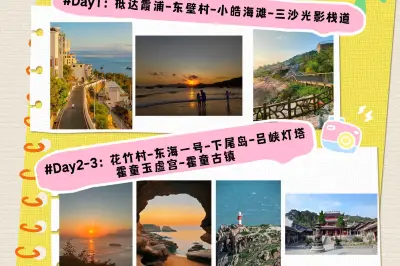
At first glance, it was a bit disappointing. Apart from the empty parking lot, the visiting area was tiny. But the more I looked, the more I felt it was worth seeing. There were many clouds, blocking the sun. The sea stretched far, seemingly merging with the sky. In the distance, countless poles and boats formed a silhouette, their reflection shimmering silver on the sea.
Dongbi Village, located in Sansha Town, is a small fishing village built on a hillside facing the sea. The village is layered and well-proportioned. Many small fishing boats were moored in the harbor, complementing the vast mudflat scene in the distance. There were many guesthouses in the village, said to be great for sunset photography. Next time, I should stay here for a night.
Beiqiz Mudflat is Xiapu's most representative scenic spot, known as a paradise for photography enthusiasts. As the highlight of our day's itinerary, it didn't disappoint. Blue sky, white clouds, mountains, village, beach, sea water, fishing boats—dynamic within static, static within dynamic. I don't know what adjectives to use; every shot was beautiful, and I couldn't get enough.
The Atour Hotel we stayed at that night opened in October this year. New facilities, good service, reasonable prices, and especially comfortable bedding—the most comfortable hotel of the trip. The "Xiaodu" smart speaker in the room was very responsive.
Xiapu is known as the hometown of Chinese kelp and Chinese laver, rich in seafood. Our carefully chosen hotel was next to the food street. We found several popular seafood markets nearby within walking distance. The bustling market scene made it impossible to tell it was the off-season. Staff were proficient in greeting, ordering, and serving. Large displays of fresh seafood attracted customers, allowing them to choose. I loved that prices were clearly marked—how much per portion, per piece. The seafood looked fresh, with many varieties I had never seen before. I took many photos to study and to tempt my chef back home. I noticed that most sea fish were prepared by steaming. For many fish, the menu only listed steaming as an option.
We ordered steamed turbot, scallion-oil crushed snails, small squid braised with tofu, Xiapu fish dumplings, and mixed wakame. We were a bit conservative with our choices but still stuffed. Yet we felt we hadn't eaten enough; we'd continue tomorrow.
Day 2 in Xiapu: East Sea Line No. 1 and Shajiang S-Bend
With a long coastline and numerous islands, the East Sea Line No. 1 connects many beautiful coastal spots, making it the highlight route of Xiapu.
Pursuing perfection without regrets, the East Sea Line No. 1 must start from Lixia Lighthouse. According to online travel notes, the road to Lixia Lighthouse is rough; some low-clearance cars gave up. Many netizens complained about the last three kilometers of bumps. But these didn't make us hesitate. We departed directly from the hotel for Lixia Lighthouse.
We drove along mountain roads with few cars. A few kilometers away, we entered a very primitive small village. The road was narrow and uneven, with shabby houses on both sides. Some pushcarts, villagers, children, and dogs roamed the street. I thought, "This is not the last three kilometers—there are another seven or eight!"
After passing the last small village, we entered the final three kilometers. Pure yellow earth, bumpy and uneven, with large and small potholes. The car jolted violently, dust flying. Our phones couldn't stay on the mount and kept falling off; we also bobbed along. The three kilometers felt like an eternity. Along the way, we only saw one car coming from the opposite direction, and there were no signs for "Lixia Lighthouse." I felt a bit nervous—was this spot so obscure?
The parking lot was small, with only our car inside, yet it looked spacious. The sea wind was strong. We wrapped our scarves tightly and put up the hoods of our lightweight down jackets, but it was still freezing. We climbed onto a seaside viewing platform. All around were reddish-brown cliffs plunging straight into the sea, like coastal canyons. Suddenly, a red-and-white lighthouse appeared proudly on the cliff in the distance. All the hardship seemed worth it. There were stone steps to approach the lighthouse, but the wind was too strong. Besides us, there was no one else, making it even bleaker. We decided to stop and view from afar.
On the return, we drove the three-kilometer dirt road again, with a sense of accomplishment. We encountered another car coming the other way, and felt a sudden kinship—great minds think alike, choosing this remote corner of the world.
After passing through the old village again, we officially embarked on the East Sea Line No. 1. Our route followed the coastline all the way.
Xiawei Island is famous for its sea-eroded caves, various shapes ideal for epic photos. We took an electric cart from the scenic area entrance to the seaside, but because of cloudy and rainy weather, we couldn't walk to the sea-eroded caves to take pictures—what a pity. We walked along the sightseeing boardwalk, changing direction to enjoy different angles of the sea view.
Danwan Observation Platform is one of many stops along Line No. 1. Villages, rocks, sea, fishing villages—different angles, but the same relaxation and comfort. Watching the sea felt so nice.
Dajing Beach has fine sand and a broad coastline. Far out at sea were mountains; fishing boats swayed, giving a unique fjord-like beauty.
Haiwei Jiao is another viewing platform on Line No. 1, a European-style photo spot. Around us were blue and white arches and castles, with the endless sea behind, very much like Santorini in Greece. Every angle produced great photos.
Jishi Dock—the harbor was filled with fishing boats, with a fishing village nearby and peaks in the distance. Viewing the boats up close was beautiful.
Gaoluo Beach—wide sandy beach, sparkling sea surface, islands of various sizes in the distance, seagulls flying by occasionally. The scenery was picturesque and beautiful.
I was greedy for beautiful sights. Seeing it was still early, we set off for Shajiang S-Bend.
Shajiang S-Bend is in the opposite direction from our hotel, unlike East Sea Line No. 1. We pressed on, driving until we could go no further—only a fork ahead. For the first time, I braved driving up a slope at nearly 45 degrees, into a yard that could only hold a few cars.
We took an elevator to the top floor of an abandoned, unfinished building—the best spot to view Shajiang S-Bend.
On the sea surface beneath the sky, rows of bamboo poles formed a large S-bend, as if weaving an enormous net covering the sky. The lines were graceful, well-arranged; points, lines, and planes came together in harmonious perfection. This was the mudflat scene I had first seen years ago—the Xiapu mudflat in my memory.
Tonight, we continued our seafood feast. Following the chef's advice, we tried new varieties. Stir-fried goose barnacles—beautiful but a bit laborious to eat: you had to bite off the outer shell and suck out the meat. Scallion-oil Arctic surf clams—previously, I'd only had them sliced thinly and served raw; here they were whole and stir-fried—too chewy, requiring good teeth. Salt-and-pepper mantis shrimp—a signature dish of our island trip. Small beltfish steamed—a first for me; deliciously fresh—only the freshest beltfish can be steamed. After dinner, we lingered, admiring the seafood displays and taking photos. There were so many new types I hadn't tried!
Fuzhou: Visiting Three Lanes and Seven Alleys, Shangxiahang, and West Lake Park
As the capital of Fujian Province, Fuzhou seems low-key compared to the province's many tourist attractions. Our Fujian trip started and ended in Fuzhou, and we deliberately set aside a day to explore this blessed city.
Three Lanes and Seven Alleys is Fuzhou's iconic destination. With Nanhou Street as the axis, ten lanes and alleys are arranged on both sides. This is a cluster of ancient residences built from the Ming Dynasty through the Qing Dynasty over several centuries. Many buildings remain well preserved, and there are many former residences of famous people. Our first stop in Fuzhou was Three Lanes and Seven Alleys.
The crisscrossing lanes and alleys, white walls and black tiles, and stone-paved streets exude a strong historical atmosphere. Small shops on both sides have strong local characteristics, many selling Shoushan stone carvings, with exquisite craftsmanship and various shapes. We entered a shop and enjoyed browsing for a long time. I love such shops.
Shangxiahang is a district blending Chinese and Western architectural styles and Min merchant culture, though somewhat desolate. As one of Fuzhou's famous attractions, we had enough time to take a stroll.
While at Shangxiahang, I received a text message that our flight was canceled due to heavy snow in Beijing. I immediately booked a train ticket for the next day. To my surprise, I got the fastest train—about seven and a half hours to Beijing.
The Yuehua Hotel, recommended by a close friend, is right next to West Lake Park. We took the afternoon to rest. For dinner, we crossed West Lake Park to eat Fuzhou specialties. The park's wide wooden boardwalk is a great place for leisure; many locals were strolling. On West Lake, the reflections of trees and pavilions under the lights were beautiful.
Preparing to go home, we spent the morning strolling through West Lake Park and Zuohai Park. Many local residents were walking children or just hanging around.
The high-speed train back to Beijing was delayed all the way. After departing Jinan, I witnessed a high-speed train traveling at 12 km/h, maintaining that speed steadily for a long time. I briefly thought it might chug along for dozens of hours. The planned travel time of over seven hours stretched to ten and a half hours; we finally arrived in Beijing at 1:30 AM. Heartwarmingly, our dedicated driver was there to pick us up, so we didn't worry about getting a taxi.
Beijing's heavy snow—always anticipated yet resented!
The round trip of southeastern Fujian's mountains and seas ended successfully, covering over 1,500 kilometers.
Fujian is a major province of mountains and waters, a food paradise.
Here, the mountains call; here, the seas roar.
December 2023