Zhejiang-Fujian Coastal Tour
During the pre-Spring Festival period, the off-season for tourism. I signed up for a five-day senior group tour to Xiapu.
On the morning of January 27, I took the D3125 train from Shanghai Hongqiao Station to Fuding Station. A bus picked us up and took us directly to Sansha Town, Xiapu County, where we checked into the hotel.
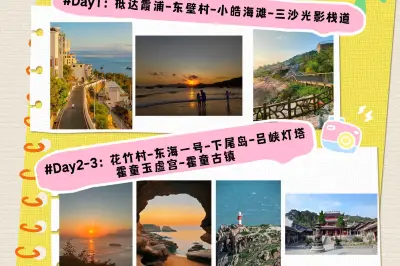
On January 28, we got up early to watch the sunrise over the sea. It was only a 20-minute drive from Sansha Town to Huazhu Village. In the pitch-black dawn, along winding mountain roads, we arrived and walked up a slope to find a stone tablet inscribed with "China's Sunrise Viewing Landmark," said to be the best spot for sunrise viewing. Unfortunately, the weather didn't cooperate. We waited for a long time but the sky remained overcast, so we had to return disappointed and have breakfast at the hotel.
After breakfast, the bus passed through Xiapu County town and headed to the first seaside stop, Gaoluo Beach. In the off-season, only a few tourists were strolling on the flat, wide beach, or riding beach buggies. The parking lot in front of the nearby "White Horse Ming Imperial Palace" temple was empty—quite a different scene from summer.
After lunch, we drove south along the "East Sea No.1" sightseeing road. This scenic road starts from Ningwan Reclamation Area in the north and ends at Beibi Township in the south, with a total length of 98 kilometers. It has two lanes, each 7 meters wide, plus a 3-meter slow lane. The road features anti-skid colored pavement, with multiple service stations, parking lots, viewing platforms, restrooms, and camping bases along the way. It connects many beaches, fishing ports, and tourist attractions. Nestled between mountains and the sea, it’s a perfect route for self-driving sightseeing and a "transportation + tourism" scenic line. Heading south from Gaoluo Beach, we enjoyed the sea views along the way, stopping at two viewing platforms and one scenic spot. The first, Haiwei Cape Viewing Platform, had blue roofs and white walls reminiscent of Santorini in the Mediterranean. It had a café inside where we could rest, enjoy the view, and take photos. The second, Danya Viewing Platform, had a fully transparent glass house offering wide, bright views. Ordering a coffee, sitting by the window overlooking the sea, it was a great place to read quietly or just daydream! The most famous feature of Xiadao Island scenic spot was a sea cave formed by years of wave erosion. The spot was free, but about 2 kilometers required walking or taking an electric cart (5 yuan one way). When we arrived, the tide was rising, so for safety, tourists were prohibited from going down to the beach to enter the cave. We could only watch the waves crashing on the shore from above.
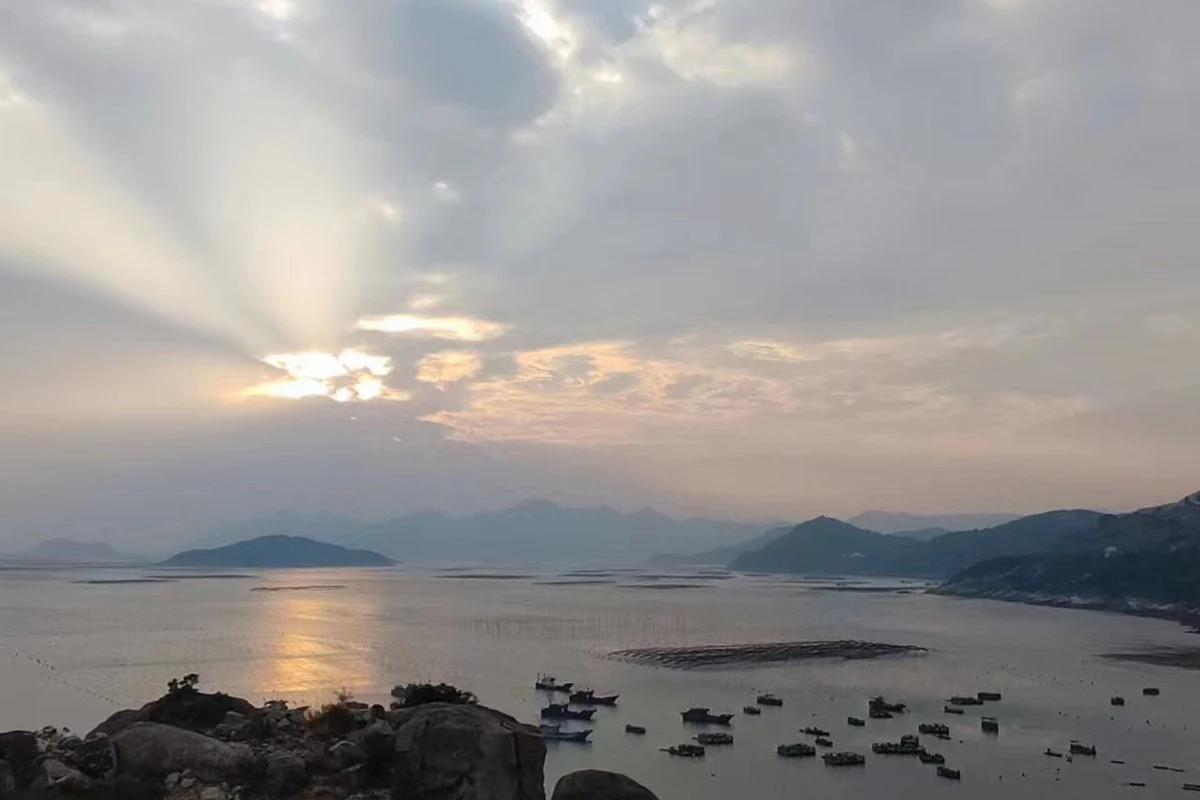
On the way back to Sansha Town, we stopped by the Light and Shadow Boardwalk. It was said to be four or five kilometers long and especially beautiful under the setting sun. Unfortunately, dark clouds blocked the sun as we entered, and only when we exited did sunlight peek through the clouds. A hundred meters past the Light and Shadow Boardwalk, we reached the Dongbi Bridge, supposedly the best spot for sunset viewing. During peak times, the bridge would be crowded with photographers, and nearby guesthouses were hard to book. We climbed a high slope, just as the golden rays of the setting sun spread over the sea. Using my phone, I captured one sun in the sky and three reflections on the water, mingling with scattered fishing boats and orderly aquaculture rafts—a stunning and beautiful scene.
On January 29, after breakfast, we drove about an hour to Fuding City. Exiting the highway, we arrived at the Taimu Mountain Visitor Center. To go up the mountain, we transferred to a scenic area shuttle bus (round trip 40 yuan), which took about 40 minutes to reach the upper parking lot. We walked through a shopping street to the Couple Peak Square of Taimu Mountain. Taimu Mountain (5A scenic area) covers 24.6 square kilometers, with several tour routes including Yingxian Bridge, Yi Pian Wa, Guoxing Temple, Baiyun Temple, and several independent routes. For safety, the tour guide specified the conventional Yingxian Bridge route and emphasized not to explore side paths. Starting from Couple Peak Square, we walked up the wooden boardwalk, passed Exploding Dragon Pool, Yingxian Terrace (Juxian Pavilion), and arrived at Guoran Mingshan. From there, a fork led up to Xiangshan Temple scenic area, and down through Yi Xian Tian (just took photos at the entrance) to Yi Pian Wa scenic area. The guide directed us to go via Tianzhu Peak and take the Sea-Viewing Boardwalk back. The boardwalk was flat and relaxing. There was a Huludong (Gourd Cave) independent route along the way (needs 40 minutes), but following instructions, we didn’t dare enter and only took photos at the entrance.
After lunch, we headed to Fuding Niulanggang Coastal Scenic Area. It was raining heavily—luckily we had already descended Taimu Mountain, or we would have been drenched and faced slippery roads with unpredictable consequences. After entering the scenic area, we could walk down to the beach (or take an electric cart for 10 yuan). The area also had slides and other activities. With rain, strong winds, and big waves, we just looked from a high slope and then returned to shelter.
Back in Sansha Town, the rain stopped. We visited Liuyun Temple in Sansha Town. The temple gate was modest, facing the sea, built along the cliff, rising level by level, with exquisite statues. Sansha Town is a fishing port, and this temple serves as a spiritual sustenance for believers praying for safe return and bountiful catches of fishing boats.
On January 30, after breakfast, we went to visit Yangjiaxi Chixi Village. In 1984, a letter titled "Hope of a Poor Mountain Village" and an editorial titled "Care for Poor Areas" in the People's Daily sparked a nationwide campaign against poverty. Chixi Village became China's first poverty-alleviation village. At the village poverty alleviation exhibition hall, we happened to hear the current village party secretary explain in person. Now, the village has public buses, a farmer culture park, a She ethnic culture square, and introductions to poverty alleviation. The streets are neat, commerce prosperous, completely unlike the poor mountain village of the past.
The second stop was Rongfeng Forest, famous for staged photos with geese, cattle, and old farmers. The garden was small. Now, the old cow, white geese, straw hats, and straw raincoats are all rentable props.
After returning to Sansha Town for a rest, we went to Xiao Hao Beach in the afternoon. Due to rising tide, the mudflats were flooded, but nearby Xiao Hao Village had thriving homestays. Sansha Town, once a small fishing village, has now become a "tourism + fishery" hub, with a path to prosperity ever widening.
Tomorrow the tour ends, so tonight the travel agency and hotel organized a farewell banquet. Not only was the food abundant, but there was also a lottery, turning the group dinner into a year-end party.
On January 31, on the return trip, the last stop was Fuding Yujing Village. Yujing is both a small village by the East China Sea and a dock. Now developing tourism, it has improved tourist facilities and added hotels and homestays. Here, you can take a boat to island tours, or stay in the fishing village to enjoy sea views and seafood.
We had seafood lunch at Fuding Food Street. In the afternoon, the bus took us to Zhejiang Cangnan Station. The group members would take G7350 back to Shanghai. I planned to visit relatives in Wenzhou and do some sightseeing along the way, so I had previously negotiated with the travel agency to buy my own return ticket and get off at Wenzhou South Station. I rented a car online, picked it up after exiting the station, and drove myself to the hotel in Rui'an City as planned.
On February 1, after breakfast at the hotel, I navigated to Baizhangji Scenic Area. Baizhangji and Liu Ji Temple together form Liu Bowen's Hometown Scenic Area, now a 5A attraction. Entering from the north gate, I walked down along the steps. Hearing the roaring water, I had to pass Yifan Peak to see the first waterfall, which cascaded from the mountaintop. The first waterfall had the greatest drop among the three, with loud thunder and mist. Luckily, the scenic area gave each visitor a raincoat, which I used to avoid getting wet. Following the water flow, I climbed a small slope to the second waterfall. The second waterfall was the most fun—a tunnel was carved behind it, allowing visitors to walk through and watch the waterfall from behind, amidst the mist and roar. My raincoat came in handy again. After passing through the second waterfall, from a small platform, I could capture the two layers of the second waterfall and the wide pool below. Continuing along the water flow, I reached the third waterfall, with even greater volume and louder sound. Unconsciously, I had exited the scenic area. On the left side of the south gate was Baizhangji Hydropower Station, making full use of green hydropower. A shuttle bus (10 yuan) outside the south gate took us back to the north gate. Liu Ji Temple was 13 kilometers away from Baizhangji, so I didn't make a special trip to pay respects.
Driving through Wencheng County, I returned to Rui'an City center. It was still early, so I took a walk around the city. Zhongyi Street had been restored into a pseudo-antique pedestrian street. At the left entrance was Yuhai Tower, the former residence of Sun Yirang, a great Confucian scholar of the late Qing Dynasty, now renovated as a memorial hall. At the right entrance was the Liji Medical School Museum, with two halls displaying famous Chinese medicine doctors and common Chinese herbs. On Zhongyi Street, there were also Yishan Private School and Yuhai Experimental Middle School (Yishan Campus), an intangible cultural heritage exhibition hall, but mostly a food street.
On February 2, I left Rui'an along the Binhai Avenue to Dongtou Island. Dongtou District of Wenzhou City is one of the 14 island districts/counties in China. Now it's common to drive onto the island. Via Lingni North Causeway, after a "triple jump," I stepped onto the main island of Dongtou. During the pre-Spring Festival off-season, there were few vehicles on the island, and traffic was smooth. Near the farmers' market, traffic was congested due to pre-holiday shopping peak. The scenic spots were even quieter: Dashanao and Fortress Hill were under renovation, only Xiandie Rock was open (half price). With few people, it was very comfortable to stroll. Facing the sea, looking at Banping Mountain Bridge in the distance, the view was wide and the mood relaxed. The terrain near Guanyin Temple was steep and difficult, but thanks to the sparse crowd, I managed to climb up and see the Guanyin footprints and golden stone carvings. Then I walked slowly along the hillside, saw the Sea Lion Going Down and the Turtle Going Up Mountain in the distance, and exited the scenic area. There was a sea-viewing boardwalk leading to Fortress Hill and Dashanao, but it was closed now. I drove across Banping Mountain Bridge, passed the mountain visitor center, entered Banping Mountain Scenic Area (half price), and had the entire scenic area to myself. The cliffs of Banping Mountain were steep, and the waves were rough. Then I descended via Niangniang Cave and exited from the seaside visitor center under the bridge.
Navigating to Dongtou Pioneer Women's Militia Company Memorial Hall took about 10 minutes by car. The red-themed attraction was free. The movie "Haixia" was based on the first company commander Wang Yuexia. The exhibition hall tells the history of the women's militia company. Now, the company still has over 80 members, undertaking the mission of "service in peacetime, emergency response, and combat readiness." There are other attractions on Dongtou Island like Haixia Military Theme Park and Wanghai Tower, but the weather was poor, so I left the island early and returned.
I took G228 National Highway to Yueqing City. Yueqing is a county-level city under Wenzhou, and it's my mother's hometown. Over 70 years ago, my mother left home to seek a livelihood in Shanghai. Over 40 years ago, I returned with my mother to visit relatives and pay respects to ancestors. Now my mother has passed away, and I am nearly seventy. With nostalgia and affection for my hometown, I made a detour to visit. Yueqing is surrounded by mountains on three sides and faces the sea on one. It has expanded several times, but what I remember most are the Jinxi and Yinxi streams winding through, and the East Pagoda and West Pagoda towering high. Most unforgettable are the North-South Main Street and East-West Main Street intersecting. Today happens to be the Little New Year in northern China. I went to visit my uncle and aunt, bringing pre-festival blessings, and received a warm welcome.
On February 3, I left Yueqing in the morning to visit Nanxi River. From Yueqing to Nanxi River, taking the Yannan Highway is a shortcut. However, it's a mountain road, but the surface was smooth and the weather good, so it wasn't too tiring. The Nanxi River scenic area is vast with scattered attractions. You definitely can't finish it in one visit, and it's best to drive yourself. The first stop was Shiweiyan Scenic Area, with east and west gates. The navigation mostly pointed to the west gate, so I didn't turn at the east gate fork and went straight to the west gate. That was a mistake! The west gate had no people and no cars. As the only two visitors, we entered from the east? Actually, we entered from the west gate. From the entrance to the core area, we passed through Xiaoshan Gorge (scenery average) and walked an extra 3-4 li. In the core area, there was a boat that could take us to view the rock from behind, or we could climb up Shiweiyan for a distant view. Almost all visitors enter from the east gate (5 km between gates), and the east gate is only 240 meters from the core area.
Nanxi River has three core ancient villages (streets) with a combined ticket available. The weather was good today, with many tourists and few parking spaces, but luckily we could park anywhere along the roadside. The ancient towns were accessible from all directions, so no need to pay for entry. First, Cangpo Ancient Village: we honestly bought tickets (5 yuan). There was a pond and some old buildings in the village. Second, Lishui Ancient Street: a long riverside covered street, a scene in itself. We skipped Furong Ancient Town.
The last stop was Yongjia Academy, built on the background of Yongjia School and rooted in business culture. It's a complex integrating landscape, leisure, and exchange. The scenic area covers 5000 mu. Walking about one kilometer along the hundred-meter-step path by Jinggu Stream, we reached the endpoint Jinzhu Waterfall. Further up, there was a mountain hiking area, with developed activities like swings, rafting, and camping. The so-called academy is a newly built structure, now used for accommodation, dining, and conferences.
After leaving the scenic area, it took about an hour on the highway to reach downtown Wenzhou. At the invitation of my cousin, I joined her family to celebrate the Little New Year in southern China.
On February 4, I filled up the car in the morning and returned it. I took G7322 from Wenzhou South Station back to Shanghai. During the pre-Spring Festival travel peak, the high-speed train was packed. Luckily, I had purchased a seat in advance online. It took only three hours to reach Shanghai Hongqiao Station. It was raining heavily when I exited! I took a taxi home—convenient and fast. The nine-day Zhejiang-Fujian coastal tour ended smoothly. I returned home to prepare for the Spring Festival!