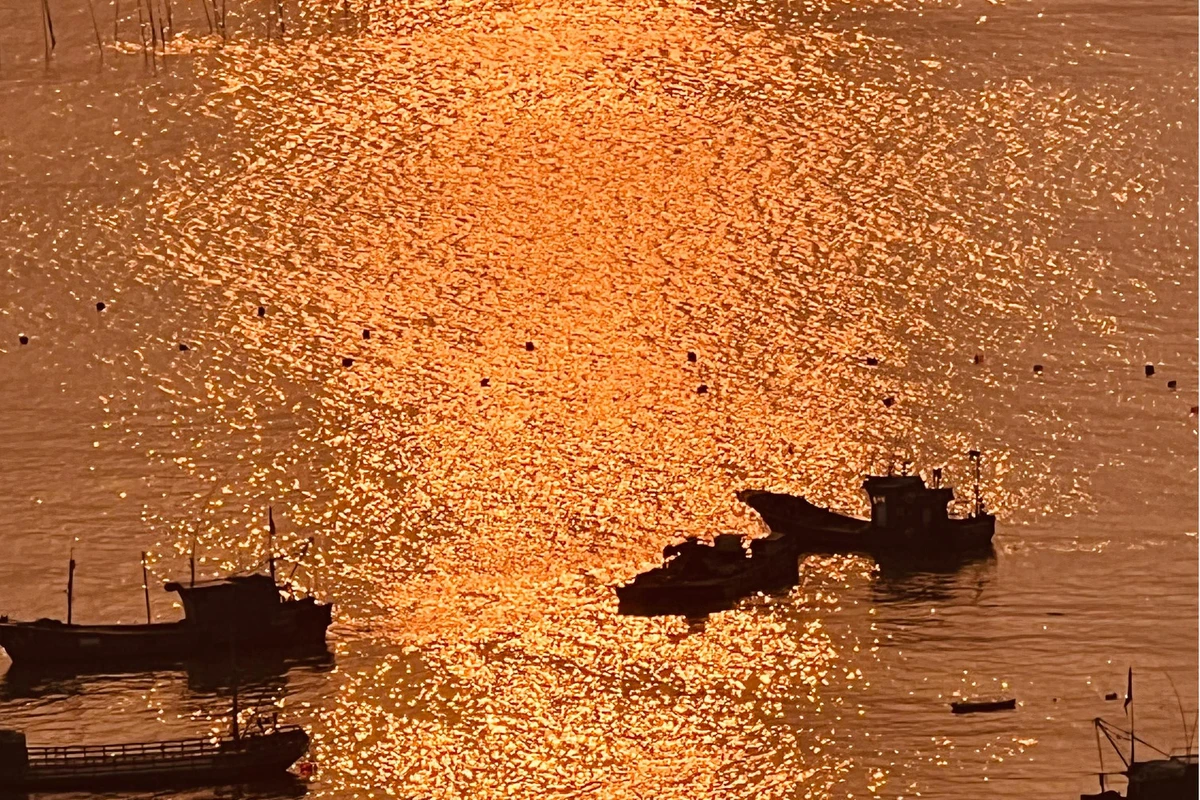
'75th Group' Zhejiang Trip (9) (The Seawater at Dongbi, Xiapu is Golden)
On the 26th, we leave Zhejiang Province today.
For this trip, the rental car order was to pick up the car at Wenzhou South Station and return it at Fuzhou South Station, with no extra fee for returning the car at a different location.
We decided to stay one night in Xiapu, Fujian Province, on the way to Fuzhou.
Xiapu is located in Ningde City, Fujian Province, with a long coastline (505 km long). The Xiapu mudflats are known as "the most beautiful mudflats in China." At sunrise or sunset, the mudflats display countless patterns with changing light and shadow, accompanied by melodious fishing songs, creating a warm and tranquil fishing village scenery.
At 08:40 in the morning, we left Yantou Town in Nanxi River and drove to Xiaohao Village in Xiapu, Fujian Province.
Transportation: Navigate to "Xiapu Xiaohao Village."
From Nanxi River Yantou Village (southbound) via: Wenzhou Ring Expressway, Shenhai Expressway to Xiapu Xiaohao Village: 233 km, 6 traffic lights, 3 hours 40 minutes.
We took a break at Taoshan Service Area along the way.
Self-driving trips rely on maps; real-time map navigation provides the latest traffic information promptly.
At noon, we exited the Shenhai Expressway at Sansha exit and turned east onto National Highway G228.
Right after exiting the expressway, we arrived at Longtou Village in Xiapu County. We continued east for 3.5 km to reach Xiaohao Village.
Xiaohao Beach is a must-visit for photographers coming to Xiapu. With the ebb and flow of tides, seasonal changes, and the rising and setting of the moon and sun, Xiaohao presents itself in a brand new form every day.
Xiaohao is nestled between mountains and the sea. The beach is mainly sandy mudflats, with a winding stream cutting through, creating complex and varied textures. In the evening, under the setting sun, contrasting warm and blue tones emerge.
Therefore, the scenery of Xiaohao is best enjoyed in the evening.
We arrived at Xiaohao at noon on the 27th day of the lunar calendar, during low tide. Thick clouds blocked the sunlight, making the scenery plain.
Xiaohao Village now has four or five rows of neat buildings, with many homestays to choose from.
There is a seafood restaurant by the beach, where we ordered several kinds of seafood.
Our main purpose in coming to Xiapu was to see the beautiful sunset at Dongbi.
At 2:30 p.m., we left Xiaohao and drove to Dongbi.
Transportation: Navigate to "Xiapu Dongbi Village."
From Xiaohao Village (eastbound) via: G228 to Xiapu Dongbi Village: 6 km, 16 minutes.
To the right of National Highway G228 is the sea.
We passed by the Sansha Light and Shadow Boardwalk along the way.
We had been here nine years ago; it is a sea-viewing boardwalk. Today, we stopped to walk a section of the Sansha Light and Shadow Boardwalk again. The iron sign reading "Sansha Light and Shadow Boardwalk West Entrance" was already rusty, and the weeds at the entrance were taller than a person.
Ahead was a Y-junction; the left road led uphill to Dongbi Village.
Since it was still early, we chose the right road toward Sansha Town, which was a port-access highway.
The map showed us driving over the sea; this section of the port-access highway was built on reclaimed land.
There was a building extending into the sea by the roadside, with several parking spaces nearby.
Upon closer look, it was the "Xiapu Marine Station of the Ministry of Natural Resources."
A fisherman was fishing on the rocks by the sea.
Continuing east, we came to the Sansha Harbor.
After stopping and going, we arrived at Sansha Town.
We turned back and drove to Dongbi Village.
Dongbi Village is located in the south-central part of the Sansha Peninsula, Xiapu County, Ningde City, Fujian Province, 28 km from Xiapu city. It is a small fishing village built on the mountainside, facing the sea.
The houses in Dongbi Village are built along the hillside, layered and well-arranged. A street called Sansha Street runs through the village from south to north.
Most buildings along Sansha Street have been converted into homestays. At the seaside homestays, you can open the window to see the sea.
Several newly built homestays are uniquely decorated and have high room rates.
We chose the "Puyin Haigu" homestay, with rooms facing the sea.
Most homestays in Dongbi do not have their own parking spaces. There is a church north of Puyin Haigu homestay, and behind the church, a parking lot on a hillside can accommodate dozens of cars.
There are multiple surveillance cameras along Sansha Street. Within minutes of stopping to unload our luggage, we received a traffic violation notice from the traffic police website.
Our room had a balcony facing west and the sea, with a wide view, overlooking the area, ideal for watching and photographing the sunset.
Dongbi is a small fishing village. Many fishing boats were anchored in the harbor.
The sun was hidden behind the clouds; we wondered if it would show its face.
To the east, a row of newly built homestays featured white walls and floor-to-ceiling windows. A lighthouse stood by the sea.
Halfway up the mountain, there were several viewing platforms built on giant rocks. A few cars were also parked by the road at the foot of the mountain. These spots offered great views of the sea and sunset.
Finally, the sun appeared, and the western sea surface glittered with golden light.
As the sun sank lower, the golden reflections on the sea kept changing, first becoming brighter, then slowly fading...
According to the homestay owner, it had been raining continuously in Xiapu for a while, and the rain had only stopped two days ago. We were lucky to enjoy the sunset at Dongbi after just one night's stay.
A seafood restaurant was right across from the homestay, where we tasted Xiapu seafood.
Reflection: If you choose a homestay facing the sea in Dongbi and stay one night, as long as it's not raining or heavily cloudy, the sunset scenery of Dongbi Village will surely captivate you.