A May Trip to Fujian: Mountains, Seas, and Tulou
From May 6 to 17, 2025, A Li traveled clockwise around most of Fujian with a tour group. During the twelve-day itinerary, we visited Wuyi Mountain in Nanping City, Yuanyangxi Grand Canyon, Baishuiyang Scenic Area, Taimu Mountain, Xiaohao Tidal Flats, and Yangjiaxi Banyan and Maple Forest Scenic Area in Ningde City, Three Lanes and Seven Alleys in Fuzhou City and Haitan Island in Pingtan, Meizhou Island in Putian City, Chongwu Ancient City in Hui'an and Kaiyuan Temple in Quanzhou City, Gulangyu Island and Xiamen University in Xiamen City, Dongshan Island and Nanjing Tulou in Zhangzhou City, and Changting Ancient City in Longyan City. This May trip to Fujian entered from the northwest and exited from the southwest. Along the way, we saw Fujian's famous mountains, beautiful seas, and renowned Tulou.
Fujian has many famous mountains, the most famous being Wuyi Mountain and Taimu Mountain.
Our first stop in Fujian was Wuyi Mountain. Wuyi Mountain is in northwest Fujian, at the border between Fujian and Jiangxi. It features Danxia landforms, known as "clear water and red cliffs." The clear water mainly refers to the Nine-Bend Stream, which winds like a green ribbon around many strange peaks and steep cliffs. Bamboo rafts carry tourists downstream on the stream. Clear water, bamboo rafts, and cliffs form a beautiful landscape painting in Wuyi Mountain.
The red cliffs in Wuyi Mountain are countless—Great King Peak, Man Pavilion Peak, Tiger Roar Rock, Jade Maiden Peak, Immortal Palm Peak, Hidden Screen Peak, and Heaven Tour Peak stand beside the Nine-Bend Stream, each with unique features. Among them, Heaven Tour Peak, located north of the sixth bend of the Nine-Bend Stream, is the most famous, a core scenic spot of Wuyi Mountain, known as the first scenic wonder of Wuyi Mountain.
A Li and travel companions climbed Heaven Tour Peak together. That day, the red sun hung high, the sky was blue and clouds white, with no fog to block our view. Wuyi Mountain unfolded its landscape scroll before us without reservation. We climbed from the foot to the top, fully experiencing the steepness and danger of Heaven Tour Peak: because the path was narrow, the uphill route was one-way, only ascending, not descending; after Half-Mountain Pavilion, we had to climb the 848 narrow stone steps of Heaven Tour Stairs step by step; we had to pass the smooth, reddish-brown "Carp's Back," flanked by steep cliffs and deep valleys over a hundred meters deep, and extremely narrow, only about one meter at the narrowest; the steepest section near the summit had a slope of nearly seventy degrees, with the feet of the people ahead level with the heads of those behind. Fortunately, no matter how dangerous the climbing path, sturdy guardrails lined the way. A Li held the railings and forged ahead, finally successfully reaching the summit—though sweat soaked through clothes.
During the climb, we also appreciated the magnificent scenery of Wuyi Mountain: surrounding peaks towering, knife-edged dark brown cliffs contrasting sharply with the green trees at their feet and summits; the Nine-Bend Stream, like a jade belt, winding bend after bend, carrying bamboo rafts full of tourists eastward around the mountains; and a waterfall leaping from the eastern cliff, as if Li Bai's lines "Flying down three thousand feet, as if the Milky Way fell from heaven" were written for it... When we reached the top of Heaven Tour Peak, looking up at the Heaven Tour Pavilion, and looking down at the mountains and the Nine-Bend Stream, it was incredibly beautiful! The fatigue of climbing instantly vanished. No wonder some say, if you come to Wuyi Mountain and don't climb Heaven Tour Peak, it's as if you never came!
The descent path from Heaven Tour Peak was much wider and gentler than the ascent path, so we quickly went down—descending Heaven Tour Peak is easier than ascending.
As for other peaks on Wuyi Mountain, A Li did not climb them. Only on the way to and from Heaven Tour Peak did we pass the foot of Immortal Palm Peak (also known as Drying Cloth Rock) and Hidden Screen Peak twice. Later, A Li went to Wuyi Palace. There, standing under a parasol tree full of blossoms, A Li looked up at the majesty of Great King Peak; then walked to the side of the Nine-Bend Stream, lowered head to appreciate the gently flowing clear waves, raised head to admire the imposing Man Pavilion Peak to the right of Great King Peak, and from afar paid respects to the jade countenance of Jade Maiden Peak beside the second bend.
As for Tiger Roar Rock beside the second bend, A Li originally intended to go, even took the scenic area shuttle to the entrance. But the staff said it would take at least two hours to go up and down! It was 3:30 PM, and A Li had already climbed Heaven Tour Peak, toured Wuyi Palace and its surroundings, passed through the test of One Line Sky, and knee joints began to ache dully. Travel companions said it would take too long to go up and down, so they didn't go; A Li didn't go either—luckily, because a group member who went up Tiger Roar Rock later told A Li: going up and down took at least three hours.
Thus, A Li missed seeing the other peaks along the Nine-Bend Stream in person, because A Li also didn't take a bamboo raft on the Nine-Bend Stream.
However, A Li had no regrets, because at Wuyi Palace, A Li saw the long poem "Song of the Nine-Bend Oars" by Zhu Xi, a Neo-Confucian scholar of the Southern Song. After reading the entire poem, A Li effortlessly enjoyed all the scenic wonders along the Nine-Bend Stream without exerting effort or spending money on a bamboo raft ticket.
Zhu Xi's "Song of the Nine-Bend Oars" was not written based on a landscape painting of Wuyi, but created after he personally boated there. In those years, Zhu Xi built the Wuyi Academy at the foot of Hidden Screen Peak on Wuyi Mountain, gathering disciples to lecture, making it a famous academy at the time. In his spare time from lecturing, Zhu Xi toured all of Wuyi's landscapes. During that time, Zhu Xi and his friends boarded a small boat at Wuyi Palace, going upstream against the Nine-Bend Stream from the first bend to the ninth. Thus came the "Song of the Nine-Bend Oars"; thus, from then on, people could enjoy the scenery of the Nine-Bend Stream without making a personal trip:
Song of the Nine-Bend Oars
On Wuyi Mountain there are immortals, below the mountain cold streams clear at each bend. If you want to know the most extraordinary places, listen to a few lines of the oars song.
At the first bend, by the stream, board the fishing boat; Man Pavilion Peak's shadow dips into the sunny stream. The rainbow bridge once broken, no news; thousands of ravines and cliffs locked in green mist.
At the second bend, the lofty Jade Maiden Peak, with flowers in hair by the water, for whom is she adorned? The Taoist does not dream of the balcony, but goes into the front mountains' several layers of green.
At the third bend, look at the shelf boats in the cliffs; no one knows how many years since the oars stopped. Mulberry fields and seas are now like this; bubbles and candle flames, can one not pity oneself?
At the fourth bend, east and west two stone cliffs; cliff flowers hang down, blue and tangled. The golden rooster crows but no one sees; the moon fills the empty mountain, water fills the pool.
At the fifth bend, the mountain is high and clouds deep; long times of misty rain darken the level forest. In the forest there is a guest no one knows; amidst the sound of oars, an eternal heart.
At the sixth bend, the green screen surrounds the blue bay; thatched huts all day close the brushwood gate. When guests come, leaning on oars, cliff flowers fall; apes and birds are not startled, spring idleness.
At the seventh bend, move the boat up to the blue shoal; Hidden Screen and Immortal Palm look back again. Yet pity last night's rain on the peak; added several cold flying springs.
At the eighth bend, wind and mist are about to open; under Drum Tower Rock, water swirls around. Don't say this place has no fine scenery; only because tourists don't come up.
At the ninth bend, nearing the end, the eyes open wide; mulberry, hemp, rain, dew see the flat plain. The fisherman seeks further the way to Peach Blossom Spring; besides this world, is there another heaven?
Another famous mountain in Fujian is Taimu Mountain, located in northeast Fujian, at the border between Fujian and Zhejiang. It stands on the coast of the East China Sea, known as the "Fairy Capital on the Sea." Taimu Mountain, together with Wuyi Mountain and Yandang Mountain in Zhejiang, are called the "Three Great Fairy Mountains of Fujian and Zhejiang"—A Li was very honored to have traveled to all three: last autumn, A Li visited Yandang Mountain with a tour group.
Taimu Mountain is in Ningde City, belonging to the Ningde World Geopark together with Baishuiyang Scenic Area and Yuanyangxi Grand Canyon. After leaving Wuyi Mountain, we went to Ningde. First we visited Yuanyangxi, then Baishuiyang, and finally Taimu Mountain.
Yuanyangxi Grand Canyon is part of the Jiufeng Mountains in Fujian. The canyon is full of peaks, ravines, and dense forests. In autumn and winter, thousands of mandarin ducks fly here to feed and winter in the canyon stream, hence the name Yuanyangxi (Mandarin Duck Stream).
The scenic area is large, the canyon deep, and the weather was sometimes cloudy and rainy. A Li and travel companions only walked the small loop route. We saw the Trumpet Waterfall, like a fairy's skirt, and the spectacular Hundred-Zhang Waterfall, 150 meters high, in the Jiufeng Mountains; we saw the beautiful scenery of rising mist in the canyon, and macaques playing in trees and on the ground. Unfortunately, the Lingyun Plank Road, built on the waist of two peaks, was closed, so we couldn't take the shortcut out of the scenic area via the plank road. By then, our remaining time was short; without the Lingyun Plank Road, we had to continue climbing up from the canyon, taking a much longer route to exit. Time was tight, so we had no choice but to speed up. We focused solely on fast climbing, panting heavily, more tiring than climbing Heaven Tour Peak on Wuyi Mountain—climbing Heaven Tour Peak was not rushed, we could climb slowly. After great effort, we finally climbed up from the canyon, exited the scenic area smoothly, and boarded our bus before the scheduled gathering time.
Although the Jiufeng Mountains are not as famous as the Wuyi Mountains or Taimu Mountains, A Li experienced their steepness through visiting Yuanyangxi Grand Canyon!
After leaving Yuanyangxi Grand Canyon, we went to Baishuiyang Scenic Area. Baishuiyang and Yuanyangxi are actually the same stream; Baishuiyang is the upper reaches, Yuanyangxi the lower reaches.
Baishuiyang Scenic Area features a rare natural shallow water square. The flat stream bed of the shallow water square is paved with intact volcanic rock, without gravel, so walking barefoot on it, there is no worry about getting feet pricked. The widest water surface is 182 meters, and the square covers tens of thousands of square meters. The water is not deep; you can wade across the stream or play in the water.
When we arrived at Baishuiyang, a vast expanse of white water spread out before us, quite spectacular—this is also the origin of the name Baishuiyang (White Water Ocean). Although the scenic area issued a pair of white socks to each person when selling tickets, to be worn on feet for slipping prevention when entering the water, and the rain had stopped, because the temperature was low that day, basically no one took off shoes to enter the water. Everyone just played with water at the streamside and took photos. Only one group member walked upstream from the shallow water square, crossed the Double Dragon Bridge to the opposite bank; on the opposite bank, he followed the footpath to the shallow water square, then took off his shoes, waded back to our side. He confirmed: the water is indeed not deep, the bottom is indeed flat without gravel, and walking is not slippery. A Li thus imagined: in summer, how many tourists would be in Baishuiyang shallow water square! How lively the water play would be then!
Yuanyangxi Grand Canyon and Baishuiyang Scenic Area are famous for waterfalls and shallow water, while Taimu Mountain is famous for strange peaks, grotesque rocks, and dangerous caves. The reason Taimu Mountain has so many strange peaks, grotesque rocks, and dangerous caves is related to its granite landforms—the granite bodies formed millions of years ago, under the long-term carving of the great artist Nature, eventually formed numerous varied and fascinating granite landscapes on Taimu Mountain.
A Li believes that the most classic granite likeness landscape on Taimu Mountain should be the Husband and Wife Peak. The first stop we reached by the scenic area shuttle was named after it: Husband and Wife Peak Square. We got off at the square and started climbing. There are countless smooth huge rocks on the mountaintop; Husband and Wife Peak is one of them. When A Li first looked, he couldn't identify it among that large group of rocks, but later, after reading the sign by the roadside, he quickly recognized it, and the more he looked, the more it resembled—the signs on Taimu Mountain have not only text but also photos. Husband and Wife Peak is not the tallest among the rocks, but it is the most vivid: it consists of two stones, one taller and one shorter, with a thin gap in between, shaped like a couple embracing. As for the many other formations we encountered along the way, such as Welcoming Guest Peak, Immortal Old Men Playing Chess, Golden Cat Catching Mouse, Immortal Sawing Board, Immortal Palm Rock, Golden Turtle Climbing Wall, and Brush Holder Peak, without reading the roadside signs and photos and using ample imagination, it was hard to agree with their names.
A Li believes that the most dangerous granite cave on Taimu Mountain is One Line Sky. A Li climbed One Line Sky on Wuyi Mountain and passed through easily. Arriving at Taimu Mountain, going through One Line Sky again, A Li found it difficult to walk straight; only by turning sideways could he squeeze through with difficulty. Taimu Mountain's One Line Sky is not only narrow but also very long, very high, and very dark inside; one has to grope forward—if not careful, the head hits the granite wall or the knee is blocked by the wall. To pass, you not only need to turn sideways but also lower your head and bend your waist.
A Li believes that the most peculiar building on Taimu Mountain should be the Main Shrine of Yi Pian Wa Chan Temple. Yi Pian Wa Chan Temple itself is very peculiar: first built during the Wanli reign of the Ming Dynasty, located in a cave near the Nine Carp Leaping Skyward Peak on Taimu Mountain, covered by a huge rock like a tile, hence the name Yi Pian Wa Chan Temple (One Tile Chan Temple). Its Main Shrine is even more peculiar: it is the first and only hanging copper hall in China, made entirely of copper, using over 150 tons of copper; construction took ten years—started in early 2001, completed in late 2011; the Main Shrine backs onto Nine Carp Leaping Skyward Peak, left by Ascending to Heaven Stone, right adjacent to Lotus Peak, below a deep valley, overlooking the East China Sea in front, suspended in the air. The entire building, set against the cliffs of Taimu Mountain, appears extremely solemn and majestic.
A Li walked via the plank road on the cliff to the front of the hanging Main Shrine, couldn't help praising its unique design and grand momentum. Passing through the Main Shrine to its back, he saw a seven-story golden pagoda towering on the platform, complementing the splendid Main Shrine. Truly wonderful!
After touring Taimu Mountain, our mountain-seeing itinerary for this May trip to Fujian ended. And our sea-seeing itinerary was about to begin. We started from the seaside of Xiapu in northeast Fujian, heading south along the coastline, all the way to the seaside of Dongshan Island in southeast Fujian. From the coast of the East China Sea to the coast of the South China Sea, the sea accompanied us all the way.
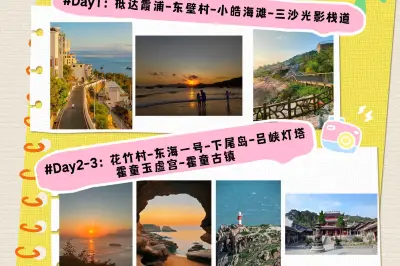
Xiapu County, Ningde City, on the northwest coast of the Taiwan Strait, is the hometown of kelp and laver in China. We went to Xiaohao Tidal Flats and Sansha Light and Shadow Plank Road, and saw the tidal flats and the sea. The sea color there was not very blue, somewhat whitish. There were many orderly markers in the sea, like fields on the sea.
We also went to Yangjiaxi Banyan and Maple Forest Scenic Area in Xiapu. It was the season when loquats were ripe, with small stalls selling loquats by the roadside. Our bus stopped briefly at a stall; someone got off, bought a small basket of loquats, tasted them, and said they were delicious. So everyone got off to buy. A Li also bought some, and they were indeed tasty. The scenic area has banyan trees and maple trees, as well as old oxen and white geese, but more loquat vendors. Loquats were packed in small baskets according to size, golden and appetizing.
Heading south from Xiapu, we passed through Fuzhou, visited its Three Lanes and Seven Alleys area, and saw Fuzhou's internet-famous tree: the Heart Tree—a banyan tree shaped like a heart on Nanhou Street. However, some said it looked more like a peach, and others said it resembled a plump bottom. Then we boarded Haitan Island in Pingtan County, Fuzhou.
The scenery of Haitan Island in Pingtan is very distinctive—here, west of the Taiwan Strait, there are many islands and reefs, strong sea winds, and large waves. We went to the 68-Sea-Mile Scenic Area, strolled on Houyan Island, Yanhou Island, and Xianshan Island, gazed into the distance in wind and rain, looking toward the treasure island east of the strait—this is only 68 nautical miles from Hsinchu Port in Taiwan, the closest point of mainland China to Taiwan Island. Due to weather and limited eyesight, A Li did not see the treasure island, only saw Niushan Island in the distance. But not seeing it didn't matter, because the planned Beijing-Taipei Expressway will pass through Pingtan; then we can take a bus to visit the treasure island.
We also went to the Immortal Well Scenic Area. The Immortal Well is not actually a well, but a circular stone cliff shaped like a well by the sea, a rare volcanic rock sea-erosion skylight landform in China. It is over 40 meters deep, with a mouth diameter of over 50 meters, and three holes at the bottom connecting to the sea. We stood by the well and looked down into the bottom; waves surged into the well through the three holes, constantly hitting the walls and tearing at each other, roaring, sending a chill through A Li.
On the evening we arrived in Pingtan, some group members went to the seaside to chase Blue Tears—Pingtan Haitan Island's Blue Tears are famous far and wide; many people come to Pingtan mainly to see Blue Tears. So-called Blue Tears are not actually blue tears. They are the pale blue light emitted by bioluminescent plankton in the sea when hit by waves; when there are many such plankton, they form a fluorescent blue sea, like the sea shedding tears. Blue Tears do not appear on all coasts, nor every night. They can only be seen on specific nights in specific locations during specific seasons. The group members who went to see Blue Tears left at 8 PM and didn't return until midnight—the distance was not far, but that night there were too many people watching Blue Tears, and the road to the seaside was blocked by cars. Fortunately, they were lucky and finally saw Blue Tears, making the long traffic jam worth it. A Li did not go to see Blue Tears, but A Li's travel companion went, and group members shared their Blue Tears photos in the group chat, so A Li indirectly saw Pingtan's Blue Tears.
The traditional dwellings on Haitan Island in Pingtan are also very distinctive. The walls of these houses are built of stone, the roofs tiled, and stones placed on the tiles. This kind of house is called stone cuo (stone house). A Li saw this architectural form for the first time and guessed it must be related to the strong sea winds.
In the following days of the itinerary, we continued south. We went to Meizhou Island in Putian, visited the grand Mazu Ancestral Temple, admired the beauty of Meiyu Tide Sound Scenic Area at the north end of Meizhou Island and the Goose Tail Marine Erosion Geological Park at the south end, where the sea and sky merge into one;
We went to Chongwu Ancient City on the Chongwu Peninsula in Hui'an, Quanzhou, strolled through the coastal stone city built in the Ming Dynasty to resist Japanese pirates, paid respects to the tall stone statue of Ming anti-pirate general Qi Jiguang standing by the sea; A Li also identified the meteorological boundary between the East China Sea and the South China Sea;
We went to Kaiyuan Temple in Quanzhou, visited its famous east and west stone pagodas built of granite;
We went to Gulangyu Island, the garden on the sea in Xiamen, climbed Sunlight Rock, saw many many old buildings, visited the Piano Museum, Zheng Chenggong Memorial Hall, Lin Qiaozhi Memorial Hall, etc.; after returning from Gulangyu, we also strolled briefly on Xiamen University campus on Xiamen Island, and looked up close at the 300-meter-tall Xiamen Twin Towers (Shimao Strait Tower).
Our sea-seeing itinerary ended at Dongshan Island in Zhangzhou City.
Dongshan Island is known as the Oriental Maldives, with rapid tourism development. It has many crescent-shaped beautiful bays, with fine, soft, white sand. The sea there is extremely azure, with many oddly shaped islands in the sea, and a winding coastline.
The day we landed on the island, the sun was exceptionally bright, the sky and sea especially blue, the clouds particularly white, the wind remarkably strong, and the trees very green. We first went to the Wind Rock Scenic Area, saw the Wind Rock that has withstood typhoons and earthquakes, then went to Nanmen Bay. By the Nanmen sea wall, large umbrellas were set up; tourists could buy some food and drink from the umbrella owner and sit on chairs under the umbrella, enjoying delicious food and cool sea breeze while feasting their eyes on the blue sky, white clouds, and white sand. A Li did not sit but strolled along the sea wall. On one wall, A Li saw a set of promotional posters, thus learning a touching history of Dongshan Island:
It turned out that the Nanmen sea wall where A Li was strolling did not exist from ancient times. In September 1962, a typhoon destroyed the original sea wall of Nanmen Bay, causing widespread destruction of houses and flooding of people's homes. The then Party Secretary of Dongshan County, Gu Wenchang, led the people to overcome difficulties and rebuild the sea wall. In less than a year, the sturdy Nanmen sea wall was completed, and no later typhoon ever destroyed it.
A Li later learned that Dongshan Island in the past was a barren island, lacking fresh water, with tens of thousands of mu of desertified sandy beaches. When strong winds blew, sand dust flew, invading villages and swallowing farmland; the people suffered greatly from wind and sand damage and water shortage. Gu Wenchang led the people of Dongshan Island to build dikes to block sand, carry soil to press sand, plant grass to stabilize sand, and plant trees to prevent sand, planting over 200,000 casuarina trees on the barren sandy beaches, building reservoirs and digging wells to irrigate farmland. After more than ten years of hard work, Gu Wenchang and the people of Dongshan transformed the barren island into an oasis.
A Li had known about Jiao Yulu's deeds from the text "The County Party Secretary's Example—Jiao Yulu": in the 1960s, the then Party Secretary of Lankao County, Henan Province, Jiao Yulu led the people to fight against the three scourges of waterlogging, wind and sand, and saline-alkali land, effectively controlling them through methods such as turning over silt to press sand, turning over silt to press alkali, sealing sand dunes, and planting paulownia trees.
A Li originally thought that wind and sand disasters only occurred in the north; he didn't expect them at the southern seaside. Fortunately, no matter north or south, there were people like Jiao Yulu and Gu Wenchang leading the people to fight natural disasters, just as in ancient times when Yu the Great led the people to control floods. Lu Xun once said in his article "Have the Chinese Lost Their Self-confidence?": "Since ancient times, we have had people who work hard, people who fight hard, people who plead for the people, and people who sacrifice themselves for the truth." The deeds of Jiao Yulu and Gu Wenchang prove that Lu Xun's words are true!
After the sea-seeing itinerary, we were going to see the Fujian Tulou.
Fujian Tulou appeared as early as the Song and Yuan dynasties. They are large rammed-earth residential buildings built by Hakka people who migrated from the Central Plains to Fujian, fully reflecting the unity, wisdom, and tenacity of the Hakka, and are known as "Oriental Castles." Tulou exist in Zhangzhou, Longyan, Quanzhou, etc. We only visited the Tulou in the Yunshuiyao Scenic Area in Nanjing, Zhangzhou.
There are many Tulou in Yunshuiyao, some square, some round, with yellow walls and black tiles, very striking. The most famous here are Hegui Lou and Huaiyuan Lou.
Hegui Lou was first built in the tenth year of the Yongzheng reign of the Qing Dynasty (1732); it is a square Tulou. Facing east, it has five stories, with 28 rooms on each floor, a total of 140 rooms. Hegui Lou is 21.5 meters high, the tallest among Fujian Tulou. Such a large building has only one gate in the center of the first floor, with a plaque above the gate reading "Hegui Lou" and couplets on both sides: "He qin ji kang lu, gui zi gong xian sun" (meaning harmony brings blessings and prosperity, noble sons and worthy grandsons).
Hegui Lou is the main building; in front of it, a low small Tulou blocks it—this small Tulou is called Hu Cuo (protective wing), which used to serve as kitchen, storage, and guest rooms, auxiliary space. Inside Hegui Lou, rooms on each floor are mainly built of wood; at the four corners of the building, there are wooden stairs to go up. In the courtyard, besides two wells, there is a single-story square small Tulou in the center, with only three rooms, also containing a small courtyard—this is their ancestral hall and private school. So Hegui Lou has a tower outside a tower and a tower inside a tower.
A Li had heard about Fujian Tulou long before, and seen many photos, but when seeing them in person this time, he couldn't help marveling at their ingenious design. Even more surprising to A Li was that Hegui Lou was built on a swamp, yet after more than 290 years and several earthquakes, it has neither collapsed nor sunk. A Li climbed from the first floor to the fifth, walking around the circular corridor on each floor, feeling the heavy historical sense of Hegui Lou. From the third to the fifth floor, there are eaves extending out from the corridors—eaves provide rain and sun protection, and can be used to dry items. Looking down from above, the four layers of eaves are neat and orderly. A Li, on the fifth floor, specifically looked at a room's window: the window was not large, with red lanterns hanging outside, and one could see the green trees and mountains behind the Tulou. The thickness of the window wall surprised A Li again: the rammed earth wall was nearly a meter thick! One can imagine the thickness of the first-floor walls—the first-floor walls are mainly made of stone, while walls above the first floor are mainly rammed earth, with thickness decreasing upwards. No wonder Tulou also had functions of preventing bandits, theft, fire, and water.
Huaiyuan Lou was first built in the thirty-first year of the Guangxu reign of the Qing Dynasty (1905); it is a four-story circular Tulou, 38 meters in diameter, with 34 rooms on each floor, a total of 136 rooms. Inside, there are also four staircases. Huaiyuan Lou also has only one gate, with a plaque reading "Huaiyuan Lou" and couplets on both sides that hide the first characters of the lines: "Huai yi de dun yi ren jie ci xiu qi zun zu xun, Yuan er shan jin er shui ping zi ling xiu yu ren wen" (meaning embrace virtue and benevolence to cultivate oneself and follow ancestral teachings; distant mountains and nearby waters rely on this spiritual beauty to nurture culture). In the courtyard, there is a circular small Tulou, which is the ancestral hall and study.
In the Yunshuiyao Scenic Area, besides Hegui Lou and Huaiyuan Lou, there are many other distinctive Tulou, such as the square Jinshi Lou (Jinshi meaning successful candidate in imperial exams), with a semicircular pond in front reflecting the building; the circular Cuimei Lou, which has no ancestral hall in its circular courtyard, and each floor has eaves.
After seeing the Nanjing Tulou, our May Fujian trip was about to end.
Our last stop was Changting Ancient City in Longyan.
Changting is located in southwest Fujian, bordering Ruijin, Jiangxi to the west; historically called Tingzhou. As the "Hakka Capital," Changting is an important birthplace of Hakka culture and the largest Hakka settlement in Fujian. Changting is also a famous old revolutionary base area—during the Agrarian Revolution, it was the seat of the Fujian Soviet Government, the economic and cultural center city of the Central Soviet Area, and one of the four starting places of the Central Red Army's Long March.
In the ancient city, we saw the ancient city gate Guangchu Gate and the Sanyuan Pavilion above it, visited the Confucian Temple, strolled through Diantou Street, walked on the ancient city wall along the Ting River (the mother river of the Hakka), and finally arrived at the General Yang Chengwu Square. The square is large, with a bronze bust of General Yang Chengwu and the Yang Chengwu Memorial Hall on the east; on the west are the Monument to Martyr Qu Qiubai, the place where Comrade Qu Qiubai was executed, and the Qu Qiubai Memorial Hall.
Everyone knows the name Qu Qiubai; he was one of the early main leaders of our Party. Qu Qiubai was from Changzhou, Jiangsu; why are his monument and memorial hall in Changting? It turns out that after the Red Army's Long March in October 1934, Qu Qiubai remained in Ruijin, Jiangxi, continuing revolutionary work. In February 1935, Qu Qiubai was captured in Changting, Fujian, and in June of the same year, he was heroically executed there at the age of 36.
Many of us are not familiar with General Yang Chengwu (1914-2004). General Yang Chengwu was from Changting; he joined the revolution at age 15 and became a Red Army commander at 17. He participated in the five anti-encirclement campaigns of the Central Revolutionary Base and the 25,000-li Long March. During the Long March, at age 20, he was the pathbreaker, leading his troops to capture the Luding Bridge, cross snow mountains and grasslands, and break through the dangerous Lazikou. When they victoriously reached northern Shaanxi, at age 21, he led his troops in the Wuqi Zhen battle. During the Anti-Japanese War, he led his troops to participate in the Pingxingguan battle and the Hundred Regiments Offensive, and commanded the famous Huangtuling battle, where Lieutenant General Abe Norihide, the Supreme Commander of the Japanese "Mongolian Garrison Army," was killed in action; Yang Chengwu had just turned 25. During the Liberation War, he achieved many military exploits. After the founding of New China, he led troops in the Korean War, the Tibet Counter-insurgency, and the Vietnam War. In 1955, at age 41, he was awarded the rank of General.
General Yang Chengwu was wise and brave, excellent in battle, with outstanding achievements, praised by Mao Zedong as the "Zhao Zilong of the Army" (a legendary general known for daring to lead the charge). He was not only martial but also literary. Throughout his life, he wrote many works. Now, the high school Chinese textbook includes an excerpt from his memoirs, "Long Live the Victory of the Long March."
Martyr Qu Qiubai and General Yang Chengwu, one executed in Changting, one born in Changting, both dedicated their lives to New China, deserving of monuments and biographies by the people of Changting, and deserving our respect!
After visiting Changting Ancient City, our May Fujian trip officially ended. We left Fujian and returned home smoothly.
Now it is June, but A Li still savors the May trip to Fujian, reminiscing about the mountains, the seas, and the Tulou there.
A Li wants to say: Fujian's famous mountains, Fujian's beautiful seas, and Fujian's Tulou are worth a visit!
June 20, 2025