Gourmet Culture Tour - 8-Day Trip to Guangzhou and Surroundings
It's time for our annual reunion. We discussed whether to go to Guizhou or Dunhuang, but ultimately felt that December's climate wasn't ideal. She said, why not go to Guangdong to explore food. As a foodie, I and she who just wanted to gather with us all gladly agreed. With limited time to plan, we selected our desired destinations based on our preferences and found a private custom tour to arrange the route, car rental, accommodation, and ticket reservations. On the first weekend of December, we gathered in Guangzhou, embarking on our gourmet culture tour.
D1 Gather in Guangzhou, check in - First meal at Taotaoju - View the Pearl River night scene from Haizhu Bridge.
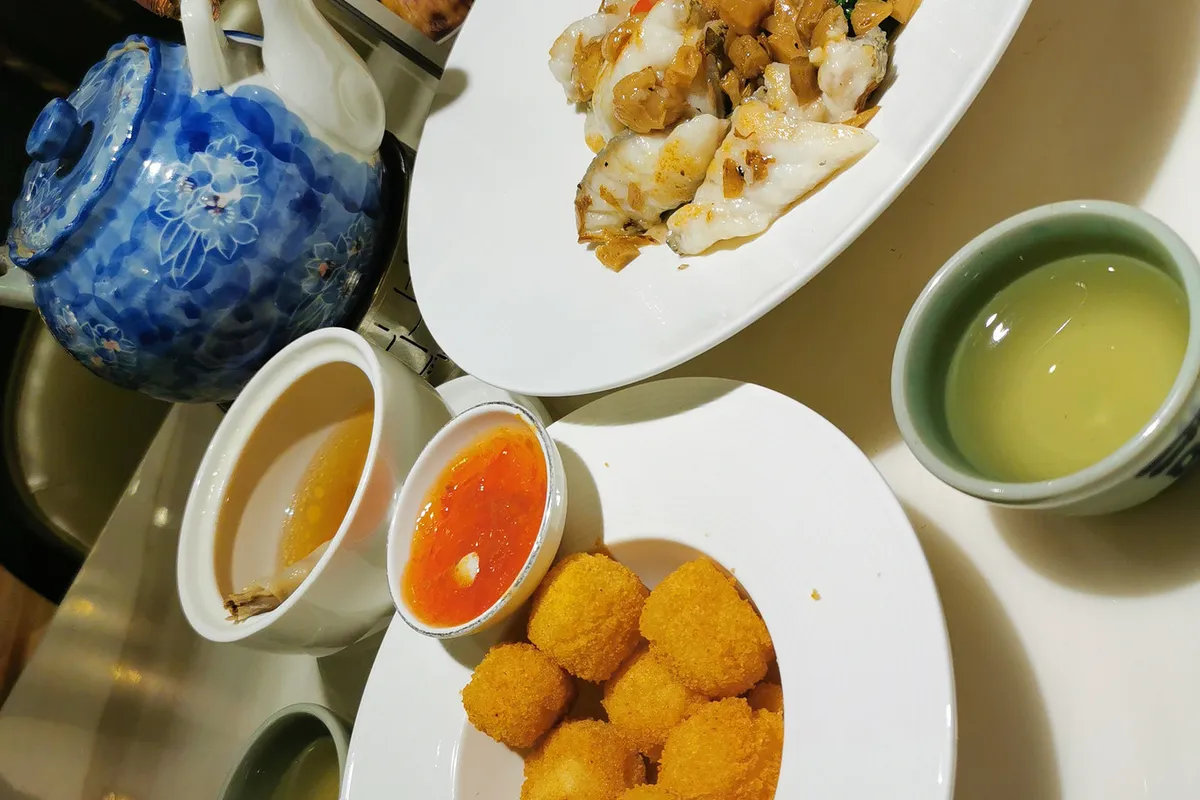
On Saturday afternoon, we embraced each other outside the airport arrival hall after a year apart. Though usually reserved, it was inevitable that three women together would be a lively scene; meeting was pure joy! Our dedicated driver was a post-90s guy from Henan, honest yet cheerful. On the way to the hotel, he chatted with us about Guangzhou's weather, answered our small questions, and smoothly confirmed the next day's car arrangements, naturally accepting our little jokes. After checking in, we tidied up and rested in the room. Seeing it was nearly 5 PM, we walked less than 500 meters to the famous Cantonese restaurant, Taotaoju. We went to the Jiefang North Road branch; the entrance was inconspicuous, and we almost walked past it. It is said that Taotaoju always has people waiting in line, but you can book online, which is convenient during peak hours. We arrived early; although there were already people waiting, we only waited about ten minutes for a table for three. Taotaoju's layout is quite distinctive: the first floor is the reception, and the dining areas are on the second floor and above. Later, we noticed that most larger Cantonese restaurants have this layout. The staircase was decorated with extremely colorful geometric patterns, somewhat like the stained glass windows of Gothic cathedrals, very striking yet not jarring or cluttered—quite unique! On the wall along the stairs were pictures and names of classic dishes, and we gladly decided to follow the pictures to order. This turned out to be a very wise decision! We wanted to eat everything we saw, but our stomachs were limited—it was so hard to decide! Later, we ate at Taotaoju several more times but never managed to try all the classics, like squab... I highly recommend the one-bite crispy tofu, stir-fried fish fillet (ban qiu), roast goose (a bit greasy), and pulled milk buns. After the delicious meal, it wasn't even 8 PM. With our round bellies, we felt we couldn't just go back, so we decided to go to the Pearl River to see the night scene and take a walk. We took Metro Line 2 to Haizhu Square, walked from Jiefang Bridge along Yanjiang West Road to Haizhu Bridge, crossed Haizhu Bridge, and then along Binjiang Middle Road back to Jiefang Bridge. These two bridges should be among the earlier bridges built on the Pearl River. The banks of the Pearl River in this area were decorated with lighting and mist devices, and there was a large commercial center nearby. Pleasure boats passed by from time to time on the river. It was clearly the Pearl River scenic belt—the night view was beautiful, giving a feeling of a street in the sky. Along Binjiang Road, many street performers gathered: some sang desolate, bold, or melodious songs performed by different singers not far apart; electric bands, Latin dancers, and a chalk artist with disabled legs all attracted passersby to stop and donate generously. Suddenly, Guangzhou's inclusiveness touched my heartstrings! From the ancient to the modern, politics to culture, family ethics... from high culture to earthly life, we started talking about food again around 10 PM. Indeed, dinner was already in the past. We took a taxi back to the hotel, looking forward to tomorrow's Guangzhou morning tea!
D2 Dian Du De Cantonese Morning Tea - Sacred Heart Cathedral - Chen Clan Ancestral Hall - Shangxiajiu Pedestrian Street - Shamian
At 8 AM, we walked about 300 meters to another famous Cantonese restaurant, Dian Du De, on Panfu Road. Compared to Taotaoju, Dian Du De is more down-to-earth in terms of dining environment, price, and delicacy of dishes, but the variety and taste of morning tea are still worth trying. Beef tripe, crystal shrimp dumplings, rice noodle rolls, and special congee are all good choices. After leaving the restaurant, the car was waiting for us, and we headed directly to the Sacred Heart Cathedral. It is a larger Catholic church in the Guangzhou diocese and one of the larger Gothic buildings in China, as well as one of the four fully stone-built Gothic cathedrals in the world. Historically, this cathedral was the site of the Guangdong and Guangxi Viceroy's office in the late Qing Dynasty, converted into a church by the invading British in 1863. The cathedral's spire is 58.5 meters high, majestic, and entirely built of granite. At the front, there is a pair of towering twin stone spires, with four large bronze bells brought from France in between. It is said that during non-Mass times, tourists can visit freely, but photography is prohibited inside. Non-Catholics can also participate in Mass. On religious holidays like Easter and Christmas, non-Catholics can also enter if the number of people is not too large. The original opening hours were Tuesday to Friday 8:30-11:30, 14:30-17:00; Saturday and Sunday 8:30-17:00. However, due to the pandemic, the church is not open to non-Catholics at this time, so we could only walk most of the way around the wall to see the exterior. Chen Clan Ancestral Hall was built in the 14th year of the Guangxu reign (1888). It is a well-preserved representative late Qing folk building in Guangdong, originally built to provide accommodation for scholars from the clan coming to Guangzhou for the imperial examinations. Entering the hall from the entrance, we toured in a zigzag pattern, visiting in order: the main hall (double-sided hollowed-out wooden screen doors), the terrace (stone carved railings and cast-iron openwork balustrades), the second hall Juxian Hall, the rear hall central hall, the east rear study, and the front east wing. Throughout the halls, corridors, courtyards, doors, windows, railings, ridges, brick walls, beams, and shrines, traditional architectural decorations such as wood carving, stone carving, brick carving, pottery sculpture, plaster sculpture, and cast iron craft are ubiquitous, with vivid shapes and rich colors. Besides sculptures, the painted murals are not to be missed. Thousands of murals, no two alike, all rely on the artists' rich imagination—worth savoring. Opening hours: 9:00-17:30 all year round (last admission 17:00). Shangxiajiu Pedestrian Street is located on Shangjiu Road, Xiajiu Road, and Dishifu Road in Liwan District (commonly known as Xiguan) of Guangzhou. It is over 800 meters long and is a famous commercial street in the city center. It was built in the early 20th century, combining Southern European architectural features with traditional Xiguan architectural style, and also incorporating Manchu-style decoration from the north. The street is full of delicious food. We chose beef rice noodles at Laoxiguan for lunch and bought a fruit mix to supplement vitamins. On the way to Shamian, someone was attracted by cat poop coffee, so we stopped to taste it. Looking at the map, Shamian should be an island in the Pearl River, with over 150 European-style buildings, of which 42 are particularly distinctive, including Neo-Baroque, Neo-Gothic, arcade-style, Neoclassical, and Chinese-Western fusion. The well-known No. 2-6 Shamian Street, commonly called the Red Building, was originally the club for customs foreign and Chinese staff. It is three stories high, built with red bricks, with pointed attic towers on the south and north, imitating 19th-century English Romantic architectural style. Shamian's streets and alleys are also dotted with statues, pavilions, flower beds, wooden benches, fountains, and other Western street elements, showcasing Guangzhou's European atmosphere in the 19th century. Hidden within these buildings are some art galleries, specialty restaurants, tea rooms, bars, etc. This is a leisure spot for local residents and seems to be a favorite dating place for couples. Everywhere you see children and elderly enjoying family happiness, content square dancers, and couples embracing, smiling, and whispering...
D3 Taotaoju Morning Tea - Yuexiu Park - Yuyin Shanfang - Check in at Foshan Li Feng Hotel (Shunde Daliang Qinghuiyuan Branch)
Yuexiu Park is the largest park in Guangzhou. Its most representative feature is the symbol of Guangzhou—the Five Rams Statue. The entire park consists of the main peak Yuejingang and surrounding Qihuaigang, Muke Gang, Liyu Gang, and other seven hills, as well as three artificial lakes: Beixiu, Nanxiu, and Dongxiu. All three lakes offer boat rides. From Dongxiu Lake, you can see the TV tower in the distance; from Nanxiu Lake, you can see Zhenhai Tower. There is a large lawn by the lake, a good place for painting and sketching; Beixiu Lake is shaded by green trees, and there are flower halls, an island heart, and a Jin Garden (with many koi fish) by the lake. Besides its natural scenery, the park is full of historical sites, mainly the Guangzhou Museum (additional fee 10 yuan), Sun Yat-sen Monument, ancient city wall, and ancient square fort. You can take an electric sightseeing car to tour the park, costing 10 yuan one way, with three routes to choose from. Route 1: Main entrance - Korean Garden - Jinyin Amusement Park - Ancient City Wall - Guangzhou Art Museum - Zhenhai Tower - Five Rams Statue - Nanxiu Lake - Main entrance. Route 2: Yongya Mountain House - Beixiu Lake - Main entrance - Korean Garden - Jinyin Amusement Park - Xiyanghong Square - Idiom and Fable Garden - Yongya Mountain House. Route 3: East Gate - Guangzhou Art Museum - Zhenhai Tower - Sun Yat-sen Monument - Ancient City Wall - Dongxiu Amusement Park - East Gate. Opening hours: 6:00-22:00 all year round. In the morning, there were many people exercising leisurely in the park. We felt like ordinary locals, calm and peaceful, but we had to ignore the fact that we were wandering around not recognizing the roads, looking for the ancient city wall and the Five Rams Statue! When we came out from the north gate, we suddenly discovered that our hotel was right next door, no need for the car at all! Yuyin Shanfang was a private garden built by Wu Bin, a juren (successful candidate in the imperial examinations) of the Qing Dynasty, started in 1866. It is one of the most exquisite among the four famous Lingnan gardens and one of the four great gardens of Guangdong. Its design structure fully considered the climatic characteristics of Lingnan. Its compact, antique layout is highly artistic, with every brick, tile, grass, and tree reflecting the architectural talent of the juren. It fully embodies the open, diverse, and pragmatic characteristics of Lingnan gardens, known as "hidden but not exposed, shrink a dragon into an inch." Over the square pool between the Shenliu Hall and the Linchi Bieguan, there is a delicate covered bridge called "Huanhong Kualv." It is only 20 meters long but perfectly creates a layered effect between the plants and pavilions on both sides, serving as the finishing touch of the whole garden. The juren's love for poetry is also reflected in the garden, as it is said that "every door has a lintel, and every scene has a couplet." His famous couplet, "The remaining land of three bows is fully red with rain, the shade sky a corner of green clouds deep," is regarded as a classic summary of Yuyin Shanfang. Opening hours: 08:00-18:00 all year round. When we came out of the garden, it was past lunchtime. Since we still had to go to Foshan, we had a bowl of spareribs rice noodles at a small noodle shop on the roadside, 15 yuan per serving. It was not only affordable and generous in portion but also very fresh and tasty! By the time we reached the hotel in Foshan, it was already dark. After freshening up in the room, we started planning dinner. We finally chose Feiguang Yusheng (Fish Raw), which was relatively close and quite special. When we followed the navigation to Feiguang Yusheng, we were all surprised—it was a small shop without a name, hidden in a deep alley, but business was booming. When we arrived, it was already past 8 PM, and the shop was still full, with people waiting outside, and nearby cars were packed. More people kept arriving. It was quite cold waiting outside at this time of year. Finally, we got a seat. We consulted the staff and ordered the 128 yuan "one fish, three ways": the fish meat for fish sashimi (yusheng), the bones with salt and pepper, and the head and tail for congee. We also ordered a small bottle of the supposedly perfect match, red rice wine, a local specialty. When the fish raw and wine arrived, we were dumbfounded! First, we thought the rice wine would be like rice soup, but it was clear, like white liquor, though luckily low in alcohol. Second, a large plate of fish raw and as many as fifteen or sixteen kinds of condiments were placed in front of us. We had to call over the busy staff to teach us how to eat. The staff immediately brought a laminated small card with detailed instructions, showing that the shop often encounters newbies like us! As a curious person, I quickly asked what some of the unrecognizable condiments were, then we poured each other some wine and started eating. This meal was really worth it! The red rice wine had a unique taste, different from ordinary liquor, easy to drink, not intoxicating, and with no real aftereffect, perhaps because it wasn't my preferred taste and I drank little. The raw fish slices with various condiments, especially the light fragrance of lemon leaves, were fresh and tender. The fish bones were crispy and savory, and the hot congee dispelled the coldness of the raw fish. In short, I really liked this way of eating. If I could find safe fresh fish, I might try making it myself.
D4 Qinghui Garden - Ancestral Temple - Lingnan Tiandi
Today's morning tea made us laugh. We drove to Weikedao Meishi Fang (Fuji Road branch). The place was packed; several floors of the restaurant had almost no empty tables. We finally found a table, but the staff were too busy to attend to us, far from the previous days when they would greet us and ask about tea. I had to brew the kung fu tea myself. When we finally got the menu, someone started reading and ordering. When she read "Mazu Chopped Meat Pie," the one who rarely gave opinions suddenly said, 'I haven't had pie in a long time.' So when the 'pie' was served, the three of us stared blankly for half a minute, then looked at each other in confusion, and then burst out laughing! It was a plate of steamed minced meat spread flat like a cake in a shallow dish! The morning tea that day was probably good, but in the end, we only remembered this 'pie' that nobody wanted to eat. So when encountering '** pie' in Guangdong, please choose carefully! Qinghui Garden is located on Qinghui Road in Shunde District, Foshan. It is one of the four famous gardens of Guangdong, together with Keyuan in Dongguan, Liangyuan in Foshan, and Yuyin Shanfang in Panyu. The name 'Qinghui' implies the grace of parents like the warmth of sunlight. The entire garden's scenery revolves around a pool of clear water, with rockeries, small bridges, pavilions, and towers, planted with ginkgo, wisteria, longan, longshun jujube, etc., complementing the landscape architecture. The koi fish in the stream are also well-fed. At the Chengyi Pavilion, we enjoyed the water and garden scenery; at the Bixi Thatched Cottage, we saw the 'Longevity Chart' with missing characters; decorative details such as ceramics, plaster sculptures, wood carvings, and glass are also worth savoring. The brick carvings and colored glass are especially beautiful. The 'Longevity Peach' in the Guiji Lu is a masterpiece of wood carving. Opening hours: 8:30-17:00 for the front garden. When we left Qinghui Garden, it was already afternoon. Not far from the exit was 'Minxin Old Shop.' We had been longing for double-skin milk, ginger milk curd, and various stewed milks. We each ordered different flavors of milk and some snacks, all very good! The Ancestral Temple (Zumiao) is located in the center of Foshan. It was first built in the Yuanfeng era of the Northern Song Dynasty and gradually became a temple complex with a complete system and strong local characteristics, a postcard of Foshan. It includes the ancient building complex of the Ancestral Temple, the Confucian Temple, the Huang Feihong Memorial Hall, and the Ip Man Hall. Entering the main gate, along the central axis from south to north are Wanfu Stage, Jinxiang Pool, Sanmen, Front Hall, Main Hall, Qingzhen Building, etc. These buildings are very distinctive. Jinxiang Pool is in front of Sanmen; its secret is that the craftsmen used visual illusion to make the original trapezoidal pool look rectangular. Sanmen is the main entrance of Lingying Temple, leading to the main body of the Ancestral Temple. The main hall of the Ancestral Temple houses many precious artworks, such as weaponry, a giant bronze mirror with a diameter of 1.31 meters, large bronze tripods, bronze bells, and incense burners. Many gods are enshrined in the temple. The architectural decoration extensively uses pottery sculpture, wood carving, brick carving, plaster sculpture, etc., with great historical reference value. Besides traditional architectural decorations, another attraction of the Ancestral Temple should be the exhibition of Foshan martial arts. There is the Ip Man Hall and the Huang Feihong Memorial Hall. The Ip Man Hall collects precious photos and letters of the martial arts master Ip Man. The Huang Feihong Memorial Hall, located on the north side of Sanmen, not only introduces his life but also displays novels, movies, dramas, and even comics about him. There is also a real photo of Huang Feihong and a real photo of 'Thirteenth Aunt' that are the only ones left in China. Opening hours: 8:30-18:00, ticket sales stop at 17:30. Lingnan Tiandi is right next to the Ancestral Temple, with a large area of Lingnan folk houses from the late Qing period, including many precious historical buildings such as Jian's Villa and Longtang Poetry Society, well preserved. The pot-ear walls, blue brick houses, stone slab roads, carved eaves, winding alleys—every part is highly symbolic. Shops line the streets, including cafes, pottery shops, and artsy general stores, coexisting harmoniously with these old buildings, developed by the government into a cultural tourism leisure block. As the lights came on, we strolled through, exploring the tempting food and artistic shops along the streets, very interesting. Seeing the long-lost 'Wu Mi Zhou' (non-rice porridge), I quickly pulled my companions for dinner. It is a hot pot restaurant with rice soup as the base, mainly light in flavor, with seafood and aquatic products as the main ingredients—very unique!
D5 Nanfeng Ancient Kiln - Dongguan Yuehui Garden - Check in at Dongguan
Morning tea at Shunde Renjia Restaurant was average, but the dishes and wontons were good. Nanfeng Ancient Kiln is located in Shiwan, the famous ceramic capital of southern China, in Foshan. It boasts a national first-class ceramic art museum, the world's largest ceramic figure sculpture 'Tao Nu' (Ceramic Girl) in the ceramic park, a fun ceramic street, and the Green Oasis Peacock Garden with thousands of peacocks. In the ceramic art museum, visitors can closely appreciate the 5,000-year-old ceramic culture of China. The well-preserved ancient kilns have been in operation continuously since the Ming Dynasty, still firing ceramics regularly. The two rows of ancient kilns extend layer by layer from bottom to top. Many local ceramic artists have studios here, firing their works in the ancient kilns. While wandering around the ancient kiln, we saw many interesting crafts, of which the fragrant cloud silk (xiangyunsha) left a deep impression. Xiangyunsha, also known as 'Liangsha,' is a silk fabric dyed with the plant dye shunliang (Dioscorea cirrhosa). It is the only silk fabric in the world dyed purely with plant dyes, hailed as 'soft gold' in the textile industry. It is crisp, smooth, and soft, with good color fastness to sunlight and washing, easy to wash and dry, non-sticky to the skin, lightweight, and resistant to wrinkles, durable, suitable for hot summers. During the Yongle period of the Ming Dynasty, it was already exported abroad, reaching Europe, America, India, Southeast Asia, etc. Probably because of its dark color, dignified and atmospheric, it is praised overseas as 'black shining pearl.' Shunde's sericulture and silk reeling industry has a long history, earning the reputation of 'Southern Silk Capital.' It fully preserves the dyeing and finishing techniques of xiangyunsha. On July 6, 2011, the former General Administration of Quality Supervision approved geographical indication product protection for 'xiangyunsha.' Opening hours: 08:30-17:00 all year round (last admission 16:30). Yuehui Garden is the largest classical private garden in China and a representative of Lingnan gardens. The east-west scenic area takes a 2-kilometer-long Dongjiang River waterway as its axis, with simple and natural building complexes on both sides, including Tailai Tower, Nanyun Hall, Tianxiangyunwai, Yuehui Tea House, etc. The north-south scenic area spans the middle of the waterway, with Dongzheng Gate, Baifuhuichun, and Fanlou in sequence. Among them, Fanlou is the main building of the garden, majestic and grand. After entering from Dongzheng Gate, you see the most important attraction of the entire garden: the largest brick carving in the country, said to use 16 million bricks and took 2 years to complete. The main subject of the brick carving is a giant bat king, with four slightly smaller bats hovering around it, symbolizing the five blessings descending upon the house. Nanyun Tower has a Cantonese opera museum that introduces the development of Cantonese opera. Opening hours: 08:00-18:00 all year round (ticket sales stop at 17:30). I really enjoyed lingering in the ancient kiln alleys, so when we arrived at Yuehui Garden, there were only 40 minutes left until closing. We hurriedly looked at the 'Baifuhuichun' while it was still light, then rented an electric sightseeing car. The rental fee was 60 yuan per hour. We drove ourselves to get a quick overview. Perhaps due to the near closing time and not being a weekend, we only met a couple and a pair of prospective newlyweds taking pre-wedding photos in the garden. The empty, ancient garden, somewhat withered winter vegetation, and the rapidly darkening sky made us feel a bit uneasy. We quickly finished the main attractions and drove back. When we saw the rental driver waiting for us, we got so excited that we ignored the steps ahead and drove straight down. Luckily, it was just a rough jolt, and we got a scare. I won't boast about my driving skills from now on! For dinner, we went to Dongguan Renjia Flavor Restaurant to calm our nerves with some wine. The Hakka stuffed tofu was good.
D6 Nanshe Ancient Village - Duanzhou Ancient City Wall - Zhaoqing Shibai Yun Hotel (Zhaoqing Hetang Yue Se Branch) check in
Nanshe Village covers an area of about 6.9 square kilometers, with a registered population of over 3,000. It is the largest village in Chashan and even in Dongguan. Most of the original residents have moved out of the scenic area, and the government has built unified housing for them next to the area. The scenic area seems to be undergoing large-scale renovation and planning to make it more suitable for sightseeing. The village maintains the pattern of a Ming and Qing ancient village, with 22 existing ancestral halls and over 200 ancient folk houses. It is a rare Ming and Qing architectural and cultural heritage site in the Pearl River Delta. The village produced many talents during the Ming and Qing dynasties, with nine jinshi (successful candidates in the highest imperial examination). It still preserves a large number of undamaged buildings and highly artistic carvings. Representative buildings include the ancient surrounding wall made of rammed earth and red stone foundations with blue brick watchtowers, and the Xie Family Ancestral Hall with a traditional three-bay, three-courtyard layout. The Baishou Archway was built to commemorate four centenarians, with flying eaves and brackets, simple and magnificent. When the archway was rebuilt, brick and wood were used with carved tenon and mortise joints, strictly following the original design, thus preserving its original style well. Next to it is the Baishou Weng Shrine, converted from a centenarian's former residence by his will. The Zizheng Di is the residence of Xie Yuanjun, a jinshi of the Guangxu reign who served as a secretary in the Ministry of Rites. It sits halfway up a hill, with stone steps and railings still maintaining their aristocratic air. The decorative lintels on the two corridors are exquisitely beautiful, and the hanging flower doors in the hall are carved with flowers and birds, with peacock tails and phoenix heads protruding from the wood, very lifelike. Opening hours: 09:00-18:00 all year round. We had lunch in the village, tasting local dishes, including a special 'General Jianwei Rice,' but the portions were large, resulting in some waste! Duanzhou Ancient City Wall is located around Songcheng Road in Zhaoqing city, first built in the Song Dynasty. It is rectangular, with the highest point at Piyun Tower in the north of the city. It is the only intact ancient city wall in Guangdong and a landmark of the cultural city Zhaoqing. Over the past thousand years, the wall has been repaired many times, featuring many different types of brickwork, which are unique evidence of its history and a living fossil for visitors to trace the past—a veritable 'museum of bricks.' Usually, you go up to the city tower from the north gate 'Chaotian.' On the city tower, you can see residents and houses. Houses are built directly on the ancient wall, which serves as the wall of the residents' homes. Originally, there were corner towers at the four corners, but they were all destroyed. Now the most magnificent is the rebuilt Piyun Tower. Walking west along Songcheng Road, turn left at the intersection to Qingfeng Altar. Inside the city wall, there is a stone tablet reading 'Song Dynasty Ancient City Wall.' Enter through the iron gate beside it to go up to the city tower and see Piyun Tower up close, which was the military command center on the ancient wall. Opening hours: 08:00-17:30 all year round. It was completely dark by the time we reached the hotel. We saw the beautiful night scene across from the hotel, with a bar street right outside. We checked in and went for a stroll. We thought about going to a bar, but it was still early, and most bars were not open yet. Finally, we went into a place with a decent size, environment, and popularity, only to find it was a Japanese restaurant. So we had two bottles of plum wine with typical Japanese dishes, chatting and enjoying our precious sisterly time. It wasn't until around 9-10 PM that the bar street became lively, and we, slightly tipsy, slowly walked back to the hotel. The next morning, when we came out, we discovered that we were staying right next to Qixingyan. No wonder the view was so beautiful! Unfortunately, our itinerary was fixed. Looking forward to next time!
D7 Deqing Panlong Gorge - Lianzhou, Qingyuan check in
Panlong Gorge is located in Guanwei Town, Deqing County, Zhaoqing. In 2005, it was rated 'The Most Beautiful Place in Guangdong' by Chinese National Geography, and it is also a photography base for the Guangdong Photographers Association. The tour of Panlong Gorge starts from the waterfall area near the mountaintop; the scenic area provides transport for visitors. Walking along the plank road, you can see various waterwheels, the largest group of waterwheels in Guangdong. Passing through the waterfall cluster, the waterfalls are divided into east and west parts, with a total drop of 300 meters. The east waterfall has four to five waterfalls with drops of over 60 meters within a distance of less than 200 meters. The west waterfall cluster is famous for its majesty, with the largest being the Tenglong Waterfall with a drop of 86 meters. After visiting the gorge, going downhill leads to the lavender world, said to be planted with various types of lavender. It should be beautiful in spring, but we only saw a few purple spots. Besides, Panlong Gorge also offers rafting and hot springs. If you come in summer, you might try 'the first brave raft in China,' said to be very thrilling. In winter, you can soak in hot springs to relieve fatigue. We only saw a hot spring area full of Southeast Asian style, but it obviously was not open and a bit messy. Opening hours: 08:30-17:30 all year round. We had lunch at a restaurant near the entrance of the scenic area. With few tourists, the menu was limited, but the food was delicious and good value. Outside by the roadside, we saw farm women selling wild tribute oranges (gonggan), which tasted excellent. However, only free shipping within Guangdong province, so we only bought some to eat on the way.
D8 Liannan Millennium Yao Village - Return trip
This was the only accommodation that included breakfast. The conditions at Anda Yinxiang were average, but the breakfast was abundant and tasty. They asked the delivery time in advance and brought it directly to the room. The Millennium Yao Village is located in Liannan, Lianzhou, Qingyuan. It was built in the Song Dynasty, with a history of over a thousand years. The ancient village is built on the mountain, with layered houses arranged in a patchwork manner; the stone slab paths crisscross, with clear primary and secondary, grand in scale. The temperature in Lianzhou was significantly lower; we felt it when we got off the car the previous night. Although we added clothes in the morning, we were still cold when we arrived at the Yao village. After putting on more clothes, we turned around and saw the village gate at an altitude of 808 meters. Entering the village, a giant long drum tells you where you are. Climbing up the winding mountain path, we admired the patchwork houses. Hundreds of folk houses scatter among the mountains, like a gray 'Potala Palace,' very spectacular. Climbing to a high place, looking back at the distant mountains, peaks of similar height stretched and meandered in the morning mist, like a series of desolate and timeless ink-wash paintings. Besides the ancient houses, the Yao people's talent for singing and dancing adds another charm. Here is where the world classic piece 'Yao Dance Music' was created in the 1950s. Today, the Yao village flower drums, Yao village song and dance hall (Pangu King Festival), and long drum dance still shine brightly. At the Yao Dance Square, you can enjoy Aguige and Shayaomei recreating scenes of Yao farming, marriage, etc. Opening hours: 09:00-17:00 all year round; on Fridays and Saturdays, the opening time is extended to 21:00 (bonfire party 19:30-20:30).
After lunch at the airport, we each waited for our flights home. Another happy reunion—already looking forward to next year's destination!