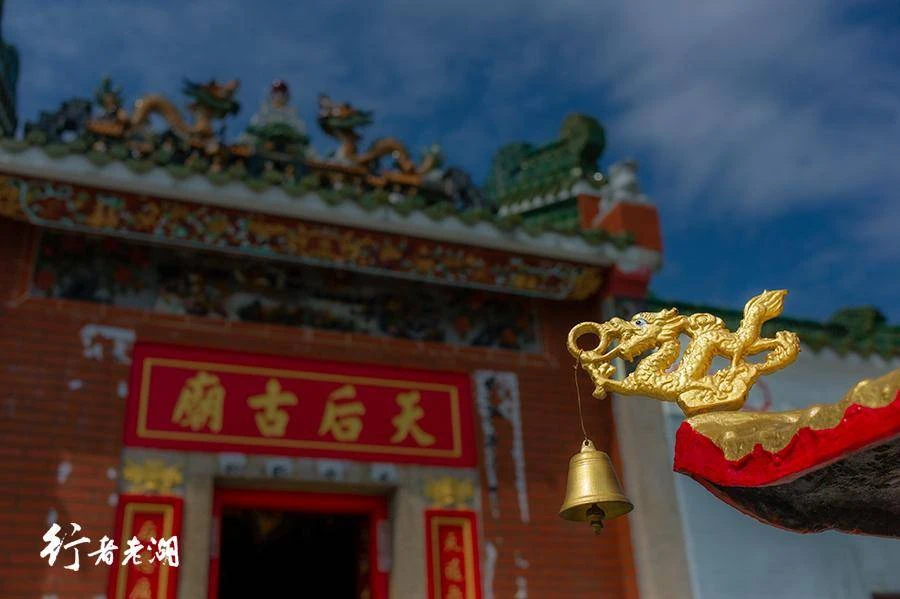
The most remote island in Hong Kong: a six-hour round trip from Shenzhen, yet backpackers long to hike around it once
Po Toi Island is the most remote island from Hong Kong, known as the 'South Pole' of Hong Kong, and also the best spot for shooting star trails. Hong Kong hiking enthusiasts love to camp, stargaze, and watch sunrises and sunsets here. The island has some weathered granite formations listed among 'Hong Kong's Ten Most Beautiful Rocks', as well as three-thousand-year-old rock carvings that record the dialogue between humans and nature over millennia.
The name 'Po Toi' has a Buddhist feel. The island has flat terrain, and from the sea it looks like a floating platform, hence the name 'Po Toi' (Po means floating, Toi means platform), later changed to Po Toi Island. In 2009, 30 staff members from a Hong Kong department took a boat to the island to hold a farewell party for a colleague, which sparked some controversy. Unexpectedly, this gave Po Toi Island an accidental tourism promotion, making it known to many in Hong Kong and attracting yachts to the nearby waters, where people would swim and then come ashore to eat.
Most visitors to Po Toi Island come for camping and hiking. The Po Toi Country Trail mostly lies in the southwestern part of the island, best visited on a fine day. The entire trail is about 4 kilometers long and takes over 2.5 hours. Starting from the pier, you pass the Niuhuding Sunrise Pavilion, Monk Rock, Turtle Rock, Lighthouse 126, Gold Panning Cliff, Buddha Hand Rock, Po Toi Rock Carvings, and finally return to Po Toi Pier.
From Po Toi Pier, follow the country trail to an L-shaped turn, where a faint path leads to the Wu Family Mansion. This old house is famous as a 'haunted house'. The inscription 'Bao Yi Liu Fang' is still clearly visible on the gate, while inside are broken walls and ruins. Legend has it that it was built in 1933 by the island's richest man, Wu Shaotang, and has long been abandoned, giving it a eerie and thrilling atmosphere. Returning to the trail from the Wu Family Mansion, after a few minutes you reach Long Rock Row. In the distance, among the shrubs, there is a rectangular stone shaped like a coffin, known as Coffin Rock.
At a three-way junction, turning left leads to a rugged mountain path up to the central peak of Po Toi Island, going all the way to the Tin Hau Temple and Conch Rock near the pier. It is said this route takes two to three hours. Turning right and continuing along the stone steps leads to Niuhuding. Near the highest point marker on Niuhuding stands the Sunrise Pavilion. At dusk, you can admire golden light on the sea; during the day, a fresh breeze blows and you can watch the surging waves. Continuing to the next fork, turning right returns to the pier, while turning left leads to Monk Rock and Turtle Rock. Monk Rock is a stone shaped like a monk, with a tall rectangular rock topped by a smaller oval stone, resembling a monk facing the sky. Turtle Rock is beside the trail, looking like a giant sea turtle laboriously climbing up the mountain, hence also called 'Sea Turtle Climbing Mountain Rock'.
The landmark of Po Toi Island is a lighthouse at Nam Kok Tsui. A white square building stands on the rocks, with the number 126 painted on its wall. It is the southernmost point of Hong Kong, thus called the 'South Pole of Hong Kong'. The lighthouse has no light pollution, making it the best spot for photography enthusiasts to capture the starry sky. Every night, couples snuggle on the steps under the lighthouse, enjoying the sea breeze, stargazing and watching the moon, gazing out at the endless South China Sea, recalling Li Shangyin's line, 'From the vast sea, pearls shed tears in the moonlight.' Below Lighthouse 126 is Gold Panning Cliff, where the cliffs meet the southernmost reefs. Fishermen used to come here to collect seaweed, selling it like panning for gold.
Continuing from Nam Kok Tsui, you can return to the pier from the other side of the lighthouse, passing several scenic spots along the way. One is a stone resembling the Buddha's palm, called Buddha Hand Rock, and another is the thousand-year-old rock carvings—Po Toi Rock Carvings. The oldest carvings are on two separate rocks; the left pattern resembles a fish and animals, while the right has spiral cord-like patterns. Another carving looks like seal script or stone drum script, with characters difficult to identify.
Beside the trail is a small beach with excellent water quality. Snorkeling reveals many sea urchins and fish. It is one of two beaches on the island where you can play in the water; the other is the beach between Ming Kee Seafood and Yiu Kee Food, which has the best water quality, so some visitors make the trek specifically for it. From the small beach back to the country trail, there is a beautiful walkway—a bridge-like boardwalk built on the seaside rocks, bathed in a warm orange-yellow glow at sunset.
There are only about a dozen villagers on Po Toi Island, and only two or three grocery stores and snack shops near the pier. The island has just two restaurants: one is Yiu Kee Food, which can seat three or four tables and is affordable; the other is Ming Kee Seafood Restaurant, which is more well-known and can accommodate dozens of people. There are no hotels on the island; accommodation is limited to wooden rooms in fishermen's houses, which must be booked in advance. There are no designated campsites and no fresh water on the island, so you can only rough it overnight in a spacious spot on the hills—not ideal for camping.
If you just want to wander around the island, buy some dried seaweed, kelp shreds, or dried octopus as souvenirs, have a meal, and return to Hong Kong city, you can walk from the pier to Lighthouse 126 and back, passing Ming Kee Seafood, the beach, Yiu Kee Food, then go up to the Tin Hau Temple on the hill behind, visit the temple, and then go to Conch Rock on the left side of the temple for a panoramic view of Po Toi Island's bay—a great one-day plan.
Po Toi Island is one of Hong Kong's easiest hiking routes, but because it is near the South China Sea, it is the most remote outlying island. Far from the city, the sea water is top-notch and the air is excellent, like a natural beauty without makeup, making people want to travel a long way to see her true face.
Po Toi Island Travel Tips:
1. Take a ferry from Aberdeen Pier, about 60 minutes; or from Stanley Blake Pier, about 30 minutes.
2. Ferries operate only on Tuesdays, Thursdays, Saturdays, Sundays, and public holidays from both piers.
3. A one-way trip from Shenzhen to Po Toi Island takes over 180 minutes; pay attention to return ferry schedules and other transportation on the island.
4. Bring drinking water for hiking, as there are no refill points beyond the pier.
Part of this travelogue is excerpted from my newly published book 'No Work, Go to Islands: A Blue Love Story of the Guangdong-Hong Kong-Macao Greater Bay Area'. Reproduction of the text and images (including but not limited to screenshots, screen captures, conversion to video, etc.) in any form under another's name is prohibited without the consent of the author and publisher.