The Legend of the Supreme Cantonese Family Feast: Taishi Cuisine (Part 2)
[ The Legend of Family Feast]
Over a month ago,
I had the last meal at Beng Ngachang.
I can't say for sure
whether that was Taishi cuisine—the pinnacle of Cantonese cuisine.
Because none of us have ever eaten at Jiang Taishi's home.
But I've gotten one step closer to the legend.
Many teachers and followers pressed me in private messages to write Part 2 of Taishi cuisine. I was momentarily stuck, not because I had nothing to start with, but because this cuisine is so profound that I lacked sufficient historical food knowledge and historical facts. Fortunately, food history master Zhou Songfang gave me some pointers: without reading Nanhai Shisanlang, it's like navigating misty waves—hard to find reliable sources. Teacher Zhou is a good friend of Lin Weihui and a mentor I've never met in person. He has done extensive research on Tan Family cuisine and Taishi cuisine, offering earnest guidance while being particularly supportive to the younger generation—truly the demeanor of a master. I eagerly await his new book "The Eastern Expedition of Sichuan Cuisine"; I was honored to review the first proof, which reads like the Sichuan cuisine version of "War and Peace"—absolutely brilliant.
Over two months, I pored over Taishi cuisine recipes, searched through Nanhai Shisanlang (Jiang Taishi's son Jiang Yuliu, a great drama master) "Xiaolan Zhai Miscellany," and looked up the diaries of Tan Yankai (a politician and Taishi cuisine enthusiast). In the end, all this reading left me hungry for the real thing. What exactly is Taishi cuisine? I rarely find myself unable to start writing. After finishing Part 1, I let my stomach settle for a month before writing this Part 2. Because my experience tasting Taishi cuisine available on the market today is still far from sufficient for Part 3—I fear I might regret writing it.
Jiang Kongyin's era spanned the late Qing, the Republic of China, and the early years of the People's Republic. Jiang Taishi was the last graduate of the imperial examination system and also "the foremost gourmet of a hundred Yue cuisines." There's a saying in Guangzhou: "The hundred Yue cuisines originate from Zhangcha." Indeed, from the early 1900s, eighty percent of the head chefs and pastry chefs in high-end restaurants in Guangzhou were from Zhangcha, Foshan. Among these cradle chefs of Cantonese cuisine, a prominent figure emerged—Jiang Kongyin. He was from Xialang Village, Zhangcha. However, he was not a chef himself; his relationship with his family cooks was like that of Yuan Zicai and Wang Xiaoyu—he was the one who best knew how to shape master chefs. His family feasts were highly coveted; a single "Taishi menu" set the trend for Cantonese cuisine at the time.
Tan Yankai, a native of Hangzhou, whose father was once the Governor-General of Liangguang, accompanied Sun Yat-sen from Shanghai to Guangzhou. He once commented on Guangzhou cuisine as "expensive but not good."
Reading his diary, his critical style indeed relied on his family background to nitpick, yet it also had the genuine feel of a man of temperament. On March 28, 1923, Tan Yankai finally had a satisfactory meal in Guangzhou, which he considered a "gourmet desert." He feasted excessively at Jiang Kongyin's residence and admitted, "Jiang, who prides himself as the number one cook in Guangdong, is indeed not wrong." His brief history of eating Taishi cuisine was also a process of constantly honing his unique taste with the exquisite dishes of the Jiang family. Each of his comments could be seen as both encouraging and authoritative towards the chefs. At the same time, from the dining table, he witnessed the rise and fall of the Jiang family.
His family feasts were never open for business, nor did they need to be. In those days, the grand residence of the Taishi feast displayed an imperial plaque, calligraphy and a desk from Emperor Qianlong, and a large bed gifted by Empress Dowager Cixi; in the back garden, there were photos with Sun Yat-sen, footprints of Liao Zhongkai and his wife, and several signature performances by Mei Lanfang.
Even if it were open for business, I was born too late.
Taishi Cuisine Background
One day, while chatting with Master Chef Tan Guofeng, I asked him: "Is the recently emerged place in Hong Kong that claims to serve authentic 'Taishi cuisine' with one table per day really authentic?" Chef Tan's reply was very balanced: "Good ingredients change every year—fish, meat, seafood are all like that. 'To prepare a fish maw dish costs nearly 20,000, how can paying 30,000 get you the top grade?'" I recalled a similar statement by Shisanlang: "The Taishi snake soup sold in the market is merely in name only. Indeed, to prepare a truly authentic 'Taishi snake soup' costs no less than seven or eight hundred gold. That was only the price from the late Qing to the Republic of China; the purchasing power of eight hundred silver dollars was about equivalent to less than 50,000 today."
He then sent me a photo like this. I said, "I understand." After the dispersal of the Taishi family cooks, Shisanlang once said plainly about the snake soup on the market: "No comment."
Shisanlang once wrote during the Republic era: "The method of preparing snake has not been lost, but Li Cai, who was skilled at preparing snake, is now a chef at Hang Seng Bank. Yet to prepare a snake feast costs seven or eight hundred gold and still does not yield good flavor. This is because the preparation requires Yunnan ham, North mushrooms, winter bamboo shoots, and other ingredients. For a 'Dragon and Phoenix Feast,' about ten chickens are needed, but the broth must not be too thick, as thickness overwhelms the snake's flavor. Moreover, it must use pure lard, not vegetable oil, to be fragrant. Nowadays, snake sellers often use MSG and pork bone broth, which lacks refinement. Eating snake also requires chrysanthemum petals, lemon leaves, coriander, and crispy wafers as accompaniments. Moreover, the snake soup must be cooked in a hot pot at the table to warm the body. The snake bile wine must be dissolved in hot double-distilled liquor and then mixed with cold wine to have real flavor. Snake skin is also edible, smooth and delicious. To talk about state affairs while eating snake shows that the intention goes beyond nourishment; drinking snake wine also carries the ambition to conquer mountains and rivers, using it to drown sorrows. My late father believed in Buddhism in his later years and had given up killing, so he hadn't eaten snake soup for over twenty years. In recent years, many in the market have been using the name 'Taishi snake soup' to attract customers, but it is far inferior to what we ate in the past. Moreover, they skimp on ingredients, substituting North mushrooms with cloud ears, discarding winter bamboo shoots for fish maw, and the soup flavor is not rich enough—they only aim to attract more customers with low prices." Everything was clear.
Nanhai Shisanlang (born Jiang Yuliu, styled Jiang Yuqiu, also known as Jiang Feng) was a renowned Cantonese opera playwright in the 1920s and 1930s, and the thirteenth son of Taishi Jiang Kongyin. In his era, there weren't many innovative dishes, and although high-quality ingredients were expensive, they were still available. At least then, the abalone, sea cucumber, shark fin, and fish maw in Taishi cuisine were not yet at sky-high prices. Those fine products would now be considered antiques. Teacher Jiang Xianzhu once mentioned: "I find it hard to accept impractical fancy dishes, and I care even less about extravagant feasts costing tens of thousands." Under current conditions, making such snake soup again would be like "reaching for the stars."
I still linger, half-suspended, over the meaning of "rough ingredients, fine preparation." It reminds me of what Mr. Donggua, an old gentleman who makes vinyl record players in Taiwan, once told me: "To appreciate vinyl, you have to put yourself back in that era."
In ancient and modern times, if a wealthy family didn't know how to appreciate fine dining, it was as embarrassing as not having read the Four Books and Five Classics. However, money also brings byproducts, such as going too far in satisfying human desires.
Stills from "The Legend of Nanhai Shisanlang"
Pleasure and indulgence often mix together. There are many gossip tales: Jiang Kongyin, a famous scholar of Southern Guangdong, was a student of Kang Youwei. The Jiang family had been wealthy tea merchants for generations, and Jiang Kongyin didn't truly love scholarship or officialdom. According to unofficial history, he got his Jinshi degree by hiring a ghostwriter—the famous scholar Luo Dundong. Luo helped him pass the imperial exam and secured him a second-class Jinshi in the last imperial examination of the late Qing. As a result, Jiang's social skills were outstanding; he entered the Hanlin Academy, later became a Daotai in Guangdong, acted as Acting Admiral of the Guangdong Navy, and concurrently served as the Superintendent of Pacification for Liangguang. Throughout this, "food" was the bridge.
Jiang Taishi was known for his extravagant and libertine reputation; besides his primary wife, he married twelve concubines, most of whom came from brothels. This reminds me of the late Qing tycoon "Red Top Merchant" Hu Xueyan in Hangzhou, whose weakness was his obsession with beautiful women. It was said that he even conducted business in brothels. Hu Xueyan had a capable wife, Lady Luo Si, who often accompanied him in social engagements. She couldn't bear to see the family fortune squandered by her husband, so she came up with a plan to select twelve stunning beauties for him, known as the "Twelve Beauties of the East Tower."
Writing this, I feel both disheartened and excited—ancient and modern clash. I believe there is nothing harder for AI to replace than "eating," especially compared to "sex"—another primal human need. Humans still cannot fill the emptiness of eating through imagination alone.
The Jiang family had a custom of admiring beautiful concubines in the moonlight. In this context, reading what his son Nanhai Shisanlang wrote about appreciating fish is interesting. "Cantonese people love seafood, so they enjoy eating fish. Some compare fish to women; eating fish is like comparing to the mistress of the household. For example, eating carp is likened to the young wife, the first wife, the homemaker. Carp is righteous, suitable for entertaining guests—dignified and generous. For everyday meals, stewing carp with dried bean curd or tofu is suitable for all ages, simple and pure in taste, like a plain housewife. The crucian carp is likened to a concubine; 'crucian' sounds like 'side' in Cantonese, meaning a side wife. Crucian carp is not as righteous as carp, but many love its tender flesh. Some people even call crucian carp 'concubine.' Bream sounds like 'one side,' meaning a concubine. Bream is also a seafood, more attractive in appearance, and is a seasonal dish. Comparing it to a beautiful concubine fits well. The mud carp is likened to a female servant; its taste is rich but bony, requiring careful tasting to appreciate its true flavor. Servants mostly come from the countryside, with rustic charm and are often fond of eating. Hence, mud carp is called 'female servant fish.' Those who have affairs with female servants are said to 'steam mud carp,' which has a special flavor—quite humorous."
We won't pass moral judgment now, just treat it as a "fact" of that era. Constrained by traditional propriety and court status, Hu Xueyan was more reserved than Jiang Taishi: he only "kept" courtesans but never brought them home, and if business required, he would give them away to "brothers." This is an old habit.
Times and culture have changed, so it's not convenient for me to comment. The Jiang family seemed to have no qualms about their private lives, except that during formal banquets, the "wives" did not dine at the table. The wives and concubines often gathered to sing opera to pass the time. The previously mentioned Shisanlang, who grew up immersed in this atmosphere, was probably influenced. It is said that Jiang himself could barely recognize his own sons and grandsons; Hu later also couldn't recognize his wives. Jiang Taishi's eldest son was born of his first wife and was also a dashing figure. Later, he met a "soulmate" in a brothel, only to discover that this famous courtesan was actually his father's mistress. The story turned into a tragedy: the eldest son was publicly punished by family law, certainly humiliated, and ended up swallowing opium to commit suicide. Opinions vary on Jiang's character: some say he was a great manager, others say that during his political career he was extremely opportunistic, and after leaving politics, he managed the Guangdong business of the British-American Tobacco Company for a while. But at least he founded Jianglanzhai Farm and cultivated the still-famous Luogang sweet oranges, a benefit to the region.
However, according to Nanhai Shisanlang's diary, Jiang Taishi's two arms hung down with a difference of half a foot. A fortune teller once read Jiang's fortune, saying, "Your face resembles a gibbon, which signifies great nobility and numerous descendants. However, you will not stay in officialdom long and must retire early, otherwise you may face dangerous storms. My father took this to heart." This also reveals another reason why Jiang Taishi was indifferent to politics.
This logic seems very reasonable to me. Nowadays, people believe in fate; back then, even more so.
The prototype of Taishi snake soup was conceived when fortune teller spoke those words, in the year of the twenty-eighth cycle of the Chinese zodiac. "His first wife, Ou Shi, gave birth to five sons and one daughter. My father took the fortune teller's words to heart and often killed snakes to host banquets. Initially, he liked to make 'Dragon and Tiger Meeting,' because cooking fruit with snake could nourish yin and yang. He also considered 'Dragon and Tiger Meeting' as a symbol of his aspirations, as Zeng Guofan once presented a couplet to our ancestor that included a line: 'In misty waves, the years pass, and in commotion, we meet dragons and phoenixes.'" The precursor of Taishi snake soup was actually a stew of civet cat and snake, a dish made to fulfill a vow.
Later, Shisanlang recalled his father's chef Li Cai's establishment, which served "Three Snake Meeting." "Served with fish maw and cloud ears, the snake flavor was strong, but the sweetness was still lacking." He said that snake soup lovers usually eat "Dragon and Tiger Meeting" or "Dragon and Phoenix Meeting"; since civet cat was not always available, chicken was used instead, called "Dragon and Phoenix Meeting."
"I was born on March 3, 1910, which corresponds to the 22nd day of the first lunar month in the Gengxu year, during the Si hour (9-11 am). The Si hour belongs to the Snake, so we used snake to entertain guests." The dog-zodiac Shisanlang once wrote. It turns out that Jiang Taishi's snake soup carried warm and profound "family values."
For traditional Chinese families that value "many children and grandchildren," having multiple wives and concubines was also a form of division of labor. After all, childbirth has never been an easy thing for women. This is just a digression from modern women who don't need to "marry for food and clothing."
For the sake of Taishi snake soup, the Jiang family's signature dish, I specially consulted Master Chef Xie Jinsong, a former chef at a Michelin three-star restaurant. He told me: "Taishi Five-Snake Soup is extremely particular. The ingredients include shredded chicken, winter mushrooms, black wood ear, winter bamboo shoots, fish maw, and snake meat. The snake must include five types: arrow snake, cobra, Bungarus multicinctus, three-lined snake, and white-lipped pit viper, to achieve the full nourishing effect. The cooking method is also complicated: first, manually debone the snake, remove the tendons, and tear it into fine shreds to maintain the original fibrous texture. Other ingredients must also be cut into very fine shreds. Knife skills are crucial—uniform and fine to achieve the right mouthfeel."
Beng Ngachang's Taishi Snake Soup
Snake broth and superior broth are prepared separately. The snake broth requires aged tangerine peel and sugarcane to be simmered together. The base is more refined, combining two broths: first, the superior broth made from old chicken, lean pork, and Jinhua ham, simmered for five to six hours; second, the snake broth made from snake bones, tangerine peel, longan meat, red dates, sugarcane, and ginger, simmered for four hours. After discarding the residue, the two broths are combined, resulting in a clear, layered, and sweet-tasting soup. Finally, fine shreds of chicken, top-grade abalone, fish maw, winter bamboo shoots, winter mushrooms, and tangerine peel are added, all cut uniformly and finely. A light starch slurry is used to thicken. The soup is served with crispy fried dough ovals made of flour (thin crisps) flavored with fermented bean curd, adding a crunchy texture. The lemon leaves, not too old or too young, have their veins removed and are cut into extremely fine shreds to release fragrance, which can remove the fishy smell of snake and enhance freshness. However, they must be freshly cut and used immediately.
White chrysanthemum petals with a hint of light purple add a fragrant, transcendent aroma. These come from the Jiang family's own cultivated large white chrysanthemums. Shisanlang said: "Among chrysanthemums, 'Windward Peony' is the most beautiful, followed by 'Crab Claw.' 'Windward Peony,' a variety originally owned by friends like Li Mingze and Yang Ehui, was found at Liyuan Hill and Yinlu before the war. There were also 'Blue Ribbon' and 'September Red' varieties, in red, white, and blue—coincidentally the colors of the British, American, and French flags. White and blue chrysanthemums are edible, but red ones taste bitter. However, I heard that friends after the war have lost the heart to grow chrysanthemums, and finding pond mud in Hong Kong is difficult, so it's tough to cultivate them. As for whether the flower varieties still exist, I have no idea." Besides employing four gardeners year-round to care for the orchids and chrysanthemums, when preparing snake soup, maids would carefully hold the flower stems and gently shake them in clean water to remove dirt, then lightly pickle them in salt to kill aphids, producing fresh, fragrant chrysanthemum petals.
Even chrysanthemums received such meticulous treatment. This shows that Taishi cuisine is inherently impossible to replicate 100% in a modern commercial environment. The Taishi snake soup I tasted at the Imperial Garden restaurant in Macau was already a rational simplification of the ultimate fancy version, yet the experience was "still elegant!" Head chef Zhuang Jiahui learned the Taishi cuisine system from Master Li Youtian at the age of 17. Master Li Youtian was a disciple of Li Cai, the last family cook of Jiang Taishi.
Imperial Garden Taishi Phoenix Soup
The restaurant "Royal Garden" at the Grand Lisboa Palace in Macau specializes in "Jiang Taishi cuisine." The Taishi Phoenix Soup originates from the Taishi Five-Snake Soup. The thickening is like surging crystal; the "thousands of threads" come entirely from the chef's knife skills, much like the intangible cultural heritage double-sided Suzhou embroidery on the walls. Expensive fish maw is not the essence of this soup; "phoenix" refers to partridge. One hundred partridges are used to make stock, simmered with sugarcane, longan, red dates, tangerine peel, and old ginger—an extremely gentle and mellow flavor. I couldn't help but exclaim, "Food knows no limit in refinement!"
Pushixuan Taishi Snake Soup
In addition, I also had a bowl of wonderfully comforting "Taishi Snake Soup" at Pushixuan restaurant in Shanghai. This version featured hand-shredded partridge and fish maw. An ancient dish with a modern twist—unforgettable.
And last year, I visited Chifa Titi, the top Chinese restaurant in South America, in Lima, Peru. When I saw "Fake Snake Paste" on the menu, I thought it must be an old dish. Sure enough, every spoonful had the depth of tangerine peel and winter mushrooms—probably a commoner's version of Taishi snake soup.
Reading Tan Yankai's comments on his first experience of the Taishi snake hotpot, I can at least clearly sense that although he frequently complained, his words were the heartfelt opinions of a knowledgeable person. "However, the shark fin was not as good as the Cao family's, the abalone not as good as Fusheng's. Although the snake meat was fresh and delicious, eating it in a hotpot is nothing special. It is also said that there is a giant eel in Xinhui; when it appears, other eels follow. This time they caught one weighing 50 jin. But it was overcooked, mushy like sawdust, not recognizing its goodness. It was not as satisfying as the steamed fresh scallop with ham. As for pigeon eggs, wood ear, and bird's nest, these only suffice to show off to the uninitiated. The way of food is indeed not easy. They served Napoleon brandy and snake bile wine, and I drank over ten cups. (The ham square had only fat, no lean; it tasted like winter melon, without greasiness, so it was good.)" The "ham square" probably refers to "Honey Ham Square." In my memory, I only ate a sweet and salty balanced, fragrant version at the "Liyuan" restaurant in Hangzhou.
Looking at the subsequent diary entries, I see this picky critic gradually shutting his mouth—indicating that Tan Yankai's experience at the Jiang family's banquets was improving. He even exchanged ingredients with Jiang, showing that they were exchanging views on fine dining. His "iron mouth" clearly softened: "(May 4, 1923) In the evening, together with Tang, Jiang, Yang, Xiao, and Zhang, I went to Lord Xia's house for a drink. The food was prepared hastily yet was quite refined and clean." And it is evident that Tan somewhat treated the Jiang residence as a private dining room for close friends: "(July 15, 1923) I went out with Cangbai, Renqiu, and Yinbo. Yinbo left us. The rest of us went to Jiang Xia's place, but by the time we arrived, they had already started eating. Sun Ke, Wu Tiyun, Chen Shaobai, Huang Yunsu, Zou Dianbang, and Old Mei were all present. The best dish was the ham-steamed winter melon with chicken. The bird's nest, shark fin, and abalone were not as good as before, but still far superior to what you get at market restaurants. The stone ear and magnolia shoot slices I had sent were served."
From Tan Yankai's diary, it can be seen that Guangzhou has long had the custom of eating snake. "(November 21, 1923) I walked to the riverbank, took a small boat to visit Jiang Xia. We met joyfully; they were just cooking snake, so I stayed to drink snake bile wine and ate several plates of snake meat. It was truly delicious."
Regarding the snake bile wine mentioned, I haven't had it while eating Taishi snake soup, but Nanhai Shisanlang once described it: "A few months ago, I ate snake soup and also drank a bottle of snake bile wine; I didn't feel drunk, and my body was as healthy as usual. Eating snake without drinking snake bile wine is truly tasteless." I believe it was standard.
By the 1920s, the custom of eating snake was prevalent in Guangzhou, but in Tan Yankai's mind, the status of Taishi snake soup was unshakable: "(December 9, 1923) Renqiu invited me to a small meal at Luyuju; the dishes were not Cantonese style. The roast pork could be purchased in small portions, the soy sauce chicken was very fatty, the spring chicken and sausage rice were excellent, but the snake was not good. They didn't use a hotpot, and there was more chicken than snake. Occasionally it had a fishy smell, so I didn't dare eat much. This confirms that what Jiang Xia said was not false."
In the text, "Xia" also refers to Jiang Taishi. Shisanlang wrote in his book: "My father was the only son of my grandfather, born to a concubine. In his youth, he lived in Shanghai with his grandfather and was nicknamed 'Xia' (meaning mist). Later, Cantonese people gave him the nickname 'Ha' (shrimp) because of his lively and active nature."
The last family cook of Jiang Taishi was Li Cai. His actual nephew was called Li Cheng. It is said that Li Cheng (also known as "Beng Ngachang"—the original Cheng) learned cooking from Li Cai in his teens and received the true essence. They say Li Cheng studied under Li Cai for much longer, especially compared to Li Yulin (former head chef at Central Kitchen in Hong Kong; both his younger brothers were Li Cheng's disciples) and Li Youtian (owner and head chef of Peach Blossom Garden, also trained at Hang Seng's Bo'ai Hall). Beng Ngachang was later taken over by Li Cheng's son Gen Ge. However, the meal I had there was their last meal; afterward, the family emigrated.
I went to eat at Beng Ngachang because many Hong Kong and Macau gourmets recommended it, saying: "If you write about food and haven't eaten at Beng Ngachang, you haven't seen the real Cantonese cuisine."
Many places in Hong Kong are "hole-in-the-wall" and never judged by appearances. There is a vulgar internet marketing term now called "old money style." But once you say that, the money has already dissipated. True connoisseurs who don't care about money are unwilling to pay for obvious gimmicks. If you want to eat something good, you go to places like "2/F, 11-13 Bridge Street, Hillier Street, Sheung Wan." If you don't know that, your culinary taste is already judged by insiders.
[HIGHLAND DUNNAGE single malt scotch whisky, Aged 31 Years, Domaine Leflaive, Batard-Montrachet Grand Cru, France, 2012, Grand Vin de Chateau Latour premier grand cru classe, Pauillac, 1998]
It's in a residential building with an independent doorbell. A steep staircase leads straight to the second floor, where you can see the small characters "Beng Ngachang." Guests bring their own fine wines. The kitchen is about the same size as the dining room—or the dining room is almost the size of the kitchen—and can accommodate one table.
In fact, Beng Ngachang is an old-style private kitchen run by a husband and wife team. This meal was for 12 people. I saw that the front and back of house were already working like a flywheel; some dishes required a week of preparation. That explains why they don't accept walk-ins and only serve one table a day.
This bird's nest with pigeon eggs reminded me of a scene from the novel "Ruyi's Royal Love in the Palace," where the emperor mentioned a winter melon bird's nest dish Ruyi once made for him: "I remember you made a winter melon bird's nest dish in the old residence. It was exquisite. The softness of peeled winter melon paired with the softness of bird's nest, the clear color of bird's nest blending into the clear color of winter melon, heavy amounts of chicken stock and mushroom stock simmered thoroughly—pure and unforgettable in the mouth." The pigeon eggs were also translucent, like jade, traditionally nourishing yin and clearing heat, much like golden thread bird's nest.
This time, I finally encountered the legendary long-simmered bird's nest that had liquefied. This "piece" of bird's nest made my throat feel elevated.
Before going to the kitchen, I thought that Beng Ngachang's famous fried shark fin was due to the ingredients. Based on texture, the plate contained at least two types: thick, short sea tiger fin and thin, long golden three-hook fin. Watching the heat control and stir-frying technique, I understood that the harmonious flavor base was not simply "rich in nutrition." Stir-fried osmanthus fin, as the name implies, eggs are evenly coated on the fin like osmanthus flowers. The ingredients include eggs and shark fin. In the Taishi family, the stir-fried fin could include up to sixteen items, but at least bean sprouts, Jinhua ham shreds, chives, coriander, bamboo shoot shreds, celery, shiitake mushrooms, and crab meat were indispensable. And almost every bite was crispy, tender, fresh, crunchy, and bouncy. Despite the large portion, the plate was cleared quickly—truly memorable.
The fin course was already spectacular. This very rare yellow fin was specially arranged by Gen Ge. Before emigrating, they only had two pieces at home; that day's serving was one of them. The meat of this fin had the texture of fish maw, very special. The superior broth was thick enough, and the umami clung to the gaps between the fin fibres. The aftertaste was clean, leaving only a lingering sweetness.
Tan Yankai's own household had excellent family chefs; even the most famous sixty-dollar fin at The Great Three Yuan restaurant couldn't compare to his family's fin. Presumably, he had eaten plenty of Jiang's top-quality shark fin back then.
Steamed Yellow-Skinned Tiger Grouper
A 5.2-catty tiger grouper steamed to be flavorful and tender was already above standard. I pinched the various ginger shreds, spring onion shreds, and ham shreds arranged like pine needles, and the large fish meat. I even felt the urge to use the fish broth to cook rice. The rice here was also delicious.
The Young Ginger Chicken was also cooked throughout with charcoal fire, using Southeast Asian thick raw charcoal that blackened the walls. The chicken was handled masterfully; its texture was between steaming and boiling, with perfect heat and incredibly smooth. The young ginger was perfectly tender and fragrant, matching the chicken's texture.
When the raw glutinous rice stir-fry arrived, I was already full, but the unique wok hei from the charcoal fire and the generous ingredients led me to unknowingly finish a bowl.
The lettuce here used only the stems, cut into uniform diamond shapes, incredibly crunchy.
Olive Kernel Fried Pork Belly Tips—this dish is rarely made anymore, both because it's fussy and difficult.
Sautéed Pork Belly Tips with Vegetables and Olive Kernels
For one tip, the chef must trim all the fat from the edge of the belly tip, then remove the inner layer, using a knife to slice away the tougher part. Only the outer part is used as the actual cooking material. The belly tip must be stir-fried to be tender and crunchy. From ten catties of ingredients, perhaps only a small plate can be obtained. The olive kernels must be fried until fragrant and crispy, right at the edge of burning but not burnt—crispy and just right.
Tangerine Peel and Lotus Seed Red Bean Paste
The red bean paste was really thick, with an elegant sheen like oil floating on the surface.
After the meal, I was still savoring Beng Ngachang's last stir-fried fin performance. I couldn't help but pair it with Tchaikovsky's "June: Barcarolle." This silent recording in my heart felt like a distant spark on a vast ocean, unquenchable. Arriving at the shore was the destination. The skills I witnessed that are beyond common reach:
1. The windowless room used full charcoal fire throughout; on cool days, the temperature difference could reach 35 degrees Celsius between inside and outside.
2. Stir-frying ten portions at once, the wok bottom was smooth and clean after serving.
3. The plates had no oil or broth at the bottom. As for what type of fin was used and how it tasted, it truly didn't matter anymore.
Looking at the photos, I sighed. Gen Ge is 70 years old. I watched the fin stir-frying for five full minutes from behind. Stirring the osmanthus fin over a charcoal fire, he sweated beside the wok in 50-degree Celsius heat, both hands never leaving, eyes never leaving. Yet the finished fin left not a single drop of oil on the plate. In Hong Kong, he rose to become a hidden god. People in the culinary world might dismiss it as "just hard work." Those who appreciate him—or complete strangers who are diners—like me, cannot help but feel a pang of sympathy at the sight. A swan song. It's time for him to rest. Nothing that seems effortless is achieved without pain. Geniuses are all stupid in that sense.
Actually, the "spiritual legacy" of Taishi cuisine is now scattered among various master chefs.
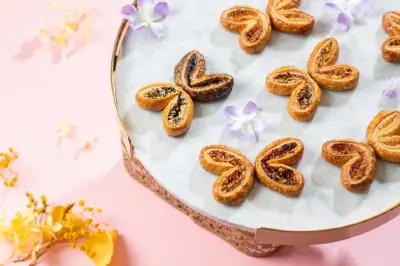
Chef Tan Guofeng's "Fried Egg Yolk Pastry" is endlessly varied. For example, the almond and coconut honey version I ate at Tan Hui was stunning! Chef Tan said: "Even if you have an 'unlimited ceiling' in terms of ideas and methods, how many people can bear the price in the consumer market? And can that business sustain itself on its own? Actually, regarding traditional old dishes, what we can inherit should not be seen merely as a dish. As chefs of our generation, what we can pass on is technique. The inheritance of a dish also depends on changes in the broader environment. As long as the younger generation of chefs is willing to learn the techniques well, they can adjust according to the ingredients they encounter in the future and start anew. That is a more rational and practical approach." I deeply agree.
I told my friends that we are in an era of mass communication that formats human intellect. We embrace it, of course, but we cannot give up independent thinking. We maintain a neutral attitude and rational choices. When discussing the present, it is always emotional. When discussing the past, there is also much fabrication. However, taken together, perhaps we can form a complete blueprint for thought, and from that, develop relatively mature cognition. The so-called 'inherit the past and usher in the future' is exactly that.
The once wealthy and luxurious Jiang family eventually declined. In 1951, during the land reform, the over-ninety-year-old paralyzed Jiang Kongyin could not bear the criticism and humiliation. He closed his eyes, remained silent, and starved himself to death. It is said that the day before his death, he left four final lines:
"Today you are right and I am wrong; tomorrow you are wrong and I am right.
Right and wrong, only later will you know."
Do you like Taishi cuisine?
"Always forgive your enemies; nothing annoys them so much."
Food Bless You!
Consultant of "Once Upon a Bite"
Host of "God's Dining Table"
Producer of "Wild China" and "The World Worth Living 369"