18-Day, 4500 km Self-Drive Tour of the Western US in July
Itinerary (July 7 - July 24, 2016)
Major stops in order: Universal Studios Hollywood, Los Angeles; Santa Monica State Beach; Sequoia National Park; Las Vegas; Hoover Dam; Williams; Grand Canyon National Park; Dead Horse Point State Park; Moab; Arches National Park; Salt Lake City; Alpine; Grand Teton National Park; Jackson Hole; Yellowstone National Park.
7/7 Day 1: Depart Shanghai, transfer in Beijing to Los Angeles.
Time difference: Los Angeles is 15 hours behind Beijing. Pick up car at Avis rental counter at LAX that evening, then check in at Best Western Woodland Hills Inn $142.39.
Flight info 1:
2016-07-07 CA1558 SHA 14:55 -17:10 PEK
2016-07-07 CA 983 PEK 21:00 -18:00 LAX
7/8 Day 2: Exciting Los Angeles: Universal Studios Hollywood and Santa Monica State Beach. Stay again in Los Angeles.
Universal Studios Hollywood was converted from 20th century Hollywood movie studios. It consists of various shows, 3D/4D experiences, roller coasters, and many other attractions. It is the top attraction in Los Angeles. That day there were many visitors; waiting times for each ride ranged from 30 minutes to 2 hours or more. We experienced four themes: WaterWorld, The Wizarding World of Harry Potter, Revenge of the Mummy roller coaster, and the Studio Tour. It felt like stepping into a wonderful virtual world, exciting and thrilling. Two of the rides made our hearts race, screaming nonstop, and our legs weak – absolutely worthwhile.
Universal Studios Hollywood ticket price at gate: Adult $115, Child $109.
The Wizarding World of Harry Potter
After queuing for 1.5 hours for the Transformers ride, we still faced a long wait and gave up – a small regret. This scene at the entrance: Transformers, the Hero of Americans.
After visiting Santa Monica State Beach and the 1st highway, we chose a high-end place to eat authentic Italian food and paid a generous tip. Our first formal dinner was a splurge!
7/9 Day 3: Daytime shopping in Los Angeles, preparing necessities for the long road trip. Evening drive from Camarillo (Los Angeles) to Visalia, check in at Econo Lodge Sequoia $192.50. Distance approx. 300 km, 3 hours.
Before shopping, we did thorough research: downloaded coupons from the Camarillo Premium Outlets official website, checked brand layouts, and searched for needed items with purpose. Even so, due to limited time and energy, we missed a few brands.
7/10 Day 4: From Visalia, California, to the General Sherman Tree in Sequoia National Park, 88 km, 1.5 hours. Daytime visit to Sequoia National Park, stay again in Visalia that night.
Sequoia National Park is the third national park in US history and the second oldest existing park (first is Yellowstone). It is home to many giant sequoias thousands of years old, 20-30 stories tall. Among them, the General Sherman Tree is the largest living organism on Earth, known as the "World Tree." Standing before them, before nature, humans seem so small.
The 6-year-old kid Zhuangzhuang crouched under a tree and took photos of two big trees with his children's camera from his unique perspective – isn't it different?
We purchased the America the Beautiful Annual Pass for $80. Valid for one year, covers two vehicles, and all US national parks.
7/11 Day 5: From Visalia to Las Vegas, check in at New York New York $120.96, distance 570 km, 5.5 hours. Evening watch KA Show (O show cancelled) and see the night view.
Located in the desert hinterland of Nevada, Las Vegas is definitely a consumer paradise. Besides casinos, it incorporates world-class shows, concerts, boxing matches, resorts, outlets, high-end boutiques, etc., catering to various needs. The night view of Las Vegas still shines brightly after midnight, without any sleepiness.
The KA show is gorgeous and thrilling, well-produced, blending acrobatics, martial arts, puppetry, fireworks, and more – a pinnacle of Cirque du Soleil. Many wonderful parts drew applause from the audience, and it ended with a climax of fireworks. KA show ticket price at gate: $88.16.
7/12 Day 6: Morning visit Lake Mead and Hoover Dam. Afternoon shopping at Las Vegas South Premium Outlets. Stay again in Las Vegas.
Hoover Dam is 55 km from Las Vegas, 40 minutes drive. Strong sunlight, temperature above 42°C. Known as one of the Seven Wonders of the World, Hoover Dam supplies all the electricity and water for Las Vegas and is called the "Diamond of the Desert." Because of this dam, the desert city of Las Vegas has its never-extinguishing neon lights. Many Hollywood disaster movies feature close-ups of Hoover Dam; Transformers also filmed there.
Lake Mead is the largest man-made lake in the Western Hemisphere, a very important water project. Standing on a high place overlooking Hoover Dam and Lake Mead, one marvels at the crystallization of human wisdom in such a huge project.
7/13 Day 7: From Las Vegas, pass through Williams, Arizona, arrive at Grand Canyon National Park to watch sunset. Distance 450 km, 4.3 hours. Check in at Red Feather Lodge $149.72.
Williams is a small town with an unusual history. It was named after the early famous hunter and guide William Shirley Williams. This town on Route 66 is considered the gateway to the Grand Canyon. In 1881, the first post office was established; in 1882 when the railroad arrived, the town had over 250 residents. Now the streets are full of gift shops, most selling items related to the famous Route 66.
In a gift shop, I found a slogan that every woman would love: "Your husband just called and said 'you can buy anything you want'."
7/14 Day 8: Morning continue viewing Grand Canyon. Afternoon drive from Grand Canyon to Moab, Utah, distance 524 km, 5.3 hours. Check in at Hotel Moab Downtown $149.28.
Grand Canyon National Park was carved by the Colorado River over millions of years. The deepest point has a drop of 1,500 meters. It is one of the Seven Natural Wonders of the World. Many Chinese tourists visit here; we could hear our hometown accents everywhere. We entered the park late afternoon, just around sunset. The oblique rays of sunset fell on the red mountaintops, making the tops fiery red and translucent, contrasting with the darkening colors of the middle and bottom. The mountains undulated, stretching thousands of miles. The unique desolation and grandeur of the American West were fully displayed. Due to the limitations of camera sensitivity and lens angle, the actual view was far more layered and stunning than the photos.
Leaving the Grand Canyon, we passed through the Indian Reservation, heading to Utah via highways 64, 160, 191. During the 500 km drive, the scenery along the way was magnificent.
Highway 64 continues the Grand Canyon scenery, allowing a close-up view of the canyon's macro appearance.
Highway 160 passes by the edge of famous Monument Valley, the running place in Forrest Gump and also the backdrop for Transformers 4.
Highway 191 transitions from desert to oasis, with vegetation increasing. Occasionally we saw jumping rabbits and deer. On both sides of the road, the vast wilderness was dotted with ochre rock formations of various shapes. As the sun set, the sky turned red. Near Moab, the sunlight almost hit the ground horizontally, gilding the grassland with gold.
Outside the town of Moab, we encountered the first arch—Wilson Arch—a warm welcome!
Most photos were taken instantly while driving at high speed; many more beautiful sceneries along the way were inevitably missed.
7/15 Day 9: Morning visit Dead Horse Point State Park. Afternoon visit Arches National Park. Stay again in Moab.
Dead Horse Point State Park is another viewpoint to observe canyon country. Driving to the top of the park, you can see the Colorado Plateau scenery with a great view. Even I, who rarely takes selfies, got a little vain and left a souvenir photo. The elevation is about 2,000 feet above the Colorado River valley, so it feels vast. The movies Thelma & Louise and Mission: Impossible 2 were filmed here. Park entry fee: $10 per vehicle.
At the high point, we happened to meet two foreign beauties and a green 1966 Thunderbird—the scene was 100% matching the movie still from Thelma & Louise.
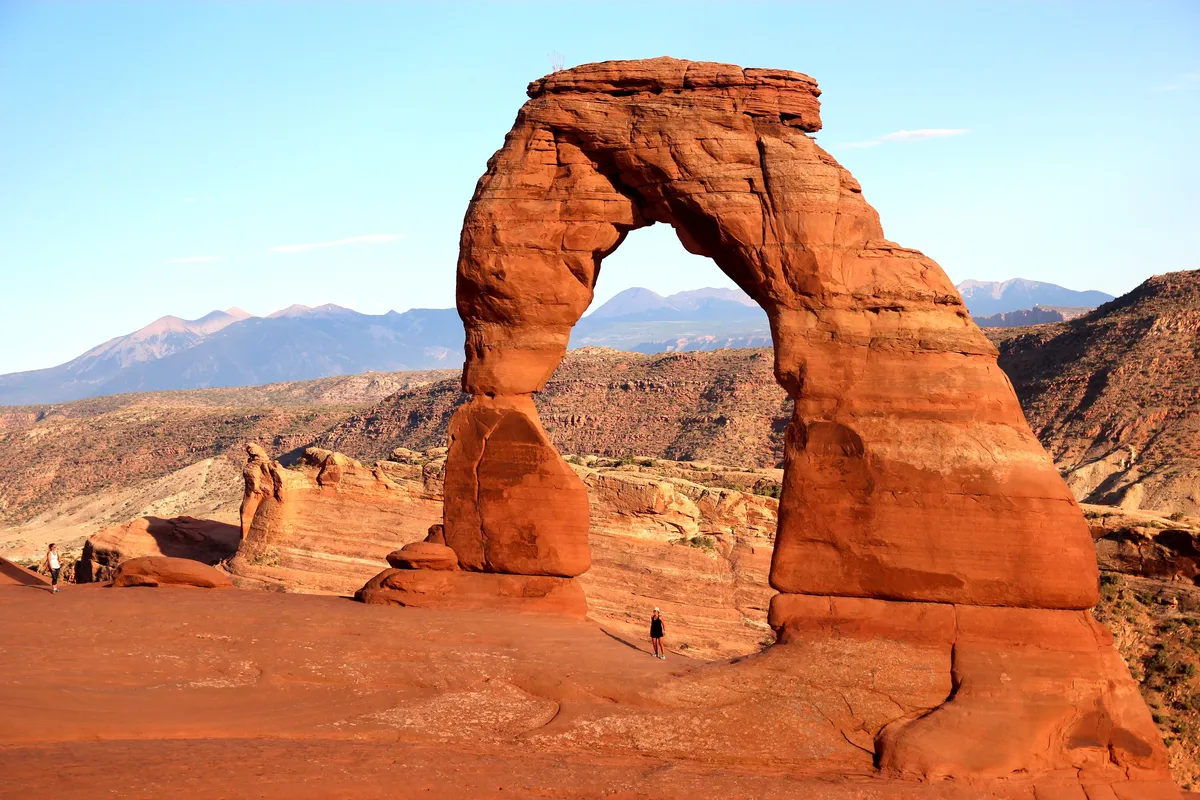
Arches National Park: Over hundreds of millions of years, ocean salt layers underwent crustal changes and natural weathering, forming the world's largest concentration of natural sandstone arches. Standing there, you can't help but wonder if you're still on Earth. The park has over 2,000 arches of various sizes. Iconic ones include Balance Rock, Double Arch, and Delicate Arch—the symbol of Utah.
Double Arch: Looking up from below, it looks like King Kong spreading his huge arms, sitting solidly and threatening. Could this giant gorilla have traveled through a time tunnel from another planet?
Balance Rock: At 6:30 pm, when the sun began to shine at a 60-degree angle, we decisively drove to the day's highlight: Delicate Arch at sunset. After getting off, we put on hiking packs, carried several pounds of water (per the Heat Kills warning), braved 43°C heat, and followed rock cairns along steep rocks and mountain paths for 4.8 km round trip. When we saw Delicate Arch glowing orange under the setting sun, every sunburned face beamed with joy and satisfaction. Witnessing another miracle on Earth made this trip worthwhile!
Heat Kills warning sign.
Hikers carrying several pounds of water.
Rock cairns as trail markers.
A few trees along the way, dry and twisted, with no bark at the bottom but lush green leaves at the top.
Delicate Arch, unlike other arches, is hidden among giant rocks, standing alone on the peak of a stone mountain with cliffs on both sides. It truly deserves to be the symbol of Utah.
7/16 Day 10: From Moab, pass through Salt Lake City, Idaho, arrive in Alpine, Wyoming. Distance 800 km, 7.5 hours. Check in at Flying Saddle Resort and Steak House $156.45.
Salt Lake is very vast, giving a feeling of blue sea and sky from afar. Walking across the beach and marshland, the smell of rot grew stronger. As we stopped by the lake, black clouds of insects immediately surrounded me. It reminded me of the description of locusts in Salt Lake City from our high school English textbook. This attraction is best viewed from a distance, not visited up close!
Driving along Idaho Highway 34, farms, grasslands, forests, and rivers intertwined beautifully.
We changed our plan on the spur of the moment and stayed in Alpine, unexpectedly encountering such beautiful scenery and atmosphere. A small river called Snake River flows quietly through the town at sunset, nourishing everything, as pristine as a paradise.
The sunset dyed the clouds red; they seemed on fire, brilliantly dancing before my eyes, making my heart intoxicated—perhaps this is the legendary "burning clouds"!
In the morning, the town transformed into a maiden's image, fresh and beautiful.
Alpine is also a winter ski resort, said to be quite different from Swiss scenery. It is a town I like!
7/17 Day 11: From Alpine to Grand Teton National Park, distance 60 km, 45 minutes. Daytime visit to Grand Teton National Park. Evening check in at Antler Inn $181.50 in Jackson Hole town.
The Snake River winds along one side of the road; the beautiful scenery along the way made us stop and linger.
Grand Teton National Park is located in the glaciated mountain area of northwestern Wyoming. Established in 1929, it covers 310,000 acres. It features the 4,198-meter-high, snow-capped Grand Teton Peak, and we saw bison, deer, and other wildlife everywhere. It is known as "the most beautiful national park." Jenny Lake is the most famous ice lake; compared to Jackson Lake, it is like a delicate and graceful girl from the Jiangnan region. Jackson Lake, formed by damming the Snake River, is the largest body of water in the area, like a dignified and composed aristocratic lady.
Entering Grand Teton from Alpine along the Snake River, the sky was clear at first, but on the way back, dark clouds gathered and thunder rolled—though only above the Teton peaks. Soon the weather cleared again; mountain weather is truly magical.
Jackson Hole town is a small town in northwestern Wyoming and the gateway to Yellowstone National Park. We rested here for half a day, preparing for the highlight of the trip—Yellowstone.
The center of town is Antler Park, famous for its four arches made of elk antlers. It is said that every winter, elk herds from Yellowstone migrate to the National Elk Refuge to spend the winter. In spring, the male elks naturally shed their antlers and grow new ones. These shed antlers are used to build and decorate the park's arches, making the antler arches a symbol of Jackson.
Cowboy carriages from Western movies are on the town streets, soliciting rides.
The green slopes on the distant mountains are traces left from winter skiing.
7/18 Day 12: Yellowstone National Park (Day 1). Depart from Jackson Hole, enter the park through the south entrance. Check in at OF Snow Lodge Western Cabin $186.00 ($99.00 without private bathroom) near the Old Faithful Visitor Center in the southwest.
The entire map of Yellowstone can be described by the Arabic numeral "8".
Now we begin a visual feast. Are you ready? Follow me—Yellowstone, here we come...
First day, visit the lower left half of the "8" loop. Main attractions:
1. Fountain Paint Pot 2. Grand Prismatic Spring (Fairy Trail is closed) 3. Old Faithful Geyser
Burned trees show tenacious vitality—standing firm through wind and rain, without lush green leaves, they still bloom with the most beautiful posture of life!
7/19 Day 13: Yellowstone (Day 2)
From the southwest of the "8", via West Thumb Geyser Basin, tour the southeast part of the lower loop. Check in at Canyon Lodge Premium Lodge $248.00 at Canyon Area visitor center.
Main attractions:
1. West Thumb Geyser Basin 2. Yellowstone Lake 3. Mud Volcano 4. Grand Canyon of the Yellowstone 5. Upper Fall 6. Lower Fall 7. Hayden Valley 8. Petrified Forests
7/20 Day 14: Yellowstone (Day 3)
Tour the upper loop attractions of Yellowstone. Check in at Moose Creek Inn $197.90 in West Yellowstone.
Main attractions:
1. Tower Fall 2. Mammoth Hot Springs 3. A Fumarole 4. Norris Geyser Basin
Yellowstone's hot springs and geysers: The park sits on one of the largest calderas in the world, famous for its geothermal features, containing more than two-thirds of the world's geysers. Blue, green, brown mud, black sand—various geysers, colorful and diverse, prompting imagination of the turbulent, boiling, and roaring forces beneath the surface.
Grand Prismatic Spring (the most beautiful eye on Earth)
Old Faithful Geyser (erupts approximately every 90 minutes)
Visitors waiting for the geyser.
The moment Old Faithful erupts passionately.
The lively geyser dances in the wind, swaying into a dreamy blue melody. The warm mist gradually blurred my vision; they were like white angels dancing in the center of the stage...
Tourists bathing in the hot spring, looking so relaxed and carefree. If you have time, you must also enjoy it!
The park has vast virgin forests. The Snake River, Yellowstone River, and Yellowstone Lake flow through it. The abundant water rushes through the Grand Canyon of the Yellowstone, forming huge waterfalls. Driving through the forest, wildflowers bloom everywhere along the wetlands and grasslands. No matter from which angle you look, it is a beautifully composed grand landscape painting!
Many forest fires have occurred in Yellowstone; the local policy is to let them burn naturally. Old forests become white or black burned forests standing there, while new young forests begin to regenerate at the right time, bringing new vitality.
Petrified Forest: A volcanic eruption 50 million years ago instantly solidified a sequoia forest, turning it into stone. Today, many petrified trees are damaged. We found a well-preserved petrified tree, the only attraction protected by an iron fence in the park.
Watching wildlife was the main purpose for kids visiting Yellowstone. We saw bison herds, ducks, waterfowl, eagles, rabbits, and ground squirrels everywhere. Evening or early morning is the best time to observe elk and bears. The animals here are not afraid of people; they don't run away when they see tourists, as if they are the natural owners, and we are just visitors.
Around the geysers, bison nonchalantly walk across the wooden boardwalks, while tourists snap photos with phones and cameras.
In the evening, on the way from lodging to the restaurant, a huge bull elk slowly crossed the road to the opposite woods to eat grass. Not far in the bushes, a family of three mule deer wandered (the baby fawn slipped away first when I took photos).
In the Grand Canyon of the Yellowstone, we saw an osprey nesting on a mountain peak.
While watching hundreds of bison by a grassland, a pet dog suddenly charged into the herd, provoking them, and was surrounded by organized bison. Reviewing these bison photos, I still hear the owner's high-pitched voice urgently calling her pet dog: "Come on, come on Sam..." The onlookers could do nothing. Later, local police were alerted; they first evacuated vehicles and tourists, then... presumably Sam returned safely to its owner's arms.
Another time, many cars stopped; we asked and learned that a bear family had just crossed the road. Not getting a close-up view of the chubby mother bear and cute cubs was the only regret of this Yellowstone trip.
Using a borrowed picture to console myself :)
Yellowstone National Park was established in the late 19th century. Its hallmark is geothermal phenomena. It boasts numerous geysers and hot springs, the colorful Grand Canyon of the Yellowstone, ancient petrified forests, abundant waterfalls, and Yellowstone Lake. The park has so many highlights—dynamic geyser eruptions, static ponds, wetlands, forests, grasslands, mountains, and the wildlife inhabiting this pristine park—all captivating.
For US travelers, those who love bustling cities choose New York; those who love nature must choose Yellowstone.
7/21 Day 15: Depart West Yellowstone to Bozeman Airport to return the car. Take domestic flight via Salt Lake City to Los Angeles. Pick up car again at Avis at LAX. Check in at Knights Inn Woodland Hills $96.84.
2016-07-21 DL4454 BZN 11:50 -13:12 SLC
2016-07-21 DL1471 SLC 16:55 -17:51 LAX
Bozeman is less than 200 km from the Canadian border. Along the way, grasslands, ranches, small towns, streams, forests, and mountains alternated. The temperature was unusually low; the car display showed 35°F (about 2°C) at 7:34 AM. Compared to the hot July heat, it was a great place to escape the heat!
7/22 Day 16: Shopping and rest in Los Angeles, preparing for the return trip tomorrow.
7/23-24 Day 17 & 18: Los Angeles via Beijing back to Shanghai, adjusting to the 15-hour time difference.
2016-07-23 CA888 LAX 11:30 -15:10+1 PEK
2016-07-24 CA1855 PEK 17:30 -19:40 SHA
Sights and experiences on the road:
1. At a gas station on the way from Grand Teton to Yellowstone, we encountered a super cool Harley-Davidson motorcycle group. When they took off their helmets, we were amazed to find a group of silver-haired handsome men and cool ladies. They were from Germany and Switzerland, flew to Denver, and had been riding in the American West for two weeks. I wondered if, when our hair turns gray, we would still have such fitness and passion.
2. Along the trip, we saw many RVs—either towed by pickups or towing boats/bicycles/ATVs. They stopped by forests and lakes to set up camp, either family groups or friends traveling together. This snail-style outdoor vacation was very common and so cool!
The shiny trucks on the highway became another scenery. Large trucks of various types whizzed past like mighty Optimus Prime, attracting the eyes of everyone.
3. On Idaho Highway 34, we encountered an elderly couple driving a Corvette convertible, wearing cowboy hats. The old gentleman had a neatly trimmed goatee and looked vigorous. Later we saw three more Corvettes in different colors. Several were also displayed at rental companies—seems this car is quite popular locally.
We saw a very old Continental in Los Angeles.
Travel Tips:
Tickets were booked on Ctrip last October. At that time, we didn't consider that July is the typhoon and plum rain season; flight punctuality drops to the lowest point of the year. For connecting international flights, delays could affect the itinerary. A week before departure, we checked the flight status daily on the "Variflight" app, and our mood fluctuated with domestic flight cancellations and delays. Luckily, on July 7, the domestic flight was only delayed 70 minutes, and the Beijing-LAX flight departed 2 hours late, still within control.
Tip 1: When planning travel routes, consider staying in the first international arrival city (Los Angeles) for two nights. This can buffer any delays affecting the schedule, and also allow preparation for the long road trip—purchasing daily necessities and food, adjusting time difference, etc.
During immigration at LAX, one passport missed the entry stamp. We asked airport staff and were told to immediately get an entry record supplement, otherwise we might have trouble leaving the US.
Tip 2: After clearing customs and immigration, check your passport records for completeness. Even seemingly careful and strict staff are not infallible!
We booked hotels 8 months in advance. First, the prices were favorable and guaranteed. Second, popular attractions during peak season have very limited availability—especially summer lodging in Yellowstone, which was fully booked half a year ahead. The price we booked in Las Vegas was 50% cheaper than the hotel's same-day rate. In Yellowstone, we encountered a situation where the booked price was higher, but the hotel refunded the difference at the current daily rate. Recommended booking websites: Hotels.com, Booking.com, Ctrip is also a good option.
Tip 3: Book hotels in advance during peak season. Hotels generally provide refrigerators, microwaves, free ice, etc. Bring your own personal items like toothpaste, toothbrush, and slippers.
Car rental, driving, and refueling:
It's convenient to rent and return cars at the airport. At the airport, take the Avis shuttle bus to the rental office. For check-in, present your driver's license, international driver's permit/notarized translation, and passport. After getting the key and contract and inspecting the car, load luggage and drive off.
To return the car, navigate near the airport terminals, find the "Rent a car return" sign, follow the signs to the rental company parking lot, note the mileage, hand the contract and mileage to staff for confirmation, and complete the return procedure.
Speed limits are in miles. Drive strictly according to traffic rules—maintain safe distance, avoid frequent lane changes. Driving felt relaxed and smooth.
At gas stations, everything is self-service. Tourists usually pay at the counter with cash or credit card. Park near the pump, note the pump number, go to the counter (usually a store cashier), tell them the pump number and amount (or volume), start fueling, then return to the counter to settle.
We booked rental cars: July 7-21: 7-seat SUV luxury Lincoln MKT, total including insurance $1,911.81; July 21-23: SUV Mazda CX-9, $198.00. Total fuel cost $400 (average $2.5 per gallon).
Highly recommend the rented 7-seat Lincoln MKT—excellent mechanical performance and appearance, resistant to high heat and low cold, never grumpy, making our trip even better.
Even the view in the backup camera was beautiful!
Tip 4: For a US road trip, choose a spacious, comfortable "muscular" car suitable for long distances. You can carry more luggage and take comfortable naps in the car when tired.
Tip 5: When encountering a "Stop" sign, even if no cars are around, you must stop, look in all directions, then proceed in turn. Not knowing this could be a big problem!
Tip 6: When refueling in remote areas, use cash if possible to avoid credit card theft in high-risk zones.
Tip 7: Remember to refuel before returning the car; ensure the tank is full. Otherwise, the rental company will charge a higher rate for refueling.
July in the American West is mostly sunny and dry with large temperature differences: 40°C during the day, dropping to around 20°C at night. No rain during the entire trip. UV rays are extremely strong; despite thorough sun protection (sunscreen, hat, sunglasses, clothing), some skin peeling was inevitable. In Yellowstone, it was only 3-4°C at night, sometimes waking us up cold.
On the scorching road to Hoover Dam, my iPhone also shut down.
Tip 8: Using an umbrella for sun protection may attract strange looks, as it's unimaginable for locals who love sunbathing.
Food and tips:
Common meals are meat-based hamburgers, hot dogs, sandwiches, steaks, and iced drinks, with very high calories. Dining in upscale restaurants requires reservations. Restaurant meals and shopping both require paying 8.1%-9.25% tax (varies by city).
In July, days in the American West are especially long; it stays bright until 9 pm without noticing. However, restaurants close early; after that time, no restaurants are open in small towns or near attractions. Along the trip, we mostly saw McDonald's and Subway fast-food chains; KFC and Burger King were less common.
Tip 9: The US is a tipping culture. Meals (except fast food), accommodation, luggage handling, taxis all require a percentage tip (10%-30%). Remember to exchange some small US dollar bills.
Communication:
Local telecom providers are mostly private, not very public-service oriented. During the trip, there was signal in cities and towns, but no signal elsewhere (including national parks). Even in Yellowstone lodge, there was no Wi-Fi, completely offline. This was painful for us who rely on mobile internet.
Tip 10: Download offline navigation maps or purchase physical maps before departure. Purchase an AT&T SIM card as backup.
This road trip covered 4,500 km, crossing seven western US states. Temperatures ranged from 43°C to 2°C. Including international flights and one domestic flight, the trip lasted 18 days. Driving in an unfamiliar country with many uncertain factors, we certainly had concerns. But along the way, we took things as they came, stopped and started, and ultimately completed our planned route successfully.
Life is a long practice; the journey is short, but life is long. This adventure full of beautiful scenery, wonders, and cultural encounters allows you to meet a better version of yourself.