Egypt Trip: From Upper Egypt to Lower Egypt (Aswan - Luxor - Red Sea - Cairo - Alexandria)
Egypt has always been a country on my bucket list. I went in October 2019, and just a few months after I returned, the pandemic hit.
Preliminary note: I had looked up a lot of information online beforehand, a lot about terrorist groups, armed soldiers, and so on. Since it was my first time going to Africa and I didn't know much, I was so scared that I didn't even bring skirts. I specifically bought a few sets of sportswear to keep a low profile and not expose myself. I didn't even dare to buy Adidas or Nike sportswear. Later I found out… the joke was on me.
Safety: Overall it was okay, not as exaggerated as I imagined. Since the majority are Islamic, women still need to be cautious. Relatively speaking, security in Lower Egypt is better than in Upper Egypt.
Geography overview: Egypt is a country in the northeast corner of Africa, separated from the Arabian Peninsula by the Suez Canal. The Nile flows through many African countries, and Egypt is just the final one. One geographical concept to adjust is that the Nile flows from south to north. Upper and Lower Egypt follow the direction of the Nile: the south is called Upper Egypt (near Sudan) and the north is Lower Egypt (Cairo, Alexandria, etc.).
Food: I'm not picky about food, nor am I a food enthusiast. If you can't live without spicy food, bring your own Lao Gan Ma, chili sauce, and pickled vegetables. Seriously, I had almost no appetite.
This time my trip went from top to bottom.
I wasn't very impressed with the Aswan Dam; it's just an ordinary dam with some monuments. Aswan also has the "Unfinished Obelisk," which was pretty underwhelming—it's just there to show you roughly how obelisks were made. It was abandoned because a crack appeared while it was being carved. The weather in Egypt in October is still a bit hot, but overall it was okay.
The highlight of Aswan was the Abu Simbel Temple (Temple of Ramesses II). Abu Simbel was built by Ramesses II, and because of the dam construction, it was moved from another location. Every year on the spring equinox and autumn equinox, sunlight shines directly into the innermost chamber. Photography is not allowed inside, but many people still take photos. The guards watch for those who are thin-skinned and demand bribes, and they're not happy if you give too little. (Don't ask me why—let's just say I have a story to tell, fellow female traveler.)
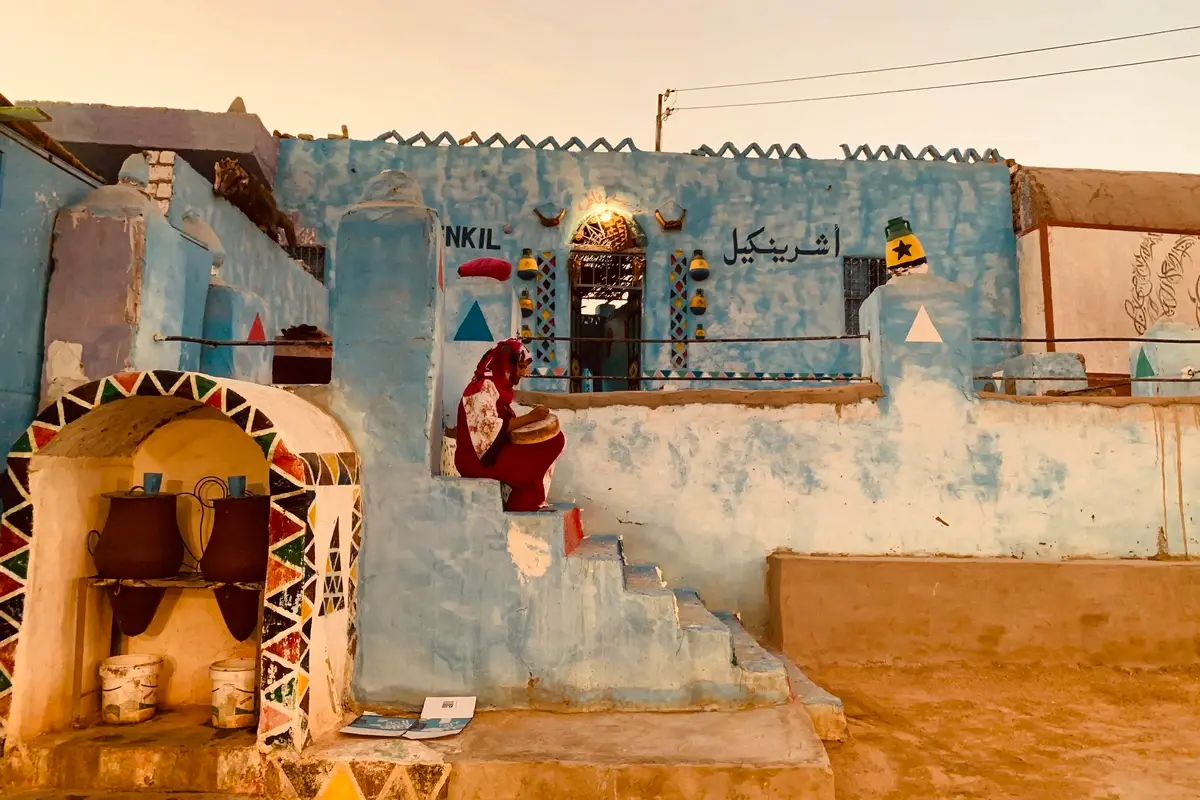
The boat journey always takes a long time. I heard there was a Nubian village nearby, so a few of us formed a small group and hired a guide to explore it. The Nubians are an ethnic minority in Egypt, of African descent, quite dark-skinned. I found riding camels here much more interesting than in the Sahara. Taking a small boat along the Nile, near dusk, the sunlight made the banks of the Nile look especially gentle and tranquil. We landed on a beach and rode camels for almost 30 minutes to reach the village. It wasn't a big place, but every house was beautifully decorated with bright colors. There were very few tourists, but the locals would still ask for money if they saw you taking photos. There was a pretty girl painting quietly in front of a blue house—it was a nice scene—but as soon as you lifted your camera, her father would shout "one dollar, one dollar," instantly reducing my好感度 by 100%.
The local guide arranged a visit to an Arabic language classroom, where we fooled around for about 20 minutes, laughing our heads off. Then we visited a local family's home, had juice, and saw crocodiles. Overall, the commercial vibe wasn't too heavy.
We visited the Temple of Kom Ombo, which has an early clinic behind it (though ancient medical practices seemed a bit like child's play). Even though I had done a lot of research on Egyptian gods, I was still clueless when I saw the statues.
The architecture looked great from different angles. The local staff were very eager to chat with you, offer to take photos, and help you find good angles. But I was afraid they'd demand payment later, so I didn't engage. Occasionally, some staff would put on a show, striking poses when they saw a camera. There was also a Crocodile Mummy Museum nearby, which also had a no-photography sign, but it was likewise ignored.
The boat arrived near the Temple of Horus before dawn. I chose to take a horse-drawn carriage to the temple, and the morning street view excited me. When we arrived, the sun was casting golden light on the yellow walls and pillars. The statue of Horus, representing revenge, looked especially magnificent, as if the glory of a thousand years ago had never left.
What touched me most at the Temple of Horus was the thought that a thousand years ago, people from all over Egypt gathered here for an all-night celebration. The priests would carry the sacred bull through the side corridors to the top to absorb the sun's power. The carvings in the corridors vividly depicted those scenes, as if you could still hear the clamor of voices—a truly magical experience.
A small incident: When passing through the locks, many Egyptians would sit in small boats, shouting at the cruise ship to do business. If you asked about anything, they'd throw the item up to you. The prices were outrageously high. If you said no, they'd keep chasing you, not in a hurry to take their stuff back, waiting for you to agree on a price. I'm not good at refusing people, and this kind of sales tactic only made me feel pressured. In the end, as we passed through the dam, the item was still in my hands and they wouldn't let me return it. They weren't satisfied with the money I gave, and they kept rowing their small boat behind us, shouting. I got annoyed—it wasn't much money anyway—so I asked a soldier on the dam to throw the extra money to the other side of the dam (the small boats couldn't pass through).
While the Egyptians were shouting from their boats, a few Germans on the deck were also shouting something I didn't understand, and even splashed water on me. My cousin was furious, saying the Germans were disrespectful. We angrily went up to the deck to find those who splashed water, but they had already slipped away. Then we found the German tour guide and the ship's captain. Eventually, we flushed out the hiding German. I demanded either an apology or I would splash water back. The German group seemed to be a middle-aged or senior group (they looked older), and they seemed quite racist. They stubbornly refused to apologize, said a bunch of German I didn't understand, and handed me a large bottle of water, telling me to pour it over his head. (There were many German and Dutch tourists in Egypt.)
Luxor was called Thebes in ancient times. Ramesses, Ramesses, Ramesses everywhere. Indeed, when a king was rich and accomplished, all he wanted to do was show off, show off, show off. The Luxor Temple is enormous; most people had lost patience by the front, so there were relatively fewer people in the back, and it was quieter. Looking closely at the pillars, some colors were surprisingly well-preserved. My cousin was led secretly by a staff member, who mysteriously opened a room to show her a stone with something embedded in it. He babbled on, and we didn't understand a word. Inevitably, it ended with a request for a baksheesh.
Luxor also has hot air balloons, but not many people ride them. They don't look as nice for photos as those in Turkey, but on one side is the Nile oasis, on the other is desert, with the sun on one side and the moon on the other. If you have money to spare, I think it's worth a ride. Before dawn, on the Nile, people were making their first prayers of the day. One side of the ancient site was quiet, while the other was full of singing—a truly unique experience. Luxor gives you a sense of division between ancient and modern, or perhaps the past has never left this land.
I felt this especially strongly in the Valley of the Kings. Although I'm not a spiritual enthusiast, I truly felt that this land has power. Even with all the noise from tour groups around, if you stop, you can feel a broader, more profound stillness that overpowers the surrounding sounds. This stillness is the most original sound bound to this land. Entering the Valley of the Kings, I saw locals working on the mountain (I have no idea what they were repairing). If you freeze that image, it probably looked much the same long ago.
Again, the no-photography rule was ignored (Korean ajummas shouting "Yeah!" in the corridors), and staff were everywhere, even guiding me to step over the railing to the place where the king's sarcophagus once stood, just to take photos for us. But I really couldn't laugh. (I didn't want to take pictures of such an inauspicious spot—who would want such a photo?) And of course, more baksheesh.
From boat to bus. Egyptian buses are really terrible, like those from the 1980s. Rumor has it they are hand-me-downs from developed or developing countries. On the way, a window broke and was patched with tape, then broke again and took a long time to fix. Hurghada is a nice place to relax for a few days, and the desert is worth seeing. The so-called local encounters and camel rides are purely commercial—okay for the experience, but nothing more. Mainly because I had never seen a desert before.
Egypt's sea is quite beautiful; the fish I saw while diving were more stunning than those in Thailand. But I've seen enough sea, so it didn't impress me much.
The items sold in the market are of low quality, not worth buying. The local vendors can be a bit intimidating—very enthusiastic when trying to get your attention, but full of malice if you show disinterest. It felt like you couldn't go out alone without feeling unsafe. Ordinary Egyptian citizens, however, are quite outgoing; they see foreigners and ask for photos, always pulling out their beauty filters all the way to MAX. Like many places, tourist spots create a bad impression of locals, but one-on-one conversations reveal the friendliness of ordinary people.
The museum was a highlight. You can buy a photography pass, but the Tutankhamun mask and mummies are not allowed to be photographed. Perhaps due to the country's resources, the Egyptian Museum is full of treasures, with so many artifacts they don't know where to put them. The museum's infrastructure is really not up to Chinese standards, which is a pity. Many excellent items were taken by Europe. I went in screaming internally and came out screaming, dizzy with joy.
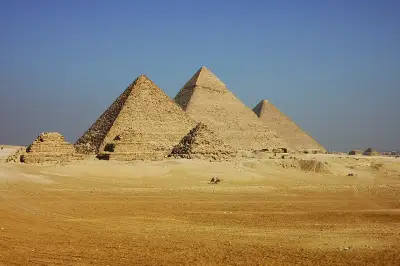
Giza Pyramids and the Sphinx are Instagram hotspots for the whole world. Don't ride the camels—I saw people get ripped off right in front of me. Don't respond to people who offer to take your photo; they start friendly but end up extorting money. And they are very much bullies who fear the strong. Some tall, burly white people, after having their photos taken, refused to pay the "service fee" and told the Egyptians to get lost, and the Egyptians dared not do anything. Both sides are not good—one freeloads, the other bullies the weak. Don't trust anyone who approaches you with friendliness around the pyramids; this is not a place to learn about local customs.
The mosques and the Hanging Church were fine. I kept thinking: the journey had been safe all along, yet I was always alert, guarding against people around me, unable to let myself blend in. I think the main reason is religion—the unfamiliarity creates distance, and because they are so many and I am so few, the unity of their language makes them seem like a formidable whole. It's not that I don't want to understand, but on the scale of understanding, my weight is too unbalanced to bear the consequences of the conflicts that arise during the process.
A city that left a great impression: very modern, and felt very safe. Perhaps port cities are more diverse, so the religious atmosphere is diluted. The Mediterranean, the cradle of Eastern and Western cultures—very moving. It was a perfect end to the journey. The young Macedonian king built grand buildings here, named various conquered territories after himself, but with his death, the empire collapsed. Darius I, Xerxes I, Caesar—all kinds of great emperors and monarchs set foot on this land, dispersing ancient civilizations. Ancient Egypt and modern Egypt are fractured; when the stone tablets were not yet deciphered, not even Egyptians themselves knew about it. I once read a description of Egyptian civilization: "It seemed to appear suddenly, while other civilizations were still in their cradle, it was already so great, and then it disappeared just as suddenly."
Finally, I once again marvel at the greatness of Chinese civilization. Because of the continuity of our written language, we can read content from a thousand years ago. This might be the most wonderful and coolest thing in the world.
Travel Log Index:
1. Aswan
2. Temple of Kom Ombo (Crocodile Temple)
3. Temple of Horus (Falcon Temple)
4. Luxor Temple
5. Valley of the Kings / Temple of Hatshepsut
6. Hurghada (Red Sea)
7. Cairo (Museum, Pyramids, Market, Mosque)
8. Alexandria
Travel Information:
Hotel Index, Guide Index, Ticket Index, Website Navigation, Travel Index, Cruise Index, Corporate Travel Index, Affiliate Cooperation, Distribution Alliance, Friendly Links, Corporate Gift Card Purchase, Insurance Procurement, Agent Cooperation, Hotel Franchise, Destination and Attraction Cooperation, More Affiliations.
About Ctrip: Ctrip Highlights, Contact Us, Careers, User Agreement, Privacy Policy, Business License, Security Center, Ctrip Content Center, Intellectual Property, Trip.com Group Algorithm Disclosure