Watch 'The West Chamber' at Pujiu Temple and Gaze at the Sunset from Stork Tower
Where does the story of “The West Chamber” take place? Where is the Stork Tower for climbing high and gazing far? Where is the ancient Pujin Ferry?
They are all in Yuncheng, in southwestern Shanxi, and specifically in Yongji. Yongji is a county-level city under the administration of Yuncheng, Shanxi Province.
The love story of Zhang Sheng and Cui Yingying is known to every household. Under the pen of Wang Shifu, Pujiu Temple is the original setting where this story unfolds.
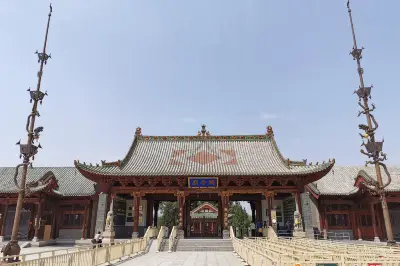
Yongji was called Puzhou or Puban in ancient times. Pujiu Temple is located on the edge of the Emei Plateau, 3 kilometers east of the ancient city, and only about ten kilometers east of present-day downtown Yongji. The temple sits facing south, perched high above, with ravines on its south, north, and west sides.
On the afternoon of October 2, it was sunny and pleasant. From afar, the landmark of Pujiu Temple — the Yingying Pagoda — stood proudly and gracefully alone under the bright sun, glowing with a golden sheen.
Pujiu Temple was first built during the reign of Empress Wu Zetian in the Tang Dynasty and originally named Yongqing Temple. It became widely known thanks to the Yuan dynasty play “The West Chamber,” and the pagoda in the temple came to be called Yingying Pagoda. Seen from a certain angle, the pagoda indeed resembles the delicate figure of a graceful maiden — slender, gentle, as if adorned with jingling ornaments, beautiful like a fairy, a masterpiece of nature.
In fact, the Yingying Pagoda is also a world wonder that can produce the “Pujiu Toad Sound.” Along with the Echo Wall of the Temple of Heaven in Beijing, the Baolun Temple Pagoda in Sanmenxia, Henan, and the Great Buddha Temple in Tongnan County, Sichuan, it is known as one of the four great sound-producing pagodas of China.
Visitors who strike stones together west of the pagoda can hear a frog-like “kr-r-oak! kr-r-oak!” sound coming from the pagoda. This astonishing effect makes tourists linger and marvel. Some acoustic experts have even listed Yingying Pagoda’s “frog croak” alongside the Wobbly Pagoda of Shan State in Myanmar, the Fragrant Tower of Marrakesh in Morocco, the Musical Tower of Szolnok in Hungary, the Bell Tower of Paris in France, and the Leaning Tower of Pisa in Italy as the world’s six great acoustic or curious towers.
The West Wing (Xixuan) is the residence where Zhang Sheng (also named Zhang Junrui) stayed at Pujiu Temple while traveling for the imperial examinations.
About a dozen meters to the east lies the Pear Blossom Deep Courtyard, where Cui Yingying’s family took temporary refuge. The stories that unfolded inside and outside these walls are well known throughout China, so I won’t dwell on them.
In the West Chamber lived the clever and bashful Miss Yingying and her bold, straightforward maid Hongniang.
On this day, in the matriarch’s upper chamber, a live reenactment of the classic scene “Interrogating Hongniang” was being performed. The old lady glared angrily, brandishing a feather duster, while little Hongniang knelt on the floor, arguing eloquently and fearlessly, and finally brought about a wonderful match.
“Hongniang ties the red thread under the moonlight; Zhang Sheng skillfully meets Cui Yingying.” Here at Pujiu Temple, we wish all lovers under heaven a happy union, never to part, and a lifetime of harmonious togetherness.
The Yongji tourist boulevard connects Pujiu Temple at one end with the Stork Tower at the other, with the ancient Pujin Ferry in between.
The famous Pujin Bridge from history and the Tang Kaiyuan iron oxen are now housed in the Iron Ox Museum at the present-day heritage park. The Pujin Ferry was a major crossing on the ancient Yellow River, located on the eastern bank of the Yellow River just outside the western gate of old Puzhou City in Yongji. Since ancient times, the Pujin Ferry has been a strategic transport point between the Qin and Jin regions, and many dynasties constructed pontoon bridges here. According to the Zuo Tradition (Spring and Autumn Annals), in the first year of Duke Zhao’s reign, the Qin prince Xian fled to Jin, and boats were joined to form a bridge over the river.
During the Kaiyuan era of the Tang Dynasty, Emperor Li Longji ordered iron to be smelted across the country, and over 100,000 jin of iron were cast into massive anchoring objects: iron oxen, iron figures, iron hill-shaped anchors, and so on. Chains were stretched, and a long bridge was erected. This project consumed three-quarters of the entire nation’s iron at the time.
Later, due to changes in the Yellow River’s course and other reasons, these huge artifacts were buried beneath the riverbed’s silt. It was not until 1989 that these precious relics were brought back to light, bearing witness to historical achievements.
When you come to Yongji, you must climb the Stork Tower. The Stork Tower was first built during the Northern Zhou Dynasty (around 557–580). It endured through the Sui, Tang, Five Dynasties, Song, and Jin periods for over 700 years, until the early Yuan Dynasty when Genghis Khan’s army invaded the Central Plains and it was destroyed in the fighting, leaving only its ruins. In the early Ming Dynasty, the ruins still existed, but later, as the Yellow River flooded frequently and its course shifted back and forth, the exact site became hard to locate. People could only treat the western city gate tower of Puzhou as the “Stork Tower,” and many came to climb it and compose poems.
The Stork Tower soared to fame entirely thanks to the Tang poet Wang Zhihuan. Wang Zhihuan is remembered for just this one poem, but one is enough; it has been passed down through the ages as a classic masterpiece: “The white sun sets behind the mountains; The Yellow River flows into the sea. To see a thousand miles further, Ascend one more storey high.”
Times have changed, and things are no longer the same. The Yellow River is no longer at its original location, and the Stork Tower is not at its original location either. The river shifted its course, and the tower’s original site is now unknown. Among China’s four famous ancient towers, the Stork Tower was the last to be rebuilt. The present-day Stork Tower was rebuilt starting in December 1997 and completed in September 2002, on the site of the old western gate tower of ancient Puzhou City. From any direction, the three-storey building with four-fold eaves is built in a Tang-style imitation.
The interior decorations also tell stories of the glorious Tang Dynasty.
To the west, the Stork Tower faces the Yellow River; to the east, it is backed by the Zhongtiao Mountains; to the south, it looks towards Mount Hua. Perhaps because the current positions of the tower and the river have shifted, or perhaps because Wang Zhihuan climbed in deep winter, but in any case, as I watched the entire process of the setting sun sinking westward, I could not fully recreate the poetic scene of “the white sun sets behind the mountains.” Instead, in mid-autumn, the setting sun slowly hid itself in the due western sky, beyond which lie the vast alluvial plains west of the Yellow River. Perhaps, in deep winter, the sun would indeed follow the course the poet described — setting toward the southwest, into the towering peaks of Mount Hua. But today, whether or not the sun truly set behind the mountains, the magnificent, splendid, and breathtaking landscape the poet wrote about, and the stirring, ardent, soaring emotions in his heart, I have indeed taken in with my eyes and felt in my own heart.