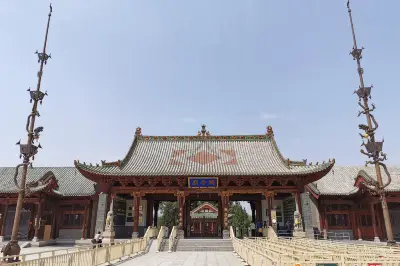
Spring Trip to Shanxi in 2021: A Brief Account (9-Day Free Travel in Datong, Yingxian, Wutai, Yuncheng, Changzhi) - Datong and Yingxian Section
They say spring is infinitely beautiful, and wasting it is shameful. So even without thorough planning beforehand, I had to set off anyway. Originally planned was the hundred-mile azalea sea in Bijie, Guizhou, but unfortunately higher temperatures this year advanced the bloom period, and by early April it was already past the peak. Fanjing Mountain was also rainy and overcast, so I decisively changed plans to revisit Shanxi. Don't ask why I chose Shanxi; the only reason is that visitors from Jiangsu, Zhejiang, and Shanghai got free admission.
Although it was a last-minute decision and a second visit, some simple preparation was necessary. I basically followed the free 5A and 4A scenic spots in Shanxi. Excluding places I had already visited like Hukou Waterfall, Wang's Family Compound, and Pingyao Ancient City, I initially set the main itinerary including Yungang Grottoes (second visit), Yingxian Wooden Pagoda, Mount Wutai, Taihang Grand Canyon in Huguan (Changzhi), Xiezhou Guandi Temple in Yuncheng, and Wulaofeng in Yongji. During preparation, I found that free travel guides for the Huguan Taihang Grand Canyon and Wulaofeng were scarce, so I will later mention some details to note for those spots for fellow travelers. Also, I should declare upfront: the following is basically a running account, with no beautiful prose or photos. And I suffer from moderate acrophobia, mild OCD, and mild trypophobia (the reason for this declaration will come up later). Unless you like free travel, public transport, and are just looking for some tips, you might want to skip this. And if you don't want to hear me ramble, you can jump directly to the tips at the end – they are straightforward. My OCD makes me prefer seamless, compact itineraries, often using overnight sleeper trains to save time. I never scrimp just to save money, but I can rough it when necessary – whether it's a leaky wooden hut on Poon Hill in Nepal, an ancient house sharing a floor with livestock in Langde Miao Village, or a Kempinski in a big city – I can enjoy it all. So for friends who prioritize comfort, this may not be very helpful.
As mentioned, due to time constraints for detailed planning, the itinerary was roughly arranged from north to south and west to east by geographic location. But after actually going through it, I found that I overestimated the convenience of Shanxi's transportation. After all, the pre-May tourism season in Shanxi is not really a peak season, and many assumptions proved wrong. I'll elaborate later.
Day 1, Apr 8: Shanghai to Taiyuan, depart at 22:15, arrive early next morning, stay near the airport.
Day 2: Taiyuan to Datong, morning train to Datong, visit Yungang Grottoes, stay in Datong.
Day 3: Datong - Yingxian - Datong - Wutai Mountain Railway Station, visit Yingxian Wooden Pagoda. The detour was a last resort. Stay at Wutai Mountain Railway Station.
Day 4: Visit Mount Wutai, overnight train to Yuncheng.
Day 5: Yuncheng visit Guandi Temple, Salt Lake scenic area, stay in Yuncheng.
Day 6: Climb Wulaofeng, stay in Yuncheng.
Day 7: Yuncheng to Huguan Taihang Grand Canyon scenic area (Changzhi), stay in Qiaoxia Village.
Day 8: Visit Baquan Gorge, Hongdou Gorge, stay in Changzhi city center (you can choose to fly back directly or return via Taiyuan).
Day 9: Changzhi by train to Zhengzhou, visit Henan Museum, overnight train back to Shanghai, end of trip.
A blunt and subjective summary: For human cultural landscapes, Yungang Grottoes and Yingxian Wooden Pagoda are five-star recommended; a second or third visit is worthwhile, but you must have a professional guide – you will definitely benefit a lot. For natural landscapes, I recommend Baquan Gorge in Taihang Grand Canyon and Wulaofeng in Yongji. Although one is 5A and the other 4A, both are niche scenic spots, especially Wulaofeng, which has very few visitors at this season but stunning scenery – five stars. Mount Wutai is very suitable for those with Buddhist faith or deep Buddhist cultural knowledge. For a pure sightseer like me, the natural scenery of Mount Wutai in this season is a matter of personal opinion. Yuncheng Guandi Temple and Hongdou Gorge in Huguan Taihang Grand Canyon (Qinglong Gorge I didn't visit so no comment) get two and a half stars – worth a visit if you have time. Yuncheng Salt Lake scenic spot is a huge pitfall – not recommended, at least not worth going inside this season; a walk outside is enough. Spending money and time to go inside, the view is the same. For the finale, I originally could have revisited Taiyuan's Jinci Temple to see peonies, or revisited Henan Museum in Zhengzhou. I chose the latter, and both are worthwhile. One more thing: The free admission policy for residents of Jiangsu, Zhejiang, and Shanghai in Shanxi is good, but throughout the trip I found that the standardization of implementation needs improvement. I'll elaborate later.
Day 1-2: Before departure, I checked flight tickets and found a special package on some app that included the flight plus a hotel near the airport for the same price as the flight alone, and also offered pick-up service for late-night flights. I grabbed it. After landing, I called for pick-up and checked in smoothly. The hotel conditions were as basic as expected, but no matter – I caught a few hours of fitful sleep, then got up and took a taxi to Taiyuan Station. The train to Datong South took less than 2 hours. However, note that Datong South is far from both Yungang Grottoes and Datong Station, and there is no direct public transport to Yungang Grottoes (Datong Station has bus 603 direct to Yungang, very convenient). I tried a carpool ride and was unexpectedly accepted, saving some money and a lot of time. If that fails, I suggest taking a taxi; the bus is very inconvenient.
Yungang Grottoes was our first free scenic spot on this Shanxi trip, so we had no idea about the procedure. After inquiries, we finally figured it out: first, register and reserve with real name on the "Travel Shanxi" mini-program; verify the reservation record and original ID at the ticket office, then take a photo for facial recognition; finally, enter by scanning your face at the entrance. Basically, it was standard and smooth. We naively thought all scenic spots would follow this process, but we were too innocent – this turned out to be the only one that was most standardized and smooth.
A reminder: After entering Yungang Grottoes, the first kilometer or so of the landscape, including the water temple, is newly built. You can quickly pass through; the real essence is the grotto area behind. It took a round trip to see all the grottoes twice, and I listened in on several guides. Why not stick to one? Mainly because each guide has their own preferences and style, and the focus of the commentary differs, so listening to several is worthwhile. If you happen to not be able to catch a guide, I strongly recommend paying for a professional one – it is well worth it.
In the afternoon, we exited the scenic area and took bus 603 back to the ancient city of Datong downtown, intending to taste Datong's specialty: lamb shaomai (steamed dumplings). But we learned that the shaomai shops here only serve breakfast and lunch, and basically stop serving after 2 pm. The boss lady reluctantly agreed to steam two baskets of shaomai for us, but couldn't guarantee whether it was lamb or beef. Fine, just fill our stomachs. Since they were not freshly steamed, I dare not judge rashly. Overall, the meat filling was too fine and soft, with chopped onions; the texture was not as firm as expected, and there were noticeable chewy sinews. However, the shaomai skin was quite tasty, and the flower-like shape was nice. As for Shanxi lamb, I generally felt it had a strong gamey smell, whether in dishes or noodles. If you are not tolerant of lamb smell, be cautious. After lunch, we strolled in the ancient city to Huayan Temple, planning to make a reservation again. But we were told to reserve through the official WeChat public account. During the reservation, we encountered a logic bug in the program: after entering the ID number, it said the ID did not match. In other words, the program logic assumed that Shanghai residents' ID numbers should start with 31. Obviously, this logic is wrong – an ID number is only related to the city where you first applied for it, not your registered residence. After communicating with the ticket office, they told us to talk to the check-in gate. At the check-in gate, after explaining the reason again why we couldn't reserve, the ticket inspector still couldn't understand (sigh, I felt quite puzzled that he couldn't understand). Fortunately, a staff member who looked like a supervisor came over, checked our IDs repeatedly, then waved us in. I was very touched. Huayan Temple is definitely worth a visit. Most of its buildings and sculptures are from the Liao and Jin dynasties, nearly a thousand years old. The wooden pagoda there is the second largest all-wooden high pagoda after the Yingxian Wooden Pagoda.
Leaving Huayan Temple, we noticed that more and more tourists had arrived. We found out we had coincidentally encountered the Datong Lantern Festival, originally scheduled for the Spring Festival but postponed due to the pandemic. What a lucky coincidence – we couldn't miss it. After checking in at Datong Guesthouse, we went to a highly-rated local restaurant, Zini 369 Coarse Grains Nanhuan Branch, for dinner. The waiter was patient and warm. Knowing we were tourists, he not only gave us a fruit platter and a baked potato but also recommended the night lantern festival. Truly touching. The food was delicious, and we were in good spirits. After dinner, we took a taxi to the ancient city. The lantern festival wasn't particularly exquisite, but it was bustling with people.
Day 3: Early in the morning, we went to the bus station and bought tickets to Yingxian. There were many departures, and the journey took one and a half hours. We also learned two things: first, although Yingxian is between Datong and Mount Wutai, there is no direct bus to Mount Wutai, so you have to return to Datong; second, there is a direct bus from Datong to Mount Wutai departing at 2:30 pm. We calculated the time and thought it would be fine, so we decided to visit the wooden pagoda first, then return to Datong to catch that direct bus to Mount Wutai. At Yingxian Wooden Pagoda, as usual, we asked about the free admission procedure. We were told that if we had reserved through the "Travel Shanxi" mini-program, we could just swipe our IDs. But in reality, swiping the ID did nothing. Fortunately, the staff checked our reservation record and IDs and let us in through the staff entrance. Like Yungang Grottoes, a professional guide is a must at the Yingxian Wooden Pagoda. The kind of tour guide commentary that relies on folk gossip and tall tales is better ignored. This time we were very lucky to encounter a professional who was leading a group. The group members called him "teacher" with great respect. This teacher was very knowledgeable, analyzing the pagoda from historical, religious, architectural, painting, sculpture, mural materials, and cultural preservation perspectives. Throughout, there was not a single dubious folk legend, and even a layman like me listened for over an hour, utterly captivated and benefiting a lot. There was also an episode: because of cultural relic protection, climbing the pagoda is not allowed, so many birds live on the beams inside the pagoda, and bird droppings fall occasionally. It is recommended to wear a hat when visiting to avoid a direct hit. The teacher, surrounded by the group like stars around the moon, unfortunately got hit. That was bad luck. But speaking of bad luck, I did encounter something during this trip – but that's another story, to be set aside for now.
Because we were so absorbed in the commentary, our actual visit time exceeded expectations. We had to rush through lunch and head back to Datong. We hurried and arrived at Datong Bus Station at exactly 2:30, but the unexpected happened: we were told that the bus to Mount Wutai that day had been canceled (I was puzzled – why didn't the morning ticket seller tell us? If they had, we wouldn't have had to come back to Datong). We had to take a bus to Shahe Town, where the Wutai Mountain Railway Station is located, and then take a bus into Mount Wutai early the next morning. Considering we needed to catch the earliest bus into the mountain (departing around 4:30 am), we decided to rough it and stay at a small hotel near the station. The owner's little black dog was adorable; it enthusiastically and expertly led my wife to a supermarket to buy sausages for itself – clearly a seasoned veteran.
Thus ended the Datong-Yingxian section, and we were about to start the Mount Wutai itinerary.
Tips:
1) The free admission policy for major Shanxi scenic spots for residents of Jiangsu, Zhejiang, and Shanghai ends at the end of 2021. There are two ways to reserve: through the "Travel Shanxi" mini-program or the scenic spot's official WeChat public account. There is no requirement to reserve in advance; as long as there are still quotas, you can reserve on-site. If you encounter system issues preventing online reservation (e.g., the system thinks your ID number doesn't match), you can generally get in by directly communicating with the ticket inspector.
2) Datong South Railway Station has no direct public transport to Yungang Grottoes; taxi is recommended. Datong Station has bus 603 direct to the scenic area, which also passes the ancient city of Datong – very convenient.
3) If you want to eat Datong's specialty shaomai, go early. Most shaomai shops only serve breakfast and lunch; they close after lunch. High-end restaurants are probably an exception.
4) During peak season, there is a direct bus from Datong to Mount Wutai scenic area departing at 2:30 pm. However, it's best to check in advance if there is a service that day. Yingxian is closer to Mount Wutai, but there is no direct bus; you need to transfer via Datong or Taiyuan.
5) The Wutai Mountain Railway Station is actually in Shahe Town, about 1.5 hours' drive from the Mount Wutai scenic area. The earliest bus from the station to the scenic area departs around 4:40 am. If you come from Beijing, there is a train arriving just in time to catch this bus. After 8 am, there are multiple buses to the scenic area. The latest bus back to the station departs from the scenic area at 4 pm. There are also many direct buses from the scenic area to Taiyuan.