2021 Two-Day Self-Drive from Taiyuan: Sweeping Through Yuncheng's Ancient Architecture (Feiyun Tower, Qiufeng Tower, Yongle Palace, Guangrenwang Temple, Guandi Temple, etc.)
Crisp autumn air, perfect for travel. I had originally planned to go to Yunqiu Mountain—the only 5A scenic spot in Shanxi I hadn't visited—but rain before the National Day holiday forced the scenic area to close. So, instead of hiking, I decided to explore around Yuncheng.
Every trip is a long-planned love affair, and like any relationship, you need to know the costs. When checking Yongle Palace on Ctrip, I discovered a 24-site combined ticket covering most of Yuncheng's attractions, and it was available to out-of-towners. I even called Yongle Palace to ask if the pass could be used during holidays; they said yes. So I quickly mapped out a route to sweep through Yuncheng!
When I passed through Yuncheng on my way to Huashan before, I visited Puji Temple, Guanque Tower, and Xiezhou Guandi Temple. Besides those three, the Yuncheng pass includes many places I haven't been. With two days, it was a great deal.
Look at this map—I spent a whole night painstakingly planning it. Considering it'd be a 4-hour drive from Taiyuan and we'd arrive at noon, the first day had fewer stops. But we had to make it to Ruicheng, the farthest point, that night, and stay near Yongle Palace to finish the rest without exhaustion.
Full itinerary:
Day 1: Taiyuan – Dongyue Temple (Feiyun Tower) – Houtu Shrine (Qiufeng Tower) – Li Family Courtyard – overnight in Ruicheng (near Yongle Palace). Feiyun Tower entrance is 10 yuan, not included in the pass.
Day 2: Yongle Palace – Guangrenwang Temple – Changping Guandi Temple – Salt Lake – Chi Shen Temple – Duiyun Cave
What we actually did: replaced Chi Shen Temple with the Guandi Statue, and added Xinjiang Ancient City at the end. Ten sites in two days—impressed?
October 2, 2021. Four locals running from where we're bored to where others are bored. Left Taiyuan at 7:30, arrived at Wanrong Dongyue Temple at noon. This was the only attraction on the trip not covered by the Yuncheng pass, with a 10-yuan ticket. Parked in the white lines on the roadside, no parking fee.
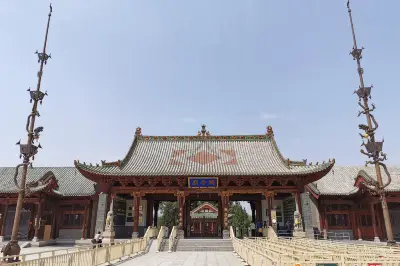
Dongyue Temple is a Daoist structure, originally from the Tang Dynasty and rebuilt during the Yuan. Its highlight is Feiyun Tower, one of Shanxi's Four Great Towers. The four are: Ying County Wooden Pagoda, Feiyun Tower, Xianshen Tower, and Houtu Shrine's Qiufeng Tower. Ying County Pagoda ranks with the Eiffel Tower; in China, it's so outstanding that none dare claim first. Xianshen Tower in Jiexiu is the world's only surviving Zoroastrian (Persian fire-worshipping) building. Qiufeng Tower is also in Wanrong, we'll go there soon.
Feiyun Tower is square in plan, with triple eaves but appears to have six layers of eaves, as if three separate structures were stacked together—spectacular and ornate. Its interior uses four sky-piercing pillars as the core framework, with multiple horizontal beams interconnecting each level, tying inside and outside into a massive square tube-like structure, showcasing the distinctive architectural art of Chinese multi-story pavilions.
Dongyue Temple isn't large; a thorough look takes about 40 minutes. Afterward, we went to eat and found the streets a bit deserted—many restaurants had 'for lease' signs. And this was during the National Day Golden Week!
After lunch, we headed to Houtu Shrine, about 30-odd kilometers away, roughly a 40-minute drive. Arrived around 3 p.m. Houtu Shrine is included in the Yuncheng pass; we just scanned our ID cards to enter.
Houtu Shrine stands on the east bank of the Yellow River, the oldest temple in China dedicated to Houtu (Mother Earth, the goddess Nüwa). Since the Eastern Han Dynasty, it was where emperors performed sacrifices. The Yellow River flooded repeatedly, destroying and rebuilding it many times. Houtu, the Sacred Mother, is considered the most ancient ancestor of the Chinese people, and this shrine was once the foremost temple in the land, the origin of Beijing's Temple of Heaven. It's the root of Chinese ancestral culture.
Does 'Houtu' refer to the earth god and imply the whole cosmos? In the middle of the courtyard, east and west, are two Five Tigers Halls: the East Five Tigers Hall and West Five Tigers Hall.
The East Five Tigers Hall enshrines the Five Great Mountain Emperors: East Mountain Emperor Huang Feihu, South Mountain Emperor Chong Heihu, Central Mountain Emperor Wen Pin, North Mountain Emperor Cui Ying, and West Mountain Emperor Jiang Xiong.
The West Five Tigers Hall is dedicated to the five tiger generals of Shu Han during the Three Kingdoms: Guan Yu, Zhang Fei, Zhao Yun, Ma Chao, and Huang Zhong. It's rare to see a temple honoring Shu's tiger generals—wonder how they infiltrated our side?
Qiufeng Tower stands at the rear of Houtu Shrine, poised by the river, majestic and spectacular. A stone stele inside bears Emperor Wu of Han's 'Ode to the Autumn Wind,' giving the tower its name and fame. The city gate has doors: east gate inscribed 'Gaze upon Lu,' west gate 'Look to Qin.' The south gate is the main entrance to ascend.
The tower was built by the Qing-dynasty magistrate of Ronghe to commemorate Emperor Wu's poem.
An hour at Houtu Shrine is enough. We left after 4 p.m. and reached Li Family Courtyard by 5.
The Li Family Courtyard has a large parking lot, free of charge—not sure if it's only for holidays or always free. To use the pass, we couldn't just scan IDs; we needed to exchange them for tickets at the booth.
Li Family Courtyard was the home of Li Ziyong, the richest man in southern Shanxi from the late Qing to Republican era. Built during the Qing, it's known, along with Qiao Family Courtyard and Wang Family Courtyard, as the 'Three Lotus Flowers of Shanxi Merchants.' As the saying goes: 'Qiao for fame, Wang for the courtyard, Li for charity.'
The Li family started in traditional farming, then expanded into commerce. They made their fortune with homespun cloth, later invested in modern industry, transforming from farmers to merchants, then national capitalists. Their philosophy: 'Profit by righteousness, balance righteousness and profit.' For generations, they were 'rich but not arrogant, wealthy but not extravagant, prosperous yet benevolent.'
This is the main street of Li Family Courtyard. The overall design is a Shanxi courtyard in the 'shaft-well' wealth-gathering style, incorporating Anhui architectural elements. Because Li Ziyong studied in England, some sections feature Gothic architecture—a fusion of north and south, Chinese and Western, unparalleled among Shanxi merchant compounds.
The exquisite gate towers are rich in traditional Han cultural depth, with high artistic and cultural value.
By 7 p.m., more tourists were pouring in, and the ticket checker at the gate was long gone. Turns out, after 6 p.m. it's free, with even more evening performances and a bustling night market. The locals are so lucky!
So now I've been to Qiao, Chang, Wang, and Li family courtyards. Wang Family Courtyard is the biggest, with a stunning layout built on a hillside forming a gigantic '王' (king) character. Chang and Li are about the same size, Qiao is smallest—but its fame outweighs everything.
After dropping off luggage, we went downstairs for dinner. The streets were lively; even at almost 9 p.m., many people were entering restaurants. Is Ruicheng that much more bustling than Wanrong?
Up at 6:30 the next morning—plenty of sites to visit. After packing and eating, we rushed to Yongle Palace by 8 a.m.
Yongle Palace is named after its original location, Yongle Town, also called Dachunyang Wanshou Palace. Construction started in the Yuan Dynasty and lasted over 110 years. The walls inside are covered with murals.
When the Sanmenxia Dam was built, the original site was to be flooded, so Premier Zhou Enlai personally approved funds to relocate it to the east side of Longquan Village in Ruicheng County.
The existing main structures are one gate and three halls: the gate is Dragon-Tiger Hall (also called Wuji Gate), and the halls are Sanqing Hall, Chunyang Hall, and Chongyang Hall.
Relocating these buildings and murals in the 1950s took craftsmen a full decade. During the Cultural Revolution, the Premier himself intervened and provided armed protection, sparing them from damage.
Sanqing Hall, also known as Wuji Hall, enshrines the Three Pure Ones (the highest deities in Daoism): Yuanshi Tianzun, Lingbao Tianzun, and Daode Tianzun. It's the main hall of Yongle Palace.
Chongyang Hall honors Wang Chongyang, founder of the Quanzhen School of Daoism, and his 'Seven True Disciples.' Inside, a comic-strip style depicts Wang Chongyang's life from birth to enlightenment, including the story of him meeting Lü Dongbin at Zhongnan Mountain, cultivating in a 'tomb for the living dead,' and achieving immortality. Seems Jin Yong's *The Return of the Condor Heroes* wasn't far off—though I wonder if he ever met Xiaolongnü?
Photography of the murals is forbidden. The walls are densely covered with over 200 deities; the eight main figures stand over 3 meters tall. Nothing in China surpasses these monumental, breathtaking works. A security guard proudly explained everything to us—was he competing with the guides?
The murals cover the four halls, collectively called 'Chaoyuan Tu' (Procession of the Immortals), depicting all deities paying homage to Yuanshi Tianzun: Azure Dragon and White Tiger lead the way, around the eight main gods such as the Southern Longevity Star and the Queen Mother of the West cluster the Thunder God, the Lightning Mother, various star gods, dragon, snake, and monkey spirits, along with warriors, strongmen, and jade maidens. Nearly 300 immortals move in one direction, forming a river of pilgrimage.
An adjacent courtyard explains how craftsmen spent ten years relocating the palace and its murals.
After over an hour at Yongle Palace, we went to Guangrenwang Temple, just 3 km behind—less than ten minutes' drive.
Guangrenwang Temple, along with Nanchan Temple and Foguang Temple on Mount Wutai, and Tiantai Nunnery in Pingshun, are the only four surviving Tang Dynasty wooden structures in China.
It's also called 'Five Dragon Temple' because a spring called Five Dragon Spring gushes out in front of its foundation. This temple is dedicated to Guangrenwang, the Dragon King of the spring. Among Tang buildings, it ranks second in age, after Nanchan Temple.
The main hall faces south, built in the fifth year of the Tang Dynasty's Dahe era (831). It's five bays wide, four rafters deep (three bays), rectangular in plan, with a single-eave hip-and-gable roof.
Opposite is a Qing Dynasty stage that forms a seamless quadrangle courtyard with the hall.
A Tang Dynasty stele, 'Record of Guangrenwang and Dragon Spring,' with bold yet elegant calligraphy, details how the county magistrate Duke Yu dug a channel to bring spring water to irrigate farmlands.
So I've now visited the top three oldest wooden structures in China. Comparing: by age: Nanchan Temple, Guangrenwang Temple, Foguang Temple. By scale: Foguang Temple is the largest, then Nanchan, then Guangrenwang. By artistic value: Foguang Temple first, then Nanchan, then Guangrenwang.
Liang Sicheng considered Foguang Temple China's number one national treasure; its East Great Hall is huge, with exaggerated eaves soaring like wings—truly awe-inspiring.
Guangrenwang Temple can be seen in about ten minutes. We left at 9:30 and reached the Guan Gong Statue Scenic Area at 10:30.
This wasn't in my original plan; next was Changping Guandi Temple, but we happened to pass the Guan Gong statue (only 2 km from Changping) and it was covered by the pass, so it was a spontaneous stop. Don't miss it if you pass by! On Zhongtiao Mountain stands China's largest bronze statue of Guan Gong (61 meters tall, symbolizing his 61-year lifespan; the base is 19 meters, representing the year he married and established himself, totaling 80 meters). Wind turbines nearby add a perfect touch.
There was a 10 yuan parking fee at the gate—the only parking fee of the two days. Later, in the city center by Salt Lake, parking was free again. Yuncheng is so generous!
China has many Guandi Temples, with five most important ones—two in his hometown of Yuncheng.
Xiezhou Guandi Temple is his ancestral temple (I've been there before, so skipped it this time); it's huge and most tourists go there.
Changping Guandi Temple is his family temple, enshrining his relatives, only 10 km from Xiezhou.
In Luoyang, Guanlin Temple buries his head. Sun Quan sent Guan Yu's head to Cao Cao to deepen the feud between Liu Bei and Cao Cao; terrified, Cao Cao buried the head with full honors.
At Dangyang Guanling, his body is buried. Hence the saying: 'Guan Gong's head rests in Luoyang, his body lies in Dangyang.'
Chengdu, as Guan Yu's base, naturally has a tomb of his clothes.
The 'Hometown of Prince Guan' gate, built in the Ming Dynasty: four pillars, three openings, with upturned lotus capitals and carved sleeping lions at the corners.
Ancestral Hall, rebuilt during the Qianlong reign: three bays wide, four rafters deep, single-eave overhanging gable roof. Inside are clay statues of Guan Yu's earliest ancestor, three generations of grandfathers, and their wives—unique among China's martial temples.
Only at Changping Guandi Temple can you truly understand the saying, 'When one becomes an immortal, even his poultry and dogs ascend to heaven' (I'm an atheist, so don't flame me). The visit takes less than an hour. It's only about a dozen kilometers to Salt Lake, a 30-minute drive. We came out at 12:30 to eat, got to Salt Lake by 2:00 p.m.
Yuncheng Salt Lake is one of the world's three largest sodium sulfate inland salt lakes. Because its salt content is similar to the Middle East's Dead Sea, allowing people to float effortlessly, it's called the 'Dead Sea of China.'
It's an ancient, typical inland saltwater lake, with a long history of salt production—over 4,000 years of exploitation by ancient people.
In the early Tang Dynasty, a method called 'five-step salt production' (or 'open-field panning') emerged in the Hedong salt ponds, a major technological advance. The quality and quantity of Lu salt from Yuncheng greatly improved, and it has now become an intangible cultural heritage of Yuncheng.
This method transformed the traditional reliance on 'sun-drying and natural crystallization' into a managed process of 'brine collection and evaporation, filtration and blending, storage, crystallization, and scraping'—the five-step salt-making technique.
Salt Lake itself isn't much to see; half an hour is enough. Then we headed to the nearby Chi Shen Temple (Salt Pond Spirit Temple).
As salt mining expanded, a phenomenon of naturally occurring red salt was discovered in the Tang Dynasty. Emperor Daizong was so delighted that he decreed the salt pond spirit be conferred the title 'Lingqing Gong' and ordered a temple built on the shore for worship—the Yuncheng Chi Shen Temple, founded in the Tang era.
Next stop: Duiyun Cave. Loaded and ready, off we shot!
Duiyun Cave is located on a ridge of Jiwang Mountain in Xia County, with ravines nearly 100 meters deep on both sides. After rain, clouds cluster around the ridge, sealing the cave entrance, hence the name 'Duiyun' (Cloud-Clustered) Cave.
Its appearance resembles Tibet's Potala Palace, earning it the nickname 'Little Potala.'
It's a Daoist temple, with construction starting in the Yuan Dynasty and additions through the Ming and Qing.
In 1928, the Hedong Special Committee of the Chinese Communist Party was established here, secretly operating for a decade, making it the cradle of revolution in southern Shanxi.
Zhenwu Dadi (True Warrior Emperor), also called Xuantian Shangdi, is the Daoist deity of the north.
Sanqing Hall enshrines the Three Pure Ones: Yuqing Yuanshi Tianzun, Shangqing Lingbao Tianzun, and Taiqing Daode Tianzun (Laozi).
Duiyun Cave has a meticulous layout, ingenious design, with pavilions and terraces blending into the terrain, grand in scale and imposing.
An old poem about Duiyun Cave: 'Spiraling up step by step, blue clouds beneath your feet let you soar. Turning back, you see where you've been, already twelve stories above the jade towers.' Truly a work of divine craftsmanship—the ancients' wisdom is boundless.
Duiyun Cave is small; even a leisurely tour takes under an hour. We came out before 4 p.m. Heading back then seemed a shame, so we drove toward Taiyuan and stopped by Xinjiang Ancient City along the way.
At 5 p.m., we arrived in Xinjiang. Exiting the highway, endless trucks crawled like snails; in town, tiny cars everywhere—parking was a nightmare.
The county town is small but packed with historical sites, scattered and needing a careful search.
Longxing Temple sits on a high cliff at the north end of Xinjiang's main street. Founded in the Tang Dynasty, it was originally called Biluo Temple because it housed a statue of Biluo Tianzun. Its ticket isn't covered by the Yuncheng pass: entrance 10 yuan, climbing the pagoda 5 yuan. I asked the old man at the gate why there were so many people and cars; he said there was a temple fair at the City God Temple up ahead.
Emperor Taizu of Song, Zhao Kuangyin, once stayed here, so Biluo Temple was renamed Longxing Temple.
Behind the Main Buddha Hall is Longxing Pagoda, also Tang Dynasty, with a body as white as jade, and bells dangling from its octagonal eaves. When the wind kisses them, the tinkling is like beautiful music, thus its reputation for 'eight-direction harmony.'
Atop the pagoda sits an iron gourd; the tower's protective deity dwells there. Normally, pagodas have treasures buried beneath—a Buddha's relic or rare gold and silver—but Longxing Pagoda places its treasure atop. That's its unique brilliance.
After Longxing Temple, we went to sample the county's temple fair. The City God Temple was about 500 meters away—arrived in no time.
Xinjiang City God Temple was founded in the Ming Dynasty, now rebuilt following original plans.
We strolled through the fair, nibbling on snacks. Winter jujubes here were so cheap: 10 yuan for 6 jin (3 kg), while in Taiyuan they're 5 to 10 yuan per jin.
At 7 p.m. we started the journey, and at 11 p.m. arrived home smoothly. Pushing the limits: ten spots in two days—perfect!