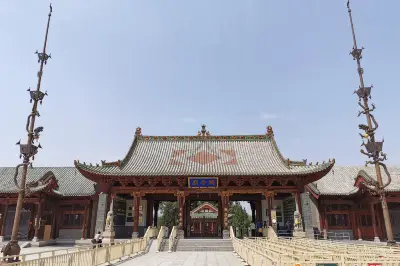
Sima Guang's Tomb in Xia County, Yuncheng
Located on Mingtiao Hill, 15 kilometers north of Xia County, Yuncheng, Shanxi, Sima Guang (1019–1086), courtesy name Junshi, a native of Sushui Township in Xia County, was known as Master Sushui. He served as a notable chancellor under Emperor Zhezong of the Song Dynasty, was posthumously honored as Duke Wenguo, and earned his jinshi degree in the Baoyuan era. Renowned for his intelligence from a young age, his story of smashing a vat to save a drowning child has been told for generations. He served four emperors—Renzong, Yingzong, Shenzong, and Zhezong—and authored works such as Zizhi Tongjian (Comprehensive Mirror for Aid in Government) and Sushui Jiwen (Records from Sushui).
The cemetery covers nearly 30,000 square meters. It is situated on Mingtiao Hill, about 13 kilometers northwest of the county seat, oriented northwest to southeast. It consists of five main sections: the burial mound area, the Zhongqing Cuide Bei Pavilion (Stele of Loyalty, Purity, and Virtue), the Wengong Ancestral Hall, the Yuqing Zen Monastery, and the Sushui Academy.
The burial ground contains thirteen surviving earthen tomb mounds for Sima Guang and his father, brothers, and relatives, arranged in an orderly manner. To the east stands the Wengong Ancestral Hall, with a main hall of five bays. Inside the hall originally stood statues of Sima Guang and four generations of his ancestors, but these are no longer extant.
In the third year of the Yuanyou era, Emperor Zhezong (Zhao Xu) ordered the Hanlin Academician Su Shi to compose the spirit way stele inscription honoring Sima Guang's great integrity and outstanding service, and personally inscribed the six-character stele title "忠清粹德之碑" (Zhongqing Cuide Bei—Stele of Loyalty, Purity, and Virtue). The inscription detailed Sima Guang's family background and life. In the first year of the Shaosheng era (1094), Censor Zhou Zhi first attacked Sima Guang, accusing him of slandering the previous emperor and abolishing his policies, calling for punishment. Emperor Zhezong ordered the original stele to be toppled. It was buried in the earth and later unearthed beneath an apricot tree, hence it became known as the Apricot Blossom Stele, but sadly the text was already too eroded to read. In the eighth year of the Huangtong era of the Jin Dynasty (1148), the magistrate of Xia County, Wang Tingzhi, had the original inscription re-engraved and set into a wall, and the monk Yuanzhen funded the construction of a spirit way stele hall to protect it, which remains intact to this day.
In the third year of the Jiajing era of the Ming Dynasty, Censor Zhu Shichang had Su Shi's text re-carved on a new stele, set on the original tortoise-shaped pedestal and topped with the original headpiece. The Zhongqing Cuide Bei that now stands before Sima Guang's tomb is exceptionally tall and grand, acclaimed as the finest stele in Sanjin (the ancient name for Shanxi). The cemetery also preserves over thirty stelae dating from the Song Dynasty to the Republic of China, such as the fish-roe patterned spirit way stele of Sima Xuan, the elegy stele for Sima Chi written by Ma Duanlin, the tomb stele of Sima Yi composed by Wang Anshi and calligraphed by Lei Jianfu, and a maxim stele inscribed by Wu Qing'e.
To the east is the tomb-guard shrine, and further east lies the Yuqing Zen Monastery (Yuqing Chanyuan), a temple built by imperial decree in the first year of the Yuanfeng era of the Northern Song (1078) as a xianghuo temple, with the original decree stone still preserved inside. Within the monastery stands a large Song-dynasty Buddha hall, the only surviving structure in the province built in the official Northern Song style. Inside are three beautifully sculpted Buddha statues in the Song dynasty style. At the rear of the complex, the Great Buddha Hall of Yuqing Monastery remains in its complete, original form.