2023 National Day & Mid-Autumn Festival – A Tour Around Yuncheng
Day 1: As usual, I set off two days early by car heading for Yuncheng. My wife, mother, and little one would fly there later. The holiday hadn’t started yet, so the expressways were clear. Passing Taizhou, I recalled the Qianduo Scenic Area I’d missed back in June. I called and found out it had just reopened two days ago, so I decided to try again. The chrysanthemums were planted and looked really pretty. There weren’t many visitors; I took some photos and felt a sense of completeness. I pushed on and stopped for the night in Xiayi, Henan.
Day 2: I set off early, planning to visit the Erlitou site first. On the way, I passed the Shixianggou Shang City Ruins, but there was only a national protection stele by the roadside – no ruins to see. Not far beyond was the Erlitou Xia Capital Museum in Yanshi. The overall area is huge. I started with the museum, skimming the exhibitions. There were plenty of fine exhibits: turquoise ornaments, jade, bronzes – mostly genuine and very beautiful. Behind the museum is the archaeological park, worth a stroll. The site covers a large area with some display spots; it’s quite good. The site dates to about 3800–3500 years ago, roughly corresponding to the Xia and Shang dynasties mentioned in ancient texts. Whether Erlitou really is the Xia capital isn’t crucial, but the civilization of that period is truly awe-inspiring.
Leaving Erlitou, I continued to the Huiluocang Granary Site, a heritage site of the Grand Canal. Built during Emperor Yang of Sui’s Daye era, it was the ‘national granary’ set up in Luoyang to supply the imperial court and citizens. It’s enormous; the layout is marked out by plants, each circle representing a former grain pit. Archaeologists have identified 220 such pits. It’s estimated the whole complex had about 710 pits, the largest known Sui-Tang granary. Inside, an exhibition hall has several excavated pits – very deep and dizzying to look at. A pit roughly 10 meters in diameter and depth could store about 250,000 kilograms of grain. Regrettably, no grain was found in them. Still, it’s well worth a visit. Just a short drive away is the popular Luoyang Ancient Tombs Museum, free to visit and also a mural museum. The museum leans against Mount Beimang. Local lore says, ‘Be born in Suzhou or Hangzhou; be buried on Beimang.’ It’s said there are hundreds of thousands of tombs there, so it’s fitting to have a museum. It’s one of the largest ancient tomb museums in China and the first of its kind in the world. The above-ground buildings are new, but the underground part is the real gem. Around a circle are dozens of tomb chambers from various eras, all authentic, with carvings and forms that truly open your eyes. After the tombs, the murals are stunning. Behind the main exhibition area is the Northern Wei imperial tomb section. The Jingling Mausoleum of Emperor Xuanwu, son of Emperor Xiaowen, is open for entry. It’s grand and well-preserved, with a simple, elegant interior that gives a systematic look at Northern Wei imperial tombs. The whole museum is fantastic and eye-opening.
At noon I left the museum and headed directly to Xiaolangdi in Jiyuan. It was drizzling and not crowded. Entering through the east gate, ignoring the tour guides hawking their services, I reached the Yellow River in minutes. The water was very clear, with a view of the dam. Crossing a rainbow bridge to the other side, past the project memorial plaza, I soon reached the outlet viewing platform – a large one. Every July they flush sediment, which is spectacular; now it’s just a park, but still pleasant. Xiaolangdi is a key project for harnessing the Yellow River. Construction began with a river diversion in 1997 and was completed by the end of 2001. It’s 130 km downstream from Sanmenxia Reservoir and 115 km upstream from the Huayuankou at Zhengzhou, the only large-capacity control project below Sanmenxia on the main stream. The reservoir lies in the Jin-Yu Yellow River gorge through Zhongtiao and Wangwu mountains, stretching 130 km – very scenic.
After Xiaolangdi I returned to Luoyang and first visited the Xin’an Hangu Pass, a World Heritage point on the Silk Road. I’d been here before without finding it, but now it’s developed. The entrance is by the roadside, free to visit. A walk of about one kilometer along the river leads to the pass. On one side the river, on the other the Longhai Railway; few tourists, quite evocative. In the Warring States period, Qin set up this strategic pass at the western end of the ‘Xiao-Han passage’ to block eastern states. What’s visible now is the Han dynasty pass, set deep in the Xiao Mountains (eastern Qinling range), backed by Fenghuang Mountain to the north and Qinglong Mountain to the south, with the Zaojian River flowing by. Worth a look. Still raining, en route to Sanmenxia I detoured to the Qian Tang Zhi Zhai engraved stones, free to enter and very cultured. Collected by Zhang Fang, there are thousands of epitaph tablets here, uniquely distinctive. Zhang Fang was no ordinary figure: he joined the Tongmenghui while studying at Baoding Military Academy and led the Shaanxi Xinhai Revolution. Later he was a key figure in various campaigns, became an army general in 1945, and in 1949 led an uprising in Sichuan. After 1949 he served on the National Committee of the CPPCC. Chairman Mao called him ‘an old militarist of the Central Plains.’ In 1935 a hall was built here to preserve the collection, part of Zhang’s private residence. Famous scholar Zhang Binglin inscribed ‘Qian Tang Zhi Zhai’ in ancient seal script, with a colophon explaining the name. Today it houses over 2,000 epitaphs and calligraphy/painting stones, part of his ‘Zhelu’ garden, and is one of China’s main collections of stone epitaphs. Behind the courtyard is a Northern Wei cave temple moved here from Xiaolangdi – worth seeing. The front galleries hold the epitaphs, said to have been installed when the Longhai Railway was built at the foot of Beimang; many inscribed stones were discarded among farmhouses, and Zhang Fang rescued them. He stored them in the western part of Zhelu, in cave-like structures reminiscent of yaodong; most tablets are embedded in the walls of 15 arched rooms and three courtyards and a corridor – truly impressive. Leaving here, the rain grew heavier; I rested in Sanmenxia.
Day 3: The first day of the short holiday and Mid-Autumn Festival. I left Sanmenxia early and crossed the Yellow River into Shanxi in twenty minutes. Following the Yellow River No. 1 Road, I tried to find the monument for the 66th Battle of the War of Resistance against Japan in the Zhongtiao Mountains, but unfortunately couldn’t locate it. There were online rumors that it had collapsed – I don’t know if that’s true, so I just took a photo by the Yellow River. Continuing with navigation to Shengtian Lake Scenic Area, I wanted to see the memorial for the anti-Japanese heroes who jumped into the Yellow River, but vehicles couldn’t enter, so I had to give up. Moving on past Yongle Palace, I drove a bit over a kilometer to Guangrenwang Temple to scout it for my wife and child who would arrive the next day, hoping for a smooth trip during the busy holiday. Reaching Longquan Village, it was quiet. I parked and saw a tall earthen platform with an opera stage on it. Climbing the steps, I entered the temple compound, very nicely restored and free to visit. It’s said that Vanke did the renovation; it has a strong design feel. In the center is the main hall of Guangrenwang Temple, dedicated to the water god ‘Guangren Wang.’ The temple is also called ‘Five Dragon Temple’ because of five springs in front. It’s one of China’s three surviving Tang dynasty wooden structures, but to me it lacks the striking presence of Nanchan Temple or Foguang Temple; Tang elements aren’t very obvious. That’s an academic question for experts – I’m just a casual observer. Around the main hall, the designed space is very nice, with introductions to Shanxi’s timber architecture and dougong brackets. Not crowded, very pleasant.
Leaving Guangrenwang Temple, I turned back to Sanmenxia to see Shanzhou Dikengyuan (pit courtyards). The entrance fee of 70 yuan is a bit steep, but the courtyards themselves are quite special. Dozens of underground courtyards, each heavily themed with cultural displays. An ancient and fascinating dwelling style, it’s called ‘ancient village under the horizon, living fossil of domestic architecture.’ Truly, ‘see trees but no village, enter the village but no houses, go in but no door, hear voices but see no one.’
Taking the G30 Lianhuo Expressway, I came to the Shihao section of the Xiaohan Ancient Road, another Silk Road heritage point. Not a soul around. I hiked up to see the ancient path. This is a Tang-Song era relic, a road remnant on the Silk Road trunk line. The road runs northwest-southeast, its limestone surface deeply rutted by long-term wheel traffic, plus hooves of horses and camels, water storage pits, and handholds of trackers – worth seeing.
Heading east, I reached the Yangshao Culture site in Mianchi. The museum was closed for renovation, but the adjacent ruins park was open. Nicely landscaped, the interpretive signs say the Yangshao remains date back roughly 7000 years for the early phase and 5000 years for the late phase, spanning two millennia. In 1921, Swedish geologist Johan Gunnar Andersson first discovered the Yangshao Village site and, together with Chinese scholars like Yuan Fuli, conducted the first excavation at 17 locations, yielding abundant materials that proved a developed Neolithic period existed in China before class society – a new epoch in Chinese archaeology, immensely significant.
Leaving Yangshao, I crossed the Yellow River again back into Shanxi. First I checked out the discovery site of the Shiji Shuyuan fossil in Zhaili. Passing through a village by the Yellow River with fine scenery, I parked and walked a few hundred meters to the site. Between 1994 and 1997, fossils of the world’s earliest higher primates, dating to about 45 million years, were found in a valley near Zhaili village in Yuanqu, providing the most complete physiological material on Shuyuan to date. These fossils are 8 to 10 million years older than those from the Fayum region of Africa, overturning the theory that higher primates originated in Africa. I came for the novelty; the path wasn’t easy, no other tourists, but a good photo spot and nice views. This is part of Shanxi’s ‘Three Ones’ cultural project – ‘One Capital, One Flame, One Dawn’ – this being the dawn.
Leaving Yuanqu County, I headed north straight to Taiyin Temple in Jiang County. Jiang County was historically China’s first ‘xian’ (county), mentioned in pre-Qin texts, thus known as ‘the Number One County under Heaven.’ It’s rich in historical sites. Taiyin Temple is where the woodblocks for the Zhaocheng Jin Tripitaka were carved. The temple is right by the road, no ticket needed, not very large inside. The main hall is a Jin dynasty structure, housing wood statues and painted sculptures. There’s the largest single-log reclining Buddha in China: a 4-meter-long gilded Shakyamuni in nirvana, exquisitely beautiful. Inside the wood shrine are well-preserved Ming dynasty Hongwu-era murals depicting mourning. According to a Yuan dynasty stele, this is a nirvana statue carved in the 20th year of the Jin Dading era when the temple was restored and the Zhaocheng Jin Tripitaka was supplemented. Three Bodhisattva statues were carved at the same time. Absolutely worth a visit.
Leaving Taiyin Temple, I entered Houma in Yuncheng area and stopped by the bronze foundry site and temple-palace park of the Jin State ruins in Houma, also called Xintian site. Located at the confluence of Fen and Hui rivers, in early Western Zhou, King Cheng enfeoffed his younger brother Shuyu at Tang, and Shuyu’s son changed the state name to Jin. In mid-Spring and Autumn, Duke Jing moved the capital to Xintian (present-day Houma), which remained the political, economic, commercial, and cultural center until the Partition of Jin in the early Warring States. The site now has little to see, mostly commemorative displays, but since it’s a national protection unit from 1961, it’s good to have no regrets. I rested in Houma for the night.
Day 4: In the morning, I took a spin around town and found the 1961 national protection stele for the Houma Jin State site at the Xijie intersection – a happy moment. Then I left Houma to visit the Dingcun site. It was foggy; the grand archway at Dingcun was impressive. At the village entrance, I first went to the site, found the national protection stele, and took photos. Dingcun is a Paleolithic site with ancient human fossils, the first major Paleolithic discovery since Zhoukoudian in Beijing, famous for the ‘Dingcun Man’ intermediate between Peking Man and modern humans. A very significant site. Back in the village, though, there were no visitors; it felt forgotten.
From Dingcun I went to the nearby Taosi site. Not many visitors even during National Day. The site isn’t fully developed; the observatory part has been partially restored, worth a look. Heavy fog, so I just walked around a bit. This is a key site of the Longshan culture Taosi type in the middle Yellow River, one of the sources of Chinese civilization. Archaeologists found an unprecedented walled city, associated royal tombs, the world’s earliest observatory, a grand palace complex, separate storage areas, and state-controlled handicraft zones. Many experts propose that Taosi is the capital of Emperor Yao, the earliest ‘China.’ This is the ‘One Capital’ in Shanxi’s ‘Three Ones.’ It will be even more worth visiting once fully developed.
Leaving Linfen, I returned to Yuncheng. My wife and child were arriving at the airport today, but I still had time, so I visited the Sima Guang Tomb in Xia County near the airport. Outside the entrance is a beautiful spirit way stele pavilion; the stele inside is called the finest in Shanxi. Inside the cemetery, which is the family burial ground of Sima Guang, grounds are not small; I paid respects. Opposite is Yuqing Temple, its main hall a Song dynasty structure with original Song sculptures, extremely beautiful and worth a visit.
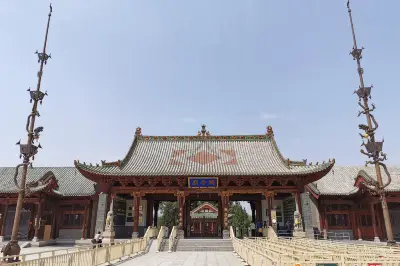
Back at Yuncheng Airport, their flight arrived at noon. I picked up my little one, starting his National Day tour. In the afternoon we drove straight through the Zhongtiao Mountain Tunnel to Yongle Palace. Considering timing, I first took my wife to see Guangrenwang Temple. My wife, mother, and child experienced a Tang dynasty building. After that, we returned to Yongle Palace. It was crowded, but luckily we parked and got in. During the holiday, tickets were 40% off – Shanxi is truly hospitable. Yongle Palace was indeed packed; guides were in short supply, with over half an hour wait. So I first took my child to try mural coloring nearby. When a guide was available, we started visiting. Toward evening, the three main halls finally thinned out a bit. Yongle Palace, originally Great Chunyang Wanshou Palace, was built to honor Lü Dongbin, one of the Eight Immortals. Because it was built at Yongle town, it’s commonly called Yongle Palace. When the Sanmenxia Reservoir was filling, the entire compound was relocated here to preserve it. It’s the largest and best-preserved Taoist temple in China, considered one of the three ancestral halls of Quanzhen Taoism alongside Beijing’s Baiyun Guan and Chongyang Palace in Huyi, Shaanxi. The architecture is Yuan dynasty; the murals in the three halls are absolutely stunning. Surviving murals cover over 1000 square meters. First, the Sanqing Hall (Hall of the Three Pure Ones) with the most exquisite mural – ‘Chaoyuan Tu’ – painted by Ma Junxiang and his son Ma Qi and others in the Yuan dynasty. It depicts immortals paying homage to the Primordial Celestial Worthy; you must see it in person to appreciate its beauty. Next, the Chunyang Hall, dedicated to Lü Dongbin, features murals showing his life from birth to immortality and his travels among mortals in a comic-strip style. Finally, the Chongyang Hall’s murals narrate the story of Wang Chongyang from birth to his enlightenment of the seven disciples. The visit was a great delight. Leaving Yongle Palace, we returned to Yuncheng, passing the salt lake which was bustling with a lively night market. A quick glance and then back to the hotel for dinner – the noodles were excellent. Early to bed.
Day 5: In the morning, we drove on the Yunfeng Expressway straight to Fenglingdu. My wife and I had been there years ago. Now the Yellow River No. 1 Road exists, and there weren’t many tourists. We admired the ferry, gazing across at Tongguan Ancient Town on the other side. This is the border of Shanxi, Shaanxi, and Henan. Once we crossed the river and hit three toll gates in ten minutes, but today we stayed on the Shanxi side, enjoying the scenery. Legend says the ferry is named after the tomb of Feng Hou, a figure from the Yellow Emperor era. Here the Yellow River makes a 90-degree turn from north-south to west-east. Not crowded, a very nice spot.
Leaving Fenglingdu, we climbed over a loess mound and soon arrived at the Xihoudu Site. This is one of the earliest sites of human fire use. A small exhibition hall shows excavated burned bones. Paleomagnetic dating indicates an age of 2.43 million years, making it one of China’s earliest Paleolithic finds. The site isn’t large, but the rammed-earth design features are great for photos. National Day half-price tickets were very friendly. Few people, good experience; climbing high, all around was loess plateau. Finally, we walked to the excavation pit for a look.
Next stop: the famous Stork Tower. It started raining. It was crowded, but order was decent, and we parked without trouble. We had Yongji’s beef dumplings and pulled noodles. Tickets had discounts for Shaanxi and Shanxi visitors, called ‘The Harmony of Qin and Jin’ – very friendly. My wife bought a combo ticket for Stork Tower, the Iron Oxen, Pujiu Temple, and the evening show ‘Dream of the Western Chamber’ – great value. We climbed Stork Tower first. Years ago my wife and I were here when it was quiet. Today I brought my little one and his textbook; climbing in the rain, we truly felt the poem’s ‘ascend one more floor.’ Though the tower is rebuilt and on a new site, it’s definitely worth coming to experience! The scenic area today is lively and a good experience.
Not far from Stork Tower is the Pujin Ferry Site (Yellow River Iron Oxen). Traffic was heavy, but the parking lot was orderly. No ticket needed; this is a genuine Tang dynasty site. The historic Pujin Bridge and the Kaiyuan iron oxen are here. After the Yellow River shifted eastward, the oxen sank and disappeared. It’s said eight stood on both banks; four oxen and iron figures have been unearthed, all from the east bank, as Shanxi folks are honest and didn’t dig up the Shaanxi ones. From a raised platform we viewed them; because of rain, two oxen wore raincoats. Each weighs dozens of tons, with iron posts extending deep underground. Previously, a lower display showed the bases, but it was under maintenance this time.
After the iron oxen, we went to Pujiu Temple, passing some ruins of Puzhou Ancient City. Years ago my wife and I merely snapped a photo at the gate; today we explored in depth. This is where the love story from Wang Shifu’s Yuan dynasty play ‘The Western Chamber’ took place. The temple’s Yingying Pagoda is also called Pujiu Temple Pagoda, and the main hall houses Southern and Northern Dynasties Buddha statues unearthed there. The whole place centers on the story: the West Study, Pear Blossom Courtyard, the wall-climbing spot – all quite interesting. The pagoda is also an acoustic marvel, similar to an echo wall. If you tap a stone at its side, the pagoda emits a clear, frog-like ‘guaa’ sound, astonishing visitors. Local gazetteers call it ‘Pujiu Toad Sound,’ one of the eight ancient sights of Yongji. Of course, the temple is most famous for The Western Chamber. Exiting the temple, rain persisted, and the evening performance seemed cancelled. But while we ate across the street at Yingying Restaurant, the rain stopped – the show was on! The evening was chilly at Pujiu Temple, but ‘Dream of the Western Chamber’ started on time. This is a large immersive night-tour experience crafted by Yongji, with almost zero distance between audience and actors. Starting from the main gate square, we followed performers through about a dozen spots in the temple, each with a performance. The whole show wonderfully brings the play to life in three dimensions. Highly recommended, worth seeing.
A deep day exploring Yongji’s sites; even during National Day, the experience was good. We returned to Yuncheng to rest.
Day 6: The weather was okay. We planned to head north to Jishan County to see Qinglong Temple. Right next door, 200 meters away, is the Macun Brick Carving Tombs. This place is low-key. Entering, we went directly underground. There are 14 tombs, 9 excavated, and only 4 open for viewing. Even with few visitors, guides were still busy; probably fewer people on ordinary days. All are brick chamber tombs, some shallow, some deep – the deeper ones are said to be later. The tombs are built like brick-carved houses underground, with brick beds instead of coffins; the deceased were laid directly on them, like an underground building, sealed from the top after burial. The walls are decorated with exquisite brick carvings imitating wood architecture, and around the chambers are scenes from folk tales and daily life, all breathtaking. These are Song-Jin period tombs, joint husband-wife burials, mostly monogamous, a few with one husband and two wives. The brick carvings and their subjects deserve detailed viewing.
After the tombs, we went to neighboring Qinglong Temple. Its murals are famous, said to be painted by the teacher of Yongle Palace’s painters. The temple is small; the middle hall and main hall are Yuan-Ming structures, with side halls also Yuan relics. No statues remain, but the murals in the main, middle, and Jialan halls are very beautiful, worth studying. The main hall features a ‘Buddha Preaching’ scene; an inscription on the south wall says it was repainted or restored in the 18th year of Ming Hongwu, with only a small southwest corner retaining Yuan fragments. The middle hall has ‘Water-Land’ paintings, the temple’s highlight. Over 300 figures fill 130 square meters of wall space, considered masterpieces of Yuan-Ming painting. Though less spectacular than Yongle Palace, they are truly splendid.
Morning flew by. In the afternoon we drove straight to Datiya Cliff by the Yellow River in Hejin – a lesser-known spot I hadn’t known much about. Driving along the Yellow River, the banks grew steep and startled me. The scenery was magnificent. Not far is Longmen, the narrowest part of the Yellow River – the Dragon Gate of ‘carp leaping over it’ legend, where the river is less than 40 meters wide. We parked by the river and entered the Datiya scenic area. It was busy but not overcrowded like a mega-attraction. We got a combo ticket: elevator up, hike down. First, the elevator – Yue Long Tian Ti – whisked us mid-mountain. I dared not take the Feiyun Du, a cliffside trail with no protection. We circled to the hiking route. The cliffs here bear wartime history. At a spot called Huacha, even I was scared, but in 1938, Deputy Commander Zhu Zhenmin of the New 8th Division ordered the 23rd Regiment to cross mountains from the Shijiatan ferry, attacking the Japanese from the Datiya side to retake all Longmen positions. They dealt heavy casualties – over 200 Japanese – forcing them back. The division lost 271 soldiers, buried at Longmen Mountain (now in Hejin, Shanxi). In 1987, the Hejin CPPCC erected a monument. Passing the cliff, we saw a glass walkway but didn’t have the nerve. To save energy, we skipped the detour to Zheshui Waterfall on the upper route and instead played around the lower route’s waterfall, strolling through the ‘Seven Li Gallery Peach Blossom Valley.’ Finally, we reached the Dayu Temple at Yiti City, once garrisoned by Emperor Xiaowen of Northern Wei, the highest point. The climb gave stunning views of the Yellow River squeezed between two mountains. Descending was another experience: first the narrow Yukaishi cleft, then past a cliff-side Guanyin shrine carved into the rock, we entered the ancient Thousand-Year Stepway. This was the path Emperor Xiaowen himself trod – incredibly perilous, steps cut into the cliff. The Datiya dates as early as Northern Wei; chisel marks remain despite weathering. The zigzag trail has 365 steps, each step about 4-5 feet wide and 7-8 cun high. From above, it looks like steps carved on a vertical stone. The terrain is steep and unique, highly recommended. Going down felt scarier than going up, even though hiking up is tiring. Perhaps hiking up and taking the elevator down is wiser. Leaving the cliff, we drove to nearby Longmen. Truly narrow, with tourist boats for sightseeing. Over the Yellow River is the Menghua Railway Longmen Bridge, a heavy-haul coal line connecting Shanxi and Shaanxi. From here, looking back at Datiya Cliff is absolutely stunning, marveling at ancient wisdom and grit. This is a really fun place.
Driving back along the Yellow River to Yuncheng, dinner and a sauna at the hotel, early to bed.
Day 7: My little one, as a junior docent at the Shanghai Museum, had learned about the Jin Hou Su bells. Today I planned to take him to the excavation site of this national treasure. We set off early for Houma, the Jin State site I had visited earlier. This time I took the family straight to the Jin Ancient Capital Museum. It closes for lunch, so we arrived early. The museum in downtown Houma is small; no guides on National Day. Exhibits mainly introduce the state of Jin; many genuine artifacts, with the best in the Shanxi Museum or even the National Museum. One hall featuring the Houma Covenant Stones was stunning, full of history.
Leaving, we soon entered Quwo and stopped at the Ganying Temple Brick Pagoda, also called Xisi Pagoda.This is a damaged pagoda in Quwo county town, between the town and the ancient city, a Song dynasty relic only a provincial protection unit – perhaps only in Shanxi. An old rhyme says: ‘People of Quwo, always homesick, can’t leave Mama a day, three days not seeing the cracked pagoda, eyes red, tears streaming.’ That cracked pagoda is this one. Built in the first year of Qiandao (1165) in the Song, it was split by an earthquake in 1303 and has stood thus for centuries. It’s said the Japanese once tried to blow it up during their scorched-earth policy, but only a small chunk at the base was damaged; the whole pagoda stood firm, so they gave up. Truly remarkable.
After the pagoda we went to the Jin State Museum, just two characters different from the morning’s museum. Both are about Jin, but Houma, being the capital site, has higher standing. The Jin State Museum is built on the ‘Qucun-Tianma Site,’ Shanxi’s first large site museum, and the excavation place of the Jin Hou Su bells and other national treasures, with numerous marquis tombs. This museum is excellent. We parked, had lunch at the gate, then began our visit. A guide first led us through the historical gallery, with artifacts from the marquis cemetery. The bird-shaped zun was unearthed here (the original is in the provincial museum, a Shanxi icon and its symbol). Exhibits explain the key events: entrusting Tang with a leaf, Quwo supplanting Yi, Duke Wen’s hegemony, moving the capital to Xintian, and the Partition of Jin – very educational. This site is also a Peking University base; it’s said many locals were trained to assist, but later, in the late ’80s, some turned to grave robbing because of the dense tombs. After the history display, we saw the site: a massive chariot pit, the largest in China, absolutely spectacular. Behind it, several excavated marquis tomb pits are open for viewing, and my child saw where the Jin Hou Su bells were found. The guide mentioned they haven’t yet found the Jin capital’s site here but are confident it will be discovered. We watched a film and bought souvenirs; the museum was great. A fulfilling day tracking down the ancient Jin capital. Back to Yuncheng, dinner, sauna, sleep.
Day 8: Today, Wanrong. Rainy, but at Feiyun Tower in Wanrong it wasn’t too crowded. It belongs to the Wanrong Dongyue Temple, with ‘North Pagoda, South Tower’ – Feiyun Tower. It may not match the Yingxian Wooden Pagoda, but it’s still very impressive. The temple is right on the street; you see Feiyun Tower immediately upon entering. The current tower was rebuilt in the 11th year of Qianlong in the Qing dynasty and is hailed as ‘China’s Number One Wooden Tower.’ It appears three stories from outside but actually has five interior levels, about 23 meters tall. Its natural wood color shines. Feiyun Tower is the representative of the temple complex; a local saying goes, ‘Wanrong has a Xie Dian Tower, half stuck in the sky.’
Not far from Dongyue Temple is the Wanrong Jiwang Temple – a very understated Song dynasty wooden structure. It’s said Liang Sicheng searched for it several times without success, a lifelong regret. Hou Ji assisted Yu the Great, teaching agriculture, the progenitor of farming, god of five grains. There are many Jiwang temples in southern Shanxi, but Wanrong’s is the oldest. At the entrance is an opera stage from the Jin dynasty, where performers entered and exited from behind, as the front had no stairs. Opposite the stage is the main hall, the only Northern Song hip-roof hall in China, beamless – an ‘infinity hall.’ It was long assumed to be Jin, but during restoration in 2011, an inscription ‘Tiansheng 1st year’ (Northern Song) was found, confirming its age. The ancient aesthetic is appealing. Of the six columns supporting the front, only one is a twisted-dragon stone pillar, the rest wooden. Research suggests it was donated by a widow from Hejin in the Ming dynasty, though another story says it was taken from a neighboring temple missing such a pillar. The cultural guardian at the gate told visitors that Liang Sicheng learned of this temple from his father’s gift of ‘Yingzao Fashi’ and came with Lin Huiyin three times, but never found it. The book said ‘Dazhao Village’ – ancient script used ‘大’ to mean ‘太’ – actually it’s Taizhao Village, and later administrative changes led to the confusion. Very few visitors here; the local folk are warm and simple.
After Jiwang Temple, we visited Wanrong Houtu Temple, by the Yellow River. This trip to Shanxi has deepened my understanding of Chinese culture, spanning 5000 years. Here, heaven and earth are worshipped; Shanxi is a treasure. Houtu Temple, anciently called Fenyin Houtu Shrine, is flanked by the Yellow and Fen rivers, where Fen flows into the Yellow. It was first established under Emperor Wen of Han, and an Houtu shrine was built in 121 BC by Emperor Wu. The original site was later submerged; the current temple was relocated in the 9th year of Tongzhi, Qing (1870), over 150 years old. It’s China’s oldest surviving temple dedicated to Nüwa. Entering, the triple-stage ‘pin’ formation is unique. We walked along the spirit path, through the gate, past the three stages, accompanying halls, altar, offering hall, pavilion, main hall, to Qiufeng Tower and Zhang Yi Road. The stele with Emperor Zhenzong’s calligraphy is prized. The majestic Qiufeng Tower contains a stone engraved with Emperor Wu of Han’s ‘Ode to the Autumn Wind’ from 1271. Below it is an ancient road, said to be the route Zhang Yi, the Warring States strategist, took on his diplomatic journeys, hence ‘Zhang Yi Road.’ A marker notes: ‘Autumn 1937, the Eighth Route Army passed here en route to the anti-Japanese front.’ The three main divisions under Zhu De and Peng Dehuai crossed the Yellow River from Hancheng, Shaanxi, landed at Bao Ding town’s Miaocun Village in Wanrong, then proceeded along Zhang Yi Road through Qiufeng Tower, marching to Houma and the Taihang Mountains. This was their first step onto Shanxi soil, a precious memorial. Passing through the road, we climbed a viewing platform: the confluence of Fen and Yellow rivers, known as ‘Glory Mist River.’ In 1011, Emperor Zhenzong of Song led ministers from Kaifeng to worship here; multicolored halo shone over the river, so he renamed Baoding County to Ronghe (‘Glory River’) County. In 1954, Ronghe and Wanquan merged into Wanrong County. From the platform, we tried to glimpse the auspicious ‘glory mist’ – weather wasn’t great, but I flew my drone to capture the feel. Back to Yuncheng hotel for rest.
Day 9: Early morning, my wife, mother, and child headed home on a morning flight. I dropped them off early, then returned to the hotel to pack. On the way back, I stopped by Yuncheng Salt Lake; no sunrise, but a nice view of Zhongtiao Mountain and the lake. I also glanced at the Salt Pond Temple, to visit properly another time. Yuncheng has the most national-level protected units among prefecture-level cities, second only to Beijing’s total – worth a return trip.
After checking out, I drove home, passing Henan. I stopped at the southern dam of Banqiao Reservoir in Zhumadian; the scenery was fine. I wanted to see and remember this place. It’s where the catastrophic August 1975 dam failure happened, described by some as the worst human-made disaster in world history. Yet it remains poorly reported, gradually forgotten. A disaster comparable to the Tangshan earthquake but lost to history. An odd typhoon from the Pacific lingered over drought-stricken Zhumadian in August 1975. Over 10,000 square kilometers across 26 counties, nearly 60 reservoirs large and small burst, trapping nearly five million people in raging floods; over ten million were affected, and more than 1.06 million lost everything. Strangely, no Chinese media reported a single word. To this day, the death toll remains unknown.
Leaving Banqiao, I headed east and passed the Bantai Sluice, which was blown up to release floods during that disaster – now a peaceful scene surrounded by farmland. Crossing vast fields, I stayed overnight in Funan, Anhui.
Day 10: Left Funan early, drove to Tongcheng in Anqing to see Liuchi Alley (Six-Foot Alley). Not many tourists, a casual stroll in the old town, a leisurely solo trip homeward. After that, facing the last National Day traffic, the road back to Shanghai was tough. I chose a clear route to Chang’an in Wuxi and rested well.
Day 11: Woke early, the first workday after the holiday, expressways tolled again but no holiday traffic. Home smoothly. A 4,600-kilometer road trip, taking my child to see the world – truly joyful.