Self-Drive Tour of Yuncheng: Guan Gong’s Hometown and the Salt Lake in Shanxi
Yuncheng City in Shanxi Province, formerly known as Hedong, is located in the southwestern part of Shanxi, in the Yellow River 'Golden Triangle' region where Shanxi, Shaanxi, and Henan meet. It faces Sanmenxia in Henan Province and Weinan in Shaanxi Province across the Yellow River.
Yuncheng is one of the significant cradles of the Chinese nation and Chinese civilization. It is the place where humans first used fire, the earliest site of salt consumption, metallurgy, and farming, and where the ancestors of the Chinese people first gathered to live. There is a saying: 'Look to Yuncheng for five thousand years of civilization.' The discovery of the world’s earliest fossil of a higher primate, Eosimias centennicus, pushed back the appearance of anthropoids by ten million years, proving that Yuncheng is the distant ancestral origin of humankind. The Xihoudu site, the oldest known Paleolithic site in China, dates back about 1.8 million years and provides the earliest evidence of human use of fire.
Historically and geographically, Yuncheng was the central area of activity for Yao, Shun, and Yu in ancient times. Documents record: 'Yao’s capital was Pingyang (today’s Linfen), Shun’s capital was Puban (today’s Yongji), Yu’s capital was Anyi (today’s Xia County),' with some saying 'Yao first made Puban his capital before moving to Pingyang.' Starting from Yao, Shun, and Yu, Yuncheng served as the capital for emperors—Yao founded his state here, Shun’s capital was Puban, Yu’s capital was Anyi, and the Xia dynasty capital was also in Yuncheng. Thus Yuncheng was 'the center of all states,' that is, 'Zhongguo' (the Central State). From the perspective that 'the emperor’s capital is the center' and 'the capital is the center of all states,' Yuncheng is the earliest place to be called 'Zhongguo' (China).
Legends related to agriculture, such as 'Leizu raising silkworms,' 'Houji teaching farming,' and 'Shun ploughing at Lishan,' all took place in Yuncheng. Leizu taught people to raise silkworms and reel silk, Houji taught common people to grow crops, and Shun cultivated the land at Lishan. These stories mark the origin of Chinese agricultural civilization, which is the foundation of Chinese civilization.
Five thousand years ago, in Xiling (today’s Xiyin Village in Xia County), there was a young woman named Leizu. She discovered that mulberry trees hosted insects that could spin silk and form cocoons; the silk was fine yet strong. She caught them and tried raising them. The silkworms ate mulberry leaves and then spun cocoons, from which they emerged as moths. Leizu found that when a cocoon was soaked and placed on a stick, she could pull out long silver threads by twisting and drawing. She called this thread 'silk.' She then wove the silk into cloth, which people called 'silk fabric.' It replaced leaves and animal hides, giving people clothes to wear. The 'Tongjian Waiji' praises Leizu for 'processing silk cocoons to provide clothing.' Leizu’s raising of silkworms and reeling silk, 'teaching the people to cultivate silkworms,' made a great contribution, and she was honored as the 'First Sericulture Goddess.' When the Yellow Emperor heard of Leizu’s deeds, he was filled with admiration and married her. The 'Records of the Grand Historian: Annals of the Five Emperors' records: 'The Yellow Emperor married the daughter of Xiling, who was Leizu. Leizu was the principal wife of the Yellow Emperor.'
'Jia se' means sowing and harvesting crops. 'Houji Jia Se' tells the story of Houji teaching the common people to grow crops. In myth, Houji, an ancestor of the Zhou people, was named Qi, and his mother was Jiang Yuan. Jiang Yuan found a giant’s footprint in the wild, and out of delight she stepped on it. She became pregnant and after a full year gave birth to a boy. Thinking it inauspicious, she wanted to abandon the child in the forest, but there happened to be many people there, so she could not. She then left the child on the ice of a river gully. However, a bird saw it and immediately flew down to cushion the child with its wings. Jiang Yuan felt the boy was magical, so she took him home and raised him. Because she had initially wished to abandon him, she named him Qi (Abandoned). The 'Records of the Grand Historian' also says that Houji had ambition from childhood; when playing games, he liked to plant hemp and beans, and they grew very well. As he grew up, he was even more devoted to farming and taught the people agricultural work, leading the Zhou ancestors away from a nomadic life of following water and grass to a settled farming age. Houji understood soil properties and crop habits, and the people all learned from him. When Di Yao, the leader of the tribal alliance, heard of this, he recommended Houji to take charge of agriculture. The 'Records of the Grand Historian: Annals of Zhou,' the ancient book 'Shan Hai Jing,' and the 'Shang Shu' all record this myth.
'Shun Geng Li Shan' tells of Shun ploughing and planting at Lishan (some say Lishan is in the Zhongtiao Mountains in Yuncheng, others say it’s in Heze, Shandong). 'When Shun ploughed at Lishan, the people there all yielded boundaries; when he fished at Leize, the people there all yielded their residences.' Wherever he worked, a spirit of courtesy arose. 'When he made pottery by the river, the pottery from the riverbank was never coarse and defective.' He made pottery and inspired those around him to work carefully, strive for perfection, and eliminate shoddy products. Wherever he went, people wished to follow him. 'In one year, his place became a village; in two, a town; in three, a capital (four counties make a capital).' Later, Shun succeeded Yao as one of the five ancient emperors.
During the Spring and Autumn period, the Yuncheng area belonged to the Jin state. In 669 BC, Duke Xian of Jin made Jiang (today’s Jiang County) his capital. After the partition of Jin by Han, Zhao, and Wei, the Yuncheng area fell to Wei, with its capital at Anyi (near today’s Yuwangcheng in Xia County). When Qin Shihuang united China and established 36 commanderies, Yuncheng belonged to Hedong Commandery, with its seat at Anyi. Over the next two thousand years, the administrative divisions changed frequently, but the name 'Hedong' endured.
Yuncheng is the only city in China established because of salt, hence its name 'Yuncheng' (Salt Transport City). In the Spring and Autumn period, it was called 'Yanyi'; during the Warring States, 'Yanshi'; in the Han dynasty, 'Solic Salt City' and 'Salt Supervisor City'; in the Song and Yuan dynasties, 'Phoenix City', 'Yunsi City', and 'Yuncheng', and it was known as 'Salt Administration City'—the only Chinese city founded for salt transport.
Yuncheng is the hometown of Guan Yu, the famed general of the Shu Han during the Three Kingdoms period. Guan Yu enjoys a lofty status among the Chinese people as an embodiment of loyalty to the sovereign, patriotism, righteousness, and valor.
Yuncheng has numerous cultural and historical tourist attractions, including the renowned ones: the 'Ancestral Temple of Guan Yu' at Xiezhou (known as the origin of martial temples), the Guanque Tower (one of China's four famous towers), the Yongle Palace (one of the three principal Daoist shrines), the Pujiu Temple (where the story of 'The Romance of the West Chamber' took place), the Houtu Shrine (a sacred site of Chinese worship), as well as the Xitan, the Li Family Courtyard, Wulao Peak, Lishan, Sima Guang's Tomb, and others.
On this trip to Yuncheng, we visited the Yongle Palace, Changping Guan Di Family Temple, Xiezhou Guan Di Ancestral Temple, the Salt Lake, the Hedong Salt Museum, the Chishen Temple, the Salt Pond, and the Yuncheng Museum. The ridge in the above photo is the Zhongtiao Mountains. The Yongle Palace sits south of the Zhongtiao Mountains and north of the Yellow River, while Yuncheng lies north of the Zhongtiao Mountains. The ridge south of the Yellow River is the Qinling Mountains.
Five thousand years of cultural accumulation add a deep historical and cultural atmosphere to visiting Yuncheng. The natural scenery of the salt pond and the Zhongtiao Mountains is steeped in this profound history. A saying goes: 'Ten years of development is seen in Shenzhen; a hundred years of vicissitude in Shanghai; a thousand years of rise and fall in Beijing; three thousand years of dynasties in Xi’an; five thousand years of civilization in Yuncheng.'
Day 1: Visiting the Yongle Palace, Guan Di Family Temple, and Guan Di Ancestral Temple
We set off from Xi’an early in the morning, with the first destination being the Yongle Palace in Ruicheng County, Yuncheng.
The Yongle Palace, originally named the Dachunyang Wanshou Palace, was built in honor of Lü Dongbin, one of the Eight Immortals. Because it is located in Yongle Town, 20 kilometers southwest of Ruicheng County, it is commonly called the Yongle Palace. Construction began in the second year of the Yuan dynasty under Emperor Dingzong Güyük (1247 AD) and was completed in the 18th year of the Zhizheng era (1358 AD), spanning over 110 years. During the Jin and Yuan dynasties, Daoism received imperial support and patronage, so Daoist temples were built on a considerable scale.
When discovered in 1952 during China’s first national cultural relic survey, the palace caused a sensation and shocked academic circles. Experts at the time concluded: the Yongle Palace is an exquisite example of Yuan dynasty architecture, the largest Daoist temple complex in the country, a model of ancient Chinese painting, and one of the largest surviving ancient mural art treasures in the world. Among them, the 'Chaoyuan Tu' (Painting of the Heavenly Court) in the Sanqing Hall represents the pinnacle of figure composition in world painting history, a rare large-scale masterpiece that can be considered a national treasure.
In 1956, to control the Yellow River flood and develop water resources, the central government decided to construct the Sanmenxia Water Conservancy Project, and the Yongle Palace lay within the reservoir’s flooding area. In February 1957, with Premier Zhou Enlai’s concern and approval from the State Council, 2 million yuan (a huge sum at the time) was allocated for its overall relocation and protection.
From August 1958 to October 1, 1959, on the eve of the tenth National Day, over 1,000 square meters of murals were successfully detached and transported to the new reconstruction site, ensuring the entire Yongle Palace was moved to its new location before June 1960 as planned. By August 1966, all murals had been reinstalled in full, and the relocation project was victoriously completed.
The new site of Yongle Palace is located east of Longquan Village, 2 kilometers north of Ruicheng County town, on the ruins of the capital of the ancient Wei State of the Western Zhou dynasty.
Admission to the Yongle Palace is 60 yuan, with free entry for seniors over 60 with ID. The parking fee is 10 yuan. Shanxi Province’s policies for the elderly are among the best in the country, as most provinces set the free entry threshold at 65.
Due to the Sanmenxia project, to protect Yongle Palace from being flooded, it was relocated from its original site in Yongle Town to the current address in Longquan Village. However, because Soviet experts miscalculated, the reservoir’s water did not actually reach the original site. As the palace was moved away from its original location, it cannot apply for World Cultural Heritage status—a bit of a pity. But there are two sides to everything; had the palace not been moved, the original site’s proximity to the reservoir would have meant higher humidity, which would not be conducive to preserving the murals.
The following illustration shows the position of Yongle Palace within the ancient Wei State ruins.
To the right of the illustration are the remnants of the ancient Wei city wall.
The Yongle Palace site map—for some reason, the layout is skewed, perhaps due to the topography and adaptation to the locale.
The palace consists, from south to north, of the Palace Gate, Wuji Gate, Sanqing Hall, Chunyang Hall, and Chongyang Hall.
The Mountain Gate, built in the 20th year of the Ming Yongle reign (1420).
The Wuji Gate, built during the Yuan dynasty.
The Wuji Gate above corresponds to the Longhu Hall on the site map.
The stone beasts flanking the threshold of the Wuji Gate are very unique; I don’t know what divine creatures they are—I’ve never seen them elsewhere.
The Wuji Gate, also called Longhu Hall, was so named because the two side chambers originally contained clay statues of the Azure Dragon and White Tiger star lords. The hall has 80 square meters of murals inside. Though damaged, the murals still clearly exhibit the style of Tang and Song gongbi figure painting. The Longhu Hall is not currently open, but a large picture album sold at the cultural creative shop features its murals.
The Wuji Gate is a typical Yuan dynasty palace gate with a single-eave hip-and-gable roof. At each end of the ridge sits a glazed chiwen, over two meters high, with fierce eyes and curling tails—majestic and imposing, a masterpiece of glazed ridge beasts.
On either side of the path between the Wuji Gate and Sanqing Hall stands a stele.
The eastern stele is the Yuan Dynasty construction stele: 'Stele of the Dachongyang Wanshou Palace Rebuilt in the Great Dynasty,' recording the historical background of Yongle Palace’s establishment and the life of Lü Dongbin. This stele carries history and tells of the vicissitudes—it is the most important carved stone in the palace.
The Yongle Palace originally was a shrine built at Lü Dongbin’s former residence in Yongle Town, Yongji County, Shanxi Province, for one of the Daoist patriarchs. In the Tang dynasty, it was built as the Lü Gong Shrine; in the Song and Jin, the shrine was changed to a Daoist temple. It burned down in a great fire in the second year of the Zhongtong era (Yuan) and was rebuilt on the original site as the Chunyang Wanshou Palace, generally called the Wanshou Palace.
The western stele is a Qing dynasty event record: 'Inscription of the Rebuilt Wuji Hall of the Wanshou Palace.' It was made in the same style as the Yuan construction stele, re-carved from the Yuan-era stone after grinding off the original text. Oddly, the bixi (tortoise) carrying the eastern stele has its head extended, while the one carrying the western stele has its head retracted.
The Sanqing Hall, also called Wuji Hall, is the main hall of the Yongle Palace, dedicated to the 'Three Pure Ones'—the Heavenly Worthy of Primordial Beginning, the Heavenly Worthy of Numinous Treasure, and the Heavenly Worthy of the Way and its Virtue.
The Sanqing Hall is one of the best-preserved high-standard Yuan dynasty palatial structures in China. Inside, an altar enshrines the three supreme Daoist deities. The hall houses the largest known ancient Chinese figure mural, the 'Chaoyuan Tu.' Among the murals of Yongle Palace, those in the Sanqing Hall and Chunyang Hall are the most spectacular. As the main hall, Sanqing Hall contains nearly half of the palace’s murals.
The 'Chaoyuan Tu' covers 430 square meters and depicts a grand scene of 290 heavenly and earthly deities paying homage to the highest deity, the Daoist ancestor the Heavenly Worthy of Primordial Beginning. The mural was completed in the second year of the Taiding era of the Yuan dynasty (1325), with an inscription reading 'the second year of Taiding, by Ma Junxiang of Henan and his eldest son Ma Qizhao,' revealing that the painters were little-known folk artisans. The 'Chaoyuan Tu' integrates the achievements of Tang and Song mural art and is a masterpiece representing the peak of Chinese temple mural development, hailed as a world art treasure and an Eastern gallery.
Photography is not allowed inside the hall. However, the park has an educational area—a mural copying room—where many students copy murals. The room has full-scale replica murals for the students to copy. I took a few photos of the replicas there.
Gouchen Star Palace Heavenly Emperor.
Donghua Shangxiang Mugong Qingtong Daojun.
Bai Yu Gui Tai Jiu Ling Tai Zhen Jin Mu Yuant Jun.
Dongji Qinghua Taiyi Jiuku Tianzun.
Jade Maiden, Taiyi God.
The mural contains about 290 figures, centered on eight main figures each three meters tall (the Southern, Northern, Eastern, and Western Poles, Jade Emperor, Gouchen, Mugong, Houtu, and Jinmu). The rest of the figures are arranged symmetrically as an honor guard, led by the Azure Dragon and White Tiger star lords on the south wall, depicting 28 major gods including the Heavenly Emperor and the Queen Mother. Around these main figures, 28 constellations, 12 celestial palaces, and other 'heavenly troops and generals' unfold across the scene. The central figures are solemn and dignified, while the group surrounds them, their figures full and rounded, each radiant, none alike. Some speak, some listen, some ponder, some gaze—their expressions and postures echoing one another, forming an organic whole.
In front of the Sanqing Hall (Wuji Hall) sits a pair of stone lions, with adorable expressions: the female lion smiles with pursed lips, and the male lion grins with an open mouth.
Behind the Sanqing Hall are the Chunyang Hall and Chongyang Hall in order.
The Chunyang Hall (also called Huncheng Hall or Lüzu Hall) is dedicated to the Quanzhen (Complete Perfection) patriarch Lü Dongbin. Lü was born on the 14th day of the fourth lunar month in the 14th year of the Zhenyuan era of Tang Emperor Dezong (798 AD). His ancestral home was Yongle Town in Ruicheng County. He was a famous Daoist scholar, physician, and health expert of the late Tang. The Lü family produced four generations of renowned ministers under the Tang. Lü Dongbin traveled extensively, offering medical help and spreading teachings. In the third year of the Zhida era of the Yuan dynasty (1310), he was bestowed the title 'Chunyang Yanzheng Jinghua Fuyou Dijun,' and temples to him spread throughout the country. The Chunyang Hall features 52 murals portraying Lü Dongbin’s legend-rich life, also reflecting the social life of the Song and Yuan periods.
The Chongyang Hall (also called Ximing Hall or Qizhen Hall) is dedicated to Wang Chongyang, the founder of the Quanzhen school, and his seven disciples, the 'Seven True Ones.' Wang was born in the third year of the Zhenghe era of Northern Song Emperor Huizong (1112) in Dawei Village, Xianyang, Shaanxi. In the fourth year of the Zhenglong era of the Jin dynasty (1159), he went to the Zhongnan Mountains to practice and founded the Quanzhen school. The hall contains 49 paintings in a comic-strip format that narrate the story of Wang Chongyang from birth to attaining the Dao and converting the Seven True Ones.
To the east and west of the Wuji Gate are small side gates—the eastern one named 'Sai Yingzhou' (Surpassing Yingzhou) and the western one 'Fang Penglai' (Imitating Penglai).
The eastern side gate leads to a courtyard with the Xuan Di Temple and the God of Wealth Temple, and at the far end is the Tomb of Lü Dongbin. The western side gate leads to a courtyard with the mural copying room and Lü Gong Shrine.
The Lüzu Tomb, also called Sanxian (Three Immortals) Tomb Garden, contains the tombs and steles of Lü Dongbin, Song Defang, and Pan Dechong. Song and Pan were disciples of Qiu Chuji, a Daoist master and leading figure of the Quanzhen school during the Yuan dynasty.
Pan Dechong oversaw the construction of the Yongle Palace. He was a high-ranking Quanzhen Daoist. In the second year of the Yuan Dingzong era (1245), he took charge of building the palace, soliciting donations and working tirelessly through hardship, dedicating his life to the project. He died at the palace in 1256.
Originally, the Yongle Palace was called the 'Lüzu Shrine,' with construction starting in 1247. Because it was funded entirely by Daoists themselves, it took over 100 years to complete. Once finished, it became one of the three great ancestral centers of Quanzhen Daoism (the 'Yongle Palace' in Yongji, Shanxi [Lüzu]; the 'Chongyang Palace' in Huxian, Shaanxi [Wang Chongyang]; and the 'White Cloud Monastery' in Beijing [Qiu Chuji]).
The Lüzu tomb was originally about 200 meters east of the Yongle Palace, facing south, with a tombstone inscribed 'Tombstone of Lü Gong, the Chunyang of the Great Tang,' erected in the first year of the Taiding era of the Yuan (1324) and re-erected in the 16th year of the Jiaqing era of the Qing (1811). On December 7, 1959, it was moved here along with the palace.
The mural copying room—many students are copying murals.
The Lü Gong Shrine. This is Lü Dongbin’s family temple. At the end of the Tang dynasty, locals admired his virtue and transformed his family residence into a shrine. During the Song and Jin periods, the shrine became a Daoist temple. The current building was rebuilt during the Jiaqing reign of the Qing.
In the western courtyard, there is a mural display resembling building blocks, recreating the scene of the mural relocation. Back then, experts cut the 'Chaoyuan Tu' into 588 pieces, moved them here, and then pieced them back together. This was one of the greatest feats of engineering in world heritage conservation. The difficulty of the project, the complexity of the relocation process, and the high level of restoration all reflect the craftsmanship spirit of the older generation of experts, who overcame hardships through solidarity. This pioneering achievement still inspires awe and admiration today.
A peculiar brick carving screen wall: a dragon claw gripping a woman’s head—what does it symbolize?
Leaving the Yongle Palace, we headed toward Yuncheng. The palace is at the southern foot of the Zhongtiao Mountains, and Yuncheng lies at the northern foot. The highway has a long tunnel through the mountains. As we neared Yuncheng, we saw a colossal Guan Gong statue at the mountain base from the highway and decided to exit and take a look. Right off the ramp, a stone tablet reading 'Hometown of Guan Di' stood by the roadside.
Yuncheng is the hometown of Guan Yu, a figure revered in Chinese folk culture. The Yuncheng Guan Gong Hometown Cultural Tourism Scenic Area includes three parts: the Xiezhou Guan Di Ancestral Temple (locals pronounce 'Xie' as 'Hai'), the Changping Guan Di Family Temple, and Zhongyi Street. Zhongyi Street is a commercial street in front of the family temple, but perhaps it was the wrong season, as it was very quiet. The giant Guan Gong statue is situated in the Guan Di Saint Statue Scenic Area at the foot of the Zhongtiao Mountains opposite the family temple.
This 'Guan Di Saint Statue' is the tallest and largest statue of Guan Di in the world, with a total height of 80 meters (the bronze body is 61 meters, signifying Guan Gong’s age of 61, and the base is 19 meters, symbolizing his starting a family and career at age 19). It used 500 tons of copper and 2,000 tons of iron.
The Changping Guan Di Family Temple is Guan Yu’s birthplace and the earliest shrine dedicated to his memory, also known as the 'Guan Di Ancestral Shrine' and 'Root of Guan Temples.' Admission is 30 yuan, free for seniors over 60 with ID.
The Guan Di Saint Statue Scenic Area.
The Guan Di Family Temple, first built in the early Sui dynasty and established as a temple in the Jin dynasty.
The Chongning Hall for worshiping Guan Yu.
In the third year of the Chongning era of the Song dynasty (1104), Emperor Huizong honored Guan Yu as 'Chongning Zhenjun' (True Lord Chongning), hence the name Chongning Hall.
Two ancient cypresses in front of the Chongning Hall.
These two cypresses are called 'Dragon Cypress' and 'Tiger Cypress,' both 1,800 years old, which dates them to the Eastern Han dynasty. The 'Dragon Cypress' resembles a coiling dragon, while the 'Tiger Cypress' has a knobby base like a tiger’s head. They are planted left (east) and right (west) of the hall’s entrance, aligning with the Chinese feng shui practice of 'Azure Dragon on the left, White Tiger on the right.' Local custom: boys tie red wool threads on the Dragon Cypress to signify 'hope that the son becomes a dragon' (successful), while girls tie threads on the Tiger Cypress to 'hope the daughter becomes a phoenix' (prosperous).
The Shengzu Hall for venerating Guan Yu’s ancestors.
The Ancestral House Pagoda is an octagonal seven-story brick tower, also called the Octagonal Seven-Story Tomb Pagoda, built to honor Guan Yu’s parents. Beneath the pagoda was originally a well. After Guan Yu killed the local bully Lü Xiong in vengeance for the people, the authorities hunted him and ordered his whole clan killed. Guan’s elderly parents, unable to flee, threw themselves into the well to prevent Guan from worrying about them. Later, to commemorate them, a pagoda was erected over the well. Built in the first year of the Zhongping era of the Eastern Han (184 AD) and rebuilt in the 17th year of the Dading era of the Jin dynasty (1177), there used to be a small house in front with statues of Guan’s parents, now no longer extant.
We are all familiar with Guan Yu’s stories: the oath in the peach garden, slaying Hua Xiong while the wine was still warm, crossing five passes and slaying six generals, drowning seven armies, and reading the Spring and Autumn Annals by night. But one misstep led to his defeat at Maicheng and his death. After his death, because of his loyalty to the state, righteousness to others, benevolence in conduct, unparalleled valor, and extraordinary character, Guan Yu was gradually deified. He was honored by the common people as 'Guan Gong,' also known as the Lord of the Magnificent Beard and the God of Martial Wealth.
Emperors throughout the dynasties regarded Guan Yu as the embodiment of loyalty and righteousness, a symbol of patriotism. After his death, successive courts conferred titles upon him, a progression from 'Marquis to King, King to Emperor, Emperor to Saint, Saint to Heaven.'
In the Northern Song, Guan Yu was titled Loyal Prince Who Benefits the State, Chongning Zhenjun, Prince of Wu’an, and Righteous and Brave Prince of Wu’an; in the Southern Song, he was titled Loyal and Brave Prince of Wu’an Yingji; in the Yuan, Righteous and Brave Prince Who Manifests His Spirit; in the Ming, the title was Emperor Guan, Holy Emperor Who Subdues Demons of the Three Realms, Awe-inspiring Heaven Revered One, and True Manifestation Brightly Assisting the Han Heaven Honored One; in the Qing, he was titled Loyal and Divine Holy Emperor Guan, with extended honors to three generations of dukes, his great-grandfather, grandfather, and father, along with further titles such as Shanxi Guan Fuzi, adding terms like 'spirit-protecting' and 'benevolent and brave,' culminating in the long title 'Loyal and Divine, Spirit-Protecting, Benevolent and Courageous, Majestic and Manifest, Protecting the Country and the People, Perfectly Sincere and Peace-Supporting, Awe-Inspiring and Virtue-Manifesting Sage Emperor Guan.' In the fourth year of the Tianqi era under Ming Emperor Zhenzong (1624), Guan Yu was officially given the title 'di' (emperor), and it was adopted throughout the land. Guan Yu thus evolved from a feudal noble to a sovereign. In the 42nd year of the Ming Wanli reign (1614), Confucius and Guan Yu were jointly revered as the Two Sages—one of Culture and one of Martial.
Confucianists honor Guan Yu as the 'Martial Sage,' equal to Confucius the 'Civil Sage'; Buddhists revere him as 'Sangharama' (protector of the monastery); Daoists honor him as 'Tianzun' (Heavenly Worthy). Sangharama Bodhisattva and Skanda Bodhisattva are the great Dharma protectors of Buddhism; Sangharama protects the right, Skanda protects the left. They guard the monastery gate together.
Yue Fei is also widely recognized by the people as a 'Martial Sage.' In some Guandi temples today, Yue Fei is worshipped alongside Guan Yu, such as the Guanyue Temple in Zhonghe Ancient Town, Danzhou, Hainan.
The Guan Di Family Temple has a Hall of the Lady for Guan Yu’s wife. Lady Guan’s maiden name was Hu, from Donghu Village in Xiezhou. When Guan Yu avenged an injustice and left home, Lady Guan hid her identity and took their child to the Zhongtiao Mountains, where they gathered medicinal herbs and treated villagers. She became revered as the 'Medicine Lady' who blesses health.
The Ancestral Pagoda, Shengzu Hall, and Lady Hall are unique among all Guan temples worldwide, known as the 'Three Uniques' of the Changping Guan Di Family Temple.
Stone archway of 'Hometown of King Guan.'
Guan Yu’s Red Hare horse and Green Dragon Crescent Blade.
Iron lions in front of the archway. Beside the lions are figures of warriors or lion tamers. Judging by their appearance, they seem not to be Central Plains people but rather Hu (non-Han) people—an uncommon detail among lion statues in China.
The Changping Guan Di Family Temple is about 11 kilometers from the Xiezhou Guan Di Ancestral Temple. The ancestral temple at Xiezhou is the earliest-established, largest, highest-ranking, and best-preserved Guan Di temple complex, hailed as the 'Ancestor of Guan Temples' and 'Finest of Martial Temples.' Admission is 60 yuan, free for seniors over 60 with ID.
The Xiezhou Guan Di Ancestral Temple was first built in the ninth year of the Kaihuang era of the Sui dynasty (589 AD) and rebuilt in the seventh year of the Dazhong Xiangfu era of the Song dynasty (1014). It was destroyed in the 34th year of the Jiajing era of the Ming (1555) by an earthquake and again by fire in the 41st year of the Kangxi era of the Qing (1702), taking over a decade to restore to its original appearance.
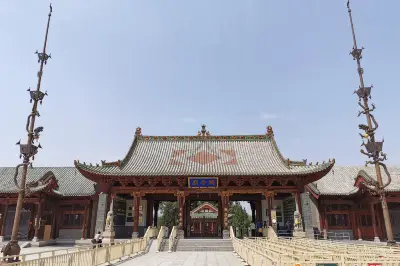
The Duanmen Gate of the Guandi Temple. The front reads 'Guandi Temple' and the back reads 'Hero Who Supports the Han,' identifying Guan Yu as a heroic figure who upheld the Han dynasty.
The right door reads 'Pure Loyalty Pierces the Sun'; the left reads 'Great Righteousness Reaches to Heaven,' encapsulating the core values of Guan Yu’s life—loyalty and righteousness.
The screen wall in front of Duanmen is a glazed four-dragon wall, made in the Xuantong era of the Qing dynasty. The composition is divided into three realms: heaven, earth, and sea. The main design features four coiling dragons flying through clouds, complemented by auspicious animals like phoenixes, qilin, and jade rabbits. Most such dragon walls in China have nine dragons, but here there are only four, because Guan Yu was posthumously made an emperor. The number four (si) is a homophone for 'death,' subtly suggesting that Guan Yu is not a living 'true dragon son of heaven.'
The Duanmen Gate is the first gate of the temple, built in the Qing dynasty. At this point, 'civil officials must dismount from their sedan chairs, and military officials from their horses.'
In front of Duanmen stands a 'gate anchor' made of three iron pillars, signifying that officials must dismount.
Behind Duanmen are the Wumen (Meridian Gate) and the 'Shanhai Zhong Ling' (Spirit of Mountains and Seas) memorial arch.
Passing through Wumen, beyond the arch and the Yushu (Imperial Writings) Pavilion, you reach the main structure, the Chongning Hall.
In the third year of the Chongning era of the Northern Song (1104), Emperor Huizong conferred the title 'Chongning Zhenjun' on Guan Yu, hence the name.
The Yushu Pavilion was originally called 'Bagua Pavilion.' It was built in the 42nd year of the Kangxi era (1703) to commemorate the emperor’s visit to the temple. Because Kangxi personally inscribed the plaque 'Yi Bing Qian Kun' (Righteousness Illuminates the Universe) here, it was renamed the Yushu Pavilion.
The Chongning Hall lies behind the Yushu Pavilion and serves as the main hall of the ancestral temple. It bears plaques written by emperors across the ages for Guan Yu.
The 'Divine Valor' plaque hangs under the front eaves. The two characters 'Shen Yong' were handwritten by Emperor Qianlong of the Qing; an additional two characters 'Qin Ding' (by imperial order) are incised in seal script on the upper edge, exuding regal authority.
The 'Wan Shi Ren Ji' (Eternal Model for All) plaque was written by the Xianfeng Emperor.
In front of Chongning Hall stands Guan Yu’s Green Dragon Crescent Blade, weighing 300 jin.
A stone desk placed before the hall is said to be Guan Yu’s whetstone.
Twenty-six gigantic stone dragon pillars with distinct shapes surround the Chongning Hall.
Behind Chongning Hall are figures of iron lions and lion tamers; as with the family temple, the tamers are Hu (non-Han) people. Perhaps because lions came from abroad, the tamers were thought to be foreign as well.
Past the Chongning Hall is the Spring and Autumn Tower. Before it is the 'Qi Su Qian Qiu' (Awe Through the Ages) arch.
The Spring and Autumn Tower is flanked symmetrically by the Blade Tower and the Seal Tower. The Blade Tower houses Guan Gong’s Green Dragon Crescent Blade; the Seal Tower contains the official seal of Han Shou Ting Hou, the Marquis of Hanshou, granted by Cao Cao.
Inside the Spring and Autumn Tower is a statue of Guan Yu reading the Spring and Autumn Annals, hence the name. The Annals is also called the 'Lin Jing' (Classic of the Mythical Unicorn), so the tower is also called the Linjing Pavilion. It was built during the Wanli era of the Ming dynasty; the current structure was rebuilt in the ninth year of the Tongzhi era of the Qing (1870).
Admission to climb the tower is 30 yuan, which includes a small flashlight, a sachet, and a tiny votive lamp.
The tower boasts three unique features: an inverted caisson ceiling, suspended beams and dangling columns, and engraved wooden boards of the Spring and Autumn Annals.
Staircase inside the Spring and Autumn Tower.
One of the three uniques: 'engraved woodblocks of the Spring and Autumn Annals.'
Another unique feature: the 'inverted caisson ceiling.'
Unlike usual caissons that recess upward, this one protrudes downward, appearing inverted. According to staff, it used to rotate slightly with the wind; for protection, it is now fixed.
Above the shrine is a normal caisson, with two outward-stretching dragon heads in a 'two dragons playing with a pearl' motif. The staff said the heads also once moved with the wind but are now secured.
On the second floor, a shrine houses a life-sized statue of Guan Yu reading the Annals by night. Judging by its size, he might have been about two meters tall. From the side, you can see four moles on his face. It is said Guan Yu had a regal countenance with seven vermilion moles on his face: three between his eyebrows and two on each side of his nose. The plaque above reads 'Zhong Guan Tian Ren' (Loyalty Pervading Heaven and Humanity), inscribed by Prince Guoluo of the Qing Yongzheng era.
On the partition boards of the warm pavilion is the third unique feature: the 'engraved Spring and Autumn Annals.' This was carved and written by an old xiucai (scholar) of the Qing dynasty over four years, with over ten thousand characters in neat regular script—without a single mistake.
The 'Spring and Autumn Annals' is China’s first chronological history. It is also known as 'Spring and Autumn Classic,' 'Lin Jing,' or 'Lin Shi,' and it is one of the 'Four Books and Five Classics,' one of the Six Confucian Classics, and the earliest extant chronological history of ancient China, traditionally said to have been edited by Confucius.
The Annals mainly record the political, military, economic, and cultural aspects of the State of Lu from 722 BC to 481 BC, covering twelve reigns from Duke Yin to Duke Ai, a total of 242 years—essentially a history of Lu. The extant text is just over 16,000 characters.
The third unique feature: 'suspended beams and dangling columns.'
The second floor of the tower is a suspended-column structure employing a technique of lifting beams and suspending columns. Twenty-six wooden columns hang from the beams around the corridor; they have no base support but are suspended, bearing weight through horizontal beams on their sides. This unique mechanical system of 'suspended beams and dangling columns' is singular and exceptional among surviving ancient buildings.
Iron lions and a lion tamer in front of the 'Qi Su Qian Qiu' arch—here the lions have been modified so their ears resemble horse ears.
Figures on the roof ridges.
Ancient buried wood in the garden.
In the small square before the Wumen, a master is teaching the Guan Gong broadsword dance, likely preparing for a festival performance.
Wishing tree in the Imperial Garden.
Iron statues before the hall.
Day 2: Visiting the Hedong Salt Museum, Chishen Temple, Salt Pond, and Yuncheng Museum.
Yuncheng is famous for salt. The Hedong Salt Museum displays the developmental history of the salt industry in Yuncheng.
A combo ticket for the Hedong Salt Museum, the Zhongjinmen City Wall, and the Chishen Temple costs 50 yuan (the temple alone is 35 yuan).
The Zhongjinmen gate tower and the archway in front of it. The museum is housed inside the Zhongjinmen tower. Officially opened in November 2021, the museum focuses on Hedong salt culture, narrating Yuncheng’s millennia-old salt history through photographs, artifacts, and other elements.
The Zhongjinmen tower and the Chishen Temple were severely damaged and are recent reconstructions.
On the archway opposite the gate tunnel, the phrase 'Fu Cai Jie Yun' (Bring Wealth, Dispel Resentment) comes from Shun’s 'Song of the South Wind.'
Yuncheng’s Salt Lake lies at the foot of the Zhongtiao Mountains. Year after year, the south wind from the mountains continuously drives away the water vapor from the brine, agitates the brine, increases the evaporation surface area, and speeds up salt crystallization. Thus, it is said: 'The Zhongtiao Mountains are the lifeline of the Salt Lake.'
In ancient times, Emperor Shun, while inspecting the Salt Lake, played the zither and sang the 'Song of the South Wind': 'South wind’s caress, can disperse my people’s distress. South wind’s time, can enrich my people’s hive.' The meaning is: let the south wind blow, carrying away our worries; the south wind comes just in time, bringing us wealth. Therefore, 'Fu Cai Jie Yun' means to remove the people’s worries and bring them wealth.
The south wind is the downslope wind from the Zhongtiao Mountains, also called 'foehn wind' or 'caressing wind.' 'When the south wind rises, salt begins to form.' As air descends, for every 100 meters, the temperature rises by 0.6 degrees Celsius and relative humidity decreases, making the wind very hot and dry—only such a wind can breed salt. The 'Song of the South Wind' depicts how Hedong salt pools depend on this wind to produce salt.
This character resembling 'salt' is read as 'gu'. The character 盬 means not solid, to stop, or to suck in drink. Here it specifically refers to the name of an ancient salt pond, or salt that hasn’t been boiled down.
Yuncheng Salt Lake, together with the Great Salt Lake in Utah, USA, and the Kuchuk Salt Lake in Siberia, Russia, is known as one of the 'world’s three great sulfate-type inland salt lakes.' It is the earliest exploited salt lake by the ancestors of the Chinese people. According to 'Hedong Salt Law Reference,' salt was discovered and consumed here over five thousand years ago, described as 'a great pioneering feat of the Chinese nation in utilizing mountain and lake resources.' The lake is long from east to west and narrow from north to south, high on all sides and low in the middle, shaped like an ancient gold ingot. It is bordered to the south by Zhongtiao, to the north by Emei, to the east by Xia County, and to the west by Xiezhou, covering 132 square kilometers. Yu Shun once rested on Woyun Hill by the lake, strummed a five-string zither, and sang the oldest known ballad in Chinese history, the 'Song of the South Wind.' Tian Han praised the lake as 'a pool of snow beneath the eternal Zhongtiao.' Because Yuncheng lake salt contains a relatively high amount of sulfate, it tastes slightly bitter and is no longer used as table salt but mainly for industrial purposes.
Without the salt pond, Yuncheng would not have been founded. The city’s development has always been closely tied to the salt pond—one could say the city thrived because of salt, was built because of salt, and took its name from salt. In the Spring and Autumn period, it was called 'Yan Shi'; in the Han, it was 'Si Yan Cheng'; under Emperor Taizong of the Yuan, the lake’s benefits earned the town the name 'Shenghui Town' (bestowed grace); by the late Yuan, the city walls were built and it was called 'Phoenix City'; later, the name 'Yuncheng' (Salt Transport City) was abbreviated to 'Yuncheng,' which eventually stuck.
Looking out from the Zhongjinmen tower towards the Zhongtiao Mountains, you can see many wind turbines on the ridges. It seems the south wind not only brings wealth to the salt pond but also provides green energy for humanity.
Viewing the Chishen Temple and the salt pond from the Zhongjinmen tower.
Chishen Temple is situated on Woyun Hill on the north shore of the Yuncheng Salt Pond. It is a temple dedicated solely to the worship of the salt pond deity. The temple faces south, with hills behind and the water in front. Its predecessor was the Lingqing Gong Shrine, built when Emperor Daizong of Tang (Li Yu) ennobled the salt deity as Duke Lingqing. Emperor Dezong (Li Shi) came in person to offer sacrifices. The salt deity was divided into an eastern and a western deity. Emperor Huizong of Song (Zhao Ji) titled the eastern deity Zi Bao Gong and the western deity Hui Kang Gong, and later elevated them to kings. Emperor Shizu of Yuan (Kublai) bestowed the temple name 'Hong Ji,' and Emperor Chengzong added the title 'Guang Ji Yong Ze.' In the early Hongwu reign of the Ming, the deity was first called the 'Salt Pond God.' The temple was renovated in the 14th year of the Jiajing era of the Ming (1535). The current architecture is a relic of that Ming reconstruction.
The Hedong Salt Industry Museum was originally inside the River God Temple. In front stands a dismounting post inscribed 'Guo Bi Xia' (Must Dismount).
The three main halls of Chishen Temple: the central hall is the 'Imperially Bestowed Lingqing Gong Shrine,' housing the eastern and western salt deities; the eastern hall is the 'Tiaoshan Wind Cave Shrine,' for the wind god of the Zhongtiao Mountains; the western hall is the 'Rain Master and Sun God Shrine,' for the sun god. The layout reflects the natural relationship between salt production, sun, and wind.
The central hall—Imperially Bestowed Lingqing Gong Shrine.
The eastern hall—Tiaoshan Wind Cave Shrine.
The western hall—Rain Master and Sun God Shrine.
Roof ridge beasts on the main hall.
A forest of stelae built during the Yuan dynasty, later destroyed in warfare.
Reconstructed Haitian Tower.
Newly built Gexun Tower.
Archway at 'The Place Where Shun Played the Zither,' with a stone zither in front. One can imagine Emperor Shun playing and chanting the 'Song of the South Wind.'
Ancient Sweet Spring. Sweet springs, also called freshwater springs, were indispensable water sources for salt production and for the salt workers in ancient times.
The Guandi Temple next to Chishen Temple is still under renovation and not open.
Looking from the Zhongjinmen tower at the salt pond and Guan Yu’s bronze statue at the foot of Zhongtiao.
The 'Salt Pond' stele inscribed by Guo Moruo—an iconic photo spot.
The Salt Lake’s visitor center was under maintenance and closed, so floating in the salt pond and taking a black mud bath were not possible.
Moreover, the season was not right; around August each year is the time for floating and mud baths, and only in summer can you see the colorful seven-hued salt pond scenery.
Yuncheng Salt Lake is a typical inland saltwater lake. Its salt content is similar to the Dead Sea, allowing people to float effortlessly, hence it is dubbed the 'Dead Sea of China.'
Because the black mud of the lake is rich in colloids, organic matter, and trace elements, it has good viscosity and plasticity, low thermal conductivity, slow heat dissipation, and long heat retention. Mud bathing, through the combined effects of heat, chemicals, and mechanical stimulation, can promote blood circulation, enhance metabolism, regulate nervous system excitation and inhibition processes, and has marked anti-inflammatory, detumescent, sedative, analgesic, and immune function-improving effects.
The most widely known effects of black mud bathing include boosting metabolism, deeply cleansing pores of dirt and toxins, absorbing excess oil and exfoliating aged cuticles. Additionally, it kills bacteria, stimulates cell tissue healing and regeneration, reduces enlarged pores, and whitens dull skin. Black mud is a completely natural product for cleansing and protecting the skin against pollution, acting like a natural vacuum cleaner for the skin.
The Yuncheng Salt Lake displays a spectrum of colors because, in summer, algae and brine shrimp proliferate rapidly. When they gather in large concentrations, the lake water takes on various hues. Different algae show different colors at varying densities and under different light, and the higher the temperature, the more vivid some of the pools become. Hence, the salt pond transforms into a colorful seven-hued lake.
Next to the Hedong Salt Museum is the Hedong History Exhibition Hall, free to visit. It showcases famous historical figures from Hedong, including: Wang Bo, author of the 'Preface to the Prince of Teng’s Pavilion'; Wang Zhihuan, who wrote 'Climbing Guanque Tower'; Lu Lun, author of 'Border Songs'; Sima Guang, chief compiler of 'Zizhi Tongjian'; Daoist patriarch Lü Dongbin; Zhao Ding, one of the Four Famous Ministers of the Southern Song; the famed Tang dynasty military strategist and politician Xue Rengui; Liu Zongyuan, one of the Eight Great Prose Masters of the Tang and Song; and Guan Hanqing, the foundational playwright of Yuan zaju drama, among others.
Yuncheng Museum.
A replica of the Spring and Autumn period bronze artifact 'Yue Ren Shou You' chariot (Chariot with a Maimed Man Guarding a Zoo), unearthed in 1989 in Shangguo Village, Wenxi County; the original is housed in the Shanxi Museum.
'Yue' was one of the severe punishments in ancient China, involving the amputation of the left, right, or both feet. In the Xia dynasty, it was called 'bin'; in the Zhou, 'yue'; in the Qin, 'zhan zhi.' 'You' means an enclosure where nobles kept exotic animals. The 'Rites of Zhou: Autumn Offices, Executioner' records that among punishments, 'those tattooed serve as gate guards, those whose noses are cut off guard the passes, those castrated guard the interior, those with amputated feet guard the enclosures, and those whose hair is shorn guard the stores.' Thus, 'a maimed man guarding a zoo' matches the historical record. The chariot has 15 movable parts and 14 animal figures, including monkeys, tigers, and birds, vividly depicting a Western Zhou noble’s zoo, consistent with the rites. It is an exquisite example of late Western Zhou bronze art and a national treasure.
Depictions of Guan Di and Lady Guan.
Fahua ware is a special type of decorative pottery popular in southern Shanxi from the mid-Ming period onward.
A model of the Feiyun Tower, located in the Dongyue Temple of Wanrong County, Yuncheng. The tower is a pure wooden structure, acclaimed as the 'First Wooden Tower in China.' I hope to visit it sometime.
Leaving Yuncheng Museum, we began our return journey, passing through the Yellow River ferry crossing at Fenglingdu. The highways of Shanxi and Shaanxi are not directly connected; we had to exit the highway in Shanxi, cross the Yellow River, and then enter the highway in Shaanxi.
Along the way, we could see the West Peak of Mount Hua (Hua Shan) in the distance. At the Tongguan service area, we caught a view of Hua Shan’s West Peak.