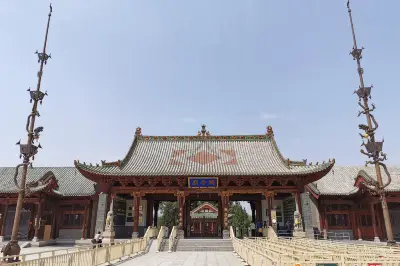
Shanxi Travelogue: Yuncheng Museum
On May 24, 2024, at 3:50 pm, we took bus No. 33 intending to go straight to the Chishen Temple scenic area. Passing the Weilai Hotel, which is very close to the train station, we noticed it was already 4:30 pm. At this time, most scenic spots would be closing, and even if still open, our visit would be rushed. So we decided to head back to the hotel and rest, planning to go the next day.
On the morning of May 25, after breakfast, at 8:20 am we took bus No. 2 and got off at the Housing and Construction Bureau stop. A short walk brought us to the Yuncheng Museum, just in time for its 9 am opening.
Yuncheng Museum is a national first-class museum, a member of the Chinese Museums Association, and a standing council member of the Shanxi Museum Association.
Its predecessor was the Yuncheng Regional Museum established in 1979. After 1986, it was successively renamed the Yuncheng Regional Hedong Museum and the Yuncheng Hedong Museum. In December 2013, the new building was completed and officially named Yuncheng Museum, opening to the public on July 1, 2016.
Currently, Yuncheng Museum operates under a central-branch management system. The Shanxi Yongle Palace Mural Art Museum and the Guan Gong Museum are also open to the public as branches of Yuncheng Museum. Yuncheng Museum is located on Weifeng Street in Yanhu District, Yuncheng. The Shanxi Yongle Palace Mural Art Museum (branch) is at the nationally protected cultural heritage site Yongle Palace in Yongle Town, Ruicheng County. The Guan Gong Museum (branch) is at the nationally protected site Haizhou Guandi Temple in Haizhou Town, Yuncheng. Supported by the rich historical and cultural resources of Yuncheng, the museums coordinate their activities, each with distinct features that complement one another.
The main museum covers about 76 mu (approx. 5 hectares), with a building area of 45,000 square meters, including an exhibition area of 19,000 square meters and a storage area of 5,560 square meters. The architecture resembles an old tree root anchored in the Loess Plateau, evoking 5,000 years of history. Viewed from above, the layout draws on the concepts of the Taiji symbol, the shape of a nebula, and the form of a cradle, symbolizing this region as the cradle of Chinese civilization.
The permanent exhibition, themed "East of the Great River," consists of six historical thematic displays: Seeking Roots in Huaxia, Treasures of the Collection, The Salt Industry Through the Ages, Outstanding Figures, Splendors of Civil Engineering, and Storms Over Tiaoshan, plus four special thematic exhibitions on Yuncheng's agriculture, industry, urban construction, and culture. As of August 2019, the museum held 17,691 artifacts, including 572 precious ones.
The Splendors of Civil Engineering exhibition covers 930 square meters and presents ancient architecture of Yuncheng chronologically, primarily through architectural models supplemented by charts, photographs, full-scale mural reproductions, and multimedia.
The Outstanding Figures exhibition, covering 600 square meters, features five sections: "The Sage Guan Yu Through the Ages," "High-Ranking Ministers and Notable Officials," "Academic and Literary Circles," "Artistic Talents," and "Prominent Clans." From more than 2,500 recorded figures from the Yuncheng area, 24 historical personages from Hedong are highlighted.
The Salt Industry Through the Ages exhibition, 430 square meters, illustrates the formation of Yuncheng's salt lake and its exploitation and management over dynasties. It comprises three parts: "Changes of the Salt Lake," "All Industries Flourishing," and "Cradle of Shanxi Merchants."
The Treasures of the Collection exhibition occupies 1,020 square meters and showcases over 1,000 items from the region, divided into "Bronze Highlights," "Stone Carvings Gallery," "Fire and Clay Wonders," and "Fragrant Ink and Elegant Script," narrating the area's history and culture through these artifacts.
The Seeking Roots in Huaxia exhibition, spanning 1,200 square meters, displays 500 objects, tracing from the 40-million-year-old "Eosimias" fossil, through Paleolithic and Neolithic eras, to relics from the Xia, Shang, and Zhou dynasties up to 2,200 years ago.
We moved through the galleries step by step, and at 11:30 am we finished our museum visit. Outside, we caught bus No. 14 to continue to Chishen Temple for further sightseeing.