Shanxi Travel Diary: Xinjiang Jiangzhou Office
At 11:30 am on May 30, 2024, we left the Xinjiang Confucian Temple and walked to the Xinjiang Catholic Church. The Xinjiang Catholic Church is located in the middle section of Zhengping Street in Xinjiang County, covering an area of 1,037 square meters. It was originally the Prince of Lingqiu’s mansion from the Ming Dynasty, with additional facilities such as a living room, residence, and small garden, but now only the gatehouse, bell tower, and passage hall remain. In 1937, Dutch missionary Bishop Kong Zhaoming of the former Jiangzhou Diocese funded the construction of a Gothic-style church in the courtyard, which was completed in 1943. The interior of the church has no pillars; it is supported by nine giant arches, each 22 meters high and spanning 25 meters. In the 1930s, it was hailed as the 'Beamless Hall' in China. The roof tiles are Chinese tiger-head cylindrical tiles, making it a blend of Chinese and Western architecture. On both sides of the nave and apse, there are a series of small chapels and radiating chapels, structurally designed to support the heavy roof’s pressure against the side walls. In 1966, Red Guards dismantled the Gothic bell towers on the church’s wings. In 1989, the church was restored to its original appearance. It is known, along with churches in Shanghai, Guangzhou, and Qingdao, as one of China’s four great Gothic churches.
Since the Catholic church was not open for visitors, we could only take photos outside; it was enough just to see it. At noon, we arrived at the north gate of the Sui Dynasty Garden across the street. This garden has been historically known as the 'Sui Dynasty Garden', 'Sui Garden', 'Lotus Pond', 'Xinjiang Garden', or 'Jiangshouju Garden Pool'. The Jiangshouju Garden Pool is a provincial-level cultural heritage protection unit in Shanxi, located behind the Jiangzhou Office, and is the only surviving Sui Dynasty prefectural garden in China. It was built in the 16th year of the Kaihuang era of the Sui Dynasty (596 AD) by Liang Gui, a military general and the magistrate of Linfen County, who channeled water from the Gu River north of the city to irrigate fields and diverted the surplus to flow through the official residence, forming a pool. In the southwest of the garden is the 'Tiger and Leopard Gate'; entering through it, you descend 29 steps directly to the Huilian Pavilion. The pavilion is square, half on land and half over water, shaded by green willows. In midsummer, lotus flowers bloom profusely in the pool, representing the garden’s 'summer scenery'. West of the Huilian Pavilion, a half-pavilion is built against the wall, with flower walls on both sides, and ancient cypresses, bamboo, and rare flowers and plants, representing the 'winter scenery'. Northeast of the Huilian Pavilion is an earthen hill formed by the soil excavated from the Huilian Pool. Trees such as locust, cypress, and willow are planted on and around it. To the east is the 'Ziwu Beam' that stretches across the northeast of the garden pool, dividing it into east and west halves. Railings with flower walls are built on both sides of the Ziwu Beam, and at its north end is the Jiahe Tower. Further east is a rockery; east of the rockery is a hexagonal gate with a screen wall. Passing through this gate, there is a shallow pavilion called 'Songwu Pavilion', surrounded by many winter jasmine plants, representing the garden’s 'spring scenery'. In the north corner of the garden are the Wind Embankment and the Moon Viewing Platform. In the east, there is the Banquet Festival Tower; south of it, a winding path leads to the 'Thatched Pavilion (Zhuo Pavilion)', surrounded by autumn chrysanthemums, peaches, and plums, representing the 'autumn scenery'. The garden was renovated during the Tang, Song, Yuan, Ming, and Qing dynasties. However, the Sui Dynasty Garden is now nearly desolate, with dry pond bottoms and empty canals, which is rather disappointing.
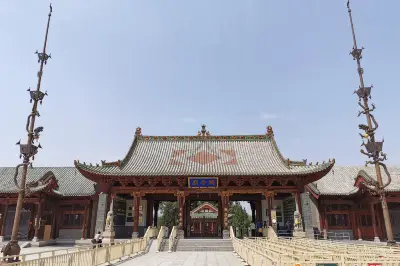
South of the Sui Dynasty Garden, there is a small gate that leads directly to the Jiangzhou Office Scenic Area, a key 4A-level scenic spot developed by Xinjiang County. The core building of the Jiangzhou Office Scenic Area is the Jiangzhou Hall, originally built in the Tang Dynasty with a history of over 1,300 years. During the Tang Dynasty, General Zhang Shigui of the Left Guard set up a tent here to recruit soldiers, and it was known as the 'Commander’s Hall'. It was here that the young white-robed warrior Xue Rengui enlisted, beginning his military career of serving the country and quelling rebellions. The Jiangzhou Hall was built in the Tang Dynasty and underwent repairs in the Yuan Dynasty, which introduced the Yuan dynasty column-reduction technique, greatly expanding the interior space. The existing building is the largest single structure among the three remaining Yuan Dynasty halls in China, and the only prefectural hall in the country with a seven-bay width.
The 'Three Towers of Jiangzhou' are among the fifth batch of national key cultural relic protection units announced by the State Council, and all three now retain the architectural style of the Ming Dynasty. They are the Bell Tower, Drum Tower, and Music Tower. The Bell Tower was first built in the Northern Song Dynasty, the Drum Tower in the Ming Dynasty, and the Music Tower in the Yuan Dynasty. The morning bell and evening drum were originally used for timekeeping: the bell was rung in the morning to open the city gates, and the drum was beaten in the evening to close them. The Music Tower, located at the bottom of the cliff slope, is equivalent to a modern stage, but it is a two-story structure—shadow plays can be performed on the upper level, and grand operas on the lower level. People could sit on the slope and watch the performances below without any obstruction, no matter where they sat.
The area covered with a glass canopy in front of the hall is the archaeological excavation site of the Jiangzhou Hall. The site covers 13,000 square meters, of which 6,300 square meters have been excavated. In this excavation area, 13,000 exhibition-worthy artifacts were discovered. Within the same site, historical remains from different periods—Tang, Song, Yuan, Ming, and Qing—were found, showcasing the historical continuity and cultural memory of Jiangzhou spanning over a millennium.
At 2:15 pm, we finished our visit, exited through the main gate, and walked a few hundred meters to the starting station of bus route 36. We caught a bus just in time, transferred to route 30 at Houma West Bus Station, and returned to the hotel to rest.
The next day, on May 31, at 1:16 pm, we took train K2665 back to Shangqiu, concluding our 20-day journey.