Revisiting Shanxi (9)
Writing this now in May, but the New Year spirit in Xinjiang still seems to linger, as if I can smell it!
We said goodbye to Fusheng Temple after 3 p.m. Our daughter didn’t fancy following us around Xinjiang’s county town, so we got off midway and let the driver take her back to the hotel.
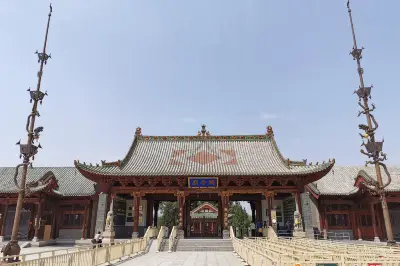
After getting off, we walked along the main street. The New Year atmosphere hit us head-on: colorful flags lined both sides, crowds everywhere, festive music filling our ears. At the town center stands Longxing Temple, which was even more bustling. For us visitors from afar, it was a sight we hadn’t seen in years: eager eyes crowded around candied hawthorn stalls, people queuing up in blocks to toss rings for dolls, and pilgrims jostling shoulder to shoulder to offer incense in the temple.
We were swept up the steps by the crowd, through the temple gate, and into a solitary pavilion where a stele was kept under glass. This is Longxing Temple’s famous Biluo Stele! It is a masterpiece of small seal script from the Tang Dynasty. (The following is taken from online commentary: “Some characters originate from Shang oracle bones, some from Zhou bronze inscriptions, and some from Qin stone drums, as well as from the Taishan, Langyatai, Yishan, and Kuaiji stone carvings. The stele is also unique for using over thirty substitute characters, which makes it extremely difficult to decipher. In the Biluo Stele, the same character rarely appears written the same way twice, and each character has a clear origin. Writing oracle bone, bronze, and stone drum scripts in small seal style was a creative achievement in Chinese calligraphy history. Its unique value in calligraphic art has earned it renown far and wide, treasured through the ages.”)
Although I know little about calligraphy, these characters looked ancient and beautifully structured. I couldn’t help but take a few more glances!
The New Year spirit in Xinjiang is indeed much stronger than in big cities. After emerging from Longxing Temple, we walked up and down the main street, it was packed with people. Passing the county government gate, it was shoulder-to-shoulder. But hanging prominently at the gate was a conspicuous sign: ‘Parking available inside, welcome to park.’
Our next stop was Jiangzhou Office. Arriving there, it was much quieter. It was close to five o’clock, closing time, and the sun’s afterglow still lingered. I heard that the white-robed general Xue Rengui enlisted here. His name has been familiar to me since childhood. My great-grandmother often sang to me a local ‘chicken-selling tune,’ one of which was ‘Rengui Returns to the Kiln.’ From her songs, I learned about Xue Dingshan and Fan Lihua, and how Xue Rengui mistakenly shot a tiger. These long-buried memories surfaced again.
Jiangzhou Hall is a surviving structure from the Yuan Dynasty. The massive beams and pillars didn’t surprise me; what did surprise me was its depth. Generally, local government halls across the country followed a standard of five bays, but Jiangzhou’s had seven bays, which is quite rare in China.
When we left Jiangzhou Office, the lanterns were already lit, with colorful lights adorning the streets. The festive night was even more dazzling.