Come to Heyuan and Experience the Unique Beauty of Northern Guangdong
This trip to Heyuan has many highlights. I am going to share a 5-day, 4-night itinerary with you. Save it!
If I told you that you could experience European scenery in Guangdong without leaving the country, you would probably doubt it: even if it were true, the scenery wouldn't be great. But the Bavaria Manor I recommend today will definitely overturn your imagination!
Tired of visiting the same places around you?
Coming here is definitely the right choice!
When mentioning Heyuan Bavaria Manor,
the first thing that comes to mind
is definitely the richly colored western-style buildings here.
The colorful houses here are just too cute. Staying inside feels like waking up in a fairy tale world. Walking among them, you can see picturesque beauty like in various European countries, but I think it leans more towards Scandinavia because the colors are very vivid and there are small windmills.
It's full of girlish heart.
This color combination looks absolutely stunning in sunny weather. You can find the romance of France, the artistry of Switzerland, and the rigor of Germany here!
Coming here feels like you've been abroad. The most beautiful place is the central lake, surrounded by all kinds of beautiful houses.
This place makes you linger and not want to leave. Actually, the whole Bavaria Town is a convergence of various cultures. Besides some traditional Hakka buildings, there are also various cuisines. When we went to the specialty store, we could see all kinds of delicious things. Heyuan Bavaria Manor.
There are the most ethereal green mountains and clear waters, and even the most touching Hakka legends performed.
In fact, Buddhism culture is also promoted here. It is the only Hakka-style roundhouse temple in the world, all round in shape. The temple replicates the Hakka roundhouse pattern, creating a unique temple~
Offering to all Buddhas, symbolizing fulfillment. The golden tree in the middle is very beautiful, and the Bodhi tree gives a sense of tranquil strength. The manor environment has an ecology of 'air washes the face, negative ions cleanse the lungs, and landscape cleanses the mind.'
An aerial shot even revealed a Tai Chi diagram.
In Heyuan, China, the forest coverage rate reaches 71.2%, the negative oxygen ion content reaches 12,000/cm³, and the average temperature is 21.4°C. The manor is adjacent to the famous Wanlv Lake scenic area, whose water area is equivalent to 68 West Lakes in Hangzhou. It is the source of drinking water for Shenzhen and Hong Kong. In such an important environmental protection area, the air is sweet!
Let's now step into Fuyuan Temple.
Heyuan Fuyuan Temple is the world's first temple featuring Hakka tulou architecture, a new Buddhist cultural holy site integrating Buddhist culture, Hakka tulou architectural culture, Zen culture, and health preservation culture.
Fuyuan Temple centers on a golden statue of Sakyamuni seated under a golden Bodhi tree, with the Mahavira Hall, Guanyin Hall, etc., arranged in a symmetrical circle, symbolizing the perfect fulfillment of all Buddhist matters.
In the center of the temple stands the world's first outdoor Bodhi sacred tree, 13.7 meters high, equal in height to the large Buddha statue in Cave 20 of the Yungang Grottoes. It is cast from 18 tons of imitation gold pure copper, with 4,800 gold leaves cast on the tree, a number derived from the Buddha's birth. The sacred tree is luxuriant, symbolizing smoothness in all matters.
The Bodhi Buddha statue adopts the Gandhara artistic style, sitting upright on a lotus throne under the Bodhi tree, painted with ancient gold foil and colors. It is a large-scale human landscape based on the Buddha's enlightenment under the Bodhi tree, solemn, majestic, and awe-inspiring.
It can be said that the surrounding scenery is very beautiful, with mountains and water, and soon high-speed rail. This place is definitely a great choice for a vacation.
The day we came, supposedly all the rooms were full because a nearby school was preparing for exams. It is said that this place will become increasingly popular in the future. Are you looking forward to it?
In Heyuan, there are two major tourist destinations that are very famous: one is Bavaria Manor, and the other is Hakka World here.
I have been to Hakka World in Meizhou, and the natural environment there is also very beautiful. It is also backed by green mountains, a great place for leisure and vacation.
Another characteristic of Heyuan Hakka World is that it has hot springs, exclusively enjoying Heyuan radon hot springs. With the theme of 'world bathing culture' and architectural styles, it creates an international hot spring area with multiple themed hot springs including Chinese, European, and Thai pavilions.
The hotel has one of the first batch of tourist hot spring water temperature and quality certifications in Guangdong, the Crystal Radon Hot Spring, with 13 natural spring outlets and unlimited soaking. It is one of China's characteristic hot spring resort hotels.
With a garden-style design, each hot spring pool has good privacy. The entire area integrates the bathing cultures of the world with themed architectural styles, making it a rare large-scale hot spring resort in South China. It features an original ecological natural environment, negative ion pure fresh oxygen, natural spiritual water streams, unique rare mineral hot springs, the essence of Lingnan culture, and world hot spring style concepts.
We came to this hot spring area during a holiday; it was very crowded, and after the rain, it was especially suitable for soaking.
The benefits of soaking in hot springs in summer are numerous, which I won't introduce here. Mainly, the environment is just too good!
The furnishings here everywhere seem to have historical allusions. Besides Chinese and European styles, there are also Japanese-style courtyards, with a dazzling array of hot spring pools.
The Nanyue King's Palace Health Hall is the most luxurious place in the entire hot spring area, with spa and various comfortable experiences. Nearby there is also a Hakka Grand Stage, sometimes with performances.
Hakka culture inherits the ancient orthodox Han culture and integrates with southern indigenous culture, forming a very distinctive traditional southern cultural expression.
Opening hours: 08:00-24:00 (Jan 1 - Dec 31, Mon-Sun); latest entry time: 23:00
Exclusive VIP rooms
Various massage pools are also very popular.
Enjoy the massage of flowing water in the endless hot springs. This is probably the most enjoyable part of soaking in hot springs.
After soaking in the hot springs, I recommend you go to the Drunken Butterfly Valley Flower Sea. The greenery here is very rich, suitable for walking and playing, letting the lush greenery take away all your bad mood!
Drunken Butterfly Valley Flower Sea is also a very beautiful scenic area, full of beautiful flowers everywhere.
In the breeze, walking aimlessly with your family in the scenic area, breathing fresh air, is extremely soothing.
Adorned with small flowers of red, yellow, purple, and other colors, it is beautiful, dreamy, warm, and romantic, making people want to take a stroll.
Blossoming flowers, shady trees, and soft grass, along with the floral art installations interspersed, feel like the Garden of Eden, a dreamy Lover's Valley. It is suitable for parent-child play, couple photos, and friends' strolls.
9:00-21:00
Hakka World Drunken Butterfly Valley Green Manor is full of spring atmosphere. The green gate wall looks even more striking in the sunlight.
After having enough fun at Hakka World, we went to taste the local cuisine of Heyuan. It was simply amazing.
The boiled beef with lemon was especially delicious.
All the dishes tasted great, especially the fried taro, which had a sweet and sour flavor.
Possessing both poetry and distance, is this homestay comfortable?
Some homestays look very beautiful at night, giving a warm feeling of home. You can also have poetry and distance at the same time. This place fulfills all your imagination!
What kind of homestay is this exactly? When we arrived, it was already evening. We took a bus along a narrow path before finally getting here. Initially, we saw a splendid back door; obviously, it used to be a wealthy family's house. When we came to the front door, it was also imposing. It is built at the foot of a hill, not far from Bavaria and Hakka World, just a neighborly distance. 'Neighborly,' yet it retains a rare peacefulness.
Such tranquility preserves everyone's dream of home and distance. The wooden ancient buildings with distinctive Lingnan characteristics make you feel like you have stepped into history. Strolling along the village paths, amidst the lush forests, it's so comfortable.
A gentle breeze passes through. The air is filled with the fragrance of trees.
Some small wooden houses are even two-story, with wooden bamboo ladders to stand on the balcony and overlook the surrounding green shade.
It is said that it rained heavily at night, so the air in the morning was particularly fresh.
We also saw beautiful phoenix flowers falling all over the ground, bright red and very lovely. Within the whole compound, there are ponds, white walls, and gray tiles, giving a very antique atmosphere. Would you like to come and stay in such a homestay?
At the Heyuan Dinosaur Museum, experience a time travel.
The museum is located inside Heyuan Dinosaur Cultural Park (Guifeng Park) alongside Binjiang Avenue, Yuancheng District, Heyuan City. It is backed by Guifeng Mountain, which has the national key cultural relic protection unit—Guifeng Tower. It was opened to the public in November 2010, and in 2013, it cooperated with the Institute of Vertebrate Paleontology and Paleoanthropology of the Chinese Academy of Sciences to establish and hang the sign 'China Paleontology Museum Dinosaur Egg Hall.'
Speaking of Guifeng Tower, we can see it outdoors. An aerial shot also shows the urban landscape on both sides of the river in Heyuan. Although it may not be the most bustling scenery, it can be considered the most beautiful.
I believe everyone had a strong interest in dinosaurs as a child. Breaking into the ancient era, today we come to the Heyuan Dinosaur Museum to see 'over 18,000 dinosaur egg fossils certified by the Guinness World Record.' This magical place is at the Heyuan Dinosaur Museum!
Whenever we mention Heyuan, if you use an input method with word association, it will pop up the word 'dinosaur' after 'Heyuan.' This shows that Heyuan is closely related to dinosaurs. When talking about Heyuan, there are also dinosaur eggs. Let's go see these ancient traces together. Looking at these once-living creatures reminds me of a line from 'Jurassic Park': 'Life finds a way,' but in fact, all dinosaurs disappeared completely in one extinction, and what remained became birds.
Such regret for life and reverence for the former rulers of the earth were once in my youthful heart. Time brings great changes; there are so many stories on Earth. All our glory and achievements might also be negated in the future. At the Dinosaur Museum, we can feel a lot. You must bring your children to see it.
The truly impressive part is inside the museum. It has a large 'Dinosaur Dream World' sculpture wall, 338 meters long, over 4 meters high, with a total span of 800 meters, as well as a 9-meter-high dinosaur main sculpture and 10 sets of steel dinosaur creative sculptures. Taking a photo with the dinosaur skeleton sculpture is very rare. At this time, we just need to stand in front of it and take an upward-looking photo; it looks great.
The museum covers an area of 3,100 square meters, with a building area of 8,300 square meters and an exhibition area of 2,800 square meters. With dinosaurs as the theme, it is divided into three exhibition halls: 'Dinosaur Delivery Room,' 'Dinosaur Footprints,' and 'Dinosaur Hometown.' I used a fixed-focus lens for the dinosaur eggs and a wide-angle lens for other scenes, highlighting the immense scale. Inside, seeing various ancient biological fossils, including an ancient giant turtle, gave me a new understanding of ancient life. Do you want to come to Heyuan Museum to see past life? Quickly add it to your travel plans.
At the foot of Guifeng Tower, Binjiang Avenue, Yuancheng District, Heyuan City
Tuesday-Sunday 9:00-17:00, last admission 16:30; closed on Mondays
On a hot summer day, you always need a cool place.
The mountains are misty and rainy, exuding a strong forest atmosphere. Layers of peaks are covered with thick wild grass. The mountain wind is so refreshing.
The sound of waves at your feet pounds against your heart. Breathe in the sweet air to your heart's content, as if drinking a cup of Hakka rice wine, sweet and slightly intoxicating, like jumping spirits drifting among them.
When visiting Yequgou, it is recommended to take a battery car to the top of the mountain, then walk down along the stream.
Yequgou Tourist Area is located in the northern part of the main peak of Daguishan. It is surrounded by mountains and water, with a quiet environment. There are diverse natural landscapes such as Yeya Lake, Baihua Garden, and Xiangshui Waterfall. You can also experience the natural fun of the exciting dark cave rafting.
At the top of the mountain, there is a very fun waterfall, with fresh air around, and a small pool below, giving a sense of tranquility.
Follow the continuously flowing spring to explore this mountain forest.
As a scenic spot in the northern Guangdong mountainous area, its advantage is the beautiful mountains and clear waters. On a hot summer day, you must experience it.
Passing through the mountain forest of the scenic area, you will inevitably pass Yeya Lake. The water here is as smooth as a mirror, the scenery is beautiful, and occasionally wild ducks appear. It is also the starting point for rafting.
Within Yeya Lake Entertainment Area, Yequgou Forest Park, 10 km away from Guishan Tourism Avenue, Yuancheng District, Heyuan City
Open: 08:00-17:00
No chicken, no feast. Here, there is a particularly delicious mushroom chicken.
The legend of 'stuffed tofu' was told to us by Mr. Xu Jiansheng, the chairman of Yequgou. This dish originated from northern dumplings. Northern immigrants came here and missed the dumplings of their hometown. Since there was little wheat in the south, they used tofu as the wrapper, put meat filling into cut pieces of tofu, and steamed them. The result was delicious!
Many people have heard of Wanlv Lake. After all, this body of water has nourished many people. The Wanlv Lake Scenic Area in Heyuan City is located in Dongyuan County, Guangdong Province, 6 kilometers from downtown Heyuan. It is the largest artificial lake in South China.
Wanlv Lake is like a man-made emerald. It is no exaggeration to say that it is 'like the Jade Pool in heaven, Wanlv Lake on earth.'
Wanlv Lake is a scenic area established by relying on the Xinfengjiang Reservoir. It is famous for its beautiful water—'magnificent water area, pure water quality, gentle water nature, and beautiful water color.'
Our first scenic spot was to go to Shuiyue Bay after passing the large lake, about a 20-minute journey. Just after boarding the boat, it was about to rain in the distance. But such weather is actually better; the air is fresher after the rain.
The yellow soil we see is exposed because the water level is low. The emerald green water surface and the yellow soil form a sharp contrast.
Beneath our feet was once a land of fish and rice with curling smoke over thousands of years, which turned into a flat mountain sea within just 15 months—the largest artificial lake in South China.
The places that emerged from the water became small islands, still very beautiful. It would be even more beautiful to take pictures when the sun comes out. The reservoir water is really clear, to the extent that when taking an aerial shot, you can even see the underwater parts of structures.
On clear days, the water color is even better than that of tropical islands.
The boat runs very steadily, so you can take pictures to your heart's content.
On Jinghua Ridge, there is a Water-Sending Guanyin. To the east, three pools reflect green; to the west, two turtles emerge from the sea; and in the middle, a crocodile plays in the waves—all are wonderfully fantastic. Time determines color; height determines realm. There is also a distinction between 'reading' and 'understanding' when visiting Wanlv Lake: reading the green is visual appreciation; understanding the green is comprehending life.
This protruding part is Jinghua Ridge. You can still see the underwater part, isn't that great? From the map, this is like a bird spreading its wings to fly between Jiulian Mountain and Luofu Mountain. From any angle, it is emerald green.
The temperature is maintained between 19-23°C, very cool. Walking on the dam, taking photos with the distant mountains and lake, is superb!
I wonder what the dam extending into the water is used for?
There are many standards for measuring water quality, and transparency is a very important one. A visibility of 5-8 meters is already excellent!
So, do you want to come here to be a nature's porter?
When we were about to return, the weather improved again. Because the lake is vast, sunlight sparkling on the water surface feels like being at the seaside, shimmering.
So, such beautiful lake water, don't you want to come and see it?
Although Pear Blossom House is far, there is an ancient path nearby to visit. Located in the mountains, it is very leisurely. When we came, there were many guests staying, showing its popularity.
From here, you can also see a small part of Wanlv Lake. We caught a glimpse of it at sunset; the scenery was top-notch.
Arriving at Pear Blossom House, a rustic Hakka-style homestay feels like living in nature. It is definitely an excellent destination for parent-child countryside tours, summer camps, class reunions, and recuperation stays.
You can take kids to ride bikes and play in the orchard.
You can play basketball on the court with the best air quality.
It's right by the roadside. Since it's in a remote village, there are very few cars; only two or three pass in the morning.
There are also all kinds of delicious Hakka dishes. Just looking at these exquisite ingredients makes it worth visiting.
There are several buildings with three-story guest rooms. People who come here simply want to relax. Simple and minimalist decoration: white walls, wooden doors and windows, sliding windows, corridor wire pendant lights, bamboo chairs, cobblestone ground—very rustic.
The rooms have a simple wood color, clean and tidy. Here, a family can let time pass. When you open your eyes, you see sunlight creeping in.
Heping Linzhai, a village that has long fought with river water. In the past, Linzhai often experienced floods. But why don't the locals want to leave?
One night in the 1930s or 1940s, a group of bandits entrenched in the southern mountainous area of Heping County, Guangdong, launched a fierce attack on multiple four-cornered buildings in Linzhai Town. It is said that these century-old castles were full of mechanisms and hidden gold.
Surprisingly, the bandits used every possible means but failed to break into the four-cornered buildings. They had to give up. So who built these massive castles in Linzhai, and why were they impregnable?
I have visited many beautiful villages, including many Hakka dragon houses and tulou, but the four-cornered buildings here are truly spectacular! We came at the best time, as we could see a large expanse of green rice paddies. With the vast rice fields as a backdrop, the scenery is naturally extraordinary!
Linzhai Town in Heping County, Guangdong Province, is an ancient village built along the river. It is surrounded by mountains on all sides, with low-lying terrain, facing serious flooding for a long time. You can see the 1964 water level line had already submerged the splendid beams.
Chen Yangtian, a villager well-versed in Linzhai's history.
The wooden boat ancient village has four city walls, still retaining their original style. Each city gate has a tower, and there are wooden boats on top. The thousand-year prosperity blends before our eyes; the lingering sound continues. Entering through the gates is like walking into a maze.
The wooden boats are placed on the upper floors so that they can go out by boat during floods and heavy rain. It turns out that the people of Linzhai, to resist floods, made wooden boats on their gate towers. When the flood reaches a certain height, they push the boats down to transport supplies and rescue people. These boats are mainly used after being flooded: the boat is pushed down and can be used along the alleyways to aid villagers or sick elderly people.
As we went deeper, we increasingly sensed the unusual nature of Linzhai Ancient Village. It is as majestic as a castle. Locals told us that these are the Hakka folk houses they live in, called four-cornered buildings. The four-cornered buildings are densely built here, with each fortress relatively close to each other. Within an area of less than 2 square kilometers, 24 well-preserved four-cornered buildings are concentrated. From a distance, the contracted woodland is spectacular, forming a unique scenic line during wartime.
Although these four-cornered buildings look tall and majestic, and you might think the interior is simple, it is actually very beautiful inside. Upon entering, some have a three-story-high exquisite gate.
The central courtyard is a cornucopia. During rain, water continuously flows in. Locals consider water as wealth, and even the drain outlets are shaped like copper coins.
According to historical records, Linzhai Town in Heping County was established in the Qin Dynasty. In ancient times, it was the 12th Du of Longchuan County. In 214 BC, Emperor Qin Shi Huang sent a large army south. To defend against invaders, Nanyue King Zhao Tuo sent a General surnamed Lin to build a fortress and guard the pass. Later, it was named Linzhai after his surname. From the Qin and Han Dynasties to the Yuan Dynasty, like other places in Lingnan, Linzhai lacked official historical records. It is speculated that during this period, military garrisons evolved into villages, with garrison troops intermarrying with local indigenous residents, forming the earliest 'Hakka people' of Linzhai.
Linzhai Ancient Village has a large number of Hakka-style square enclosed houses, also known as four-cornered buildings. They include both western-style buildings and Chinese-style courtyards. Each building has three or more floors, each floor covering several hundred to several thousand square meters. Their scale and number are rare nationwide. The most representative one is the Qiangguang Building, which integrates Hakka culture, Chaoshan culture, Cantonese culture, and Western culture.
Linzhai Ancient Village is a special type of Chinese historical architecture. It is a pastoral castle group integrating flood control, defense, residence, storage, and Chinese and Western architectural art.
Many people used to live here together. The decorations outside look relatively new.
[Four-cornered buildings by the rice paddies, aren't they beautiful?]
[The pond reflects the scenery.]
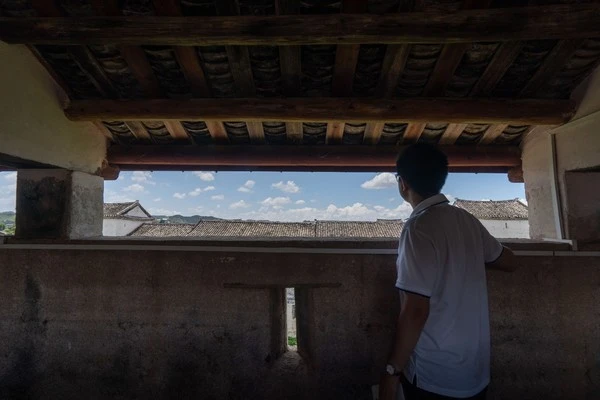
Afterwards, we also went up a castle. The view was superb!
[Looking from the high building.]
The plaque of 'Yingchuan Old House' was inscribed by Tan Yankai, the first chairman of the National Government. To this day, the plaque is well-preserved, making it even more precious. Many of the calligraphy inside the building was written by political figures and famous calligraphers of the Republic of China era, forming a historical scroll. It also retains historical memories such as the Xinhai Revolution, the Whampoa Military Academy, the Peasant Movement Training Class, and the Anti-Japanese Comrades Association.
The orientation of the building is simply facing south, which avoids the direct impact of floods. What about other flood control facilities? How does it work when a flood comes? First, water from the eaves converges through the courtyard into the pool below, then drains outside through drainage holes. Secondly, there are downpipes hidden in the building columns like bamboo, both beautiful and practical.
Statistics from 1948 show that Heping County had over 260 large and small ships, with over 1,100 employees. Water transportation was thriving, and the scenery was also particularly beautiful. Time passes, and great changes have taken place around Linzhai. Now when we come, we can only constantly marvel at its beauty and wonder. At the same time, the four-cornered buildings of Linzhai are also applying for World Cultural Heritage status. Do you think they have a chance of success?
In my memory, there are relatively few well-preserved ancient cities in Guangdong. Apart from Chaozhou, there are few complete ancient cities. This time, I still got a feel for the ancient city style in Tuocheng, Heyuan.
Although Tuocheng is not a very complete ancient city, it has all the necessary attractions: archways, city gates, a cinema, a Confucian school, examination sheds, and other places. We took a battery car to visit various attractions, big and small, and many places can be connected.
First, we saw an archway outside. The archway in Tuocheng Scenic Area is the first landscape. Archways, also known as paifang, existed as early as the Zhou Dynasty. They are gate-shaped structures with pillars, set at important roads as markers for dividing street blocks. The archway looks relatively new, but after entering, there are various beautiful old buildings, including arcade streets, as if stepping into old times.
Tuocheng is the site of Longchuan County, the earliest ancient county established in Lingnan. It is also one of the first eleven historical and cultural cities announced by Guangdong Province. Originally called Longchuan City, later renamed Xunzhou City. In 1941 (the 30th year of the Republic of China), it was renamed Tuocheng to commemorate Zhao Tuo, the first county magistrate of Longchuan.
Tuocheng Confucian School is located at Xiaodongmen, Tuocheng Town. It was a temple for Confucian worship and a government agency for Confucian education in past dynasties, also known as the Confucius Temple. It was built in the 7th year of Shunzhi of the Qing Dynasty (1650 AD), covering an area of 7,287 square meters.
I had seen a Confucius Temple in Langzhong before, and the scope of Tuocheng was also really large. We visited all the sights by battery car. If no new buildings had been built inside, it might have been almost as large as the four existing ancient cities in China in ancient times.
King Zhao's Temple, also known as Guangxiao Temple or Pingkou Temple, was built by later generations to worship the Qin county magistrate Zhao Tuo. It is located on Zhongshan Street, Tuocheng, covering an area of 352 square meters. This is also a must-see. You see the 12 sages, all of whom have visited Tuocheng.
In the middle, the enshrined Zhao Tuo brought many technologies from the Qin State, so he brought the gospel to the uncivilized Lingnan area~
During the Anti-Japanese War, after Guangzhou fell, some parts of the Kuomintang Guangdong provincial government once moved here to work. Before the liberation of Longchuan on May 16, 1949, Tuocheng was always the political, economic, and cultural center of Longchuan County. Due to its long history, the ancient city is rich in cultural relics and historic sites.
Longchuan Examination Shed is the only historical imperial examination venue in Guangdong; there are none elsewhere. There are only 20 such sites left nationwide. I saw one in Guilin last time, which was not bad. Let's go in and take a look!
The examination shed is quite large. Inside, we can see the reenactment of the civil and military imperial examinations, which is quite good.
[Military examination scene.]
Nearby, there is also King Zhao's Well. This well has been dug for thousands of years. At that time, because the soldiers were not acclimatized and the river water was not clean enough, they dug it.
You can still draw clear spring water on site, and you can even taste it!
A small town like this with so many historical sites, do you want to have a good look?
Arriving at the parking lot here, we got off the car and started from here. The cinema next to it has been converted into a restaurant. This city is also quietly changing.
Before the storm, the afterglow of the setting sun is very beautiful, isn't it?
There are also some nice buildings, though I don't quite remember if they were former banks or guild halls, very stylish, with the city wall beside them.
Most of the existing ancient buildings in Tuocheng were built during the Ming and Qing Dynasties. There are two types: ancestral halls and residential houses. In Tuocheng, there are two many things: many centenarians and many surnames. Longchuan has 237 surnames, and Tuocheng, with only over 40,000 people, has 179 surnames.
With many surnames, there are many ancestral halls. On Baishui Street alone, there are over ten ancestral halls: Mao, Wang, Lin, Zhang, Ye, Zeng, Chen, Xie, Zhu, etc. According to records, in the late Qing and early Republic, ancestral hall construction reached its peak, with 89 recorded ancestral halls, one per surname. There are 48 existing old ancestral halls in Tuocheng, scattered everywhere in the town, mixed among the residences. These roads are incredibly clean; I have only seen such clean streets in Japan.
Only about 50 meters of the city wall remain, but the North City Gate is quite well-preserved. Let's end our last stop at this historic city gate!
According to the national high-speed rail plan, the Ganzhou-Shenzhen High-Speed Railway will pass through Longchuan. Perhaps in the future, these dormant beauties will be shown to more people.
Huoshan is a famous cultural mountain. In the Qin Dynasty, Huo Long moved from Wu to Yue to avoid chaos, lived in seclusion here, built a hut, lectured, and spread Central Plains culture. Later, he achieved immortality and ascended. The people, grateful for his kindness, named this mountain 'Huoshan'. When climbing the mountain, you will certainly sweat profusely. After about 200-300 meters of cobblestone path, we rested in front of Lingshan Temple. At the mountain pass or under the trees, there is always a cool mountain breeze blowing.
Famous attractions include 'Boat Head Watching the Sun', 'Jade Lin Playing with the Moon', 'Lion Roaring at the Wind', 'Horizontal Rock Defying the Mist', 'Thread of Dawn', 'Long Mortar Receiving the Buddha', 'Seven Wells Immortal Spring', 'Sand Monk Wishing Longevity', 'Iron Crutch Li Carrying a Gourd' and other 'Huoshan Cloud Shadow' wonders... breathtaking!
Jiuweng Stone: also known as 'Jiuweng Lingyun', a solitary peak rising from the ground, shaped like an inverted wine jar, piercing the blue sky, with lush vegetation on top, like clouds and mist.
It is called 'the second Danxia Mountain' for a reason. Besides the geological landforms being the same as Danxia Mountain, the climbing experience is also similar.
Here you can see various plants and small flowers. Although not stunning, the winding paths and continuously climbing roads are much better than the roughly three paths, with richer vegetation.
Apart from sunny days, when it's foggy, you see clouds below, peaks revealing stone tips, faintly visible in the sky. If you are here, you see clouds below, peaks above, clouds drifting back and forth beneath your feet, rising and falling, mist and clouds swirling, gathering and dispersing rapidly, a myriad of changing scenes, as if stepping into a fairy mountain pavilion. Truly, only the sky is above, and no mountain is level.
The road we see now is a shortcut up. It's better to use it as a return path. The distant scenery is even more beautiful. As this is a protected area, they won't develop more peaks for you to climb. But actually, the Danxia mountains are really numerous. At Huoshan, the playability is so high that there is even a glass bridge!
There is also an amazing glass bridge at Huoshan. Walking on this transparent glass, the beautiful scenery at the foot of the mountain is fully visible.
The canyon is deep and looks amazing from afar. Danxia Mountain, as a World Heritage site, it is reasonable not to develop large areas. If you want to see more beautiful mountain forests and have a deeper experience, come to Huoshan.
Besides the glass walkway, ordinary cliffside walkways basically cover the entire route, occasionally giving a thrilling feeling of being suspended.
After passing through the 'Thread of Dawn', there is a large rock wedged between two mountains. I don't know when it fell out, forming a natural cave below. Sitting here feels very cool.
'Thread of Dawn' is a common stone formation in famous mountains and peaks in China. It is named because the gap between two cliffs shows a thread of blue sky. The mountain wind here is also very cool.
The path to 'Thread of Dawn' will lead back to where we came. Many rocks are within reach here. Many people raise their hands to take a group photo; it's suitable.
Climbing Huoshan was an experience of sweating and then drying off. Next, we came to Sijifeng Manor.
Actually, it's very suitable to bring children to soak in hot springs on weekends and then come to Sijifeng Manor. Here, children can experience tie-dye classes, but usually, the class starts only when a group of children gathers.
Here, you can also learn about various plant dyes. Finally, we saw a large tie-dye pattern completed by everyone working together on the grass. Sijifeng Manor also has some accommodation.
Also, there were educated youth here in the past, so there is also a Museum of Educated Youth.
At Sijifeng Manor, the vineyard is now full of fruit. Clusters of grapes, big and small, are crystal clear and very tempting.
In the farm, we can see various fruits and vegetables: figs, dragon fruit, and a group of ducks in the bamboo forest, all very cute and lovely. If you want to get close to the countryside, this is definitely the place.
[Large clusters of grapes.]


