2024 Blooming to Meet You || Lianping Wengyuan Ink Wash Peach Blossom Photography Tour
Spring has arrived, the earth is warming, and flowers are blooming on the branches. Spring in Guangdong comes especially early, as if winter hasn't ended yet, but spring is already waving. From a friend, I got the itinerary of the "Lianping Wengyuan Ink Wash Peach Blossom Photography Tour" organized by the Guangzhou Photography Alliance. I loved it instantly, and despite the cold and gloomy weather, I resolutely decided to join.
The peach blossoms in Lianping seem to be the heralds of spring photography in Guangdong. Those eagle-beak peach trees, each resembling a bonsai, attract photography enthusiasts and flower lovers every year. Our trip coincided exactly with the Lianping Peach Blossom Festival on February 25 and the Wengyuan Peach Blossom Festival on March 1. There was much anticipation, except that the weather was not very cooperative.
I had been fond of Lianping peach blossoms for years, because the peach trees here are not ordinary ones but eagle-beak peach trees. What I love most are the old peach trees, with their twisting, rugged brown trunks full of tension, like bonsai, beautifully shaped. Though their fruit lacks the pretty appearance of honey peaches and is not large, it is deeply loved by Guangdong people for its crisp sweetness.
At 9:30 a.m., we gathered at Tan Village Metro Station Exit D to depart. The organizer, 41 Degrees, warmly introduced each participant on the bus; there were a few first-timers like me.
Like most tour groups nowadays, women made up four-fifths of this group! It seemed most of them were into travel photography. Not surprising—everyone wants to catch the last glorious moments.
【Encountering Peach Blossoms at Sisters Peak, Longnan, Ganzhou】
At noon, we crossed the border between Guangdong and Jiangxi and arrived at the foot of Mount Xiaowudang in Longnan City, Ganzhou, Jiangxi. At 12:45, we turned into Sisters Peak Farm Restaurant for lunch. Once inside, we found it was another world. Not far from the restaurant was a stretch of undulating mountains shrouded in mist and clouds, with one peak especially prominent—perhaps it was the one locals call Sisters Peak, standing tall and proud among the other peaks.
Peach trees are likely an important cash crop for the local villagers. During harvest season, the eagle-beak peaches here are very popular and in high demand. Beneath the towering peaks lay vast peach orchards. The owner told us he had over 20 mu of peach trees, and the income from eagle-beak peaches accounted for nearly half of his total cash crop revenue. These trees were about four years old, with some aged one to two years. Entering the peach grove to take photos cost 10 yuan per person. The place seemed to have become a peach blossom photography base; we even saw a monk clicking his shutter frequently there.
These peach trees varied in style. My idea at the time was to find uniquely shaped ones and combine the peach trees and blossoms with the mountains in the photos.
【Meeting Peach Blossom Fate at Shuangxing Peach Garden in Lianping】
After a half-hour warm-up shoot, we moved to Shuangxing Peach Garden in Zhongcun Village, Shangping Town, Lianping County, Heyuan. There, on February 25, the live shooting event "Meeting Peach Blossom Fate, Gathering Millions" had been held. Entering Lianping, we saw peach trees everywhere along the roadsides, on slopes, and around houses, covered with red, pink, and white blossoms. The sun even seemed to smile, clearing the gloomy atmosphere, and everyone got excited.
The warm-up shoot after lunch had stirred up everyone's enthusiasm for photography. When our car arrived at Shuangxing Peach Garden in Zhongcun Village, Lianping Town—the venue for the 2024 Lianping Peach Blossom Tourism Culture Week—the road was jammed solid. There were quite a few tourists and cars coming to see the flowers. We got off and walked to the gate of Shuangxing Peach Garden. This peach grove lay on a hillside beside the road, lush with romantic blossoms; each tree and patch of peach blossoms vied for attention.
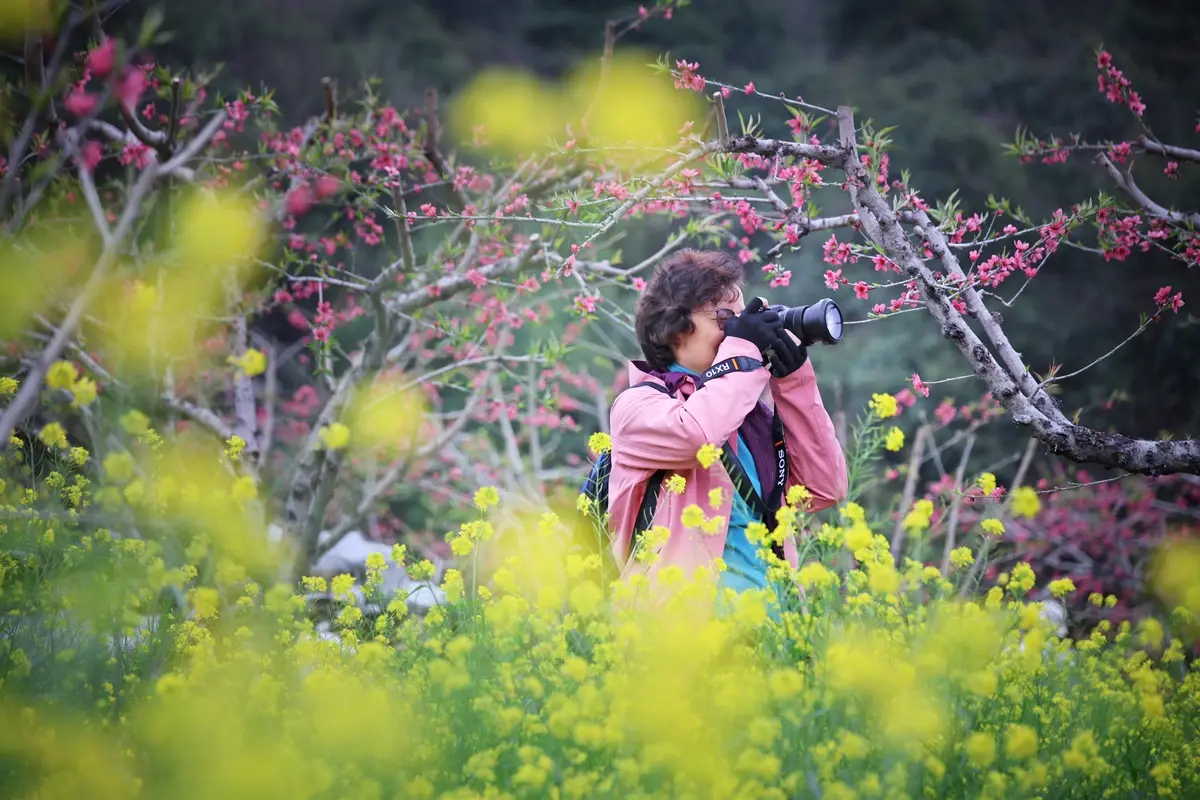
Near the foot of the hill, the peach trees were planted amidst rapeseed flowers. The yellow-green background of the rapeseed made the peach blossoms even more beautiful and dazzling.
When peach blossoms meet rapeseed flowers, the peach blossoms bloom on the branches, with pink petals like jade, their fragrance alluring; the rapeseed flowers bloom on the ground, golden like patches of small sunshine, exuding joy.
Peach blossoms and rapeseed flowers—one romantic, one joyful—adorn the earth with colorful splendor in spring. A friend wittily commented: One toils to produce oil and vegetables, the other only cares to blossom beautifully, a perfect match with mutual consent.
On the hillside were some scattered white stones with unique shapes. I remembered a colleague who had been here before telling me that the white stones skillfully blend with the exquisitely shaped peach trees to create an unexpected ink-wash peach blossom effect. I kept looking but didn't seem to find the ideal result.
While I was photographing others, I also became the subject of someone else's lens.
Seeing women in Hanfu, it was inevitable to take some candid shots. The ancient costumes added much charm to the peach blossoms.
The sky darkened by 4:30 p.m. We left for Wengyuan County and stayed that night at the Wengyuan Yuyue Hotel (Jinxiu Square Branch). We had about two hours of shooting, not enough; we hadn't even gone up to the hilltop, and the weather wasn't ideal either. A bit of regret remains.
At 6 p.m., we arrived in Wengyuan, which belongs to Shaoguan, the southern gateway of northern Guangdong. I had never been there before. Over 90% of the people here are Hakka. The city flower is the orchid, and all streetlights are orchid-shaped. This is an orchid base; I remembered buying perfume orchids from Douyin before the New Year, and they were from Wengyuan. Local specialties include Shanhua pear and Jiuxian peach.
【Donghua Zen Temple in Wengyuan: Mind Empty, See Zen】
Everyone knows that Shaoguan has a famous Nanhua Temple, which I visited during a graduation internship in the early 1980s. But I had never heard of Donghua Zen Temple. Before entering the gate, we saw two huge Bodhi trees being transported on a cart in the square. The Bodhi tree holds great significance in Buddhism, representing enlightenment and wisdom.
Donghua Zen Temple was first built in the first year of Emperor Wu of Liang's reign in the Southern Dynasties (502 AD), with a history of over 1,500 years. The Sixth Patriarch Huineng first practiced in seclusion at Donghua Temple before going to Nanhua Temple to propagate the Dharma, hence the saying "First Donghua, then Nanhua." The current site has been rebuilt. The area in front of the mountain gate is Taoist, while behind it is Buddhist.
Originally named Lingjiu Temple, it was founded by the Indian eminent monk Zhizhi Sanzang (Dhyana Master Zhizhi).
In 661 AD, after inheriting the Fifth Patriarch's robe and bowl, the Sixth Patriarch Huineng returned south, passed this temple for secluded practice, and renamed Lingjiu Temple as Donghua Zen Temple, a name that has been used ever since.
Donghua Zen Temple flourished in the Tang and Song dynasties but was destroyed in the Ming and Qing. In 1997, Master Wanxing entered this mountain for seven years of closed-door cultivation, completing a seven-year retreat journey from Zhangzhou, Fujian, and Linzhi, Tibet, to Wengyuan, Guangdong. After successfully completing his retreat, he rebuilt Donghua Zen Temple.
In 2008, the temple was formally completed, and Master Wanxing ascended as the first abbot of the contemporary reconstruction of Donghua Zen Temple. With strong government support, the temple was built on a larger scale with a unique architectural style. The current Donghua Zen Temple features a simple and elegant architectural style; the monks strictly observe precepts and engage in true practice, making it the most distinctive practice center and Zen culture research base in the country.
We entered the temple gate in the rain. The temple in the rain seemed more serene, with few visitors. The peach blossoms inside dotted the solemn halls, adding softness and artistic conception.
The architecture of Donghua Temple seemed different from temples I had seen before—more creative and grander. Nestled among the mountains, it made full use of the terrain, rising in terraced steps.
The resplendent Mahavira Hall is always the most important hall. The statues of Sakyamuni, Amitabha, and Medicine Buddha inside appeared younger and more amiable than those I had seen in other temples. The side walls were covered with golden scriptures from the entire Platform Sutra of the Sixth Patriarch.
Behind the Mahavira Hall, in the Family Style Square, there is a double-eaved golden pavilion. Under a transparent glass cover is a jade Guanyin statue made of emerald, 4.35 meters high, 1.63 meters thick, 2.88 meters wide, weighing 38 tons, crafted by dozens of jade carving masters over 8 years.
In the Dragon and Phoenix Blessing Square, the "Dragon and Phoenix Prosperity" design features a golden dragon on the left and phoenix on the right, coiled on both sides of the square, symbolizing auspicious dragon and phoenix, prosperity of the Chinese nation. Above the square is the Zhengyue Hall.
The "Donghua Fu" inscription above "Dragon and Phoenix Prosperity" records the rise and fall of Donghua Zen Temple in running script.
On one side, an inscribed stone reads "Bless China," wishing blessings on China, favorable weather, and national peace and security.
Standing at the highest point of Zhengyue Hall, one can overlook the entire scene. On the right are the Wanjian Tower and Cultural Museum under construction; on the left is the Donghua Buddhist Grotto, where over three hundred golden Buddha statues of various sizes sit in the grotto, gazing compassionately at all beings. In the center of the grotto, a large red character "佛" (Buddha) is everywhere! The character is 26 meters high; it is said that there are pictures within the character, but I didn't see them at the time. Below the "Buddha" character is a cave—the Three Saints Cave—where it is said that Indian Dhyana Master Zhizhi and the Sixth Patriarch Huineng both practiced in seclusion.
The largest Buddha statue in the grotto.
Walking along the grotto, we arrived at the Arhat Forest, which I called the "group of monks." The Arhat Forest originated from a wildfire in 2000, when Master Wanxing was still in retreat. The mountain fire started naturally at dawn; stones all emerged. Each stone closely resembled arhats of various shapes and sizes, naturally forming this Arhat forest landscape. Later, with simple carving, they became even more lifelike.
These rocks were arranged in a scattered yet orderly way. Each carved monk statue was hidden among the rocks, and different expressions could be seen on the rocks. Occasionally, Buddhist life mottos inscribed by the abbot of Donghua Zen Temple could be seen on the rocks: "Mind Empty, See Zen," "Buddha is Mind, Mind is Buddha," "Enlightenment," "Harmony"...
Although I am not formally a follower of Taoism or Buddhism, I deeply felt the great power of Buddhism here... Donghua Zen Temple is still under construction; it is free to enter, photography is allowed inside, and presumably drones can be flown.
The rain kept falling. Our original plan to photograph the ink-wash peach blossoms at Lidong in the afternoon had to be changed. Instead, we went to visit the Tu Zhiwei Art Museum and Tu Wen'an Photography Studio in Wengyuan. These two private museums/art galleries, funded by individuals with government support, provided us with a visual feast.
【Visual Feast at Tu Zhiwei Art Museum】
As the car stopped in front of the museum, through the window I could see its unique exterior by the Weng River. The rock-like facade blended harmoniously with nature, quite imposing. With government support, Tu Zhiwei raised 60 million yuan of his own funds to build the Tu Zhiwei Art Museum beside the Weng River. Surrounded by mountains on three sides and water on one, its shape resembles a piano set amidst green mountains and clear waters.
I never expected that such a small place as Wengyuan would harbor such a great painter, and even less did I expect that the museum named after the painter himself would be so artistic from outside to inside, filling the Weng River and Wengyuan with an artistic atmosphere, leaving a deep impression on me.
Painter Tu Zhiwei is a native of Liuli Town, Wengyuan. He graduated from the Oil Painting Department of the Guangzhou Academy of Fine Arts (master's program) and joined the China Artists Association. In 1987, he went to the United States to study, earned a Master of Fine Arts degree, and later settled in the US. He is now a famous painter originally from Wengyuan living in the US. He was awarded the title of "Oil Painting Master" by the American oil painting community, and in 2004, he was elected president of the Oil Painters of America, the first person of Chinese descent to hold this position in the organization's history.
Entering the museum lobby, a massive oil painting with visual impact immediately caught our eyes. Titled "Face, Banner, Heart Move," the painting is 10 meters long and 6 meters high. It depicts the story of Huineng, after inheriting the robe and practicing for fifteen years, encountering two monks arguing at Guangxiao Temple about whether the banner moves or the wind moves, and Huineng suddenly realizing: "It is neither the banner moving nor the wind moving, but the heart of the benevolent one moving."
"Dunhuang Art Series": Using oil painting to express Dunhuang art, such as "Playing the Pipa Behind the Back," "Tang Dynasty Music and Dance," "Dunhuang Double Dance," "Dunhuang Triple Dance," "Dunhuang Ribbon Dance," etc., moving the imagined "heavenly scene" to the human world. Tu Zhiwei is the first person to use oil painting to express Dunhuang art.
"Dance Music, Bell Chime, Ancient Sound" is the origin of Tu Zhiwei's historical paintings. In 1978, after watching the CCTV news about the excavation of the chime bells, he went to Sui County, Hubei, to investigate. After visiting the scene, after many conceptualizations, he created this work over more than ten years. The chime bells are the largest musical instrument in the world with the most tones and the richest volume.
"Drunken Imperial Concubine"
"He Shi Bi" depicts "Returning the Jade Intact." He Shi Bi is a famous piece of jade in Chinese history. Tu Zhiwei painted the scene where the King of Qin, upon seeing the jade, proudly showed it to his concubines and ministers.
"Head, Books, and Great Pit" tells the story of Qin Shi Huang's book burning and scholar burying. Tu Zhiwei condensed the tragic scene of the "Fen Shu Keng Ru" onto canvas, revealing extraordinary visual imagination.
"Chest, Zheng He's Fleet, and the Sea" depicts the scene of Zheng He's voyages to the Western Seas. Zheng He was the pioneer and explorer of the Maritime Silk Road. His voyages had a profound impact on cultural exchange and economic trade between East and West. The chest is used as the expressive form.
"Hand, Raft, and Yellow River" is a sketch; the original is collected by the National Art Museum of China. When this large painting was exhibited at the National Art Museum of China, the Chinese Collectors Committee decided to collect it. Tu Zhiwei thought for three days and finally reluctantly agreed. The picture shows a raft floating down the rolling Yellow River with raftsmen. Using the Yellow River as his subject, Tu Zhiwei expresses his passion for Chinese culture, pushing visual impact to the extreme.
"Feet, Soldiers, and the Earth" In 1980, Tu Zhiwei visited the excavated terracotta warriors in Xi'an. The grand and spectacular scene was breathtaking and inspiring. Chinese history can also be said to be a history of war, either external or civil. War brings poverty, suffering, and disasters. In the end, it is the people who suffer. Over time, thinking and pondering year after year, Tu Zhiwei cultivated the oil painting "Feet, Soldiers, and the Earth."
Oil painting, a field long dominated by the West, after the interpretation of Master Tu Zhiwei, draws themes from China's most famous historical events and creates many realistic oil paintings to express the culture of the Chinese nation, instantly bridging the distance between us and oil paintings. Especially the handling of light in these paintings shares similarities with photography.
The spacious and bright exhibition hall gave us enough time and space to slowly appreciate each painting, providing a very good experience. I looked at each painting, scanned codes with my phone to listen to explanations, deeply moved by these paintings and liking them very much.
【Tu Wen'an Photography Art Gallery Takes Me to Tibetan Areas Again】
Next we came to the Tu Wen'an Photography Art Gallery, another private gallery funded by an individual, focusing on photography. The owner is also from Liuli Town, Wengyuan County. The gallery displays more than 100 of his representative works. The first floor mainly features portraits of Tibetan people, a subject I am familiar with.
The second floor is a Zen culture photography area, where all photos are masterpieces. The biggest impression after visiting was that the author is very good at using light, making every photo lifelike.
The portrait of the Sixth Patriarch Huineng's true body is the soul of this area. It is said that his true body is preserved at Nanhua Temple. A fellow traveler, Lingling, sat in front of the photo for a long time, deeply moved, seemingly entering a meditative state, unable to extricate herself.
I didn't expect that the rain would provide us with an opportunity to absorb artistic nourishment.
【Answering the Appointment of Lidong Ink Wash Peach Blossoms in Wengyuan】
The rain finally stopped, but it was damp and cold, with temperatures 3-8°C. The opening ceremony of Lidong Ink Wash Peach Blossoms was held this morning. As long as it wasn't raining, we certainly wouldn't give up, even though the weather was still gloomy. But no more rain was already a favor. The opening ceremony was held in the Ink Wash Peach Blossom Valley, half an hour's drive from the county town, turning into narrow village roads. Because of the cold weather, not many people attended the ceremony. Our group of 26 was considered a large team (a few were missing, including me).
This was a hillside covered with oddly shaped white stones. Peach trees grew among these stones. I wonder which came first, the white stones or the peach trees?
The opening ceremony started at 10:30. We arrived early and immediately dispersed, wandering among the white stones and peach blossoms.
Lidong peach blossoms have long been known as "ink wash peach blossoms." Why are they called that? What is "water" and what is "ink"? I asked Baidu. "Old trees after frost bloom new flowers; wild ridges with twisted branches sprout tender buds. Ink wash naturally creates exquisite strokes; leaving blank space depends on the heart." This poem depicts old trees after frost blooming with new flowers, twisted branches on wild ridges sprouting tender buds, expressing the vitality and beauty of nature through ink wash painting. It is probably the ancient poet's best praise and depiction of ink wash peach blossoms, and also reminds us that to capture the artistic conception of ink wash peach blossoms, one must leave blank space and observe carefully.
The deep green earth acts as "paper," white stones are the "mountains" on the ink wash painting, and the peach blossoms on the old branches become the theme of the ink wash painting. What a real-life natural ink wash peach blossom landscape painting!
I was immersed in it but didn't know where to start, how to capture this wonderful moment. I tried stepping over white stones, circling each peach tree to observe and ponder, but the results of my shooting were not satisfactory. However, having people in the scene produced surprisingly good results (captured by a master).
We left at 11:30.
【Huxinba Enclosed Houses Take Us Through Time】
The subject of enclosed houses (weilou) was not unfamiliar to me. The enclosed houses in Zhangzhou, Fujian, are perhaps the representatives, with their "four dishes one soup" style famous far and wide. I never expected that there were also enclosed houses in Nantang Village, Jiangwei Town, Wengyuan County—little known, never heard of in all my years in Guangzhou.
We had lunch at "Huxinba Family Restaurant," eating farm-style dishes. This place had a strong rural atmosphere, with both indoor and outdoor spaces retaining traces of the 1960s-70s, very familiar and intimate, inadvertently taking us back in time through a time tunnel.
There are four well-preserved enclosed houses in the village: Chang'an Wei, Waihan Di, Daifu Di, and Sanmen Lou, all provincial-level cultural relics protection units in Guangdong. We mainly visited Huxinba Chang'an Wei, also known as Huxinba Hakka Residential Complex.
We mainly visited Huxinba Chang'an Wei, also known as the Huxinba Hakka Residential Complex. According to introductions, Huxinba Chang'an Wei was first built during the Ming Dynasty Zhengtong era, over 550 years ago. The ancestors came from Fujian. It was mainly inhabited by the Shen clan, accommodating up to a hundred people at its peak. Now, most have moved out to the new socialist countryside built by the government; a few remain, using the enclosed house site to sell orchids. We encountered one such person.
Chang'an Wei is a microcosm of southern Hakka enclosed buildings. In front of the building is a semicircular pond with clear water, rippling in the wind. The Hakka believe water represents wealth; having water in front of the ancestral hall signifies that the clan can gather wealth from all directions. The pond water can also be used for firefighting.
We happened to see a group of people offering sacrifices to their ancestors in front of the enclosed house, presumably descendants of this building. Firecrackers crackled, sending thick smoke straight into the sky. The pond in front of the enclosed house was a great place to photograph reflections.
This ancient Hakka enclosed house covers an area of about 300,000 square meters, with 59 enclosed buildings constructed during the Ming and Qing dynasties. Although 27 of them have collapsed, been demolished, or renovated due to disrepair, 32 ancient buildings still retain their original historical appearance in terms of main structure and artistic features.
Huxinba Chang'an Wei is not only famous for its scale and historical value but also for its unique architectural style and deep cultural heritage. These enclosed buildings are mainly semicircular, with exquisitely arranged lanes of varying widths, well-proportioned.
Not far away, a field of rapeseed flowers became a foreground for photos of people with the enclosed houses.
The three-day trip ended at Huxinba Enclosed Houses. The time was short, but the content was rich, and we gained a lot. I would like to thank the masters who took photos for me and express my gratitude for using their images! Completed on March 7, 2024.


