Self-driving Sichuan-Tibet Highway (In) - Qinghai-Tibet Highway (Out)
I've been to many places, but the Sichuan-Tibet Highway has always been a dream.
In July 2020, I started planning a trip on the Sichuan-Tibet Highway. Driven by the call of "Must drive Route 318 in this life," I decided to take my sedan on Route 318.
When I started making plans, I considered a timeframe of about 15-17 days. For the route, I planned to enter via the Sichuan-Tibet Highway and exit via the Qinghai-Tibet Highway. At first, it felt a bit tight, so I cut some parts not on the Sichuan-Tibet Highway. I dropped the day at Phoenix Ancient Town, but kept the rest basically unchanged.
As the trip approached, I kept checking road conditions, weather along the way, and my car's maintenance status. I worried whether my car could handle Route 318, since it only had a 1.6-liter engine. But none of that could stop my determination.
Before leaving, I gave the car a thorough maintenance: changed spark plugs, changed oil, checked tires, etc. Compared to a regular service, I only added one extra spark plug change—nothing else special.
Day 1: From my starting point to Chongqing. I planned to see the night view there, but ended up stuck in traffic for two hours. I missed the night scenery, but met up with an old college friend who waited until late. We hadn't seen each other for 11 years and had a late-night snack together. I felt how much life had changed... we were no longer young.
Day 2: From Chongqing to Chengdu. This day was relatively relaxed. I left at 10 am and arrived around 4-5 pm. There I met teammates I had arranged online and set the departure time for the next day. Since I had been to Chengdu before, I had dinner, walked around a bit, and went to bed early.
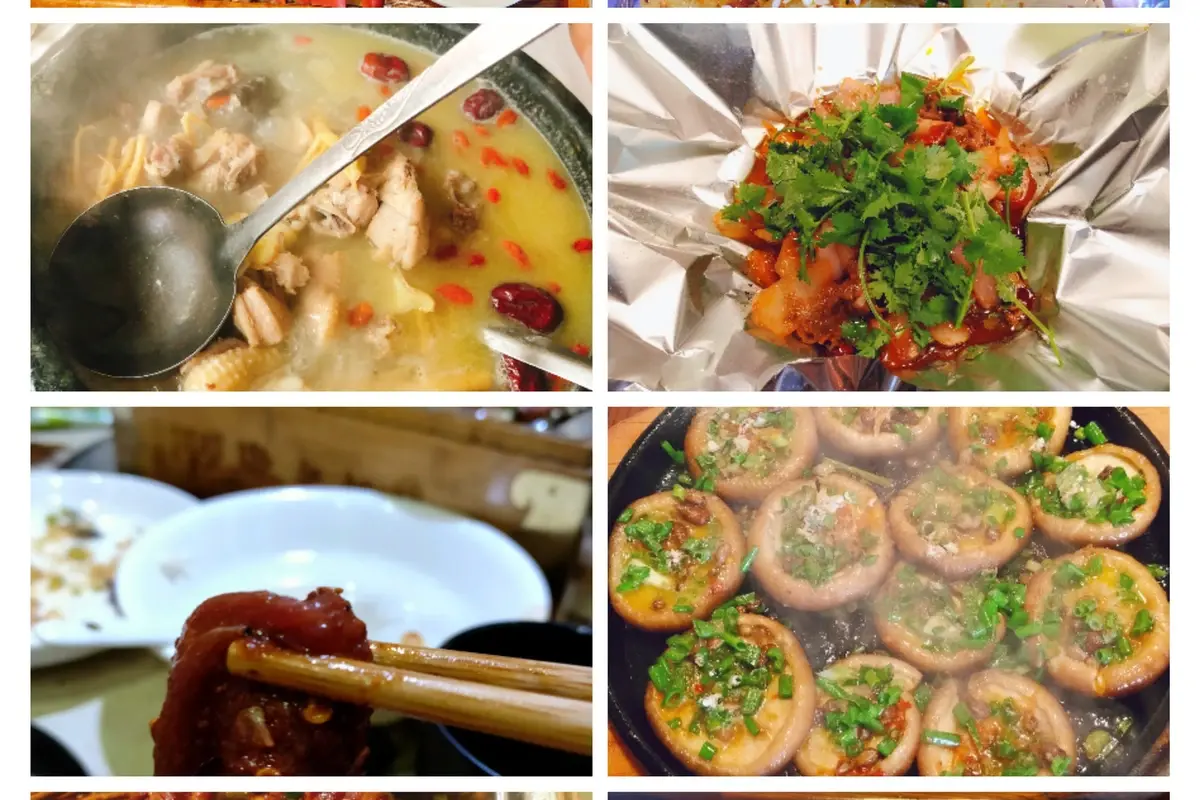
Day 3: This was a long day—I drove straight from Chengdu to Batang, arriving around midnight. Along the way, I passed Luding Bridge, Hailuogou, Kangding, Zheduo Mountain, Xinduqiao, Jianziwan Mountain, and all the way to Batang. The first day was very lucky: the weather was clear, and I saw all the scenery. And since most of the spots were along the road, I didn't waste much time stopping. On the first day, my car climbed mountains over 4,200 meters in altitude with many winding roads. But luckily, the car held up fine. The only issue was that at high altitudes, even with the accelerator floored, the speed wouldn't pick up. At that point, I didn't feel sorry for the car—I just thought I would have to get a large-displacement turbocharged off-road vehicle in the future. (I have to mention a Tibetan home-style restaurant in Kangding that was really delicious.)
Day 4: Since we drove so long on the first day, we didn't rush for the rest. Our planned destination was Baxoi, but we took it slow. By 9 pm, we reached Bamda, but the road was closed and restricted; we had no choice but to stay overnight in Bamda. That night turned out to be a tragedy the next day. Bamda's altitude is around 4,100 meters, and I had severe altitude sickness that night. The next day, I felt terrible—I was vomiting while driving, then continuing after throwing up.
Day 5: We planned to go to Bomi. This day went smoothly with no landslides or roadblocks. However, because of the altitude sickness from staying in Bamda, I was vomiting while driving and then driving again. It was an exhilarating feeling. Luckily, I'm tough and persistent. Along the way, I went through the 72 Turns and the viral water crossing ditch. I sped through, but my car got a nail and lost air. Fortunately, I had a pump. I pumped air and drove, and after about 20 kilometers, I found a tire repair shop—50 yuan fixed it. We passed Ranwu Lake and Midui Glacier, but at that time, going to Midui Glacier was basically just seeing snow-capped mountains.
Day 6: From Bomi to Nyingchi. Along the way, many people checked in at the Tongmai Bridge, passed through Lulang Town (I must praise Lulang stone pot chicken—it was really delicious), and the scenery in Lulang was beautiful, pastoral. Then we went over Sejila Mountain, Ranwu Lake, and finally arrived in Nyingchi. At Sejila Mountain, I didn't see Mount Namjagbarwa, which was a pity.
Day 7: From Nyingchi to the Yarlung Tsangpo Grand Canyon. This was the first time I bought a ticket to see a scenic spot (240 yuan combo ticket). Actually, the scenery was pretty average, but the road in Nyingchi was quite nice—so the whole Sichuan-Tibet Highway is full of beautiful scenery. After visiting the Grand Canyon, I drove straight to Lhasa. The Linla Highway (free expressway) was smooth. At one service area, it was pitch black; it was around 9 pm, and two dogs ran out, scaring me to death. I quickly drove off without even using the restroom (and I couldn't find one anyway).
Day 8: Lhasa one-day tour: Jokhang Temple, Barkhor Street, taking photos. I have to say, the raw beef in Lhasa is really delicious. Actually, Lhasa now doesn't have much local Tibetan culture; it's basically dominated by Sichuanese people. Jokhang Temple isn't as big as you might imagine, but it's magnificent. Most pilgrims come to Lhasa to worship the gold statue of Shakyamuni at Jokhang Temple.
Day 9: Another day in Lhasa: I went to Yamdrok Lake. There were so many lakes along this Tibet trip. Yamdrok was beautiful, one of the sacred lakes in Tibet. No ticket needed—don't be fooled by people at the entrance asking you to buy one. In the evening, I watched the large-scale outdoor performance "Princess Wencheng." It was really good and worth seeing (ticket 290 yuan).
Day 10: Potala Palace one-day tour. During the pandemic, you must book tickets in advance. There aren't many rooms to visit in the Potala Palace—only about 20-plus rooms, but they are grand. Inside, there are murals of the Shunzhi Emperor meeting the 5th Dalai Lama, stupas, and more.
Day 11: From Lhasa to Namtso Lake—this officially marks entering the Qinghai-Tibet Highway. This section was easy to drive. I set off around 7 am and arrived at Namtso around noon. Ticket price: 110 yuan. The lake was vast, stretching to the horizon like an ocean. The water was very clear and beautiful. After Namtso, I headed to Nagqu, which is at about 4,400 meters. I stayed at an oxygen-enriched hotel (420 yuan per night). Since I had a sedan, I couldn't go to the Holy Elephant Sky Gate. But that's on the other side of Namtso Lake, so no regrets.
Day 12: This was the toughest day—driving straight from Nagqu to Golmud. Passed through Tanggula Pass, Tuotuo River, Hoh Xil, Kunlun Pass—all scenery along the way, snow-capped mountains everywhere. In Hoh Xil, I saw red rivers, the snow peaks of the Kunlun Mountains, and the red mountains of Fenghuo Shan. All very spectacular. I arrived dusty in Golmud around 9 pm, driving for over 13 hours total. The Qinghai-Tibet Highway section was really rough—full of big potholes and uneven surfaces. My sedan barely made it; the undercarriage scraped many times. Luckily, I had installed a steel skid plate for the engine compartment before the trip.
Day 13: From Golmud to Chaka Salt Lake. Since I had seen many lakes on this trip, Chaka didn't impress me much. After two hours, I left to head to Xi'an.
Day 14: Arrived in Xi'an, visited the Tang Paradise Night Market. Stayed right next to it (528 yuan per night) and had local Xi'an cuisine.
Day 15: Return trip.
Summary of the entire trip: it was truly dusty, full of hardships and thrills. The hardships came from the long drive; the thrills came from the breathtaking scenery and dangers. Route 318 has many winding roads and quite a few landslides. Route 109 has fewer curves but plenty of potholes.
Can a sedan make it? I can tell you responsibly: yes, it can. Any worries about refueling are unnecessary.
One regret: after reaching Qinghai, I couldn't visit Dongtai Jiner Lake, Emerald Lake, or Water Yadan due to time constraints.
Costs for two people in the car: about 19,000 yuan.
Tips: Remember to stay at places with low altitude along the way...
Read ten thousand books and travel ten thousand miles!
If I have the chance in this life, I want to travel through mountains and rivers with the one I love... let life flow slowly, taking in all the scenery...