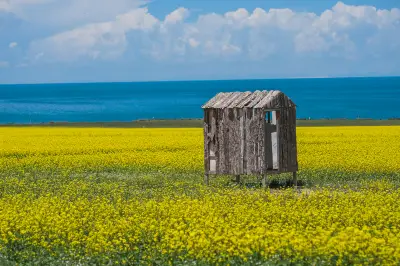
Qinghai Travel: An Unforgettable Journey on the Qinghai-Tibet Line through the Kunlun Mountains (Photo)
The Kunlun Mountains in Qinghai have always been sacred in the journalist's heart. As luck would have it, in September 2008, due to participating in the collection of holy water from the Kunlun Divine Spring for the First World Mind Sports Games, the journalist had the opportunity to travel along the Qinghai-Tibet Line through the Kunlun Mountains. Driving from Golmud, heading south out of the city and then west not far, the Qinghai-Tibet Line runs parallel with the railway and highway. The Qinghai-Tibet Highway is National Highway 109, while the newly built railway is the one beautifully known as the "Sky Road."
A Close Look at the Kunlun Mountains (Photo by Feng Ganyong)
On September 3, 2008, after leaving Golmud, both sides of the road were a boundless black Gobi with sparse shrubs, located on the southeastern edge of the Qaidam Basin. Thirty-two kilometers ahead is Nanshankou Station, the starting point of the first phase of the Qinghai-Tibet Railway. On June 29, 2001, news of the start of construction of the Qinghai-Tibet Railway was first announced from here, spreading across Qinghai, Tibet, China, and the world.
Kunlun Mountains Entrance Marker (Photo by Feng Ganyong)
Not far past the Nanshankou toll station, two imposing memorial stele standing on both sides of the Qinghai-Tibet Highway come into view. The stele on the east side is inscribed with "Ancestor of Ten Thousand Mountains," and the one on the west side with "Majestic Kunlun."
Photo at Kunlun Mountain Pass (Photo by Ma Chunxiao)
The eight large red characters glistened brightly under the sunlight, extremely eye-catching. Xiao Yan, the driver from the Golmud Tourism Bureau accompanying the group, told the journalist: "This marker means that from here we enter the Kunlun Mountains."
Kunlun River (Photo by Feng Ganyong)
Continuing onward, we entered the Golmud River valley area. After crossing the river several times, we saw the Kunlun Bridge ahead. Here, the Kunlun River (upper reaches of the Golmud River), originating from the northern foothills of the Kunlun Mountains, has long eroded the rock layers, carving a canyon 30-40 meters deep. The bottom of the canyon is wide and winding, while the narrowest point at the top is only a step away. Standing there, the melting snow from the mountains rushes forward, roaring past, the sound of the water deafening—this spot is called "One-Step Natural Danger."
Highest Railway Bridge on the Qinghai-Tibet Line (Photo by Feng Ganyong)
The Kunlun Mountains stretch like a giant python, known as "Vast Kunlun." Historical records describe the Kunlun Mountains as the place where jade dragons soar into the sky, and they are often called the backbone of Asia. The Kunlun Mountains start from the Pamir Plateau in the west, with a total length of 2,500 kilometers, an average altitude of 5,500 to 6,000 meters, a width of 130 to 200 kilometers, narrowing in the west and widening in the east, covering a total area of over 500,000 square kilometers. The highest peak is at the border of Qinghai and Xinjiang, named Xinqing Peak—Bugda Ban Peak, at 6,860 meters, the highest point in Qinghai Province.
River on the Qinghai-Tibet Line (Photo by Feng Ganyong)
The Kunlun Mountains have undulating peaks, deep forests, and beautiful scenery. Every spring and early summer, the mountains are covered with green trees and flowers competing in beauty, adding charm to the Kunlun Mountains, making it one of the famous scenic areas in Qinghai Province. Cui Hong, a historian of the Northern Wei Dynasty, described it in the "Sixteen Kingdoms Annals" as "the ancestor of all mountains under the sea" and "famous mountains under heaven are mostly occupied by monks."
Migrating Camel Caravan of Herders (Photo by Feng Ganyong)
Since ancient times, the Kunlun Mountains have attracted Buddhists and Taoists to build temples and monasteries here for cultivation and preaching. As early as the Han and Tang Dynasties, many temples stood here with incense burning continuously. By the Jin and Yuan Dynasties, the founder of the flourishing Quanzhen School of Chinese Taoism, Wang Chongyang, along with his seven disciples, chose this place as the "Cave Heaven and Blessed Land" for establishing their sect, leaving behind many fascinating Taoist relics.
Migrating Flock of Sheep (Photo by Feng Ganyong)
Traveling on the Qinghai-Tibet Highway, occasionally we could see herders migrating with their camel caravans and flocks of sheep, a grand sight. The railway, sometimes on the left and sometimes on the right, accompanied us all the way. Especially when a train passed by, the long line of carriages dashed across the rolling mountains like a rolling black dragon.
Nachitai Kunlun Divine Spring (Photo by Feng Ganyong)
At the 90th kilometer of the Qinghai-Tibet Line, at an altitude of 3,700 meters, there is a small town called Nachitai, where the Kunlun Divine Spring is located. It is an excellent natural mineral spring, regarded as a wonder of Kunlun. The Nachitai spring consists of two springs, one large and one small, 50 meters apart. The large spring is beside the Qinghai-Tibet Highway, with the spring eye enclosed by a stone platform in an outer circle and inner octagon shape, one meter high, the spring mouth 1.6 meters in diameter, the spring eye 1 meter deep, with an outlet nearby. Now, the Golmud city government has specially built a beautiful hexagonal pavilion with green glazed tiles and red columns over the Kunlun Divine Spring, along with a monument to the Divine Spring.
Sparkling Spring Water (Photo by Feng Ganyong)
The Kunlun Spring water is abundant, gushing out day and night, constantly creating small ripples and making sounds, with a year-round constant temperature of 20°C. The spring pool is surrounded by a polygonal pattern made of granite slabs. In the center, a clear spring suddenly spurts up from the pool, forming a crystal clear mushroom shape, throwing countless jade-like petals around, resembling a blooming lotus or silent splashing pieces of jade falling into a clear pool, then flowing into the roaring Kunlun River.
Waterfall of the Kunlun Divine Spring (Photo by Feng Ganyong)
To this day, there is a legend about Princess Wencheng resting here when she entered Tibet. According to legend, when Princess Wencheng married the Tibetan king, she carried a giant statue of Shakyamuni Buddha. When the princess and her entourage reached Nachitai at the foot of the Kunlun Mountains, they were exhausted from the long journey. So the princess ordered the group to rest there. When cooking dinner that night, they found there was no water nearby, so they had to eat dry rations and sleep in their clothes.
Scenery Around the Divine Spring (Photo by Feng Ganyong)
The next morning, when people woke up, they found that the mountain where they had placed the Buddha statue the previous night had been flattened into a platform. Not far from the platform, a clear spring gushed out, flowing gently. Everyone immediately understood that Shakyamuni Buddha had pressed the spring water out of the mountain. The devout Buddhist princess, to show her respect, threw a string of pearls from her body into the spring, making the water even cooler and sweeter. Thus, people called Nachitai "Buddha Terrace" and the Kunlun Spring "Pearl Spring."
Three Girls of Tibetan, Han, and Mongolian Ethnicities (Photo by Feng Ganyong)
Another legend says that after attending the Queen Mother of the West's birthday banquet at the Yaochi (Jade Pool) in the Kunlun Mountains, the creator god Fanmo was still in high spirits. He casually drank the Yaochi nectar gifted by the Queen Mother, then threw his golden goblet to the ground, spilling the nectar everywhere. His lotus-shaped shrine turned into the Chitai mountains, and the spilled nectar became the Kunlun Spring.
Photo with the Ethnic Holy Water Girls (Photo by Ma Chunxiao)
On September 4, 2008, at the launching ceremony of the "Wisdom Origin" Holy Water Collection for the First World Mind Sports Games, three girls of Tibetan, Han, and Mongolian ethnicities served as holy maidens to collect the holy water from the Kunlun Divine Spring. Two holy maidens held the water from the Kunlun Divine Spring and poured it into a holy water bottle made of Kunlun Mountain stone held by the third maiden, then they all raised the bottle high.
View of Kunlun Snow Mountains in the Distance (Photo by Feng Ganyong)
The Kunlun Divine Spring is the largest non-freezing spring in the Kunlun Mountains. Its water comes from the melting snow and ice of the Kunlun Mountains, which seeps into the ground and then gushes out. It is clear, cool, sweet, clean, and hygienic. Due to its high altitude and lack of pollution, it is known as "Glacier Dew." This spring water is a low-mineralized, heavy carbonate-chloride, calcium-magnesium type mineral water. Before emerging from the strata, it flows underground for more than 20 years, dissolving beneficial chemical elements such as strontium, calcium, potassium, and bicarbonate from the surrounding environment. Among them, the strontium content reaches 0.7 mg/L, which is effective in treating hypertension, heart disease, arteriosclerosis, and other conditions. It is a high-quality natural drinking mineral water. It is a must-pass spot on the roof-of-the-world auto exploration route and an important attraction for Taoist pilgrimage to the Kunlun Mountains.
West Beach Viewing Yuzhu Peak (Photo by Feng Ganyong)
Heading west along the Qinghai-Tibet Line for several dozen more kilometers, continuous majestic snow-capped mountains appear on one side of the road. This area is called West Beach, and it is the location of the famous Yuzhu Peak in the Kunlun Mountains. Yuzhu Peak, also known as Kekesaimen Peak, is 6,178 meters above sea level, located in the eastern section of the Kunlun Mountains, at 94.2 degrees east longitude and 35.6 degrees north latitude. Yuzhu Peak is covered with snow all year round, with crisscrossing glaciers, magnificent and imposing. There are more than 20 snow peaks above 5,400 meters around the main peak.
Road Sign at Kunlun Mountain Pass (Photo by Feng Ganyong)
Continuing west past West Beach, we arrive at the 165th kilometer of the Qinghai-Tibet Line, which is the Kunlun Mountain Pass. By the roadside, you can see a sign indicating an altitude of 4,767 meters, with "Kunlun Mountains" written in both Tibetan and Chinese characters. The Kunlun Mountain Pass is located in southwestern Qinghai, in the middle section of the Kunlun Mountains. It is a necessary route from Qinghai and Gansu provinces to Tibet and a major pass on the Qinghai-Tibet Highway, named after the mountain valley opening, also known as "Kunlun Saddle."
Dragon Racing on the Sky Road (Photo by Feng Ganyong)
Standing at the Kunlun Mountain Pass, you can see the entire eastern and western Kunlun. Looking east, amidst the silent ancient snowfields, Yuxu Peak stands alone and majestic, dominating the mountains, creating the unique natural landscape of the ice and snow world.
Photo at Kunlun Mountains (Photo by Ma Chunxiao)
Legend has it that Yuxu Peak is the incarnation of Princess Yuxu, daughter of the Queen Mother of the West. The peak is towering and steep, with clouds and mist lingering at the top all year round, covered in white snow. Strange peaks and rocks come to life between the mountains, with birds and animals appearing from time to time. In the distance, under the blue sky and white clouds, a black dragon speeds along the sky road, a spectacular sight.
Marker Stele at Kunlun Mountain Pass (Photo by Feng Ganyong)
At the foot of the mountain, on the green grassland, temples and palaces are scattered in perfect order, forming a beautiful picture of a fairyland on earth. Not far away is Yuzhu Peak, said to be the incarnation of another daughter of the Queen Mother of the West, Princess Yuzhu. Yuzhu Peak is covered with snow all year round, with crisscrossing glaciers, majestic and imposing. The ice and snow terrain on the southern side of Yuzhu Peak varies, and at the end of the glacier, it forms ice organs over 10 meters high. The alpine meadow zone on the southern side of Yuzhu Peak is a paradise for wildlife, often with herds of Tibetan antelopes, Tibetan wild donkeys, and other rare animals.
Monument at Kunlun Mountain Pass (Photo by Feng Ganyong)
There are several monuments at the Kunlun Mountain Pass. The marker stele of Kunlun Mountain Pass, surrounded by colorful prayer flags, consists of five parts: main stele, secondary stele, accompanying stele, sculpture, and base, made of white marble. The main stele is 4.767 meters high, one-thousandth of the altitude of Kunlun Mountain Pass. The base is built with granite blocks covering 9.6 square meters, symbolizing its standing firmly on the 9.6 million square kilometers of the motherland.
Photo at Hoh Xil (Photo by Ma Chunxiao)
Every year, descendants of the Yellow Emperor from around the world come here to seek their roots. They kneel and worship on the hillside, where a forest of root-seeking monuments forms another scenery of the Kunlun Mountains.
Monument to Sonam Dargye (Photo by Feng Ganyong)
Another monument is the Sonam Dargye Monument, covered with white hada scarves. Sonam Dargye, a hero who gave his life to protect Tibetan antelopes and defend Hoh Xil, his loyal soul clings to Kunlun. His vigilant eyes still watch the Hoh Xil he defended with his blood and life. Nearby also stand the "Kunlun Mountain Pass Monument," "Kunlun Mountain Pass West 8.1 Magnitude Earthquake Monument," and "National Geopark Monument."
Earthquake Monument (Photo by Feng Ganyong)
The 8.1 magnitude strong earthquake that occurred on November 14, 2001, west of Kunlun Mountain Pass, was the largest earthquake in China in nearly 50 years and the largest since the beginning of the 21st century. The surface ruptures caused by this earthquake are the only such phenomena in China, rare in the world, and the best preserved, most spectacular, and newest earthquake remains. They are precious natural heritage for humanity. The earthquake remains have been recognized by the international geological community as a natural "classroom" for studying the Himalayan orogeny and the mechanism of strong earthquakes.
Golmud River Valley Area (Photo by Feng Ganyong)
This monument was erected by the China Earthquake Administration, with practical significance for the protection and study of earthquake remains and the popularization of earthquake knowledge. It is understood that due to its proximity to the highway, since the earthquake occurred, the earthquake rupture zone near the Kunlun Mountain Pass has attracted many passing drivers and tourists every day with its magnificent and spectacular sights. Traveling through the Kunlun Mountains on the Qinghai-Tibet Line, although it was a quick and hurried visit, left an indelible and beautiful memory... (Text and photos by Feng Ganyong)