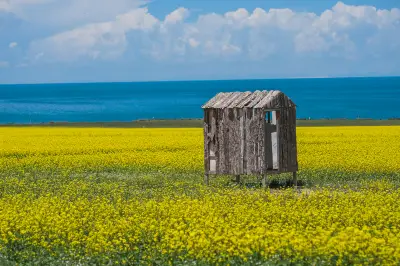
Mysterious Kunlun, Source of Three Rivers! Why is this desolate and vast uninhabited area called the 'Water Tower of Asia'?
When we think of the Kunlun Mountains, we imagine vast Gobi deserts, endless yellow sand, extreme altitudes, and forbidden zones of life. But how many people know that this is also the source of three major Asian rivers: the Yangtze, the Yellow River, and the Lancang River? Sounds contradictory, doesn't it? Yet it truly is the case.
The Three Rivers Source is China's first national park and the largest national park in the world by area. Located in the heart of the Qinghai-Tibet Plateau, it is the birthplace of the Yangtze, Yellow, and Lancang rivers, earning it the reputation of being the 'Water Tower of China' and the 'Water Tower of Asia.' Moreover, the geographical wonder of three major rivers originating from the same region is unique on a global scale.
The Three Rivers Source National Park covers a total area of 123,100 square kilometers, larger than many provincial administrative regions. It encompasses the counties of Zhidoi, Qumalai, Madoi, and Zadoi, as well as the jurisdiction of the Hoh Xil Nature Reserve. Within this area lie famous mountain ranges such as the Kunlun Mountains, Bayan Har Mountains, and Tanggula Mountains, with crisscrossing valleys, endless snow-capped peaks, and towering glaciers.
The average altitude of this region exceeds 4,500 meters, with countless 'forbidden zones of life' above 5,000 meters. Vast snowfields, numerous rivers, swamps, and lakes dot the landscape—there are as many as 167 lakes with an area greater than one square kilometer. These lakes are mostly formed by the melting of snow and ice from glaciers and mountains, gradually creating countless small streams that eventually flow into the three great rivers: the Yangtze, Yellow, and Lancang.
Although it is called the Three Rivers Source, the actual sources of the three rivers differ. The source of the Yangtze is known for its stunning alpine glaciers, the Yellow River's source features a vast number of lakes scattered like stars, presenting a spectacular 'thousand lakes' competition, while the Lancang River's source is famous for its canyons, with boundless scenery on both banks and serving as a paradise for highland wildlife.
The Three Rivers Source is vast. During our 'Source of Three Rivers, Mysterious Kunlun' expedition, we only reached the periphery of the Yangtze River's source, an intersection zone between the Hoh Xil National Nature Reserve and the Three Rivers Source National Nature Reserve.
It is understood that the Yangtze River's source comprises several areas, primarily the Chumar River, Tuotuo River, Tongtian River, and Qumalai River. The place we arrived at is called Qumalai River, which falls under both the Three Rivers Source National Nature Reserve and the Hoh Xil National Nature Reserve. The altitude here is 4,700 meters, and most people will experience altitude sickness upon arrival, so strenuous activities such as running or jumping must be avoided.
When we launched a drone and surveyed the area from above, although vegetation was sparse and the climate dry with little rain, we could still see rivers crisscrossing the land. Though we weren't sure if the river we saw was exactly the Qumalai River marked on the map, it was at least one of its tributaries, eventually flowing into the Yangtze. In that sense, we share the same river water with downstream cities like Shanghai, Nanjing, Wuhan, and Chongqing.
It is often said that when drinking water, one should think of its source. As children of the Yangtze River basin, when we came to this ecologically sensitive and fragile land, witnessing the high-altitude, semi-deserted primeval alpine cold grassland wetlands, our hearts were filled with mixed emotions. Perhaps it is far less livable and prosperous than the lower reaches of the Yangtze, but it is extraordinarily mysterious and sacred.