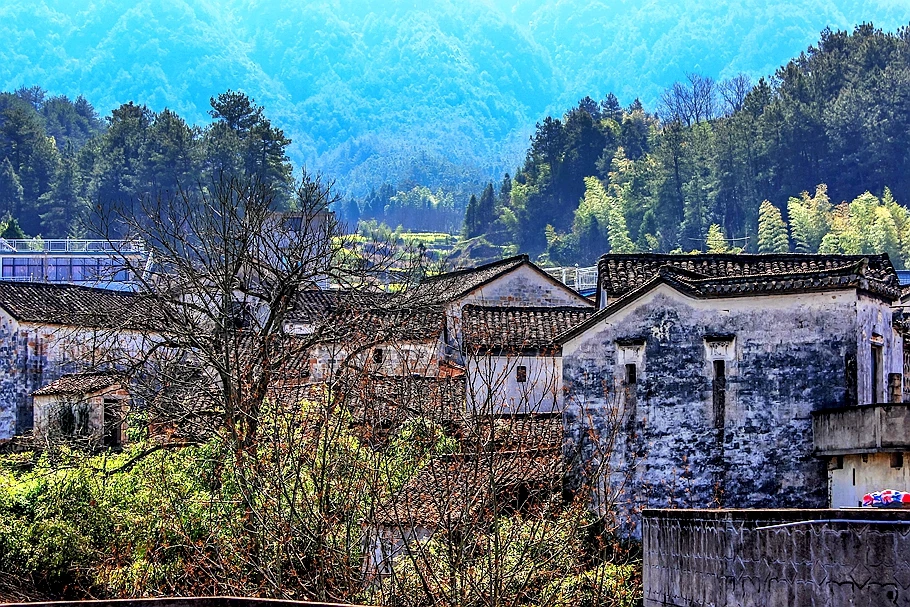
Shang Village in the Deep Mountains, with its Mottled White Walls and Black Tiles, Time Seems to Have Lingered in a Distant Era
The trip to Shang Village was not originally in the itinerary. While chatting with villagers in Kantou Village, I learned that there would be a traditional folk performance in Shang Village the next day. So, after breakfast the next day, I drove to Shang Village. However, when I arrived, there was nothing to see—the performance had been rescheduled. I took a stroll around Shang Village and still gained a lot. Follow my lens to see a rare thousand-year-old ancient village in old Huizhou with multiple surnames—Shang Village.
Arriving at the entrance of Shang Village, I saw large fields of colorful rapeseed flowers, exceptionally beautiful. This beautiful village, located northeast of Jiaping Township in Jixi County, is surrounded by towering mountains, with picturesque scenery and a tranquil environment—a typical paradise. Coming to Shang Village is not just for enjoying the flowers; it feels like stepping into a village in a painting. Let’s take a look!
Shang Village is a thousand-year-old village built along the mountain, surrounded by dense forests, hugged by five small hills, known as "Five Dragons Playing with a Pearl."
Here, there are layered mountain ridges and cloud-swept peaks, terraced fields of flower seas, small bridges and flowing water, as well as quaint Huizhou ancient villages and numerous ancient buildings and relics.
This ancient village called Shang Village once had a very elegant name in ancient times, "Yanwa Village" (Ink Slab Village). It means every household had an ink slab and a brush, reflecting the flourishing literary culture. Although Shang Village has not produced very prominent famous figures, it places great emphasis on the普及 of cultural education, which is said to be largely influenced by the migration of outsiders.
The formation of Shang Village can be traced back about a thousand years. During the late Tang Dynasty, due to wars in the Central Plains, various aristocratic families moved into southern Anhui’s Huizhou region. Because Shang Village is located in a remote area, connected to the outside only by streams and narrow paths, and with rugged peaks and steep cliffs behind the village, it was defensible and had enchanting scenery like a secret land—a typical paradise. Some families with different surnames chose this place and gradually moved in, forming a rare thousand-year-old village with multiple surnames in southern Anhui.
Shang Village has 10 surnames and 9 ancestral halls, mostly well-preserved. The village customs are simple; although there are many surnames, the entire village is like a big family of mixed surnames.
In ancient times, at the southern road entrance of Shang Village, there was a "Dismounting Pit" (Xiamakeng). Anyone coming to Shang Village—civil officials had to get out of their sedan chairs, and military officers had to dismount from their horses—walking from the Prince’s Temple into the village to show respect for Shang Village. This shows that this village held an extraordinary social status in ancient times.
Located deep in the mountains, Shang Village has many mountains but little farmland, making it difficult to be self-sufficient in grain. To save a portion of food for the family, over the years, villagers mostly arranged two paths for their children: one was to study and go out to "eat official meals"; the other was to apprentice in a craft from a young age, becoming skilled artisans who "eat by their craft." The village had many craftsmen, famous in old Huizhou.
Many craftsmen traveled from village to village, earning meager wages with their exquisite skills and exchanging their work for three meals a day. Calculating, a craftsman could save quite a bit of grain for the family in a year. Even today, the village still maintains over thirty types of craftsmen, such as coppersmiths, carpenters, and barrel hoopers. Many of these craftsmen still travel between villages, passing on the craftsmanship of old Huizhou and providing convenient and fast services to the villagers.
The village is built along the mountain terrain, with houses staggered at different elevations. The ancient residential buildings are well-preserved, and the lanes and alleys within the village crisscross like a maze.
The village is built along the mountain terrain, with houses staggered at different elevations. The ancient residential buildings are well-preserved, and the lanes and alleys within the village crisscross like a maze. Outside the village, rapeseed flowers are planted everywhere, turning it into a garden. Traditional crafts such as bamboo, wood, and palm weaving are displayed in the village. In recent years, it has gradually become a top choice for photographers and photography enthusiasts from home and abroad.
Nowadays, most of the people living in the village are the elderly and children. Young people work outside for years on end, making the village somewhat less lively. Occasionally, I encountered elderly people chatting leisurely, sitting on stone steps in front of their doors, looking quite content.
When visiting Shang Village, you must not miss the unique Craftsman Street. Dozens of traditional handicraft workshops still tell the ancient history of Shang Village.
Crumbling walls and broken tiles record the vicissitudes of history.
The whole village seemed to have few people in sight.
A small shop in the ancient village.
The pastoral scenery of Shang Village truly looks like a painting!
Dashuikeng (Water Fetching Pit), originally called "Houmentou Danshuikeng" (Back Door Water Carrying Pit), has been the drinking water source for most households in Shang Village for thousands of years. Located in the northeast of the village, the stream here flows gently year-round. The ancestors of Shang Village used the natural water source to carve pits into the rocks, creating an inner well, an outer well, and a lower well, and established rules for each: The inner well was for scooping drinking water only before 8 a.m.; after 8 a.m., it could be used for washing tea utensils and other non-polluting items. The outer well was for washing vegetables and clothes. The lower well was for washing chamber pots and farm tools. Everything was orderly and well-organized—truly a well-ordered system!
The change from "carrying" (dan) to "fetching" (da) originated in the Wanli era of the Ming Dynasty. One summer, there was a prolonged drought without rain. Although Danshuikeng did not dry up, it no longer overflowed. One day, the village head at the time timely defused an imminent water-grabbing conflict. To promote harmony in the village, he blurted out, "Today, carrying water was nearly a fight; this pit should be called Dashuikeng." From then on, the name "Dashuikeng" with its警示 meaning came into use.
The folk customs here are very simple. Walking into a farmyard, a warm-hearted grandma greeted me with a smile and took the initiative to lead me to her rooftop to take a panoramic view of the ancient village.
The old stove—does it make you miss crispy rice?
Standing on the rooftop, looking into the distance, the mottled white walls and black tiles, the deep courtyards with high walls, seem to still be telling the stories of the past...


