Lingering Tea Aroma on the Lips, Art in Every Breath: Could This Outskirts Museum Become the Next Instagram-Worthy Spot?
[Preface]: A Dialogue with Museums. If scenic spots interpret the relationship between humans and nature, then museums build a bridge between people and their inner selves. On my travels, I love visiting all kinds of museums. Public museums unfold a nation's history and heritage before visitors like a two-dimensional scroll, majestic and awe-inspiring. Private museums, on the other hand, reveal the collector's inner world and artistic philosophy to kindred spirits, like an intimate conversation over tea with old friends.
Hidden Gem Nearby: Tai Hui Life Cultural Park. The pandemic has made faraway poetry and distant places seem remote, but it has also brought nearby scenery into sharper focus. Without leaving Shanghai, this weekend I discovered this hidden private museum on the city's outskirts—Tai Hui Life Cultural Park—which offered me two days of leisurely bliss and an unforgettable artistic journey. Tai Hui Life Cultural Park is located in Nanhui, Pudong, just 3 kilometers from Shanghai Wild Animal Park and about a dozen kilometers from Shanghai Disney. It may look unremarkable from the outside, but inside it is a national 4A-level scenic area and one of the largest private museums in Shanghai. The contrast between the hustle outside and the tranquility inside is striking.
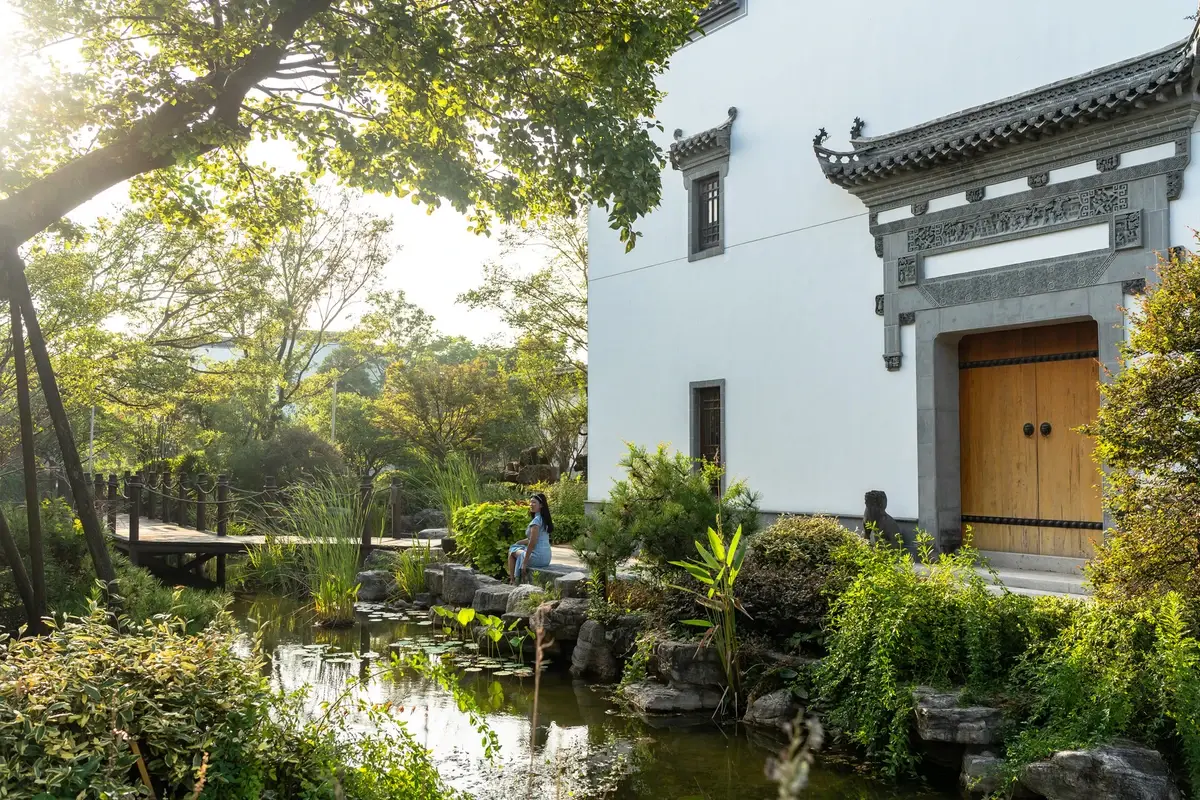
Once you pass through the plaque inscribed by Mr. Yu Qiuyu, the urban clamor of "Magic City" Shanghai is shut out. The entire cultural park was transformed from a former factory, yet it features artificial hills, waterfalls, winding streams, and scenic spots everywhere, evoking the meandering paths of a Jiangnan garden. Beyond the winding paths, there are even more surprises. In the four corners of the former factory, eight authentic old houses were relocated intact from places like Anhui and Jiangxi. They bring the essence of traditional culture across thousands of miles and through the ages. The classic structures of Huizhou architecture blend seamlessly with the modern factory buildings, complementing each other. They bring the essence of Chinese traditional culture and the ancients' restrained elegance and natural tranquility to modern audiences in just the right measure. No wonder it is hailed as a classic example of factory transformation.
[The Vast World in a Mustard Seed, the Universe Hidden in Vajra]. The heart of Tai Hui Life Cultural Park is the Jingang (Vajra) Museum. "Vajra" is a Buddhist term; in Mahayana scriptures, it refers to something indestructible and irreplaceable. This wonderful blessing is aptly bestowed upon a museum that houses the world's treasures. The vast space, transformed from a factory and covering over 20,000 square meters, has shed its industrial assembly-line style through the designer's deft touch and is now filled with Chinese architectural elements and artistic imagination. As you step inside, you completely forget its past and feel as if you've entered an oversized traditional courtyard-style building. It houses over 40,000 rare artworks, including antiques, calligraphy and paintings, sculptures, contemporary art, stone carvings, ancient architecture, and more. They are categorized into ten exhibition halls: the Tea Museum, Oil Painting Hall, Shanghai School Painting Hall, Watercolor Hall, Glass Art Museum, Sculpture Hall, Crystal Hall, Ancient Stone Carving Hall, Jade Hall, and Temporary Exhibition Hall. The museum regularly hosts theme exhibitions, master exhibitions, and special exhibitions. You can wander through the long artistic corridors of the painting world and engage in dialogue with Feng Zikai's masterpieces; in the time tunnel of the Tea Museum, savor the soul-infused fragrance of legendary teas; and in the Crystal and Jade Halls, marvel at the wonders of nature and the exquisite craftsmanship. In the Huizhou-style old buildings, opening a cellar of aged Pu'er tea reveals the swirling, dancing tea spirits, which in the hands of the "tea fairy" release their deeply captivating natural aroma.
Entering the museum, aside from a huge screen covering an entire wall that transports you to tea gardens and mountains, a jade landscape stone beside the lobby catches the eye. Watch how a naturally formed stone, through the hands and heart of a master artist, uses the varying layers of color, grain, and texture to present the essence of nature on the jade surface. Even before entering the exhibition halls, you are awestruck by this masterpiece, making you even more eager to see the collections inside. Each treasure is invaluable. To allow close viewing, many exhibits are not enclosed in glass cases, so visitors must be especially respectful and careful.
[Shanghai School Painting Hall: The Universe in the Masters' Brushstrokes, Do You Know?] Among China's myriad arts, painting is foremost. For traditional literati, regardless of their specialties, Chinese painting and calligraphy were essential skills. The "Shanghai School," rooted in old Shanghai, is a typical representative of the fusion and development of traditional Chinese painting with Western techniques in the modern era. A museum in Shanghai naturally boasts an outstanding collection in this area. The Shanghai School Painting Hall exhibits representative works from various periods, from the late Qing Dynasty to contemporary times, fully displaying the style that inherits Tang and Song Dynasty techniques while extensively drawing on the strengths of folk and Western art.
Upon entering, I was immediately drawn to Feng Zikai's "Amitabha." A heavyweight figure indispensable to 20th-century Chinese art, his knowledge spanned almost all artistic fields—painter, calligrapher, writer, essayist, translator, and theorist of art and music education. The master's achievements are breathtaking. Most of Feng Zikai's surviving works are small in size, so this unusually large painting with auspicious symbolism—its value is hard to estimate, a question for collectors to ponder.
Feng Zikai once studied under Li Shutong (Master Hong Yi), the most extraordinary artist of modern times. This legendary figure of vast learning reached heights in multiple artistic fields that later generations find hard to match. Reading about his legendary life always fills me with wonder at the miracles of creation. Ordinary people struggle to grasp even one path, yet this exceptional person not only excelled in numerous fields but also attained profound Zen insight, leaving us only to look up in admiration. In the museum, I also saw an image of Master Hong Yi—serene and peaceful, soothing the heart.
A set of six hanging scrolls titled "Gongbi Figures" by Master Huang Shanshou was equally captivating. The ladies and figures are elegantly refined, with a pure and graceful aura that leaps off the paper. Shasha is grateful to have studied Chinese painting a few years ago; though I only scratched the surface, I can appreciate the master's brilliance.
As a local Shanghai painting school, the Shanghai School, like the city itself, is both all-embracing and keeps pace with the times. The museum's collection of modern Shanghai School paintings also reflects this fusion and evolution. Masterpieces like Han Tianheng's "Lotus Pond" and Shi Dawei's "Folk Customs" make you stop and marvel at the vast and wonderful world of painting. Between the brushstrokes, it's as if lively spirits capture the world's splendor and the universe of the mind, all recorded on paper and passed down to future generations.
[Tea Museum: Soul-Stirring Aroma of Legendary Tea] Tea lovers must not miss the Mingyue Tea Museum. Throughout history, literati and artists have all cherished tea. The story of this leaf has been written for thousands of years. From nature's essence to the craft of tea makers and the skill of tea masters... as the warm tea liquor flows down your throat, you can almost hear the rhythm and breath of life. Shasha is also a tea enthusiast and enjoys tea daily, but the Mingyue Tea Museum still opened my eyes wide. You may distinguish the characteristics of black, green, oolong, white, dark, and scented teas, but do you know how tea culture has evolved over a thousand years? What are the features of tea wares from different dynasties? What are the origins and development of modern tea schools? The museum holds all the answers. The Mingyue Tea Museum is likely the most comprehensive and richly-stocked tea museum in Shanghai. Starting with the historical progression of tea-making tools, its complete collection vividly presents Chinese tea culture: its germination in the Qin and Han, its processing techniques in the Tang and Song, the innovations of the Ming Dynasty, the ethnic fusion of the Qing Dynasty, and its inclusive development into modern times. It's truly mind-opening.
Do you know how this excavated Tang Dynasty tea cake differs from modern ones? The portable tea sets of the Qing Dynasty blend the ethnic traits of Han, Manchu, and Mongolian cultures—can you tell which parts are Han, Manchu, or Mongolian? Of course, there is a dazzling array of ceramic tea wares, from blue-and-white to purple clay, from Jian ware to Jun kiln. Shasha specially wore this qipao—doesn't it match well with this blue-and-white porcelain? Remarkably, the museum also houses numerous iron and silver kettles from China and Japan, with representative works from various schools. This area was a knowledge gap for Shasha, a feast for both eyes and mind.
Beyond tea wares, the tea collection is the museum's true pride. The Mingyue Tea Museum holds over 50 tons of tea. The "tea fairy" has traversed more than a hundred ancient tea mountains in Yunnan that remain untamed by human hands. In collaboration with professional institutions like the China International Tea Culture Research Association, the Tea Industry Development Research Center of the Chinese Academy of Social Sciences, and the Tea Science Department of Zhejiang University, they have collected samples of ancient tree tea from a hundred tea mountains in Yunnan to build this astonishing ancient tea gene bank. Standing before countless samples, you understand: tea is a gift of nature, but even more so the crystallization of human effort. From selecting sites and picking tea to processing, finishing, and tea etiquette... this culture, beyond the tea itself, has permeated our very blood through millennia of heritage.
After learning about the veins of this leaf in the tea museum, do you crave a pot? Hold on; after the exhibition, I'll treat you to some fine tea.
[Crystal Hall: Crystal Clear, Exquisite Heart] What is a crystal collectible? Is it merely silica crystals, a chemical name? Nature's transparency and clarity, the delicate heart of mineral deposition—combined with the artistry and thought of master craftsmen—make a truly unique crystal collectible. As the Qing Dynasty poet Hong Sheng wrote in "The Palace of Eternal Life": "The cool moon rises over the high pavilion, as the curtain lifts, the breeze reflects the crystal."
The Crystal Hall, next to the Tea Museum, fulfills your fantasies of crystal treasures. Here, you'll find flawless pure crystals, some snow-white and translucent, others blushing with pink, complemented by divine carving skills. It's easy to see why people throughout history have cherished crystals so deeply.
Compared to transparent ice-clear crystals, I prefer those with natural mineral inclusions, like rutilated quartz or green phantom quartz. Each tiny inclusion seems like nature's playful trick: wispy threads, dancing flames, or metallic flecks, giving the crystal a vivid life and ever-changing beauty that fires the imagination. Most of the crystal carvings here feature Buddha images. The spirituality of crystal and the serene aura of Buddhism resonate, inspiring reverence and an unwillingness to disturb.
[Jade Hall: Natural Beauty Awaits Exquisite Craftsmanship] Fine garments woven with jade, golden bridles jingling. Precious horses' hooves light and steady, fragrant dust rises in clouds. Jadeite jewelry has a relatively short history in ancient China, but its red and green hues, with pink tones, perfectly symbolize the joy and auspiciousness of traditional culture. This hard jade from Myanmar has become a gem cherished by countless people in modern times. Shasha once lived for a long time in Heshun Ancient Town in Tengchong, western Yunnan. For centuries, caravans traveled the jade road from the deep mountains of northern Myanmar to the mansions of royalty and nobles, and from there westward, spreading the fame of jade worldwide. Among these stones, stories abound.
Jade's value lies in its texture: from glassy to icy to glutinous, nature's variety compressed into a small space reveals distinct grades. Its beauty lies in color: imperial green is breathtaking, but the infinite variations between green and pink are even more marvelous. Its soul lies in carving: only a master artist who understands the hardness, softness, and color transitions can, with a soul-infused carving knife, transform a rough stone into a masterpiece with artistic spirituality. The Jade Hall at Tai Hui Life gathers classic works by today's most influential jade carving masters. The exquisite shapes and natural color transitions leave you in awe. It's no wonder some describe it as "the highest level of contemporary jade carving art."
[Sculpture Hall: The Art Power that Touches the Soul Directly] If the Crystal Hall and Jade Hall showcase artists' achievements built upon nature's shoulders, the Sculpture Hall purely presents masterpieces born from the artists' inner creativity. It gathers over 80 outstanding works by three generations of Chinese sculptors—young, middle-aged, and senior. From the epoch-making grandeur of early leaders to detailed depictions of social reality and soaring abstract imaginations, a leisurely visit unfolds the developmental history of modern Chinese sculpture. Standing before each sculpture, you're not just looking at the object; you are engaged in a dialogue with the creator across time and space. You may not fully grasp the artist's intent, or you might have a sudden realization, but isn't this process itself a journey of artistic self-cultivation?
[Watercolor Hall: Within a Small Space, a Camera Capturing Art through the Brush] Perhaps no painting form is closer to ordinary learners than watercolor. Many people's childhood art class memories are sketches and watercolors. When I first saw the Watercolor Hall, I was a bit surprised, as watercolor paintings are usually fresh, bright, small-scale landscapes and rarely massive, famous works. But after visiting, I realized that master watercolors can possess such flexible and realistic charm. Each watercolor sketch, though small in size, vividly restores precious historical moments and recreates specific scenes from a time tunnel. You can find the old Bund, ancient water towns, the joy of harvest, or the passion of mass production... Through variations in color and shade, the painter freezes fleeting moments within a tiny frame. Unlike the stark realism of historical photos, these subtly shaded images blend the real and the imagined, offering more room for imagination and a sense of vitality that moves you deeply.
[Oil Painting Hall: The Artistic Charm Transformed from Great Men's Poetry] Compared to the delicacy of the Watercolor Hall, the Oil Painting Hall overwhelms you with a different kind of force. Majestic yet detailed, it leaves a lasting impression. During our visit, the theme exhibition was "The East Is Red: Mao Zedong’s Poetic Paintings Collection Exhibition." Huge oil paintings vividly recreate the magnificent revolutionary history led by the great man. What's especially interesting is that each masterpiece corresponds to one of Chairman Mao’s poems. How many do you recognize? This grand painting of a battle must be the Yangtze River Crossing Campaign, likely inspired by "The People's Liberation Army Captures Nanjing": "With power still to spare we pursue the fleeing foe, not like the vainglorious overlord." That painting of ancient emperors must be from "Regretfully, the Qin Emperor and Han Wu lacked literary talent; Tang Zong and Song Zu slightly lacked romance. Genghis Khan, the proud son of heaven, only knew how to bend his bow and shoot eagles." Can you identify the others? I suggest preparing a complete anthology of the poems beforehand. Matching poem to painting is quite an amusing challenge.
[Tea Tasting: The Dancing Spirits in the Tea Fairy’s Hands] "A leaf falls into water, changing its flavor, and thus tea was born." After visiting one hall after another, you inevitably become thirsty. Especially after seeing the Tea Museum with its vast tea cellars and gene bank from a hundred tea mountains, let's move to the museum's tea room to appreciate how these lively leaves turn into intoxicating tea fragrance in the hands of the legendary tea fairy. Throughout the museum, tea elements appear everywhere. This magical leaf seems to be the soul of the place. From selecting tea mountains at the source, to the classic tea-making skills of intangible cultural heritage inheritors, to the professional brewing by tea masters, every sip of tea here is meticulously sourced and prepared. Under the afternoon sun, in the central courtyard tea room, we savored this "tea with an identity card."
"Waking Up" is the tea's identity marker, sealed in silver to block moisture and odors. Opening this 2014 ancient tree Pu'er, six years of aging unfold. Waking Up tea follows the ancient method of slow, manual fermentation. From picking spring tea to drying and fermenting, it takes a long year—far from the quick modern fermentation taste. Thus, these leaves contain the flavor of sunlight from seven years ago.
Good tea requires proper brewing, and this final step is full of nuances. Different teas require different water temperatures and brewing sequences. When dried leaves meet water again, they must release their deeply hidden aromatic elements fully. What impressed me was that because they trust the source and production process, Waking Up tea can be brewed without the usual "rinsing" step. This surprised me, given my modest tea knowledge. After watching the tea fairy's motions, I couldn't resist trying my hand at this elegant art. The movements are easy to imitate, but understanding the tea's nature is a whole different story.
As boiling water enters the pot, the curled leaves leap like reborn spirits, infusing nature's fragrant essence into the water and into the air—a scent so pure it makes you forget worldly concerns. A sip of the amber tea liquor sends warmth down your throat, and the fragrance seems to seep into every pore. Troubles melt away, and in my ears I almost hear Zen music and Buddhist chants.
[Huizhou-Style Ancient Buildings, Hidden Universes Within] Along a winding wooden path, I set out to explore those Huizhou-style old buildings I spotted during the aerial filming. Let's see what historical stories lie between the white walls and grey tiles. Still water flows past the late-summer lotus pond, under a small bridge, embracing the revitalized old houses. Unlike the treasures displayed inside, isn't the building itself the most precious collectible? Inside the old houses, the wooden beams and pillars, though restored, still retain their original appearance. The former courtyards have been transformed into eco-friendly glass ceilings, making the space comfortable and bright without being gloomy. The interior retains a classical charm yet reveals modern design aesthetics everywhere. Sipping tea and nourishing the soul in such an old courtyard, conversing with time, surely brings a deeper sense of transcendence, doesn't it?
[Stay at Tai: A Reclusive Retreat in the Art World] Behind the museum stands the adjacent Tai Hotel. For those coming from afar or wishing to linger a few more days, it is the perfect choice. Conveniently close to both Shanghai Wild Animal Park and Shanghai Disney, linking the museum with these two attractions makes for a nice two- or three-day itinerary. The hotel's style seamlessly matches the museum's, both offering a contemporary Chinese aesthetic that makes you forget the mundane. Choose a room name rich in antique charm, enveloped in traditional Chinese culture, and fall peacefully asleep, temporarily setting aside the city's troubles. Give both your body and spirit a thorough relaxation.
[Dine at Tai: A Taste of Pristine Nature on the Tongue] Dinner was served within the park. For a weekend countryside escape, this is exactly the kind of authentic, natural flavor we needed. No need for lavish feasts; seasonal ingredients and fresh local produce, with down-to-earth cooking, are enough to comfort both stomach and soul for those seeking relaxation.
[Mingyue Tea Aroma, Takeaway Life] If you're still longing for the tea fragrance, the museum's creative gift shop sells various gift boxes, along with exquisite tea sets—a great way to bring that unforgettable aroma home. If you're interested in the tea fairy's classical attire, you can also find it here.
[More Tips]
1. Ticket prices: Admission to the Jingang Museum is 100 RMB per person. Discounts are available on OTA platforms; you can book online in advance. Besides museum visits, there are occasional study tours and meditation activities; interested visitors are advised to follow the official website.
2. Free admission policy:
a. Children aged 6 or under (or height 1.2m or under) are free.
b. Seniors aged 70 or above (with original ID) are free.
c. Retired cadres (with retirement certificate) are free.
d. Disabled visitors (with disability certificate) are free.
3. Opening hours: 9:30-17:30 (Tuesday to Sunday)
4. Recommended visit duration: Combine the museum trip with Shanghai Wild Animal Park. Especially for families, allow 1.5 to 2 days for the museum alone.
5. Transportation: Self-driving is recommended. By public transport, take Metro Line 16 to Wild Animal Park Station, then take a taxi.
As the tea fragrance fades, I realize that what I've awakened to is the easygoing attitude of being truly at ease in the midst of the city. When the fast pace of urban life forces us to let go of many things, it also burdens us with more. Perhaps by focusing on our inner selves and treating ourselves kindly, those who know how to live are rewarded with the most comfortable life.


