Tour of Four Countries: England, France, Switzerland, Italy Part 6: Italy – Florence
Tour of Four Countries: England, France, Switzerland, Italy Part 6: Italy – Florence
September 15 Sunny, today's itinerary is to visit Florence city center in the morning, go shopping at The Mall in the afternoon, then head to Rome, staying overnight in Rome.
Florence is a world-famous art capital, a cultural center of Europe, the birthplace of the European Renaissance, and a renowned cultural tourism destination. Florence is located in the Tuscany region of Italy and was once the capital of Italy. The Italian name Firenze literally translates to "City of Flowers," hence Florence is also known as the "Flower City."
The entire city sits in the middle of the Apennine Mountains, in the Arno River valley, surrounded by hills. During the 15th–16th centuries, Florence was the most famous art center in Europe, renowned throughout the continent for its art crafts and textiles. The most glorious period of this historic city was the Renaissance. It gave rise to artistic masters such as Leonardo da Vinci, Dante, Galileo, Raphael, Michelangelo, Donatello, Giotto, Titian, Boccaccio, and others, leaving a brilliant chapter in the history of art.
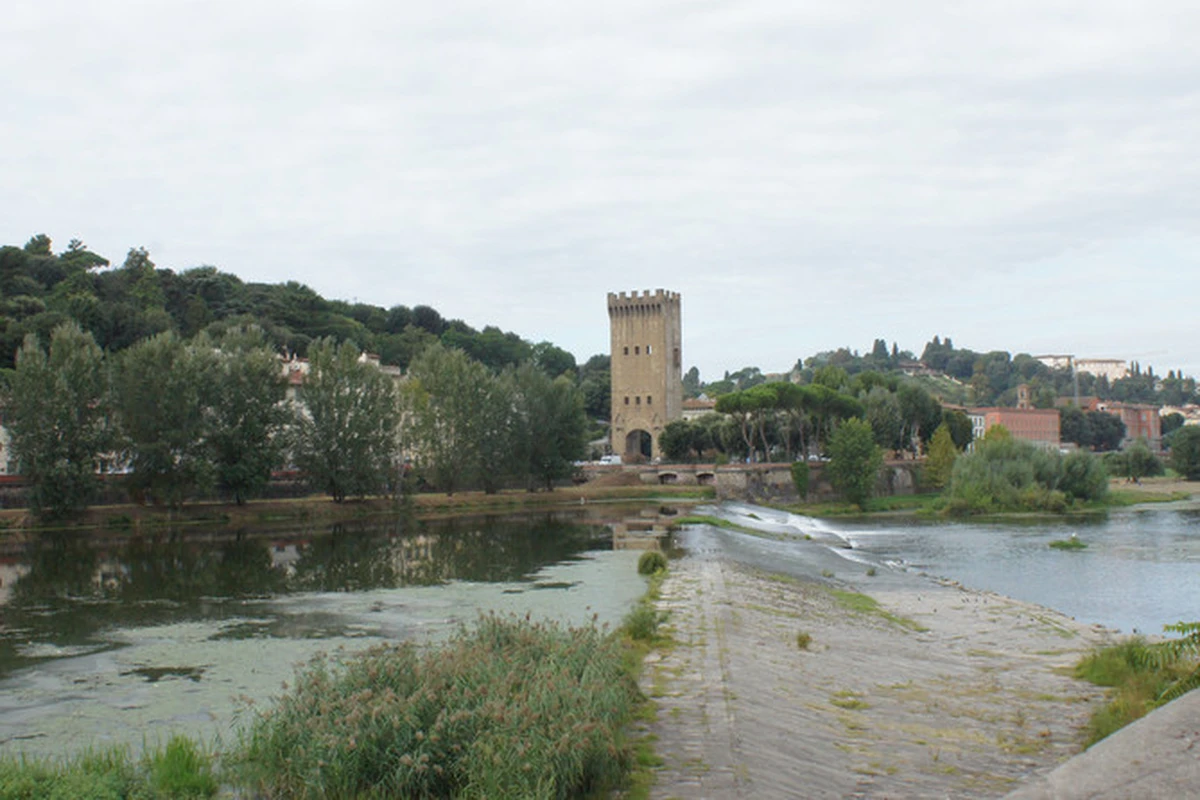
The Arno River is the mother river of Florence, much like the Huangpu River in Shanghai, the Haihe River in Tianjin, and the Pearl River in Guangzhou.
We walked to the north bank of the Arno River and entered Piazza Santa Croce.
The Basilica of Santa Croce is a Gothic-style church designed and built in 1294, but construction was only initially completed and opened in 1443, taking 149 years. The church is famous for its tombs, containing monuments and tombs of many important figures, such as Dante, Michelangelo, Galileo, Machiavelli, Rossini, and others. The square in front of the church is large and rectangular. At the east end of the square, in front of the church, stands a statue of Dante.
We walked through the streets and alleys of Florence, seeing few locals aside from tourists, yet the narrow streets were packed with small cars.
Dante statue beside the church
Taking a photo in Piazza Santa Croce
We then walked to Piazza della Signoria. The Palazzo Vecchio, also known as the Signoria Palace, was originally the residence of the rulers of the Republic of Florence, built in the early 14th century, and now serves as Florence's town hall.
The most distinctive feature of the Palazzo Vecchio is its rectangular tower above, which stands 94 meters high. The walls of the palace are weathered in some places, looking somewhat dilapidated; they do not repair it, probably to show its long history. The square north of the palace is called Piazza della Signoria. The square and its south side feature an open-air sculpture museum, displaying many magnificent sculptures, each a priceless artistic treasure. Among them are nine important sculptures, all works of famous Italian Renaissance sculptors such as Michelangelo, Bandinelli, Cellini, Ammannati, and Giambologna.
After the tour, I checked online and found the names of the nine important sculptures: "David," "Hercules and Cacus," "Perseus with the Head of Medusa," "Neptune Fountain," "The Rape of the Sabine Women," "Hercules and Nessus," "Equestrian Statue of Cosimo I," "Marzocco (Medici lion)," and "Menelaus Supporting the Body of Patroclus."
These priceless treasures have been displayed outdoors for centuries, free for anyone to view, which is truly hard to believe. In China, they would likely charge a hefty admission fee.
Streets barely wide enough for one car, and sidewalks only for one person.
Equestrian statue of Cosimo I
Town hall tower
Statue of Hercules and Cacus
Equestrian statue of Cosimo I
Neptune Fountain statue
David statue
Back view of David and Hercules and Cacus
Our guide said that every time she brings a group, the town hall tower is always under renovation.
Taking a photo by the Arno River
Florence's seat of power, the town hall, its most obvious landmark is a fortress-like tower building. Above the rectangular building is a small tower, and a large clock hangs on the wall.
There is a free drinking fountain in front of the town hall.
Loggia dei Lanzi contains many statues.
In front of the Dante statue
Viewing the tower through the courtyard inside the town hall
Florence's city emblem – a lion statue. In the eyes of Florentines, the lion is a symbol of majesty, the guardian deity of Florence, protecting its peace, freedom, and prosperity, so lion statues can be seen everywhere in Florence.
Photo in front of a statue inside the town hall, I forgot the name of the statue.
Florence's alleys look very old and dilapidated, yet they carry historical glory and sediment.
We took photos in front of the statues in the square.
Passing by a street florist shop; Florence is known as the Flower City.
Heading to Dante's house.
Looking at Florence's shutters brings back memories; there used to be many old houses in Shanghai with such shutters, but they have all been demolished. Society advances, cities change. Should historical old buildings be preserved or demolished? Clearly, Europeans and we have completely different views.
There is a Dante profile on the ground in front of Dante's house.
A must-buy in Florence is leather goods. Handmade leather shops can be seen everywhere, with finely crafted leather shoes and belts. Passing by a small leather shop filled with bags and wallets, an Asian person was intently making a belt.
From Piazza Santa Croce we walked to the Cathedral of Santa Maria del Fiore, again through the streets and alleys of Florence, passing by buildings with history.
The Cathedral of Santa Maria del Fiore is the fourth largest Catholic church in the world and the cathedral of the Archdiocese of Florence. This 106-meter-high Gothic building is famous for its external decoration with green, white, and red marble, the colors of the Italian flag. The church complex consists of the cathedral, the bell tower, and the baptistery. These three buildings form an integral whole, appearing particularly grand and majestic. In 1982, it was inscribed as part of the Historic Centre of Florence on the UNESCO World Heritage List.
The cathedral's foundation was laid in 1296, and the construction encountered many twists and turns. Later, an octagonal dome with a diameter of 43 meters and a height of 52 meters was built, and the cathedral was finally completed in 1436.
Another feature of the church is the geometric patterns made of green, white, and red marble, which are extremely striking, spectacular, and rare. It must have been very difficult to find three colors of marble raw materials back then, let alone cut them into geometric shapes. The arches of the cathedral also feature exquisite glass mosaic paintings. From inside the church, one can climb to the tower-like structure above the dome to overlook the church and its surroundings.
Florence is rich in leather, and it's being promoted to Chinese tourists.
These pine trees are trimmed into mushroom-like shapes, known as Mediterranean pines.
We drove to Piazzale Michelangelo on the south bank of the Arno River. Piazzale Michelangelo was built in 1868. Originally, the center of the square displayed Michelangelo's marble statue "David." In the last century, the Florence city government moved the statue to the Accademia di Belle Arti di Firenze for protection, and a bronze replica of David was erected in the square.
The square is located at a higher altitude, offering a panoramic view of the old city of Florence, making it the best vantage point to see the entire city.
Looking from the square toward the city of Florence, the nearby Arno River is lined with greenery, while the distant city is dominated by brick red and earthy yellow tones, with red roofs and earthy yellow spires faintly visible. The most conspicuous is the Cathedral of Santa Maria del Fiore, clearly visible in its entirety. The towering Giotto's Bell Tower and the red-tiled large dome are the most prominent buildings in the old city.
The panoramic view of Florence feels ancient and elegant, exuding an artistic atmosphere.
The entire city of Florence is laid out before us.
On the right side of the photo, the octagonal red dome is the Cathedral of Santa Maria del Fiore; on the left is Giotto's Bell Tower.
The David statue in Piazzale Michelangelo is made of bronze, but it's a replica.
At noon, we finished our tour of Florence and drove to The Mall, located in the southern suburbs of Florence, a distance of 20 kilometers and a drive time of half an hour.
The Mall is the second largest outlet in Europe, a famous large luxury outlet center gathering a variety of top luxury brands, including men's and women's clothing, shoes, handbags and wallets, accessories, perfumes, jewelry, etc.
The Mall is built on the slopes on both sides of the road, with a fashionable layout, unique architectural style, elegant environment, with snack bars, free restrooms, lawns, small bridges, and flowing water. It has flagship stores for Italian top-tier brands such as Prada, Gucci, Ferragamo, as well as brands like Burberry, Armani, Valentino, Montblanc, Dunhill, and many others. According to the guide, these brands sell at factory discount prices, much cheaper than at Galeries Lafayette in Paris or the Galleria Vittorio Emanuele II in Milan, and you can also get tax refunds.
Before coming, we had already heard from friends in Shanghai who had visited about the shopping scene here. We had the intention to spend, and some friends also asked us to buy luxury items for them. Since the shopping time was only three hours, we were afraid we wouldn't be able to complete the shopping list. Before the bus had even stopped, we couldn't contain our shopping excitement and hurried off. Looking at everyone shopping there, they all seemed to forget that one euro equals seven yuan. Buying luxury items seemed like getting them for free. As soon as we saw items on the list, we grabbed them and didn't let go...
When leaving Florence, the guide told us to arrange our own lunch and restroom breaks at The Mall. It wasn't until we finished the items on the list that we felt the urge to use the restroom and hunger pangs; by then it was already past 3 PM. Now I think those three hours at The Mall were the most intense part of this trip. Back on the bus, almost everyone had big bags and small bags; no one was empty-handed.
As we were about to leave Florence, the most beautiful city in Italy, I felt many emotions: Florence is a unique specimen left to us today from the great Renaissance era. The bell tower bathed in sunlight reflects in the Arno River, the magnificent cathedral radiates brilliant light, and the entire city still exudes the atmosphere of the Renaissance. The streets, the churches, the bell towers, the squares all retain the original flavor of the Renaissance. The weathered and dilapidated walls diffuse the ambiance of the Renaissance. It is worth remembering, lingering, feeling, and reminiscing.
After shopping at The Mall, we drove to Rome at 4 PM, covering 280 kilometers in about 3 hours, arriving in Rome in the evening, the last city of this tour.
Over the next two days (September 16–17), we will begin our tour of Rome. Please stay tuned for the final travelogue of this trip: "Tour of Four Countries Part 7: Italy (Rome)"