Africa Travel: Mauritius, the Pearl of the Indian Ocean (Part 2)
After visiting the Indian temple in Port Louis, the Seven Seas Holiday Africa tour proceeded to the third attraction: the Mauritius National Pamplemousses Botanical Garden. On January 5, 2025, at 9:40 a.m. local time, our group, led by tour leader Jiao Jian and guide Ye Zi, arrived by car. Also known as the Royal Botanical Garden of Mauritius, it is one of the oldest botanical gardens in the Southern Hemisphere.
Entrance to the National Botanical Garden (Photo by Feng Ganyong)
As we stepped inside, the first thing that caught our eye was a vast, immaculate lawn, gleaming like a soft green velvet carpet under the gentle sunlight. Scattered across the lawn were various tropical trees, their lush branches and leaves outstretched as if warmly greeting visitors.
Entering the Botanical Garden (Photo by Wang Jue)
Strolling along the sightseeing boardwalk, guide Ye Zi said, "Look how beautiful the scenery is here." Tall, flourishing palm trees lined the path, their dense foliage casting dappled shadows as sunlight filtered through. A highlight along the path is the grove of trees planted by heads of state from different countries, each marked at the base with a plaque recording the name of the planter and the date.
A corner of the commemorative planting area (Photo by Feng Ganyong)
Wandering through the national botanical garden, it felt as if every breath of air was infused with the fragrance and mystery of nature. This garden is not only a sanctuary for plants but also a vivid testament to the intertwining of Mauritius' history and nature.
Palm Avenue (Photo by Feng Ganyong)
As we roamed, the towering traveler's palms drew everyone's gaze, their long leaves resembling unfolding fans or arms reaching skyward, as if whispering ancient tales of this land.
A corner of the giant water lily pond (Photo by Wang Jue)
Following a winding path, we soon encountered the garden's famous giant water lily pond. The lilies here were introduced from China. Enormous leaves of the Victoria amazonica floated on the water like giant green platters with slightly curled edges, resembling a natural aquatic stage.
Huge water lily leaf (Photo by Feng Ganyong)
The Amazon water lily pond is a star attraction; the colossal leaves, up to two meters in diameter, rest serenely on the emerald water, with delicate blossoms and leaves sturdy enough to support the weight of a baby. Besides the lily pond, bamboo from China also thrives here, growing tall and robust.
Photo taken at the water lily pond (Photo by Jiao Jian)
Looking closely, the veins on the leaves were clearly visible, an exquisite design holding the secrets of life. It is said that with luck, one might see a small wooden board placed on a lily pad with a curious child sitting on it—a whimsical and delightful scene that evokes wonder at nature's marvels and human ingenuity.
Cycad in bloom (Photo by Feng Ganyong)
During our visit, we also witnessed a flowering cycad. In the rare plant section, there is the blood tree, whose branches ooze a bright red sap like blood, and the sausage tree, with fruits resembling sausages, used for medicine and brewing. The garden is also home to animals: giant tortoises from Seychelles, deer from Indonesia, and red-beaked birds from Madagascar.
Seychelles giant tortoise (Photo by Feng Ganyong)
Deep within the garden hides a tranquil palm grove. Tall, straight palms stand in neat rows like soldiers awaiting inspection. Sunlight pours through the layered leaves, creating patches of golden light, dreamlike and surreal.
Indonesian deer (Photo by Wang Jue)
As the breeze rustled the palm fronds, a gentle rustling symphony filled the air. Time seemed to slow down here, and with every breath we savored nature’s tenderness and serenity.
Scene of a small bridge in the garden (Photo by Feng Ganyong)
The garden also features a dedicated spice plant area. Upon entering, an array of rich aromas greets you. Lemongrass, mint, vanilla, and other plants emit distinctive fragrances that are integral to Mauritian cuisine and serve as unique sensory markers of the land. Gently touching these plants leaves a lingering perfume on your fingertips—a precious gift from nature.
A corner of the garden’s architecture (Photo by Feng Ganyong)
Beyond its botanical riches, the garden’s architecture is distinctive. Classical European styles blend harmoniously with tropical charm; white buildings appear particularly elegant against the lush green and vibrant blossoms. These structures provide rest areas for visitors and stand as repositories of history and culture.
SSR Monument (Photo by Feng Ganyong)
At the same time, this is a place to delve into history and culture. The garden contains the burial memorial of Sir Seewoosagur Ramgoolam, the SSR Monument, and a bust of French naturalist Pierre Poivre.
Statue in the garden (Photo by Wang Jue)
All in all, visiting the Mauritius National Pamplemousses Botanical Garden is a feast for the eyes and nose, and an enchanting journey of intimate dialogue with nature. Here, the boundary between humans and the natural world blurs, and every corner brims with vitality and hope. Leaving, our hearts were filled with nostalgia for this green realm, already anticipating a reunion and eager to uncover more stories hidden among the plants.
Fort Hill (Photo by Feng Ganyong)
At 11:10 a.m. Mauritius time that day, the Africa tour group arrived at the fourth stop: Fort Hill in Port Louis. Located in the city center, the hilltop fortress is called Fort Adelaide, built between 1834 and 1840. The fort was named after the wife of King William IV of England and was originally intended to quell resistance movements against slavery.
Photo taken at Fort Hill (Photo by Jiao Jian)
As the highest point in Port Louis, it offers panoramic views of the cityscape, the old racecourse, and even the distant sound of Muslim prayers. Abandoned for many years and reduced to ruins, the fort was renovated in the 1990s.
Entering Caudan Waterfront (Photo by Feng Ganyong)
The Africa tour group finally visited Caudan Waterfront in downtown Port Louis. Situated in the capital, Caudan Waterfront is one of the country’s earliest commercial centers, with a history stretching back to the 18th century.
A corner of the museum (Photo by Feng Ganyong)
Walking into the streets of the complex, you are greeted by an array of buildings with unique architectural styles that exude character. There is a museum here, but unfortunately it was closed that day, so we could not see inside. The area is a comprehensive destination for shopping, dining, and culture.
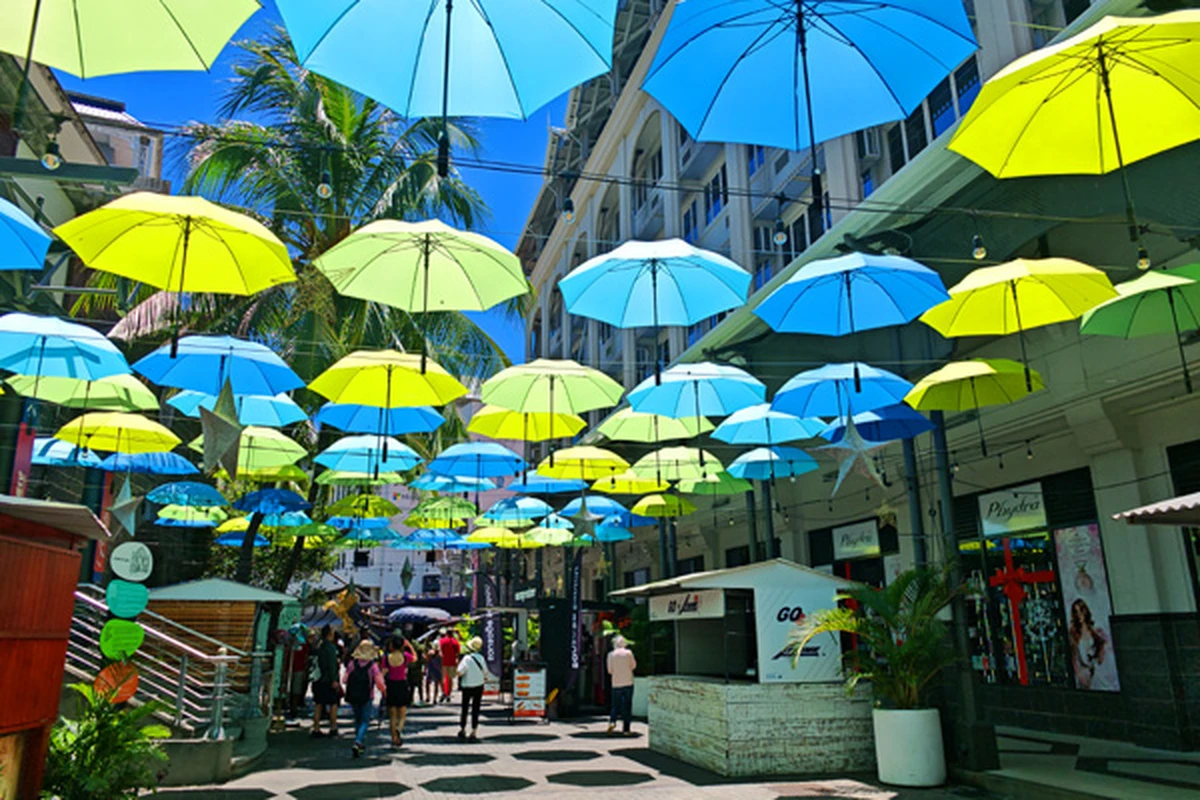
Photo taken on Umbrella Street (Photo by Jiao Jian)
Umbrella Street is the liveliest spot, home to over 120 boutiques and specialty stores offering fashion, water sports equipment, books and magazines, cosmetics, and diamond jewelry.
Street scene on Umbrella Street (Photo by Wang Jue)
The Caudan Arts Centre regularly hosts public art exhibitions. At the heart of the square, Umbrella Street is decorated with a canopy of colorful umbrellas, making it a famous attraction. Here you’ll find shops selling local specialties and handicrafts, numerous cosmetics stores, and a selection of mainly Western-style eateries and bar areas that buzz with activity.
A corner of Caudan Waterfront buildings (Photo by Feng Ganyong)
During my days in Mauritius, I, the reporter, seemed to forget the passing of time, immersing myself fully in the beauty of nature and the tranquility of life. Everything here brought relaxation and joy, offering new insights and appreciation for life, leaving my heart brimming with reluctance.
Photo by the sea at Caudan Waterfront (Photo by Jiao Jian)
As the Africa tour group wrapped up its visit to Mauritius, this beautiful island has already become a cherished memory in my heart. No matter how time flows, this travel experience will forever stay with me, inspiring me to explore more of the unknown world. (Text and photos: Feng Ganyong)


