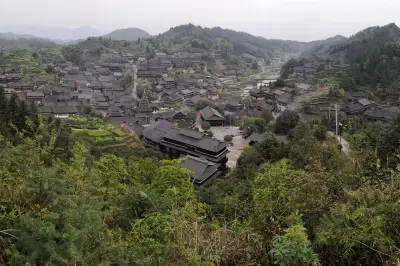
Earthly Paradise
As the solar year drew to a close, I pooled my remaining annual leave, filled out the company leave application, and once the boss signed off, I suddenly felt a different kind of lightness. After all, I had eight or nine days completely under my own control, with no need to rise early and work late. It felt as if the whole world belonged to me — pure excitement.
To make the most of such a break, I figured I should take a trip. Yes, at least that's what I thought. So I racked my brain for a destination and settled on Guangxi. I'd already been to Guilin, Yangshuo, Nanning, Detian, and Mingshi Tianyuan. Of the remaining options, Liuzhou came to mind first, then Goose Spring (Equan) in Jingxi. Considering the convenience and cost, I decided to connect everything by train, using stopovers in Nanning and Guilin as a chance to fill in gaps from earlier trips. This seemed more efficient, cheaper, and offered diverse sights — fitting my usual travel ethos.
2020-1-19
D1: Longtan
Liuzhou is an industrial city where two railway lines intersect, but as a travel destination, few would choose it deliberately. An old saying goes: 'Eat in Guangzhou, dress in Suzhou, play in Hangzhou, die in Liuzhou.' The first three make sense; the reason for dying in Liuzhou was supposedly the high quality of its coffins. In modern times, that's obsolete. But there's another twist: 'coffin' (棺材) sounds like 'official wealth' (官财), so it became a symbol of career advancement and prosperity. The Chinese imagination is truly fertile, turning something eerie into a hopeful wish — quite understandable. As for me, having visited Guilin and Yangshuo before and a bit of Nanning, I was drawn to the scenery and culture here while scanning the map, and so Liuzhou became my destination.
Upon arrival, I headed straight for Longtan Park.
Longtan Park is classic karst landscape. Besides the oddly shaped peaks, there are several emerald pools, especially Lei Tan (Thunder Pool), whose water is smooth as jade. In good sunlight, it would shimmer with many more shades, and the fish swimming in it are clearly visible. Any scenery with water's fluidity is beautiful, a natural bonsai landscape. Add the fact that Liu Zongyuan of the Tang Dynasty once prayed for rain here for Liuzhou, and it gains an extra layer of culture and history.
The hallmark of karst is peak forests and caves — caves within caves, linked by tunnels, hiding rivers inside. But I'm rather indifferent to limestone caves; they feel similar to me. After seeing one or two, I lost interest, so even though I knew there were caves in the park, I didn't bother exploring. I'd rather admire the clear, straightforward scenery under the open sky. Karst peaks demand imagination. Some shapes are obvious, others vary depending on angle or the viewer's perception. I just enjoy the quirky forms without needing to see a face here or an animal there. There's a spot called 'Beauty Looking at the Mirror' — I couldn't make it out at the time, only noticing it later when looking at my photos at home. So such interpretations aren't easy and differ from person to person.
Longtan Park is large, and it's free. The scenery is no less stunning than the famous Guilin landscape, at least not inferior to Guilin's downtown scenery, yet its fame is modest. On a Sunday afternoon, only a few locals strolled or exercised leisurely. There are also some artificial sights, mostly ethnic-style buildings: a Wind and Rain Bridge, Miao, Yao, and Dong villages. For city dwellers living in concrete forests, these are surely novel and fun. I loved the tranquility and leisure here, not lacking in charm or liveliness. If time allowed, I'd gladly spend a whole day here — I'm not joking!
D2: Liyu Peak, Ma'an Mountain, Liuhou Park, Liu River, Jiahe Mountain, etc.
On my second day in Liuzhou, a fine, steady rain fell. Crossing the street from my hotel, I entered Liyu Peak Park. The peak is named for its shape resembling a carp leaping out of the water. Beside it lies a small lake called Lingquan (Spirit Spring), facing a spring pavilion. Behind is an ancient temple, and behind that, a peak shaped like a horse saddle, taller than Liyu Peak. A cable car connects the two. That day, with mist swirling in the drizzle, looking up from below, it seemed like a route to a fairyland. By the spring is a reconstructed former residence of Liu Sanjie (Third Sister Liu) and a singing platform. Next to the lakeside pavilion stands a statue of Liu Sanjie riding a leaping carp up to the sky, becoming the Singing Fairy... Legends are always beautiful and add beauty to the scenery.
I had planned to climb Ma'an Mountain for a panoramic view of Liuzhou, but the rain persisted and fog thickened, so I gave up the idea and caught a bus to Liuhou Park. 'Liuhou' refers to Liu Zongyuan, the famous Tang Dynasty essayist and poet. I recall studying his works in middle school: 'The Donkey of Guizhou,' 'The Snake Catcher,' and of course the renowned poem: 'A thousand mountains, no bird; ten thousand paths, no trace. A lone boat, straw cloak and hat, an old man fishing in the cold river snow.' Much else has faded, but such a large park commemorating him shows he must have done many good deeds for the people during his tenure, earning their remembrance and praise — truly respectable, and not only for literary achievements. The same goes for Bai Juyi, Su Dongpo, and many other historical figures.
In the northwest corner of Liuhou Park, there's a miniature garden within a garden — Zhonghua Garden. Inside, rockeries, bonsai, winding bridges, pavilions, and terraces are exquisitely arranged, with a new view at every step. An artificial mist creates an ethereal, fairyland-like atmosphere.
Exiting from the park's south gate and heading further south along the street, you reach Wenchang Bridge over the Liujiang River. Standing on the bridge offers fantastic views of the river, the ancient city tower, Wenchang Pavilion, and the surrounding hills and water. I particularly loved the water — so clear and deep green. Even in the overcast drizzle, it was mesmerizing. I can imagine that on a sunny day, the radiant green would instantly lift your spirits.
Crossing Wenchang Bridge back to the south bank, a small hill appears on the left. At its foot is Jiahe Mountain Park. There's an academy named after the mountain, caves, paths up the hill, a pond, and a singing platform. Very few visitors. I walked around the pond, and from the opposite shore of the academy, the scene looked like a tranquil, beautiful paradise.
After lunch, I rested briefly at the hotel, then took a train to Nanning.
D3: Goose Spring (Equan) in Jingxi
Each time I visit Nanning, my main task seems to be transferring trains. This time was purely a pass-through. I stayed one night in a hotel near the railway station and set off for Jingxi the next morning. The sole purpose: Goose Spring (Equan). Of course, Jingxi has more to offer — the Jingxi Grand Canyon, Jiuzhou Ancient Town, and other karst spots like Dragon Pool. But public transport here isn't convenient; doing it all by bus and train, as I do, would be extremely difficult. Otherwise, when I visited Detian Waterfall two years ago, I could have taken these in along the way. So I left it until now and picked the one place my heart most desired.
As soon as the train left Nanning, the scenery was spectacular, like Guilin's landscape everywhere, with endless clusters of fantastic peaks, frequently plunging into one long tunnel after another.
Arriving in Jingxi at noon, I had learned beforehand that there were rural buses from Guan Supermarket in town to Goose Spring, so I went downtown for lunch first. I then asked locals where the bus stopped; few knew. I relied on my sense of direction and found one. I spotted a bus parked on the roadside and asked the driver if he went to Goose Spring. He pointed across the street — a purple-red bus. That was lucky. When I got on, it was shabby inside, full of local elders who paid no attention to the no-smoking sign, puffing away as if it were normal. I chose a seat near the door for slightly better air and waited. Ten minutes later, a male conductor boarded. The door remained open; he chatted with everyone, evidently regulars. The bus started moving slowly along the road, picking up more passengers here and there. When seats ran out, people sat on the engine cover. Then the doors closed, the bus sped up, and the conductor came around to collect fares — five yuan per person, two or three for shorter distances, and some got off midway. I was the only one bound for Goose Spring. The final stop was called Lisi, as I vaguely remember. Watching the bus wind away among the peculiar peaks, I felt a mix of delight and disorientation — it seemed like a truly remote place. But the view before me was so exciting.
Goose Spring Village is a real-life paradise: green hills, clear water, fertile fields, farmhouses, and livestock — a natural painting of agrarian life. The farmhouses are now concrete buildings, and every household runs a guesthouse and restaurant. Mobile payments are common. Yet free-range chickens, ducks penned by the river, oxen in the fields, and the distant bleating of goats remain — all delightful for a city dweller. I stayed in a riverside guesthouse, a six-story concrete building, spacious and bright, with decent rooms. After dropping my luggage, I strolled around the village.
The village lies opposite the scenic area, which has a ticket checkpoint. The owner said no one checks before 7 a.m. or after 7 p.m. The ticket is rather steep. I'd planned to explore the countryside first and then enter for free the next morning, but I noticed the back gate wasn't strictly guarded. After wandering the village in the afternoon, I quietly slipped into the scenic area right under the watchman's nose.
Goose Spring, though called a spring, looks like a small lake. On closer inspection, the spring source is clear, with water overflowing to form a wide river. One bank is inside the scenic area, the other is Goose Spring Village.
At the center of the spring eye is a tiny island with a small Dragon King Temple. The surrounding water is a transparent, oceanic green, so soothing. The fish swim in schools, as if floating in air, barely moving. Liu Zongyuan wrote in his 'Record of Little Stone Pool': 'There were about a hundred fish in the pool, all seeming to swim in the air without support. Sunlight pierced, casting shadows on the rocks. Some remained still, others darted away, darting to and fro. They seemed to share the joy of the visitors.' This description fits perfectly here.
After dinner, I walked to the village entrance again and saw some senior tour groups squatting by an ancient fifteen-arch stone bridge, waiting for the cattle herder to return so they could photograph the cows crossing the bridge with their reflections in the water. This narrow Qing Dynasty bridge adds a touch of humanity to the beautiful landscape, and the evening return of cattle is full of warm, rustic charm.
D4: A Hidden Paradise
The next morning I woke before dawn, ate breakfast, and stepped out of the farmhouse into pitch darkness — no streetlights, not a glimmer. I oriented myself by the sound of flowing water and faint sky glow, carefully finding my way along the path in the dark. I reached the scenic area's back gate and slipped in again. I seemed to be the only visitor; silence reigned. Guided by the black silhouettes of hills and water, I slowly made my way to the little central island and sat quietly by the water's edge, watching the sky gradually lighten. If not for the thick clouds, I would have seen a sky full of stars and a beautiful sunrise — how wonderful that would have been! Even without those, I could feel the magical transformation of the world in the pure darkness until full daylight arrived.
I was reluctant to leave such a place. The scenery was simply too beautiful for me, and the pace of life was soothing. It felt like a utopia in a daze. After the intoxication, I also knew deep down it was an illusion born of novelty and distance. So I'll treasure this illusion for now; perhaps after leaving, the memories will be even more beautiful. Isn't that good?
I shouldered my backpack and left Goose Spring Village, glancing back at the fifteen-arch bridge at the entrance, capturing all the beauty in photos. Then I walked to the new highway bridge and waited for a bus. The bus seemed never to come. Finally, I flagged down a local three-wheeled covered motorcycle and got to Jingxi downtown. After lunch, I found another similar three-wheeler to the train station, headed back to Nanning for my connection.
D5: Back in Guilin
This time Guilin was also a transfer point, but I used it as an excuse to explore more. Guilin city center was familiar territory; I even stayed at the same hotel as before. After strolling and having dinner, as evening approached I planned to visit Seven Star Park (Qixingyan). It was said that after 7 p.m., entry became free. But I arrived just before six. After hanging around the entrance for a while, I boldly strode in as if I were a local. Having seen so many beautiful sights, the scenery here was nice but no longer stood out. The steep ticket price felt truly undeserved — luckily I didn't have to pay. Inside, only Camel Hill stirred my heart. By then night had fully fallen, so like viewing the Lover's Peak nightscape in Yandang Mountain, I could only appreciate the camel's graceful silhouette. The camera couldn't capture it, but my eyes could still make out the magical contours in the faint light.
D6: Filling in the Gaps on the Two Rivers and Four Lakes
The Two Rivers and Four Lakes scenic area is the best in Guilin city. I had already walked the entire route on my previous visit, but missed a few nearby spots. Not that I didn't know about them, but I had prioritized efficiency and highlights to avoid unnecessary detours. With ample time now, I could fill in those gaps and regrets. This included Li Zongren's former residence and the southern shore of Ronghu and Shanhu lakes. It was just a way to pass the time, a leisurely stroll. Wandering in an unfamiliar city always brings a sense of novelty and curiosity.
When I visited Diecai Hill last time, I remember a saying: 'I'd rather be a Guilin local than a deity.' It shows Guilin is a city worth revisiting often. My Guangxi journey ended here, though in my heart there are still many places in Guangxi worth visiting. Sadly, we must still work according to a schedule, follow society's set orbit, and return to the position we temporarily left. If only one could break free from this system and be completely free, then one could be a bit more willful and unrestrained. But that desire is endless; I don't want to be too greedy. I just hope I can keep this bit of freedom — that would be quite wonderful.