Liuzhou's First Living Museum of Dining: Even the Decorative Wood Was Transported from Miao Mountain!
Famous writer, painter and cultural scholar Feng Jicai once said: 'Our more than 600 cities have basically lost their individuality, with blurred cultural context and fading memories.' Urban development has brought cultural convergence, making it increasingly difficult for people to clearly perceive the culture of their cities.
Recently, the southwest industrial hub of Liuzhou opened a living museum of dining that skillfully brings our ethnic culture into a restaurant, allowing citizens to experience culture up close right at their doorstep.
Liuzhou's Little Miao Village, Hidden in the Bustling City
From the entrance, you can feel the strong Miao ethnic atmosphere. Young women dressed in ethnic costumes sing unique Miao folk songs, clapping and singing with great enthusiasm.
Before entering, guests must drink the 'blocking-door wine,' which reflects the sincerity and respect of the Miao people—as strong as the liquor and as pure as mountain spring water. Following ancient Miao customs, it is also called 'friendship-recognition wine' in some places. With the changes of time, the blocking-door wine has become a ceremony to welcome honored guests.
Such a grand welcome right at the doorstep! The authentic ethnic song and dance performances offer a unique audio-visual feast for everyone present. Seeing the lively crowd, you can't help but look forward to the 'Miao Village journey' ahead.
Stepping inside, you find the first floor is incredibly spacious, with a strong Miao ambiance filling the air. Ethnic masks, flutes, bamboo flutes, cow bone fiddles, and other cultural items greet your eyes. The owners have put great effort into bringing Miao culture here.
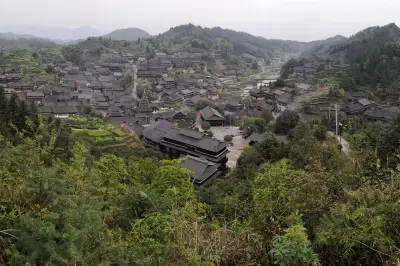
Historically, Miao architectural culture dates back to ancient times. Even today, many primitive old Miao villages still follow ancient lifestyles and building techniques. From the hanging lanterns on the ceiling and the vessels on display, you can see what Miao villages used to look like.
The most distinctive feature is the stilted house (diaojiaolou), a unique ancient architectural form in southern China. The upper floor is for living, while the lower floor is stilted. Modern architects consider it the best form of ecological architecture. As a marvel of Miao architecture, these houses rise in layers, row upon row.
Huánténg Miáo Zhài (Joyful Miao Village) faithfully recreates the details of Miao stilted houses. Every window and door frame is adorned with custom carvings. This place, full of ingenuity and meaning, blends beauty with history and culture, exuding a high-class vibe with its strong historical filter. Whether bringing friends or clients, it shows plenty of sincerity.
Hanging lanterns cast warm yellow light everywhere, with shadows falling on the wooden window frames, creating an ancient ambiance. Sitting in this serene and atmospheric space, you can experience authentic Miao customs without leaving Liuzhou—through sight, sound, and taste. It's not only delicious but also a lot of fun, making it the top choice for out-of-town friends visiting Liuzhou.
Miao Ethnic Flavors: Food That Captivates the Heart
Once seated, Miao girls quickly begin serving dishes. The courses file in one after another, each with strong ethnic characteristics, and even the plating is very particular.
The first dish is a showstopper! Allow me to introduce the famous 'Niu Bie Soup' (beef tripe soup). It is considered a 'unique Miao dish,' but the preparation is very complicated. The main ingredients are the undigested contents from the stomach and small intestine of cattle or sheep, and it is believed to have stomach-strengthening, heat-clearing, and digestion-aiding effects.
The smell can be quite intense at first—a strong earthy scent mixed with meat. When guests 'steel themselves' to drink it, the taste is slightly bitter, but after a moment, a hint of sweetness returns.
There's also the unique Miao-style sand ginger pig trotters, which are hard to find elsewhere. The trotters are crispy-skinned, tender, and not greasy. Prepared with this secret method, they not only have the distinct flavor of sand ginger but also a sweet and sour taste, perfect for summer.
The beautifully presented steamed chicken shines as soon as it arrives. The glossy, golden chicken skin contrasts sharply with the white meat, radiating ethnic charm from inside out. The steaming method retains the tender texture of white-cut chicken while locking in nutrients. With a secret herbal recipe, each bite brings a light fragrance, and the sweetness of the chicken perfectly blends in the mouth.
The dish that best showcases the rich Miao culture is the bamboo tray feast. The five-colored glutinous rice on the tray is a Miao mascot: the five colors represent life as blooming flowers, and the glutinous rice signifies the unity of all ethnic groups. This dish is not only rich in meaning but also incredibly tasty. The fish in the center is specially processed so that any fishy taste turns into savory meat flavor. The unique salty fragrance and the sticky texture of the glutinous rice intermingle in the mouth, truly leaving a lasting fragrance.
When you are about 80% full, you suddenly hear the sound of lusheng (Miao pipes) and bronze drums approaching. Miao girls and boys in festive attire, blowing lusheng and holding wine ewers filled with rice wine, sing beautiful toasting songs. They come to offer guests the highest toasting ritual: 'High Mountain and Flowing Water.'
A simple passing-game selects the guest. The Miao girls then arrange the wine ewers in a descending line at a slant, each higher than the last. The wine flows gently from the ewers like a series of small waterfalls, one after another, cascading into the guest's mouth.
The Miao, as an ethnic minority, have historically always been a migrating people. They once lived in the fertile plains of the middle and lower Yellow River, but they were continuously driven away until the 19th century, when they finally achieved stable farming and life. Therefore, they treat outsiders with an innate respect, and the 'High Mountain and Flowing Water' best expresses their reverence.
'Joyful Miao Village' successfully brings Miao ethnic culture to life through food and service, allowing more people to experience the Miao customs vividly and in three dimensions. This is more than just a restaurant—it is a cultural medium. In the next step, the Joyful Miao Village living museum of dining will take promoting ethnic culture as its mission, measure itself by visitor satisfaction, continuously improve the quality of its facilities, products, and services, and with higher standards, truly create an immersive living museum of Chinese ethnic culture! (Xie Wen)