Two-Day Tour of Sanjiang Danzhou in Liuzhou
Thank you to the hotel leadership for arranging this outing, allowing the management team of Vienna International Hotel (Guangxi Guigang Sports Center Wanda Branch) to visit Chengyang Ancient Village and Danzhou Ancient City in Sanjiang County, Liuzhou, and experience the ethnic culture there.
This time we joined a group tour. We had to get up quite early, gathering at 7:20 AM under the flag opposite the Guigang City Government. I suggest you buy some snacks the day before, otherwise you might have trouble finding food if you get hungry on the road.
It took over six hours to travel from Guigang to Sanjiang County in Liuzhou. Along the way, the guide had to pick up a few more tourists in Laibin to make up a full group. Oh, it wasn't easy!
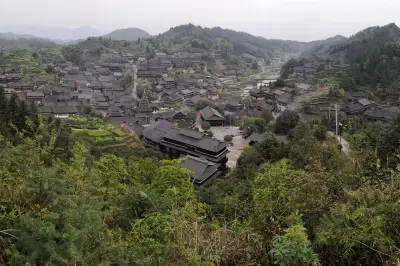
Chengyang (Sai'er) Eight Villages is located in Sanjiang Dong Autonomous County, Liuzhou City, Guangxi, 19 kilometers from the county seat. The Chengyang (Sai'er) Eight Villages consist of eight natural villages, commonly known as the "Chengyang (Sai'er) Eight Villages," which are under the administration of three village committees. Nearly 10,000 Dong people live here. This area has many festivals and is known as the "Land of a Hundred Festivals." When the Spring Festival arrives, every village is bustling, every stockade sings, and everything is joyous. This time we chose to come just before the Winter Solstice, so there were very few tourists, not as crowded and lively.
Traveling in the off-season, tickets are not expensive, about 15 yuan each. The most important thing is that entering the village requires drinking a cup of "blocking road wine." If you really can't drink, you need to prepare some small change to give to the Dong sisters! This is also a custom: outsiders entering the village must give a lucky gift to ensure the safety and peace of the village.
After entering the village, we experienced the ethnic atmosphere. The Dong working people are warm and diligent, working from sunrise to sunset, a lifestyle many aspire to. Away from the noise of the city, we came to the beautiful village. Relax and feel the atmosphere.
We watched performances by Dong girls and experienced their daily labor. The weather today was quite clear, not cold, but there was no sun. A bowl of oil tea made our hearts feel especially warm.
Oil tea is also called "eating bean tea." It is a traditional hospitality food of the Yao and Dong peoples, popular in Hunan, Guizhou, and Guangxi. It is made with fried glutinous rice flowers, fried peanuts or soaked soybeans, corn, puffed rice, and fresh tea. Some also add scallions, spinach, pork liver, and sausage. The Dong people eat different kinds of bean tea on different occasions.
After finishing the oil tea and watching the performances, it was time for the Hundred Families Feast! Since the package only included a long-table banquet, we were lucky that by adding just 5 yuan per person, we could enjoy the Dong Hundred Families Feast!
The Dong Hundred Families Feast is a gathering where all the villagers of a Dong stockade eat together. Each household brings tables, benches, and food, gathering in front of the drum tower. Although the dishes may not look impressive, they are all special Dong delicacies, delicious and full of local flavor.
The guide said it well: "Eat the Hundred Families Feast, receive blessings from a hundred families." After a few bites of the dishes in front of me, I couldn't wait to walk along the "assembly line" and sample the food! My colleagues followed the crowd, going from table to table to taste each household's dishes. They were very homely and distinctive, especially the sausage, duck, and cured pork, which were especially tasty. The pesticide-free greens in the village were also very popular. After going around once, my bowl was already overflowing. I saw that my colleagues' bowls were also full. The Dong sisters in the village really took good care of us visitors. At every table, they had gas stoves heating hot pots. In such cold weather, eating steaming hot food, it was best to find a place to sit down and enjoy the meal slowly. Haha...
After eating, we had to go back to Sanjiang County to watch a special Dong performance before returning to the hotel to rest.
This unique performance was the most representative of the Dong culture. According to the host, this large-scale stage show had traveled all the way from Sanjiang County, Liuzhou, to the halls of Vienna. Sitting in the performance hall, I felt the hard work and wisdom of the Dong people, starting from the deep mountains all the way to modern civilization. They did not forget their roots and continued to move forward. They never forgot the teachings of their ancestors, revering the gods and the laws of nature, never breaking the rules set by their forebears.
The performance lasted about 40 minutes, then we returned to the hotel. After a day of travel fatigue, I could finally lie on the hotel bed and rest. The guide specifically instructed us to gather at 7:30 AM the next morning, get up at 6:30 AM, and have breakfast at 7:00 AM.
In winter, the temperature difference between morning and evening in mountain areas is huge. The morning in Sanjiang County was especially cold. The guide introduced us to this ancient bridge, which is over 100 years old. It was built without a single nail, all using wood mortise-and-tenon joints. Looking at this bridge, I marveled at the great wisdom of the ancient Dong people.
We still had an hour's drive to the next attraction—Danzhou Ancient City. I got up too early, so I slept a bit in the car!
Finally we arrived at Danzhou Ancient City! The wind was very strong when we got off the car, and everyone felt cold. Although the sun seemed bright, the temperature was still low.
Danzhou Ancient City is located in Sanjiang County, Guangxi Zhuang Autonomous Region. Construction began on April 20, 1591 (the 19th year of the Wanli era of the Ming Dynasty) and was completed on April 14, 1592. The city is nearly square, with a perimeter of 293 zhang, battlements 1 zhang 6 chi high, walls 1 zhang 2 chi thick, and a walkway on top of the wall (excluding battlements) 9 chi wide. The walls are built with standard Ming Dynasty bricks. The city has four gates: east, south, west, and north. Historically, the east gate was the Red Gate, used by officials and for important ceremonies; the west gate was the Execution Gate, from which criminals were taken out for beheading in old times; the south gate was the Colorful Gate, used by young people for weddings and happy events; the north gate was the Mourning Gate, through which coffins were carried out during funerals. The four gate towers were named: East Jiuri Tower, South Xunfeng Tower, West Taibai Tower, and North Beidi Tower. The south and west gates were demolished in early 1976 during the "Break the Four Olds" campaign of the Cultural Revolution and no longer exist. The east gate was demolished in 1958 and was rebuilt by Danzhou villagers in 2006. The north gate was rebuilt by all villagers in 2004.
To this day, Danzhou Ancient City has no bridge connecting to the opposite bank. The local government once intended to build a bridge, but the residents unanimously opposed it, arguing that "once there is a bridge, there will be no more Danzhou." If a bridge were built, China's only ancient city on water would cease to exist. For this reason, visitors must take a ferry to enter Danzhou Ancient City. Danzhou Ancient Ferry is located on the Rong River at the border of Sanjiang County and Rong'an County. It has evolved from simple wooden ferries to motorized boats over more than 500 years, playing a significant economic role in connecting Danzhou with other places over the centuries and providing convenient transportation for generations living on Danzhou Island. The ancient ferry is also the only way for tourists to enter the ancient city.
The most representative products of Danzhou Ancient City are pomelos, cured duck, cured sausage, and cured pork. The pomelos on the island are relatively sweet but not as sweet as those from Rong County. Those who don't like them should buy carefully. The pomelos on the island are sold by the piece, not by weight, which is novel. The cured meats (pork, sausage, duck) are smoked with sugarcane skin and pomelo peel, and they taste very good!
We strolled around the island, experiencing the local customs and buying some local specialties: beef sauce, papaya strips, pomelo honey, dried pomelo, shrimp paste, peanut sauce, small river fish, etc. The prices ranged from 20 to 35 yuan per jin (500g).
We had lunch at a local resident's house at our own expense, costing 400 yuan. If you want to try the fisherman's home cooking, you can give it a try.
After lunch, it was time to head back!