![[Three Days in Guangxi] Chengyang Bazhai Wind and Rain Bridge: Dong Ethnic Culture Ignites the Heart's Lantern](/img/ec543b3f70d99a39_l.webp?src=https%3A%2F%2Fdimg04.c-ctrip.com%2Fimages%2F0105k120008dzr3lc94A9_W_320_0_Q80.jpg)
[Three Days in Guangxi] Chengyang Bazhai Wind and Rain Bridge: Dong Ethnic Culture Ignites the Heart's Lantern
[Three Days in Guangxi] Chengyang Bazhai Wind and Rain Bridge: Dong Ethnic Culture Ignites the Heart's Lantern
I had long heard of the Wind and Rain Bridge in Sanjiang, Guangxi, but only today did I see it with my own eyes. It is located in a Dong ethnic mountain village in Sanjiang, Guangxi, and its name is Chengyang Bazhai. When we arrived at the scenic area, more than a dozen tourist buses were already in the parking lot, and crowds of people were everywhere. I recalled what the tour guide said on the bus: "This month, Guangxi has turned into Guangdong—everyone here is from Guangdong, because with a Guangdong ID card, you get free admission, and all you hear is Cantonese."
The entrance to the scenic area was packed with people.
A square where everyone was scrambling to take photos.
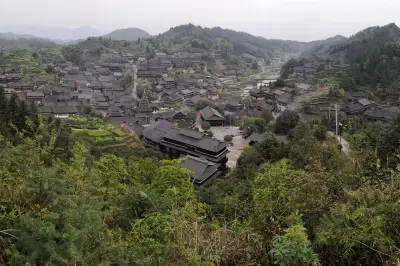
Looking at the surrounding scenery from the square. Chengyang Bazhai consists of eight natural villages, commonly called "Chengyang Bazhai," administratively under three village committees, with a population of nearly 10,000 Dong people. The nationally protected cultural relic—the world-famous Chengyang Wind and Rain Bridge—is located on the Linxi River next to Chengyang Bazhai. This wood-and-stone bridge spanning the Linxi River was first built in 1912, with five stone piers in the river, a bridge deck made of fir planks laid on wood beams. The bridge is 64.4 meters long, 3.4 meters wide, and 10.6 meters high. Five bridge pavilions sit atop the piers, harmoniously connected with 19 bridge verandas, forming a grand and magnificent whole. It is the most famous among the many Wind and Rain Bridges with Dong charm in Guangxi's Zhuang region, currently the largest Wind and Rain Bridge in the world, and an outstanding representative of Dong architectural art.
Most Wind and Rain Bridges are built over streams below the villages, serving both as transportation and having religious significance. They symbolize a flying dragon circling the village, ensuring good weather, abundant harvests, and happiness. Hence they are called Wind and Rain Bridges, Returning Dragon Bridges, Eternal Relief Bridges, Bestowing Fortune Bridges, etc.
Mr. Guo Moruo once wrote a poem: "The Linxi Wind and Rain Bridge is praised; twenty-four zhang long and high. With layered eaves and connected pavilions, it delights the spirit; the row of stone piers spans the distant view. Bamboo and wood are tougher than iron; tea groves grow fresh shoots for thousands of years. When can I walk on the Sanjiang road, learning to hold a plow and work the fields?"
Entering from the scenic area gate, we first pass Chengyang Bridge, the largest Wind and Rain Bridge in the scenic area. Every Dong village has its essential features: the Wind and Rain Bridge, the drum tower, the stage, and the stilted Dong houses.
This is Chengyang Bridge, Ma'an Village Drum Tower, and Theater.
Taking the scenic area's electric cart to the Wind and Rain Bridge.
Such a famous bridge naturally needs guarding. At the head of Chengyang Wind and Rain Bridge, Dong aunties wearing large silver necklaces stood in two rows on the steps, with a few in front holding a red rope to block the way onto the bridge. One carried a large winnowing basket, another held a wine glass. They sang a Dong welcome song. To get on the bridge, you had to pay a road (bridge) toll. After paying, you were given a small cup of rice wine and allowed to pass. One tourist said he had no cash, and the auntie said, "WeChat, WeChat!" He had to pull out his phone and pay via WeChat—like snatching money, so mercenary!
See? The ones collecting money with a large winnowing basket, holding wine glasses to offer welcome drinks, and playing instruments—all Dong aunties.
Looking left and right from the bridge, I saw the Linxi River winding in the distance. On both sides of the bridge, tea groves covered the slopes, surrounded by green trees; farmland fields with farmers working; a riverside reservoir for slow irrigation—a beautiful pastoral scene.
The unique ancient Dong architecture—the multi-eaved, pagoda-like drum towers with flying eaves and layered roofs. These are high-rise buildings in Dong villages, named for the drum placed in the upper floor. The drum tower in Ping Village is a newly built single-column drum tower, the largest in scale and unique in structure. The interior is supported by wooden posts and crossbars, with a large central pillar. The roof is covered with tiles, layered with gaps between layers for ventilation while keeping out rain. Originally, drum towers were used to beat the drum to summon villagers for resistance against invaders; now they serve as places for rest and entertainment. The unique ancient Dong architecture—the multi-eaved, pagoda-like drum towers with flying eaves and layered roofs! These are high-rise buildings in Dong villages, named for the drum placed in the upper floor. They were assembly halls where Dong people beat the drum to gather for major events and discussions, and now are places for socializing, entertainment, and festive gatherings.
Looking at its interior structure, it has only one large pillar supporting it, hence called a single-column drum tower. You have to pay incense money to enter.
This is a Dong settlement area. All houses retain the Dong style, with few concrete and steel; they are mostly wooden structures with tile roofs. Walls are wooden planks, pillars are timber. Years of wind and rain have left the walls unevenly black and white. The brightest part of the whole house might be the white wooden board under the eaves.
The villages we passed along the way were all very rustic, with exquisite wooden drum towers and ancient bridges—precious cultural relics.
There are also fixed-time ethnic cultural performances, with elaborate stages and backdrops, equipped with sound and lighting. The final acts inevitably involve interaction between performers and tourists.
Dinner was the Dong long-table feast, also called a hundred-family banquet.
The "hundred-family banquet" is a cultural symbol of the Dong people's hospitality, unity, friendship, and harmony. It has been practiced in Sanjiang Dong areas for centuries and represents the highest etiquette of Dong hospitality. It is held during major festivals or when important guests visit. Each household in the village prepares its own food and drink (usually two families share responsibility for one table of six, with each family offering different dishes). They set out long tables in a line at the drum tower square. Guests can eat from the first table to the last, sampling Dong specialty country dishes. In my opinion, the taste was just so-so.
Before the hundred-family banquet began, there was a ceremony. Leaders gave speeches, then led the crowd to raise their glasses and toast, welcoming the distant guests.
The lively but chaotic scene was overwhelming. During the meal, Dong aunties lined up, led by an auntie playing an instrument, singing and toasting each table—a strong ethnic minority atmosphere.
Before eating, everyone took photos, using various vegetables on the stage as props.
This was the dishes on my table.
The hundred-family banquet involves moving from table to table, drinking and eating from different households, uniting a hundred hearts, driving away a hundred evils, and accomplishing a hundred things—from daytime until the lights come on... That is the significance of the hundred-family banquet.
In short, the "hundred-family banquet" is the highest courtesy of the Dong people for guests, a collective way of interacting that emphasizes unity, friendship, harmony, and mutual engagement, carrying the migration history and cultural accumulation of the Dong people over thousands of years.
After the banquet, we walked out, looking at the shops under the night sky.
Passing the Wind and Rain Bridge again, there were no lights on the bridge. Walking on the wooden planks in pitch darkness was a bit scary, and I was very surprised. I guess the Dong people are not afraid of the dark and are used to walking at night.
I randomly snapped a night view of the scenic area entrance, only to realize that the lights were meant for outsiders, to create a dazzling appearance.
With the tide of the market economy, unique ethnic customs inevitably acquire some mercenary tarnish. However, it is precisely through the profit-driven promotion of tourist attractions that more people come to ponder the heart-lantern of human societal progress. Humanity, amid nature and the storms of society, has crossed one Wind and Rain Bridge after another, just like holding a hundred-family banquet—from family to clan to ethnic group to nation, and to a multi-ethnic integrated country. As the world moves toward a global village, must we, while trudging arduously over the "Wind and Rain Bridges," also hold thousand-family banquets, ten-thousand-family banquets, hundred-million-family banquets, and ultimately merge into the global village's "round banquet"?!
(2184 2020/12/17)
![[Three Days in Guangxi] Chengyang Bazhai Wind and Rain Bridge: Dong Ethnic Culture Ignites the Heart's Lantern image 1](/img/c46fcd27690b1ad4_l.webp?src=https%3A%2F%2Fdimg04.c-ctrip.com%2Fimages%2F0105k120008dzr3lc94A9_W_640_400_Q90.jpg%3Fproc%3Dautoorient)
![[Three Days in Guangxi] Chengyang Bazhai Wind and Rain Bridge: Dong Ethnic Culture Ignites the Heart's Lantern image 2](/img/5306c1457edac145_l.webp?src=https%3A%2F%2Fdimg04.c-ctrip.com%2Fimages%2F01047120008dzqx55A1B5_W_671_0_Q90.jpg%3Fproc%3Dautoorient)
![[Three Days in Guangxi] Chengyang Bazhai Wind and Rain Bridge: Dong Ethnic Culture Ignites the Heart's Lantern image 3](/img/c1f3fce0597ac261_l.webp?src=https%3A%2F%2Fdimg04.c-ctrip.com%2Fimages%2F0101w120008dzqqxmB040_W_671_0_Q90.jpg%3Fproc%3Dautoorient)
![[Three Days in Guangxi] Chengyang Bazhai Wind and Rain Bridge: Dong Ethnic Culture Ignites the Heart's Lantern image 4](/img/e4213e67e2891b80_l.webp?src=https%3A%2F%2Fdimg04.c-ctrip.com%2Fimages%2F0100u120008dzqwk265E6_W_671_0_Q90.jpg%3Fproc%3Dautoorient)
![[Three Days in Guangxi] Chengyang Bazhai Wind and Rain Bridge: Dong Ethnic Culture Ignites the Heart's Lantern image 5](/img/02c694acb597f17d_l.webp?src=https%3A%2F%2Fdimg04.c-ctrip.com%2Fimages%2F01029120008dzqu5c9611_W_671_0_Q90.jpg%3Fproc%3Dautoorient)
![[Three Days in Guangxi] Chengyang Bazhai Wind and Rain Bridge: Dong Ethnic Culture Ignites the Heart's Lantern image 6](/img/f0ceb1577357b311_l.webp?src=https%3A%2F%2Fdimg04.c-ctrip.com%2Fimages%2F01016120008dzr3se5900_W_671_0_Q90.jpg%3Fproc%3Dautoorient)
![[Three Days in Guangxi] Chengyang Bazhai Wind and Rain Bridge: Dong Ethnic Culture Ignites the Heart's Lantern image 7](/img/f44efed64099682d_l.webp?src=https%3A%2F%2Fdimg04.c-ctrip.com%2Fimages%2F0102x120008dzr3lh03F8_W_671_0_Q90.jpg%3Fproc%3Dautoorient)
![[Three Days in Guangxi] Chengyang Bazhai Wind and Rain Bridge: Dong Ethnic Culture Ignites the Heart's Lantern image 8](/img/1aa27cdaef79da40_l.webp?src=https%3A%2F%2Fdimg04.c-ctrip.com%2Fimages%2F0100i120008dzr5mpC2E5_W_671_0_Q90.jpg%3Fproc%3Dautoorient)
![[Three Days in Guangxi] Chengyang Bazhai Wind and Rain Bridge: Dong Ethnic Culture Ignites the Heart's Lantern image 9](/img/bd81db49e6c2d3d4_l.webp?src=https%3A%2F%2Fdimg04.c-ctrip.com%2Fimages%2F0106q120008dzqw6i43D4_W_671_0_Q90.jpg%3Fproc%3Dautoorient)
![[Three Days in Guangxi] Chengyang Bazhai Wind and Rain Bridge: Dong Ethnic Culture Ignites the Heart's Lantern image 10](/img/90eb9871ad4ac026_l.webp?src=https%3A%2F%2Fdimg04.c-ctrip.com%2Fimages%2F0106i120008dzr3sk084A_W_671_0_Q90.jpg%3Fproc%3Dautoorient)
![[Three Days in Guangxi] Chengyang Bazhai Wind and Rain Bridge: Dong Ethnic Culture Ignites the Heart's Lantern image 11](/img/0dd2157f15fcccfc_l.webp?src=https%3A%2F%2Fdimg04.c-ctrip.com%2Fimages%2F0105t120008dzqu5gC2F9_W_671_0_Q90.jpg%3Fproc%3Dautoorient)
![[Three Days in Guangxi] Chengyang Bazhai Wind and Rain Bridge: Dong Ethnic Culture Ignites the Heart's Lantern image 12](/img/03b597318a3dcce2_l.webp?src=https%3A%2F%2Fdimg04.c-ctrip.com%2Fimages%2F0104a120008dzqv557C5C_W_671_0_Q90.jpg%3Fproc%3Dautoorient)