China's Only Water-Surrounded Ancient City on an Island, Over 400 Years Old, Yet Sadly Little-Known
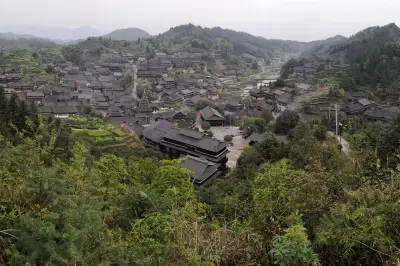
China is an ancient civilization with a long history, boasting many ancient capitals and cities, some of which have even been ranked into lists like the Four Great Ancient Capitals, Ten Great Ancient Cities, Ten Great Ancient Towns, etc. But among the many ancient cities, one is very special: it is a city built on an islet in the middle of a river, surrounded by water on all sides, extremely beautiful. Unfortunately, not many people know about it—it could even be described as little-known.
This ancient city is Danzhou Ancient City, located in Sanjiang County, Guangxi. Danzhou Ancient City is bordered to the east by National Highway 209 and the Zhiliu Railway, to the west by the Sanliu Expressway, about 50 km from Sanjiang county seat. The city sits on an islet in the Rongjiang River, surrounded by water on all sides. The island covers about 1.6 square kilometers and is home to five ethnic groups: Dong, Miao, Yao, Zhuang, and Han. There are 72 surnames, over 200 households, and more than 1,100 residents.
Danzhou has no road access; a ferry is the only way in and out. The scenic area does not charge an entrance fee, but there is a ferry fee of 20 yuan per person (including admission). There is almost no waiting—once a passenger boards, the boatman immediately sets off, and within minutes you are on the island.
It is said that the local government once intended to build a bridge connecting the island, but the villagers of Danzhou unanimously opposed it. Their reasoning was, 'Once there is a bridge, Danzhou will be no more.' If a bridge were built, China's only water-surrounded ancient city would cease to exist. Because of this, visitors must take a ferry to enter Danzhou Ancient City.
Regarding the architecture of Danzhou Ancient City, an ancient poem circulates locally: 'A silver chain around Danyang, dreamlike mist locks the Rongjiang. Minyue Guild Hall speaks of elegance, Danzhou Academy steeps in essay crafting. Fishermen's songs startle the dawn moon, visitors' joy intoxicates the morning light. Revisiting the scenic spot to seek ancient relics, ascend the tower to compose poems and recount vicissitudes.' This poem basically summarizes Danzhou Academy, Minyue Guild Hall, East Gate Tower, North Gate Tower, the ancient city wall, and other ancient structures.
As for the origin of Danzhou Ancient City, historical records show that Danzhou got its name in the 17th year of the Wanli reign of the Ming Dynasty (1589). At that time, the local magistrate Su Chaoyang, while inspecting Danzhou, saw that the islet resembled a giant fish (aoyu) with its head raised and tail swinging, as if about to leap into the sky and dominate the scene. Viewed from afar, it was surrounded by green mountains and embraced by clear water, with mountains as barriers and water as a natural moat. He decided to move the county seat to this islet. It was the end of autumn and beginning of winter, and the entire island was dyed red with maple leaves, so he named it 'Danzhou' (literally 'cinnabar island').
Since Su Chaoyang established the city here, Danzhou served as the county seat for more than 340 years. It was not until the 21st year of the Republic of China (1932) that the county seat was moved to Guyi, and this once-prosperous ancient city gradually fell into obscurity.
The ancient city suffered severe damage in the last century, and very few ancient buildings survive today. Among them, the Minyue Guild Hall stands out. It is known that the Minyue Guild Hall, also called Tianhou Temple, is located on the northeast side of Danzhou. It was built at the end of the Ming Dynasty and the beginning of the Qing Dynasty, over 300 years ago, by an elderly merchant surnamed Xue who spent thousands of taels of silver on its construction. The hall was built in the style of the Tianhou Temple in the Zhangzhou area of Fujian, facing east. The main hall is in the west, the front hall in the east, and flanking buildings on the north and south sides. In the center of the main hall stands a statue of Mazu (the sea goddess), for the worship of merchants traveling from north to south. The front hall and the main hall are connected, presenting a magnificent view. The guild hall features high walls and green tiles, with ancient and elegant painted decorations, making it one of the largest Mazu temples in the Lingnan region.
In front of the Minyue Guild Hall, there is a couplet. The left line reads, 'Vast as the heavens, abundant virtue in water,' and the right line reads, 'Bright and clear, our queen occupies the right place of earth.' The horizontal scroll says, 'Min and Yue are one family.' The fourth characters of the left and right lines together form 'Tianhou' (Heavenly Queen), indicating that the goddess Tianhou's wisdom and lofty virtue hold an extremely high position in the hearts of Fujianese. The horizontal scroll 'Min and Yue are one family' does not refer to Fujian and Guangdong, but solely to Fujian—meaning Fujian compatriots are one family.
Shown in the above picture, the wall covered with green grass is the oldest section of the Danzhou city wall, a true antique. According to the information board, it was first built in the 19th year of the Wanli reign of the Ming Dynasty (1591), costing ten thousand taels of silver. The wall has a base of bluestone strips, with the body built of brick and stone on both sides, rammed earth inside. It has a perimeter of 879 meters, a height of 5.3 meters, and a thickness of 3.6 meters. There are 450 crenellations for archers during wartime. Due to years of neglect, only the north section of the wall is relatively well-preserved; the east wall remains half, and the west and south walls and gates have collapsed or been demolished. Currently, only about 300 meters of the east and north walls remain, and they have been listed as a key cultural relic protection unit of Guangxi.
There are four main streets in the ancient city, the most central being Fujian Street, located northeast of the outer city, over 120 meters long. At the end of the Ming and beginning of the Qing Dynasty, Danzhou's administrative structure had stabilized, providing safety for local and inland freight trade from north and south, making it very prosperous.
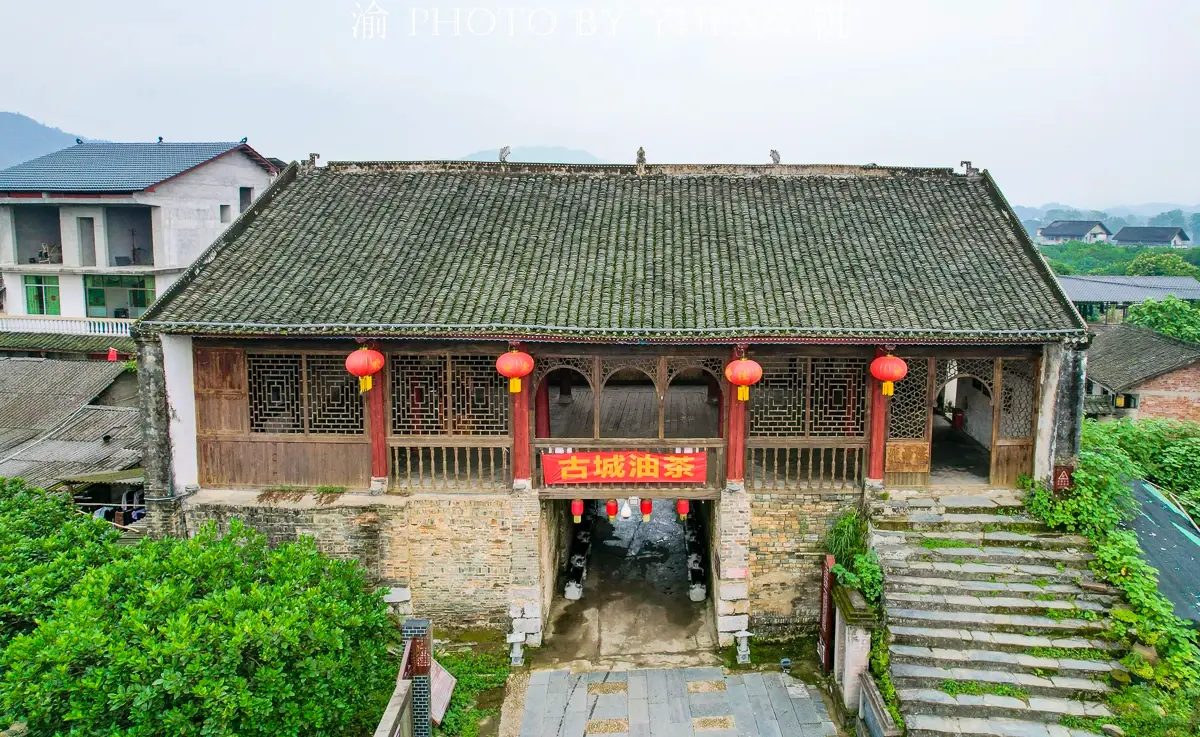
The ancient city has two city gates: the North Gate and the East Gate. The North Gate, also called 'Zhi Ding Men' (Gate of Stabilized Rule), has the characters 'Bei Di Lou' (North Emperor Tower) above the gate tower. It is located on the north side of the Danzhou city wall. The four gates of Danzhou city wall were originally an ensemble. Now, Zhi Ding Men is the best-preserved Ming Dynasty ancient building among the four gates. The steps leading up to the gate tower have 19 steps, making it the best-preserved ancient relic on Danzhou Island.
As for why it is called Zhi Ding Men, local staff explain: During the Ming Dynasty, the border between Guangxi and Guizhou was mostly high mountainous areas, often called barren lands with backward culture and underdeveloped economy. Minority groups frequently rebelled against the oppression of Han officials, seizing mountains and declaring themselves kings. Thus, warfare was constant. After Su Chaoyang moved the county seat to Danzhou, he built four city gates and walls facing east, west, south, and north. This gate faces due north toward the Guangxi-Guizhou border, and was named 'Zhi Ding,' meaning that through governance and administration, peace would be established from then on.
Viewed from above, apart from the cross-shaped old streets, the rest of Danzhou is filled with green, mostly pomelo trees. Danzhou is truly a 'hometown of pomelos.' Local residents make a living by growing Shatian pomelos, so the entire ancient city is hidden among pomelo groves. Almost every household has pomelo trees in front and pomelo orchards behind. If you visit in autumn, you can taste authentic Shatian pomelos, said to be as famous as those from Rong County, Yulin.
China's only water-surrounded ancient city—Danzhou may not be as large as Pingyao, Lijiang, Langzhong, and other ancient cities, but it has its own charm. Unfortunately, very few people know about it. Not only is it little-known outside Guangxi, but even within the province, it is obscure compared to Huangyao Ancient Town. Fortunately, it has begun to attract attention and has successfully been promoted to a national AAAA-level tourist attraction. If you travel to Liuzhou, do not miss this unique Danzhou Ancient City.