The Most Beautiful Tea Garden in Guangxi, Hidden in the Mountains Where Guangxi, Guizhou, and Hunan Meet, Resembling a Fingerprint of the Earth from Above
Sanjiang Dong Autonomous County, an autonomous county under Liuzhou City in Guangxi, is located at the junction of Guangxi, Guizhou, and Hunan provinces. This is a beautiful land hiding many lesser-known scenic spots. One of them is Xianren Mountain in Bajiang Town, a place with dense forests and lush vegetation, like a paradise.
The full name of Xianren Mountain is Buyang Xianren Mountain, named after a Dong village called Buyang Dong Village at its foot, which belongs to Buyang Village. As for why the mountain is called Xianren Mountain (Immortal Mountain), I asked local friends but no one knew; they only said it has been called that for a long time. So I can only interpret it as: this place is as beautiful as a fairyland, hence the name Xianren Mountain. What do you think?
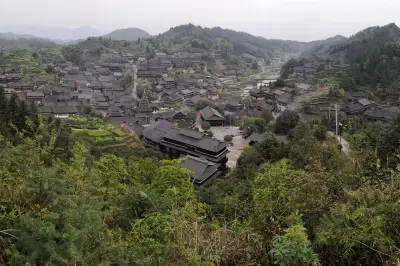
When visiting Xianren Mountain, there are two main attractions: the rustic Buyang Dong Village and the pristine high-altitude tea garden on the summit. Since we had already visited Chengyang Eight Villages, Yuedong Village, Guandong Village, and the Grand Dong Village in Sanjiang, we went directly to the high-altitude Dong tea garden on the mountaintop.
The Xianren Mountain Dong Tea Garden is locally called the Ten-Thousand-Mu Tea Garden (I learned it actually covers over 3,600 mu). These tea gardens are spread across high-altitude terraced fields at elevations of 600 to 1,000 meters, often shrouded in mist, making it a true high-altitude cloud tea garden.
Because Xianren Mountain is located in the remote mountains where Guangxi, Guizhou, and Hunan meet, with no industrial pollution within a hundred miles, the environment is excellent. The air is fresh, and the negative oxygen ion content is more than five times that of the foothills. Such conditions are ideal for tea growth, and the Dong tea produced here is rich in nutrients, truly gathering the essence of the earth and the spirit of the sun and moon, earning it the reputation of 'China's First Spring Tea'.
Viewed from above, the tea terraces resemble the fingerprints of the earth, orderly yet varied, very beautiful.
With its excellent ecology, environment, and scenery, this place is a poetic dream for many urban dwellers. It has now been developed into a tourist attraction. Upon arriving at the foot of the mountain, sightseeing buses take visitors directly to Buyang Dong Village and the summit tea garden. Even just strolling around feels refreshing.
High-altitude clouds produce fine tea. Tea from Xianren Mountain is an important income source for the Buyang Dong people. Early May is the tea-picking season. When we arrived, we saw many villagers picking tea. Except for a small portion they keep for personal use, most is sold to tea merchants.
I asked about prices: one jin of fresh tea leaves sells for over ten yuan, and a picker can collect about ten to twenty jin a day, earning around 200 yuan. For them, this is a decent income without leaving the village, a gift from the mountains.
We noticed that Buyang Xianren Mountain has built well-equipped walking paths and numerous pavilions for rest and sightseeing to welcome tourists. It's truly a beautiful, uncrowded spot—perfect for photography. If you wear a flowing Hanfu, the photos will be even more artistic.
If you're tired, you can descend to the Dong village halfway up the mountain to rest and enjoy authentic Dong cuisine. Or you can choose a guesthouse with stunning views, stay in the mountains, and push open the window to see the scenery. On clear nights, you can see a sky full of stars—a breathtaking sight. What do you think?