Chengyang Eight Villages in Guangxi: A Millennium of Low-Key Charm, Home to a Centuries-Old Bridge Rivaling Zhaozhou Bridge
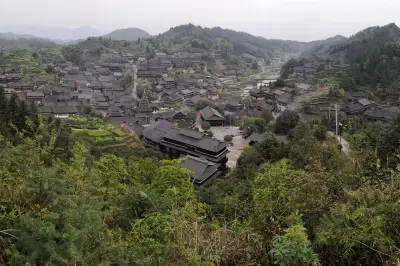
I once thought only Yangshuo embodied the beauty of Guangxi, but later discovered I was truly a frog at the bottom of a well. In Sanjiang County, an hour's drive from Guilin, I found a peaceful, hidden paradise. Sanjiang lies at the border of Hunan, Guangxi, and Guizhou provinces (regions). Frontier towns are often geographically remote, located at the intersection of several provinces, and thus not widely known. Yet precisely because of this, they preserve some relatively traditional elements, perfect for those nostalgic souls seeking the past. Starting from the county seat of Sanjiang, heading north along the highway for 20 kilometers, you encounter this vast ancient village cluster. Beneath winding mountain ridges, the meandering Linxi River, like a ribbon, strings together eight villages. Rows of stilted wooden houses, typical of the Dong ethnic group, line the riverbanks. Ancient water wheels continuously lift clear river water into terraced fields, creating a serene pastoral landscape. After the rain, the fields of Sanjiang are rich with the fragrance of soil; green rice paddies spill verdure everywhere. Stilted wooden houses stand by the water, one after another, high and low, layered and clustered, forming a vast expanse of villages. To enter any village, you must first pass through a beautiful wind-and-rain bridge, a shelter from wind and rain for travelers, and also a moonlit meeting place for Dong girls and boys. Beside the ancient village stands that wind-and-rain bridge—in Dong tradition, wherever Dong people live, they must build a wind-and-rain bridge over a nearby stream. They believe such a bridge is a medium between the living and the dead, the soul of the village. Every new life born in the village comes into this world through this bridge. The nationally protected cultural relic—the world-famous Chengyang Wind-and-Rain Bridge—spans the Linxi River beside these eight villages. Built in 1912, the Chengyang Bridge is currently the largest wind-and-rain bridge in the world. According to records, it is ranked alongside China's stone arch Zhaozhou Bridge, the iron-chain Luding Bridge, and the fabricated "Roman Steel Beam Nova Bridge" as one of the world's four historic bridges. Seen from afar, the multi-eaved tower pavilions have eaves angling upward, with neat rows of bluish-gray tiles on top, very imposing. Below, pavilions and corridors connect seamlessly with the bridge's railings, like a winding, secluded painted corridor. The bridge foundation consists of two abutments, four piers, and five spans, partly submerged in the stream. The exposed stone piers reveal solid, stable blue bricks. On both sides of the wind-and-rain bridge, tea trees are planted. Villagers often work in the fields, and the sound of water wheels never ceases—a true pastoral idyll! The shallow stream flows beneath the bridge, driving ancient water wheels in slow, ceaseless rotation, never pausing through the years. The birth of Chengyang Eight Villages dates back to the wars at the end of the Tang Dynasty. After the Dong ancestors, the Yue people, were defeated, one branch surnamed Yang migrated northward here, where they encountered the Chen clan, who had fled south due to turmoil in the Central Plains. The two groups settled and multiplied, giving rise to the Chengyang Eight Villages. Chengyang is not only famous for its wind-and-rain bridge; the scenery of the eight villages epitomizes the essence of Dong culture. Since the Qing Dynasty, eight natural settlements gradually formed: Ma'an, Yanzhai, Pingzhai, Dazhai, Dongzhai, Jichang, Pingtan, and Pingpu, collectively known as Chengyang Eight Villages. Most of these eight Dong villages are connected to the main road by wind-and-rain bridges across the river. With their unique wind-and-rain bridges, drum towers, stilted wooden houses, surrounding mountains, streams, fields, and rich folk customs, they form a distinctive landscape painting, earning renown as one of "China's most beautiful towns." Chengyang Eight Villages nestle against the mountains and encircle the water, scattered yet orderly. Stilted houses perch on terraced fields, arranged with care. Flagstone paths are green, alleys are deep, ancient and quaint, full of old-world charm. Water flows murmuring, distant mountains are lush. Wind-and-rain bridges and drum towers soar into the clouds, with flying eaves and upturned corners. Mountains and water reflect each other, towers and bridges depend on one another, creating the most captivating and soul-soothing scenery.